Aceito em: 31/07/2023
Representation associations services: focus on agricultural inputs distributors
Serviços de associações de representação: foco nas distribuidoras de insumos
agrícolas
Douglas
Rafael Ferreira Tamer Soares1i,
ORCID: https://orcid.org/0009-0002-4738-581X; Sérgio Augusto
Pereira Bastos1ii*,
ORCID: https://orcid.org/0000-0002-5697-3624.
1. Fucape Business School,
Vitória, Espírito Santo,
Brasil.
*Autor correspondente: sbastos@fucape.br
Abstract
Difficulties
in influencing the institutional environment create collective action
opportunities through associations representing interests. This paper aims to
understand what affects associates’ satisfaction with interest representation
services. The approach is qualitative-quantitative. Primary data from the
agricultural inputs distribution sector originate from a survey and in-depth interviews. Data were analyzed
by response incidence
using a Likert
scale and content analysis,
respectively. The results
indicate that service
quality influences members’ satisfaction. Members trust
representation services and value the association’s reputation, impacting quality
and trust. Social and trust relational benefits can strengthen quality and trust relationships with the satisfaction of interest
representation services. The research contributes
to corporate political activities through private interest representation
services in a country where lobbying is not regulated. In practical terms, it
helps managers of representative organizations and their associates determine
sectoral collective agendas.
Keywords: distributors
of agricultural inputs;
associations; representation of interests; service satisfaction; collective action
theory.
Resumo
Dificuldades em influenciar o ambiente
institucional criam a oportunidade para atuação de forma coletiva, por
associações de representação de interesses. O objetivo deste artigo é
compreender o que influencia a satisfação dos associados com os serviços
de representação de interesses. Os dados primários
do setor de distribuição de insumos, em abordagem qualitativa-quantitativa, foram obtidos
por meio de levantamento tipo survey e entrevistas de aprofundamento. Os
dados foram analisados pela incidência de resposta utilizando escala Likert e análise de conteúdo, respectivamente. Os resultados apontam
a qualidade dos serviços
na satisfação dos associados.
Associados confiam nos serviços de representação e valorizam a reputação da associação,
impactando a qualidade e a confiança. Benefícios relacionais sociais e de confiança podem fortalecer a relação entre
qualidade e confiança com a satisfação dos serviços de representação de
interesses. A pesquisa contribui para atividades políticas corporativas por
serviços de representação privada de interesses em um país em que o lobby não
é regulamentado. Na prática, auxilia gestores de organizações de representação
e seus associados em determinar pautas coletivas setoriais.
Palavras-chave: distribuidores de insumos agrícolas; associações; representação de interesses;
satisfação com serviços; teoria da ação coletiva.
Citação: Soares, D. R. F. T, &
Bastos, S. A. P. (2023).
S Representation associations services: focus on agricultural
inputs distributors. Gestão & Regionalidade, v. 41, e20259084.
https//doi.org/10.13037/gr.vol41.e20259084
1
Introduction
With
the advance of the deregulation of several markets in the European Union (EU)
after the 1980s, companies started discussions on collective action through private representation associations (PRA)
in response to state interventionism (Farina, Azevedo, & Saes, 1997).
During the same period, Brazil underwent changes in the regulation and
organization of business interests. Despite the state regulations, companies
began to influence sectoral policy through
representation services, whichcontributed to increased competitiveness across different
production chains (Belik, 2019; Nassar & Zylbersztajn, 2004; Zylbersztajn
& Machado Filho, 1998).
PRAs services originated in the Theory
of Collective Action,
proposed by Olson
(1971). When examining collective actions, collective goods, and selective
incentives, the author observed that shared values and
selective incentives are binding elements of
organizational behavior, given that they serve to satisfy the personal objectives of the organization’s members. The few studies
on PRAs in the Brazilian
literature do not address quality,
trust, benefits,
and satisfaction
related to representation services (Nassar & Zylbersztajn, 2004; Ricciardi
et al., 2014; Fornazier & Waquil, 2012). Also, the international literature
is not very useful as a reference for the Brazilian market, considering lobbying
is not regulated and other local particularities (Almeida, Abdalla, &
Ferreira, 2022).
This research
seeks to fill this gap in the Brazilian literature, shedding light on the work of a PRA. The objective is to identify
the antecedents of the companies’ satisfaction with these
organizations, examining the sector of agricultural inputs distributors as the
unit of analysis.
The
sector studied is regulated and has gained substantial importance in the
Brazilian economy. The subsistence agriculture model that dominated the Brazilian scenario
for centuries has evolved
into a large segment, significantly impacting the agricultural inputs
distributors. These companies’ role as suppliers of seeds, fertilizers,
pesticides, machinery, veterinary products, farming implements, and support
services puts them in a central position in the agricultural production chain
(Neto, Marques, & Neves, 2020; Coughlan, Anderson, Stern, & El-Ansary,
2002; Cade, 2020).
The
research contributes to improving corporate political activities, that is,
strategic actions not oriented
to the market but to influence the institutional environment (political, legal,
regulatory) through services of representation of interests, as established in
the Theory of Collective Action. In practical terms,
the research helps
PRAs managers and their associates to put forward collective sectoral agendas.
2
Theoretical Reference
2.1
Agribusiness, inputs
distribution, and PRAs
The
term agribusiness appears at the School of Business Administration at Harvard
University and has experienced significant transformations thanks to
technological advances (Davis & Goldberg, 1957). However, the expected
self-sufficiency of large agricultural properties did not occur, requiring a
decentralization of raw material supplies, creating space for input distributors and interdependent organizations offering products or services (Coughlan et al., 2002).
The
global demand for food and the regulation of the export market represent
opportunities for Brazilian agribusiness, one of the world’s leading food
producers, thanks to its high productivity (Neves, Valerio, Cambaúva,
& Marques, 2020).
In this scenario,
companies seek more
flexible, compact, and adaptable structures while facing high operating costs,
informational asymmetry, and increasing regulation. These challenges can
compromise the business’s production chain, creating opportunities for
institutions offering services and representing interests (Zylbersztajn &
Machado Filho, 1998).
The
incentive for companies to form a PRA refers to collective benefits and the
possibility to adopt
different strategies that enable an institutional and competitive environment. However, these benefits may
not be enough to attract and retain the necessary number of members to achieve
sustainable PRA. The decision to join depends
on a cost-benefit analysis. When the proposal comes from defending sectoral
interests, there may be some economic incentive, even if involuntarily (Moe,
1988; Nassar & Zylbersztajn, 2004; Barra, Silva, & Machado, 2007).
2.2 Quality, trust, and
reputation
Quality is a subjective judgment that refers
to expectations of a service
(Mitra & Golder, 2006). Perceived quality stems from obtaining a product or service as expected; it is a function
of the attributes valued by the customer (Fornell et al., 1996). According to
Fleischman, Johnson, and Walker (2017), widespread disclosure about reputation,
service quality, and the perception of value and cost, influence the perception of quality. Grönroos
(1984) and Lehtinen and Lehtinen (1991) reinforce
that examining which and how services are provided to customers is essential.
Trust refers
to the understanding that service
users and/or providers are willing to submit
to the other party’s actions based on expectations about how this other party
will behave in a given situation (Ramos,
Ferreira, Freitas, & Rodrigues, 2018). Therefore, the members’ trust
in PRA may come from involvement, demonstration of the organization’s operational competence when carrying out its activities, prioritizing the
associates’ interests over the interests of the organization itself, and from
being a problem-solving oriented organization (Sirdeshmukh, Singh, & Sabol,
2002).
For
Rousseau, Sitkin, Burt, and Camerer (1998), trust results from the correlation
between the parties’ expectations and behavior. It manifests through attitudes
and behaviors required in a relationship where the parties affect each other
(Goel, Bell, & Pierce, 2005). Relational benefits are found in what the
parties are looking for in – or when they enjoy the benefits of – an interpersonal relationship with the professionals who provide the service (Mota & Freitas, 2008).
In this context, conflicts (and actions to
resolve these conflicts) influence the level of trust and the parties’ interest
in establishing permanent relationships (Morgan & Hunt, 1994). Gwinner,
Gremler, and Bitner (1998) point out that service customers
do not seek to be served
but expect additional benefits from customer/supplier relationships, including special treatment, trust, and social benefits. They believe that relational benefits
are the most relevant trust benefit.
Finally, reputation is based on the service provider’s relationships and
performance, reflecting its ability
to meet expectations and bring benefits. Thus, performance strengthens trust and raises the entity’s
reputation level in the market so that it retains and captures
new
customers (Zucco,
Santos, Begnini, & Carvalho, 2022).
2.3. Service satisfaction
Satisfaction is the complete
experience, the actual execution of
what is expected, from contracting to the end of the service
(Hult et al., 2017). It is the end state
of the service
experience, which
may be a positive perception of the reward the customer obtained in their
relationship with the supplier (Khurana, 2013). It may involve kindness,
empathy, trust, warmth, etc. (Fitzsimmons & Fitzsimmons, 2010). For Wong,
Chan, Ngai, and Oswald (2009), perceived service quality
precedes satisfaction.
Customer
satisfaction is one way to perceive a service’s performance through evaluations
that asses value, quality, and meeting expectations (Hult, Sharma, Morgeson
& Zhang, 2019). When adding
quality to the service, the perceived value
relationship is expected to influence customer
satisfaction (Johnson et al., 2001).
3
Research methodology
This
qualitative-quantitative study was designed to identify the antecedents of
service satisfaction of private representation associations (PRA) representing
agricultural inputs distributors. PRA are the research
subject and these companies are the unit of analysis.
Primary data was collected through a survey and in-depth semi-structured
interviews with members of the represented companies.
The
survey’s questionnaire comprises 36 statements adapted from scales validated in
the literature on service satisfaction (Verhoef et al., 2002), quality of services (Burnham
et al., 2003), trust in services (Bansal et al., 2004), and relational benefits
(Gwinner et al., 1998). A 5-point Likert scale captures respondents’
perceptions, ranging from 1 [totally disagree] to 5 [completely agree].
The questionnaire was made available on the Google
Forms application. It was distributed by email, Whatsapp
group, and individual electronic messages after a pre-test that did not point
out any difficulty concerning its content.
A
total of 52 responses were received. Of these, 78.8% were PRA members, thus
reaching 41 valid answers. Concerning the positions held by the respondents,
34.1% are partners in the company they work for, 7.3% are Presidents, 29.3% are
directors, 24.4% are managers, 2.4% are in the area of supplies, and 34.1% are
responsible for technicians. As for working time in the company, 51.2% have
over 20 years experience, 34.1% have between 10 and 20 years, 4.90% between 5 and 10 years, and 9.8% up to 5 years. Male respondents counted
92.7%, and 7.3% were female.
The semi-structured interviews were conducted with
directors, executives, and managers of agricultural inputs distributors, as
shown in Table 1.
Table 1
List of interviewees
|
Inter-viewee
|
Brazilian state
|
Sex
|
Working time in the
company
|
Position
|
Company revenue (BRL million)
|
|
#1
|
Minas Gerais - MG
|
Male
|
Between 5 to 10
years
|
Director
|
Between 250 to 500 BRL MM
|
|
#2
|
Rio Grande do
Norte - RN
|
Male
|
Over 20 years
|
Director
|
Between 100 to 250 BRL
MM
|
|
#3
|
Minas Gerais -
MG
|
Male
|
Between 10 to 20
years
|
Director
|
Between 250 to 500 BRL
MM
|
|
#4
|
Rio de Janeiro -
RJ
|
Male
|
Between 10 to 20
years
|
Manager
|
Between 50 to 100 BRL
MM
|
|
#5
|
Rio de Janeiro -
RJ
|
Male
|
Between 6 to 10
years
|
Manager
|
Between 50 to 100 BRL
MM
|
|
#6
|
Rio de Janeiro -
RJ
|
Male
|
Between 10 to 20
years
|
Manager
|
Between 50 to 100 BRL
MM
|
|
#7
|
São Paulo - SP
|
Female
|
Up to 5
years
|
PRA
Executive
|
-
|
Source: Elaborated by the authors.
The
interviews were analyzed using template analysis, which allows the creation, in
a hierarchical way, of unlimited themes or subjects that can be adjusted (King,
2004). The literature review gave rise to this ex-ante codification. Thus,
questions were elaborated according to the research
objective with four first-level
codes: satisfaction with representation services, quality of representation
services, trust in representation services, and relational benefits. The second and third-level codes emerged inductively from the interviews (Figure 1).
Figure 1
Template analysis
summary (themes)
|
1st Level Codes
|
2nd Level Codes
|
3rd Level
Codes
|
|
Satisfaction with representation services
|
|
Level of satisfaction with the service
quality
|
|
Relationship between satisfaction and qualification of the PRA’s
staff
|
|
Quality of representation
services
|
|
Variation
of quality in services provided by different PRA
|
|
Differences
between PRA when
the company experienced or has knowledge of
services from more than one of them
|
|
Trust in representation
services
|
|
Belief in the PRA services
|
|
Trust that the PRA will help whenever the company needs
it
|
|
Relational benefits
|
Trust benefits
|
Risk of something going wrong with
matters conducted by PRA
|
|
Reduction
of uncertainties due
to representation services
|
|
Social benefits
|
A close relationship between the company’s personnel and the PRA personnel
|
|
Possibility
of having competitive advantages due to social aspects
of relationships with PRA
|
|
Special treatment
benefits
|
The company access
special conditions not available to other PRA members
|
|
The company receives better representation services than other PRA members
|
|
Lower prices for
representation services compared to prices paid
by other PRA members
|
|
The PRA prioritizes the company’s needs
|
Source: Elaborated by the authors.
4 Data analysis
4.1
Survey results
Table
2 presents the distribution of responses by level of agreement. These results
and those obtained from the interviews were analyzed together, considering the
dimensions indicated in the table.
Tabela 2
Survey results
|
Dimensions
|
Statements
|
1
|
2
|
3
|
4
|
5
|
|
Satisfaction with representation services
|
My company is satisfied with the quality of the representation service.
|
|
|
4.90%
|
36.60%
|
58.50%
|
|
My company is satisfied with the representation services provided due
to the specialization and
training of the
PRA team.
|
|
4.90%
|
7.30%
|
34.10%
|
53.70%
|
|
Satisfaction with the representation services provided reflects the relationship
with the PRA team.
|
|
2.50%
|
14.60%
|
39.00%
|
43.90%
|
|
My company is satisfied with the
representation services due to the availability of the PRA technical team to
explain the procedures related to legislation and other issues pertinent to
the sector.
|
|
2.40%
|
14.60%
|
29.30%
|
53.70%
|
|
Total
|
0.00%
|
2.44%
|
10.36%
|
34.76%
|
52.44%
|
|
Quality of representation services
|
The quality of service varies
significantly between the different PRA representing this sector.
|
|
|
29.20%
|
41.50%
|
29.30%
|
|
My company could
be affiliated with other PRA without noticing much difference.
|
12.20%
|
24.40%
|
24.40%
|
31.70%
|
7.30%
|
|
Different PRA in this sector offer programs and resources that are
very different and of better quality than the primary PRA representing my company.
|
9.80%
|
29.30%
|
17.00%
|
36.60%
|
7.30%
|
|
PRA are practically the same, and it does not matter which one my company is
affiliated with.
|
34.10%
|
39.10%
|
9.80%
|
14.60%
|
2.40%
|
|
Total
|
14.02%
|
23.17%
|
20.12%
|
31.10%
|
11.59%
|
|
Trust in representation services
|
My
company believes that
it can rely entirely on the PRA with which it
is associated.
|
|
2.40%
|
4.90%
|
41.50%
|
51.20%
|
|
The PRA my company is associated with is completely sincere in its
promises.
|
|
|
7.30%
|
29.30%
|
63.40%
|
|
My company can rely on the PRA to
obtain help when needed.
|
|
|
2.40%
|
29.30%
|
68.30%
|
|
The PRA is honest and truthful with
my company.
|
|
|
|
22.00%
|
78.00%
|
|
|
Total
|
0.00%
|
0.61%
|
3.66%
|
30.49%
|
65.24%
|
|
Trust benefits
|
My company believes there is less
risk of something going
wrong by having a representation service.
|
|
2.50%
|
14.60%
|
31.70%
|
51.20%
|
|
My company can rely on representation
services.
|
|
|
|
39.00%
|
61.00%
|
|
My company is confident that representation services will be provided
correctly.
|
|
|
|
39.00%
|
61.00%
|
|
My company has less business uncertainty because it has representation services.
|
2.40%
|
2.40%
|
12.20%
|
56.20%
|
26.80%
|
|
My company knows
what to expect
from representation services.
|
|
|
9.80%
|
48.70%
|
41.50%
|
|
My company receives representation services of the highest level.
|
2.40%
|
2.40%
|
12.20%
|
46.40%
|
36.60%
|
|
Total
|
1.22%
|
1.22%
|
8.54%
|
47.56%
|
41.46%
|
|
Social Benefits
|
The PRA staff
recognizes my company.
|
|
2.40%
|
12.20%
|
41.50%
|
43.90%
|
|
My company’s personnel are familiar with the PRA personnel.
|
2.40%
|
9.80%
|
4.90%
|
58.50%
|
24.40%
|
|
People at my company have developed a close relationship with people at the PRA.
|
2.40%
|
12.20%
|
12.20%
|
46.40%
|
26.80%
|
|
PRA personnel address
people from my company by name.
|
7.30%
|
7.30%
|
12.20%
|
48.80%
|
24.40%
|
|
My company takes advantage of
certain social aspects of the relationship with the PRA.
|
2.40%
|
4.90%
|
22.00%
|
46.30%
|
24.40%
|
|
Total
|
3.66%
|
8.54%
|
12.80%
|
50.00%
|
25.00%
|
|
Special Treatment Benefits
|
My company accesses special conditions
that the PRA does not offer to other members.
|
48.80%
|
4.90%
|
22.00%
|
17.00%
|
7.30%
|
|
My company pays less for representation
services than most other members.
|
61.00%
|
2.40%
|
17.10%
|
14.60%
|
4.90%
|
|
The PRA provides better services to my
company than to most members.
|
56.10%
|
7.30%
|
22.00%
|
9.80%
|
4.80%
|
|
The PRA considers my company a priority.
|
58.50%
|
12.20%
|
17.10%
|
9.80%
|
2.40%
|
|
The PRA serves my company more promptly than it serves
other members.
|
58.50%
|
7.30%
|
22.00%
|
9.80%
|
2.40%
|
|
Total
|
58.54%
|
7.32%
|
19.50%
|
10.98%
|
3.66%
|
Note: 1 – totally disagree;
2 – partially disagree; 3
– neither disagree nor agree;
4 – agree; and 5 – totally agree. Source: Elaborated by the authors.
4.2 Satisfaction with representation services
The
results showed that 87.2% of the respondents agree or totally agree with the
statements in the dimension “satisfaction with the representation services.”
The interviewees corroborated the overall satisfaction: Interviewee #1 stated
that PRA supports members on a daily basis; Interviewee #2 declared to be satisfied, despite using few of the resources the PRA
offers. However,
some interviewees expected more services (interviewee #5). For interviewee #7, the members’ satisfaction is perceptible because
he sees and perceives daily when they talk
about the problems.
PRA
needs a qualified team to satisfy its members. The association has to offer
continuous training and ensure the staff can disseminate knowledge to the
associates. For Interviewee #4, “Even if it [the PRA] offers the service,
without the team to be in contact and establish a relationship, it would not help [...],
so [what helps] is certainly the relationship with the team.” According to
Interviewee #6, “We have a
person from the association who follows our company more closely, and [he is available] whenever we need to talk to him.” Therefore, the interviews offered
evidence that PRA have sought a close relationship with members, adding value
to agricultural inputs distributors.
Interviewee #7 adds that communication between
PRA and members is crucial:
“If you don’t show what you do, they [PRA] don’t know what you do; so if we don’t
talk about it daily,
they don’t see it.’ The same
interviewee mentions the team performance issue within PRA: “I know few people, I believe so – because
the association is national
– who cover many regions.
They are part of a wide team offering services. They seek information
nationally and from all over the world.”
Thus, even though many distributors do not have a close
and daily relationship with the PRA team,
they are satisfied
with the quality
of the service because they trust that their
PRA has well-prepared and constantly updated personnel to offer
state-of-the-art knowledge.
4.3 Quality of representation services
The
results showed that 37.19% totally disagree or disagree, 20.12% neither agree
nor disagree, and 42.69% agree or totally agree with the set of statements
regarding the quality of representation services. The survey pointed out
diverse and complementary perceptions regarding the service quality provided by
the different PRA. When considering the particularities of companies and the
wide range of needs,
it is clear that identifying differences between PRA is not as relevant as
exploring the best each one can offer to the sector. While criticizing PRA, Interviewee #2 mentioned not having observed
significant variations between PRA, especially when it comes
to those operating
regionally: “When we compare associations with regional activities,
service provision is minimal; it is one more thing for you to comply with
regulations, so we didn’t notice much difference.” In turn, Interviewee #3
perceived variances in the services
of different PRA “due to proximity
and relationship.” Interviewee #4
brings another perspective as he works in a nationwide company associated with
the only national PRA in the sector.
This means that there is no competition or element for an appropriate comparison. The interviewee stated,
“We are only in the national [association], and if I were in another one, the service would not
vary.”
Interviewee #5 follows the same perception as interviewee #4, saying “it does not make
a difference because there is only one [national PRA] in which we are
associated.” However, Interviewee #5 suggested that the PRA could offer
more services, “ Interviewee #6 corroborates
the others, recognizing the possibility of finding differences, but a comparison is limited by the
fact that the sector has only one nationwide PRA: “possibly, however, as we do
not have one of the same size to compare,
it turns out that we cannot evaluate.” Interviewee #7 believes
that differences would “depend on what each one [PRA] is going to
offer.”
Only
respondents #4 and #6 perceived differences in the services of distinct PRAs.
As exposed by some interviewees, the fact that there is only one nationwide PRA
and several smaller regional ones, the services provided differ according to
the characteristics of their representation services. While the national
PRA aims at macro performance, the regional ones
address
local legal obligations. The two statements in the questionnaire covering this
aspect show equivalent perceptions and indifference regarding the differences
between PRA.
Most respondents (73.2% ) disagreed with the statement, “PRA are practically the same, and it
does not matter which one my company is affiliated with.” Finally, the study
revealed, differences in quality between PRA and interviewees highlighted the
role of the nationwide PRA.
4.4 Trust in representation services
According
to Interviewee #1, although it is possible to trust PRA, these organizations
are not completely trustworthy. He mentioned
that the company seeks further
information and other perspectives in order to obtain a clearer understanding
of an issue. Interviewee #2 considers the PRA a trustworthy organization, while
Interviewee #3 suggested that trust in representation services depends on PRA managers.
Interviewees #4, #5, and #6 trust their PRA,
and Interviewee #7 reflects that some members
may not trust the association, observing that, at the end of the day, the activities are
carried out by people, and sometimes a person may not inspire trust, mainly at
the top management level. However, Interviewee #7 reinforces her perception
that most members trust PRA.
For
Interviewee #5, “despite us being a small company considering the national
landscape, every time we needed a response, we got it; they always gave us technical support, in terms of legislation and with a
theoretical foundation.” Interviewees #4 and # 6 confirmed this perception.
A
trust-based relationship between members and PRA implies exchanging accurate
information and honest behavior. The results obtained from the survey
corroborate this assumption, as 95.73% of respondents totally agree or agree
that PRA are trustworthy. All respondents totally agree or agree that the PRA
representing their companies is honest.
4.5 Reputation of representation associations
For
Interviewee #1, the PRA representing his company has an outstanding reputation
and no signs of discredit. Interviewee #2 considered that his PRA has a good reputation and has been continuously consolidating itself in the representation market. Interviewee #4, on the other
hand, addressed issues of high relevance for the distribution sector. In his
words, “The association we are part of is very important because
even multinationals participate in important events, and this is certainly a reflection of reputation.”- Interviewee # 5 contributed in the same direction by stating that the PRA his company
belongs to “is highly respected and representative
in Brazil.”
Interviewee
#6 stated that the reputation of the PRA his company is associated with
reflects the positioning of its top management, “Because it has been solidly
positioning itself and its top management are people who pay attention to the
institution’s name [reputation].” Therefore,
respondents demonstrated that service quality
and satisfaction influence
reputation, and reputation affects satisfaction.
4.6 Relational benefits
with representation services
4.6.1 Trust benefits
For
interviewee #1, being associated with PRA does not eliminate risks: “The
representation service helps us to mitigate the business risk by updating
and informing us about
changes in legislation and giving
management tools, so being associated brings less uncertainty for the company.” Interviewee #2 believes that being associated brings less risk and uncertainty to the company, in the sense
of strengthening the company vis-à-vis the sector’s regulatory bodies due to
the high complexity of the legislation. The interviewee stated, “There
is less risk for the company to be part of an
association because they are strengthened to deal with regulatory bodies, which
helps to reduce uncertainties.’
Interviewee
#3 believes risk reduction refers to gaining performance parameters based on
the market average. These parameters are obtained from reports
the PRA releases annually,
sharing the paths other
members are going through in terms of credit management and training personnel, for instance. The interviewee believes that
there is a decrease in risks. Interviewee #4 assumes that there are fewer risks
but makes reservations by stating that “if it is related to legislation on products and distribution, yes, but
if it is something that involves the company’s
management, the association would not be able to intervene.”
Interviewee #6 believes there
would be reduced
risks because they have a place to look
for information that helps them. Meanwhile, Interviewee #7 stated “it certainly reduces
the risk of something going
wrong because they know who they can count on to clarify doubts in the sector,
but some do not become members because they do not trust [the PRA].”
It
is essential to highlight how much the members trust and believe in the correct
provision of representation services. The survey results showed that 89.02%
totally agree or agree with trust benefits, which suggests that trust brings
less uncertainty to associates.
4.6.2
Social benefits
A
total of 75% of the survey respondents declared to totally agree or agree that
PRA offers social benefits. The majority of responses obtained in the set of
statements related to social benefits in the questionnaire showed agreement or
total agreement. However, there is a non-inexpressive contingent of those who
are indifferent or who disagree with the statements (25%).
Interviewee
#7 expects social benefits because this dimension refers to relationships
between people, which is evidenced in the statement: “This is natural, they are
people, and it cannot be different, it is inevitable; it happens anywhere
because when you establish contact, you end up creating bonds.” Interviewee #2,
on the other hand, brings up a very peculiar situation in the agricultural
inputs distribution sector, in which company executives are PRA board members.
For the interviewee, this situation helps develop relationships; however,
“regional associations may facilitate this access, this approximation. This
helps to explore the services” (Interviewee #2). For Interviewees #1 and #5,
the relationships are professional; however,
they claim that regional PRA are more likely to witness the development of friendship
relationships.
According to
Interviewee #7, inevitable bonds are built, although this is not so
relevant to PRA service quality.
In every relationship where
social benefits are evident and
individuals engage in exchanges, the parties involved
are expected to enjoy certain
social aspects. Interviewee #3 highlighted the network of relationships and that companies
make considerable use of them. Interviewee #4 added, “It is normal to have access to
information and services provided by the
association, when you need to go straight
there and ask [for the information].”
It should be noted that social benefits, at certain times,
may not be perceived, especially when related to development. According to Interviewee #5, when asked if his company takes
advantage of certain social
aspects of the relationship with the PRA, he said:
“I think so because
our company has evolved beyond the issue regarding products, by seeking
information about them.” It is expected that every PRA member will have this benefit. However, as Interviewee #7
stated, “some [members] yes, but not the majority.” That happens because many
PRA members do not reflect on the reasons that led them to become part of such
association, assuming a herd behavior” (interviewee #7).
4.6.3 Special treatments benefits
The results
obtained for the dimension of special treatment benefits showed that 58.54%
of respondents totally disagreed with the set of statements. Only 16.6% agree
or completely agree that there are such benefits.
Interviewee
#1 highlighted that “there are no special
conditions, the provision
of service is the same as the others,
except in some particular case of your company, where there is a greater need for attention
and support; other than that, I do not perceive
any difference.” However,
Interviewee #2 added that “whoever has demands obtains more responses.” While
Interviewee #6 understands that “everyone is equal and who seeks and needs
obtains assistance.” Interviewees #3, #4, #5, and #7 believe no special conditions exist for any member.
Even so, Interviewee #7 observed that there may be special or different
treatments, as members pay different fees according to the company’s revenue.
However, there is a general claim among interviewees that PRA do not treat
members differently. According to Interviewee #5, “I don’t
think so [about the existence
of special treatment]; for me it depends more on the
company wanting a specific activity.”
Among
the benefits of special treatment, pointed out in the questionnaire, there is
the priority given to certain companies (consequently, differentiated services), which is an essential
element for many companies, as this special attention
improves businesses. On the other
hand, other members that do not enjoy the same treatment may lose potencial benefits. In addition, the
survey showed a high rate of responses totally disagreeing with the statement
about differences in payments to the PRA, which is a positive aspect
considering the different sizes of companies in the sector.
The
interviewees say they were not served more promptly and that the company was
not considered a priority. However, two interviewees brought to light
interesting points. Interviewee #1 stated, “When associations operate
nationally, there is no differentiation. However, when they are regional
associations, the company’s size can influence its prioritization due to the
member’s representativeness.” Interviewee #2 highlights that the fact that the
president or director of a company is
part of the PRA’s board can bring
some benefits to that specific
company: “I am not going to say a priority, but like it or not, the
association’s board ends up having first-hand information, it turns out that
they have easier access to information; this ends up happening because of their
role [in the PRA].”
5
Discussion
The
antecedents of satisfaction with PRA representation services supported the
logic proposed by Olson (1971) and Sandler (1992) of meeting the demands
of numerous interested parties,
consolidated in the Theory of Collective Action. In this study, the
understanding of satisfaction with representation services is aligned with the
concept of customer satisfaction presented by Khurana (2013). In this case,
satisfaction is the end state of the experience of receiving the representation services,
which may be a positive
or negative perception,
depending
on the quality of representation services, trust in these services, and the PRA
reputation.
The
high complexity of regulating the agricultural inputs distribution sector and
the liberality of the states to establish
rules independently can benefit PRA,
facilitating their work of meeting
the members’ needs and increasing satisfaction. This phenomenon occurs because
PRA members face difficulties anticipating events and understanding and
influencing the elaboration of legislation. They need the help of a
specialized, qualified, and quite large team that is not easily incorporated
among the company’s regular staff. Consequently, these professionals are
accessed differently and in cooperation with other organizations, which
suggests a collective aspect of satisfaction.
The results
point out that the quality
of representation services
influences PRA member satisfaction, even in a context of
lack of comparability, i.e., when distributors are associated only with the
nationwide PRA and do not have
experience or elements to compare the
quality of the service
received. This result
is in line with Mitra and Golder
(2006), who state that quality is a subjective judgment that
refers to the service user’s expectation according to the quality presented by the service
provider. This result
emerges from the respondents’ disagreement with the statement presented in the questionnaire “PRA are
practically the same, and it does not matter
which one my company is affiliated with.”
This perceived quality
was also addressed
by Fornell et al. (1996) and is the result of satisfaction after
experiencing good and complete service.
The results
show that the members trust PRA. This is in line with the findings
by Ramos et al. (2018), in which trust is the understanding that service users and providers are willing to submit to the other party’s actions
based on expectations about how this other party will behave in a given situation.
Reputation
is part of the criteria for perceived quality and trust in the representation
services, so reputation relies on interactions between PRA and members.
According to the survey, respondents are satisfied with PRA’s reputation, which
can mediate quality and trust relationships with satisfaction. For Zucco et al.
(2022), reputation is built from interactions between members and PRA, PRA
performance, and PRA ability to meet expectations and benefit members. The
respondents attributed a high reputation for their PRA, demonstrating these
associations’ importance in Brazil. According to Zucco et al. (2022),
performance strengthens trust, raises the entity’s reputation in the market,
and contributes to retaining and attracting new members.
The
results show relational benefits in the trust and social dimensions. Relational
benefits can strengthen relationships between
quality and satisfaction and trust and satisfaction,
corroborating Goel et al. (2005), who argue that trust benefits manifest in
attitudes and behaviors in certain relationships, and the actions of one
may affect the others. This is
pointed out in the result – being a PRA member
brings fewer business
risks and uncertainties. The result is aligned
with Morgan and Hunt (1994),
who believe that the level of trust is influenced by the perception of
initiatives and immediate concerns to resolve conflicts of interest and
problems. The study shows that PRA members can trust that representation
services are provided according to their expectations.
As
for the social and relational benefits, it was possible to observe that
PRA recognize members and have a close relationship with them. Therefore, the
results are in line with Mota and Freitas (2008) regarding the perception that
members take advantage of their relationship with PRA. Agricultural inputs
distributors benefit from PRA services and interpersonal relationships with the professionals providing such services. The respondents and interviewees
did
not perceive having received special treatment benefits from PRA, which is a
positive aspect, indicating the plurality and justice of representation
services.
The
study showed that members are satisfied with PRA and consider their sector
represented before government institutions (executive, legislative, and judiciary). The findings
support the argument that quality and trust in PRA services positively impact
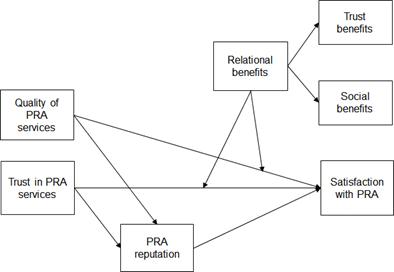
their reputation and members’ satisfaction. In addition, as PRA reputation
directly impacts satisfaction, reputation may mediate quality and trust
relationships with satisfaction. Finally, social, trust, and relational
benefits can moderate – or strengthen – the influence of the quality of
representation services and trust in representation services with members’
satisfaction with PRA. As a result, a proposed conceptual model to be tested in
future research is presented in Figure 2.
Figure 2
Proposed model
for satisfaction with PRA services
Source: Elaborated by the authors.
6. Conclusion
The findings
offer elements to propose the model presented
in Figure 1, highlighting the difficulty of approaching an issue such as representation and lobbying, which is unregulated in Brazil. The dissemination of PRA reflects the development of
collective actions to influence individuals, organizations on the institutional
environment at the government executive, legislative, and judicial branches and
other interested parties.
The
study offers a theoretical contribution to businesses’ political activities,
proposing a model aligned with the Theory of Collective Action. As for
practical contributions, the research points out to companies the importance of
making the best use of PRA.
One of the limitations of this research
was the difficulty in obtaining participants willing to respond to the questionnaire, which is explained by
the fact that lobbying is an unregulated activity in Brazil, and this type of
representation has a negative connotation in the country. Therefore, only a few
valid questionnaires were retrieved, and it was necessary to use a joint
quali-quanti approach with complementary interviews. Another limitation was the
concentration of members in the only nationwide PRA. In addition, the sector of agricultural
inputs
distributors encompasses many micro and small distributors with a limited
capacity to exploit PRA potential.
Future
research may work on the proposed model, statistically prove the relationships
suggested, and explore the possibility of including new constructs and relationships that impact
satisfaction with PRA services. The results indicate satisfaction with the
representation services, and shed light on the potential improvement in these
services' cost/benefit ratio. This
satisfaction cannot be based only on the fact that
there is an impending cost for
each company to act before government institutions and other interested parties
that are larger
and operate with a wider scope. Being a PRA member,
especially when the PRA is a large and nationwide organization, increases the
perception of security. However, this
perception of security cannot be a barrier to the development of other arrangements aimed at the defense of interests, such as
the creation of possible new, more specialized associations or mechanisms that
facilitate companies in maximizing their interests and in preventing and
mitigating future risks for the business, whether acting individually or
collectively.
References
Almeida, P. M. M. D., Abdalla,
M. M., & Ferreira, A. (2022). Regulamentação do lobby no Brasil:
transparência ou manutenção do status quo? REAd. Revista Eletrônica de
Administração, 28, 262-291.
Barra, G. M. J., Silva,
V. C., & Machado, R. T. M. (2007). O papel das associações de interesse
privado no mercado cafeeiro brasileiro. REGE Revista de Gestão, 14(2),
17-31.
Belik, W. (2019). Estado, grupos de interesse e formulação
de políticas para a agropecuária brasileira. Revista de Economia e
Sociologia Rural, 36(1), 9-34.
Cade - Conselho Administrativo de Defesa
Econômica. (2020). Caderno do CADE: mercado de insumos. Retreived February 24,
2023 from https://cdn.cade.gov.br/Portal/centrais-de-conteudo/publicacoes/estudos-economicos/cadernos-do-cade/mercado-de-insumos-agricolas-2020.pdf.
Coughlan, A. T., Anderson, E., Stern, L. W., & El-Ansary, A. I. (2002).
Canais de marketing
e distribuição. Porto Alegre: Bookman.
Davis, J. H., & Goldberg, R. A. (1957).
A concept of agribusiness. Boston:
Harvard University. Farina, E. M. M. Q., Azevedo,
P. F., & Saes, M. S. M. (1997). Competitividade: mercado,
estado e organizações. São Paulo: Editora
Singular.
Fitzsimmons, J. A., & Fitzsimmons, M. J. (2010). Desenvolvimento de
novos serviços: operações, estratégia e tecnologia. Porto Alegre: Bookman.
Fleischman, G. M., Johnson, E.
N., & Walker, K. B. (2017). An exploratory examination of management
accounting service and information quality. Journal of Management Accounting
Research, 29(2), 11-31.
Fornazier, A., & Waquil, P. D. (2012).
A importância das organizações de interesse privado
no agronegócio: o caso da cadeia produtiva da maçã no Brasil. Organizações
Rurais & Agroindustriais, 14(1), 46-59.
Fornell, C., Johnson, M. D., Anderson, E. W., Cha, J., & Bryant, B.
E. (1996). The American customer satisfaction index:
nature, purpose, and findings. Journal of Marketing, 60(4), 7-18.
Goel, S., Bell,
G. G., & Pierce, J. L. (2005).
The perils of Pollyanna: Development of the over-trust construct. Journal of
Business Ethics, 58(1), 203-218.
Grönroos, C. (1984).
A service quality
model and its marketing implications. European Journal
of Marketing, 18(4), 36-44.
Gwinner, K. P., Gremler, D. D.,
& Bitner, M. J. (1998). Relational benefits in services industries: the
customer’s perspective. Journal of the Academy of Marketing Science, 26(2),
101-114.
Hult, G. T. M., Morgeson, F. V., Morgan,
N. A., Mithas, S., & Fornell, C. (2017). Do managers
know what their customers think and why? Journal of the Academy
of Marketing Science, 45(1), 37-54.
Hult, G. T. M., Sharma, P. N., Morgeson III, F. V., & Zhang, Y.
(2019). Antecedents and consequences of
customer satisfaction: do they differ
across online and offline purchases? Journal of Retailing, 95(1),
10-23.
Johnson, M. D., Gustafsson, A., Andreassen, T. W., Lervik,
L., & Cha, J. (2001).
The evolution and future of
national customer satisfaction index models. Journal of economic Psychology,
22(2), 217-245.
King, N. (2004). Using templates in the thematic
analysis of text.
Essential guide to qualitative
methods in organizational research, 256.
Khurana, S. (2013).
Service quality versus
customer satisfaction in banking sector:
A literature review. The
IUP Journal of Marketing Management, 12(4), 65-78.
Lehtinen, U., & Lehtinen, J. R. (1991).
Two approaches to service quality
dimensions. Service
Industries Journal, 11(3), 287-303.
Mitra, D., & Golder,
P. N. (2006). How does objective quality
affect perceived quality?
Short-term effects, long-term effects, and asymmetries. Marketing
Science, 25(3), 230-247.
Moe, T. M. (1988). The organization of interests: Incentives and the
internal dynamics of political interest groups. University of Chicago
Press.
Morgan, R. M., & Hunt, S. D. (1994). The commitment-trust
theory of relationship marketing.
Journal of Marketing, 58(3), 20-38.
Mota, M. D. O.,
& Freitas, A. A. F. (2008).
Análise dos benefícios relacionais
observados por usuários de serviços. RAM. Revista de Administração Mackenzie,
9, 126-147.
Nassar, A. M., & Zylbersztajn, D. (2004). Associações
de interesse no agronegócio brasileiro: análise de estratégias coletivas. Revista
de Administração, 39(2), 141-152.
Neves, M. F., Valerio,
F. R., Cambaúva, V., &
Marques, V. N. (2020). Modelo
MAPEA-Mercados-Alvo Para Exportação de Alimentos. Revista Agronomia
Brasileira, 4.
Neto, S. B., Marques, P. V., & Neves, E. M. (2020). Agribusiness cooperativo, eficiência e princípios doutrinários. Revista
de Economia e Sociologia Rural, 33(4), 71-98.
Olson, M. (1971). The logic of the collective action:
public goods and the theory of groups.
Cambridge,
USA: President and Fellows of Harvard College.
Rahi, S., Ghani, M., & Muhamad,
F. (2017). Inspecting the role of intention to trust and online
purchase in developing countries. Journal of Socialomics, 6(1),
1-17
Ramos, F. L., Ferreira, J. B., Freitas,
A. S. D., & Rodrigues, J. W. (2018).
O efeito da confiança
na intenção de uso do m-banking. BBR - Brazilian Business Review, 15,
175-191.
Ricciardi, A. R., Vilhena, B. P., Neto, F. A. G. D. S., Spers, E. E.,
& Chini, J. (2014). Associações de Interesse Privado no Setor de Equinos em
São Paulo: O Caso da ABQM. Desafio Online, 2(3), 44-59.
Rousseau, D. M., Sitkin, S. B., Burt, R. S., & Camerer, C. (1998). Not so different
after all: A cross-discipline view of trust. Academy of Management Review,
23(3), 393-404.
Sandler, T. (1992).
Collective action: Theory and applications. University of Michigan Press.
Sirdeshmukh, D., Singh,
J., & Sabol,
B. (2002). Consumer
trust, value, and loyalty in relational
exchanges. Journal of Marketing, 66(1), 15-37.
Wong, Y. H., Chan, R. Y., Ngai, E. W. T., & Oswald, P. (2009). Is
customer loyalty vulnerability-based? An empirical study of a Chinese
capital-intensive manufacturing industry. Industrial Marketing
Management, 38(1), 83-93.
Zucco, J. D. A., Santos, S. S. S., Begnini, S., & Carvalho, C. E.
(2022). Marketing de relacionamento e reputação corporativa: estudo do setor
bancário. Revista de Administração Unimep, 19(7), 223-246.
Zylbersztajn, D., &
Machado Filho, C. P. (1998).
Ações coletivas – o papel das associações de interesse privado no agribusiness. São Paulo: Pioneira.
i
Master's
degree in Business Administration and Accounting from FUCAPE Business School (2023). Doctorate candidate in Business
Administration and Accounting from FUCAPE Business School.
ii Associate Professor at FUCAPE Business
School. Graduate Program
in Accounting and Administration at FUCAPE Business School, Vitória, ES, Brazil.
Doctor in Business Administration from the Pontifical Catholic University of
Rio de Janeiro - PUC-Rio (2012), Master's
degree in Business
Administration from the Pontifical
Catholic University of Rio de Janeiro - PUC-Rio
(2006).