Implementing the Food Acquisition Program in a higher education institution: public management potentials, weaknesses and challenges in Baixada Fluminense/RJ
A implantação do Programa de Aquisição de Alimentos numa instituição de ensino superior: potencialidades, fragilidades e desafios da gestão pública na Baixada Fluminense/RJ
Igor Samuel de Oliveira Pinto 1i, Orcid: https://orcid.org/0000-0003-0208-7667; Márcio Silva Borges2ii, Orcid: https://orcid.org/0000-0002-1527-8529; Luana de Oliveira Santos3iii Orcid: https://orcid.org/0009-0007-5845-3554; Anderson Leite do Nascimento4iv, Orcid: https://orcid.org/0009-0002-6737-9302.
1. Universidade Federal Rural do Rio de Janeiro, Nova Iguaçu/RJ, Brasil. E-mail: igor_samuel@hotmail.com
2. Universidade Federal Rural do Rio de Janeiro. Nova Iguaçu/RJ. Brasil. E-mail: marcioborges@ufrrj.br
3. Universidade Federal Rural do Rio de Janeiro, Nova Iguaçu/RJ, Brasil. E-mail: luana_oliveira_santos@hotmail.com
4. Universidade Federal Rural do Rio de Janeiro, Nova Iguaçu/RJ, Brasil. E-mail: alnascimento@ufrrj.br
Abstract
FAP (Food Acquisition Program) was launched in 2003 and regulated in 2012. It is one of the main structuring actions of Fome Zero Program (Zero Hunger Program) and an innovative public policy capable of combining two important objectives: encouraging family farming, promoting its economic and social inclusion by encouraging production; and giving access to food at the necessary amount, quality and regularity for people facing food and nutritional insecurity. The current article introduces FAP as public policy focused on family farming. Therefore, its aim is to address this program’s implementation and conduction at Nova Iguaçu/RJ Campus, in a Federal Higher Education Institute (IFES), based on its Institutional Purchase modality to supply its university cafeteria and present the potentialities, weaknesses, and challenges of its implementation. According to SWOT-Matrix analysis results, FAP-CI at Nova Iguaçu Campus has a promising future, although it did not reach the 30% rate required by law.
Keywords: Food Acquisition Program; Family Farming; Public Policy.
Resumo
Lançado em 2003 e regulamentado em 2012, o Programa de Aquisição de Alimentos (PAA) foi considerado uma das principais ações estruturantes do Programa Fome Zero e representou uma inovadora política pública capaz de conciliar dois objetivos importantes: incentivar a agricultura familiar, promovendo a sua inclusão econômica e social, com o fomento à produção; e promover o acesso à alimentação em quantidade, qualidade e regularidade necessária às pessoas em situação de insegurança alimentar e nutricional. O artigo apresenta o PAA como política pública de promoção da agricultura familiar e, para tanto, objetiva-se abordar a implementação e a execução do programa no Campus Nova Iguaçu/RJ de uma Instituição Federal de Ensino Superior (Ifes), por meio da modalidade compra institucional, em atendimento ao seu restaurante universitário, buscando apresentar as potencialidades, fragilidades e os desafios de sua implantação. A análise dos resultados da Matriz SWOT indicou que, embora o projeto não tenha atingido o percentual de 30% exigido por lei, o PAA-CI do Campus Nova Iguaçu mostrou um horizonte promissor.
Palavras-chave: Programa de Aquisição de Alimentos; agricultura familiar; política pública.
Citação: Pinto, I. S. de O., Borges, M. S., Santos, L.de O. & Nascimento, A. L. do. (2024). A implantação do Programa de Aquisição de Alimentos numa instituição de ensino superior: potencialidades, fragilidades e desafios da gestão pública na Baixada Fluminense/RJ. Gestão & Regionalidade, v.40, n. Especial: Regionalidade e desenvolvimento: o papel da gestão e20249124. https//doi.org/10.13037/gr.vol40.e20249124
1 Introduction
Family farming presents different dynamics and features in Brazil, besides being featured by great economic diversity and social heterogeneity, which is notably marked by small landlords who use family manpower in production aimed at self-consumer and trade (Schneider & Cassol, 2014).
From the legal viewpoint, law n. 11.326 (2006) provides the family farming definition in its article 3, as well as the legal definition of rural family entrepreneur. Based on this legal framework, data from the last Agricultural Census (2017) show that Brazil has 5,073,324 agricultural establishments, and 3,897,408 of them are classified as Family Farming business, i.e., this number corresponds to 77% of the total of rural properties in Brazil. When it comes to territory extension, family farming covers 80.9 million hectares, and this amount represents 23% of the area recorded for all agribusinesses in Brazil. When the subject is production value, family farming generates 107 billion Reais, and it corresponds to 23% of the whole Brazilian Agricultural production. Finally, approximately 10.1 million people working in agriculture in Brazil come from family farming, and it means 67% of the total of new job position created in rural areas.
The introduced data points towards Family farming relevance for the country’s economy and shines light over the need of paying close attention to public policies capable of stimulating this sector. The rise of the rural territorial development approach infers that the ideal analytical and conceptual treatment given to concrete issues must lie on the action space where social, economic, political and institutional relationships take place (Schneider, 2010). Accordingly, based on Duncan (2010), new public policies emerged in Brazil as alternative to the hegemonic system. These new policies aim at family farming, since it is linked to territorial and environmental matters. Some of these policies include the National Family Farming Program, also known as PRONAR and FAP (Food Acquisition Program), which is an arm of PRONAF. These programs emerged as innovative public policy capable of boosting family farming income generation and of fighting starvation and food insecurity.
Luís Inácio Lula da Silva’s administration, back in 2003, opened room for discussions about, and for the formulation of, public policies focused on family farming and on fighting starvation. These policies included actors so far marginalized from this process. FAP was enacted by law n. 10.696, from 2033, and changed by law n. 12.512, from 2011. It is a program bond to Fome Zero Program and has two main aims, namely: encouraging small family farmers and broadening access to food. Grisa (2010) highlights that the combination between buying food from Family farmers, and food and nutrition security actions, is FAP’s differential. The concept behind this program lies on boosting family farming through governmental purchasing in order to ensure a regular market and a trading channel for family farmers. It also aims at fighting starvation through healthy food eating. Accordingly, FAP represented the rupture with public policy models set for field production in place, so far, since the State was now buying food straight from some family farmers, which was a pioneering action in the world.
According to a report issued by the World Health Organization, in 2019, there are 821.6 million people starving worldwide, and 513.9 million of them are in Asia, 256.1 million in Africa, and 42.5 million in Latin America and the Caribbean. Moreover, it is important highlighting the warning datum that approximately 2 billion people in the world do not have access to nutritious food and to right amounts of food over the year. According to the aforementioned report, this situation is classified as moderate to severe food insecurity. After the SARS-COV-2 pandemic, this situation got even worse.
Giving food security the status of strategic development fundamental means acknowledging the food issue inherent to development processes that must be based on 3 factors, namely: 1) being well nurtured is a basic human right, 2) Food System – food production, supply and intake – plays key role in economic, social and cultural configurations -, 3) understanding that food production-related matters and those associated with food consumption have always been a source of concern and social mobilization, as well as permanent objects of public policies (Maia & Rodrigues, 2009).
According to Silva (2014), there is close link between starvation and poverty, since both phenomena influence each other within a “perverse circular causation” of multidimensional nature. The aforementioned author got to such a conclusion by thinking that starvation deriving from the intake of low amounts and/or low quality food implies individuals’ health condition deterioration, since it compromises their productivity and social integration. Starvation associated factors are determining for the uneven access to basic-need goods and services, such as food, housing, water, education and healthcare. Therefore, the poorer the family, the higher the relative food impact on its income.
FAP is part of the National Food and Nutrition Security System (SISAN). The National Supply Company (CONAB) is the institution managing its operation at federal scope. SISAN reinforces the key role of this program in promoting food security and in fighting starvation.
It was only in July 4, 2012, that FAP was regulated (Brasil, 2012)[1], whose article 17 implements the program based on support modalities linked to the stock formation of family farming goods, to seeds’ acquisition[2], simultaneous donations, straight purchase from family farmers, milk production incentives[3] and institutional purchase.
In 2015, President Dilma Rousseff issued Decree n. 8.473, in 2015, which provided on the minimal rate of 30% budgetary resources at Federal Public Administration scope to be destined to food acquisition from family farming goods and from their organizations. This policy allowed bureaus and entities - linked to the direct, autarchic and foundational Public Federal Administration - to acquire food through the modality named “Institutional Purchase”.
Nowadays, based on the last report by the UN: “Overview of regional food security in Latin America”, approximately 21 million people in Brazil do not have food every day and approximately 70 million people face food insecurity (ONU, 2023). Based on the last survey on Brazilian public college students’ income - the 5th National Research on the Socioeconomic and Cultural Profile of Undergraduates in Higher Education Institutions (ANDIFES, 2019) -, 70.2% of Brazilian college students live on family monthly income per capita of up to 1 minimum wage, and the mean income of these families is R$ 640.00. Students living on income higher than 5 minimum wages per capita only correspond to 4.6% of the total of students enrolled in public universities. This study also showed that 64.7% of students completed high school in public schools. College cafeterias provide thousands of meals on a daily basis, and these meals are based on healthy food provided to young students in public universities who face social vulnerability and live on monthly income lower than 1 minimum wage. UFRRJ, in Nova Iguaçu, Seropédica and Três Rios campi, provides high-quality food acquired through FAP to hundreds of students and to its academic community, on a daily basis (UFRRJ, 2021).
This is a relevant study because its aim lies on seeking to better understand FAP’s importance to universities, either at theoretical level – mainly to better understand this topic, since studies on this field are scarce in the literature – or at practical level, because this topic is experienced by our students in their daily routines. Accordingly, the present study is in compliance with the perspectives by Oliveira (2018), Salgado (2020, 2022); Lopes (2022) and Triches et al., (2022), who assessed FAP implementation in public universities by having in mind the local reality of each university and by disclosing the main challenges to implement this huge program, which has significant impact on IFES countrywide.
According to a survey carried out in the Agricultural Census (2017) (IPEA, 2021), family farming is a fundamental support to Brazil’s economy and supply, since it accounts for 77% of agricultural establishments in the country, for 23% of its total agricultural production, and for 67% of workers in agricultural establishments. Brazil did not have public policies capable of fulfilling this sector’s economic and social specificities, up to mid-1990s. The first policy was implemented in 1996 after significant claims and mobilizations by several social movements. Later on, the Family Farming Reinforcement Program (PRONAF) was implemented. This is a credit-provision program aimed at supporting family farming production and at introducing several modalities based on producers and farmers’ yearly income (Silva and Nunes, 2023).
In 2021, the federal government destined more than R$900 million to this program, and R$700 million were invested in the Purchase modality. Moreover, several contracts signed with family farming cooperatives aimed at the acquisition of more than 45 thousand tons of food, which was split into 350 product types (IPEA, 2021). Law 14.601 helped introducing new FAP guidelines in Brazil by mid-2023 in order to reach the whole Brazilian territory through income transfer and social assistance programs, such as Bolsa Familia (BRASIL, 2023). Finally, the administration in office issued Decree n. 11.476, from 2023, which regulated the last FAP update (BRASIL, 2023).
Family farming cooperatives play key role in help reaching the sustainable development goals (SDG), thanks to strategies and public policies developed for cooperatives aimed at reinforcing it (Alotaibi and Kassem, 2022; Silva and Nunes, 2023). Actions like adopting more sustainable practices and supporting family farming have benefited many individuals, for decades, and these benefits include reducing poverty, promoting members’ food quality and well-being, and adopting sustainable agricultural practices (Candemir et al, 2021; Zeng L et al, 2023).
Family farming cooperatives stand out for their fundamental principles, such as a) free and voluntary adhesion to them, b) democratic control by their members, c) equitable contribution by members to cooperatives’ capital, d) autonomy and independence, e) availability of education and qualification, f) cooperation among cooperatives, g) concern with local and regional development (Felício and Cristofoli 2004; Abarghani et al., 2013; Marcis et. al, 2019).
Accordingly, the aim of the present article was to analyze FAP implementation Pilot-project at UFFRJ, Nova Iguaçú campus, in Baixada Fluminense, Rio de Janeiro State, based on the Institutional Purchase modality. The study was based on Public Call 01/2019, which regarded purchasing 7 food types (banana, cooled banana, sweet potato, yam, cassava, cucumber, okra) to supply the campus’ cafeteria.
The article comprises this introduction about the FAP topic and its relevance for Family farming. The second section introduces FAP as innovative policy in Brazilian university. The third section presents FAP-CI implementation process at Nova Iguaçú Campus. The fourth section introduces the methodological path. The fifth section presents and analyzes relevant analysis data applied to the identified potentials and weaknesses. Finally, the last section provides study conclusions by disclosing the challenges, results, field study outcomes and interviews with actors involved in IFES’ FAP-CI construction process through SWOT Matrix analysis.
2 Theoretical references
2.1 Introduction scene: FAP-CI in Brazilian public universities
The instrument called ‘Public Call’ was implemented after FAP’s Institutional Purchase modality was created through Decree n. 7.775, from 2012, to make family farming food purchasing feasible by direct and indirect State bureaus, entities and institutions; State Federations, Federal District and Municipalities (Brasil, 2018).
This innovative purchasing mechanism created by the public power is nothing but the possibility of acquiring food grown by family farmers, without the need of traditional biding, as provided on Decree n. 8.473, from 2015. The minimum rate of 30% of the federal public administration budget would be destined to food acquisition.
However, it is necessary to accumulate the following demands (MDS, 2018) to achieve this modality: prices compatible to those practiced in the market, at regional and local scope, measured and defined based on the GGPAA methodology; proof of food quality by beneficiaries, suppliers and supplying-organization based on DAP-PRONAF presentation, or on other documents demanded by MDA in combination to other federal public administration bureaus; respecting the following yearly maximum values per buyer bureau to acquire the food types: a) $ 20,000.00 per family unit and b) R$ 6,000,000.00 per supplying organization, by respecting family-unit limit; and acquired food must be produced by producing beneficiaries, based on respecting quality-control criteria in the standards in place.
Public calls and Decree n. 8.473, from 2015, allowed and demanded several public administration bureaus, such as Federal Universities countrywide, to supply at least part of their cafeterias (Rus) based on food types coming from local family farmers.
Given the current low public-investment scenario, several studies have been published in the Brazilian Academic literature. These studies focused on disclosing FAP-CI’s potentials, challenges and benefits in federal universities.
Assis (2016) analyzed FAP-CI implementation at Federal University of Viçosa (UFV), between 2013 and 2015. She highlighted that, although FAP-CI implementation in the university was problematic, due to high prices, cafeteria structure’s physical limitations and farmers’ lack of organization to supply the market, it was possible observing the programs’ benefits either to UFV or to the involved family farmers. UFV pointed out its access to healthier food as benefit, since it respected the local food culture. Farmers highlighted trade-relationship reinforcement, product valorization and higher family income as program benefits. However, the aforementioned author also pinpoints that the association between institutional purchasing and family production based on previous planning was essential for FAP-CI consolidation in the institution, as well as the need of setting partnerships and extension projects to prepare farmers for social participation in the program’s operation.
Barroso (2019) diagnosed and followed-up the early years (2016-2017) of FAP-CI implementation at Federal University of Rio Grande do Sul (UFRGS). At that time, UFRGS issued 10 Pubic Calls to increase the number of family farming cooperatives in each call. In 2017, UFRGS signed 13 contracts with 9 different cooperatives and 493 family farmers who participated in food production and supplying to the university.
According to Barroso (2019), FAP-CI was successful at UFRGS mainly because of the actions by key participants and of the institutional environment favorable to environmental sustainability and social principles, rather than just because of involved actors’ motivation and engagement.
Nevertheless, the aforementioned author highlights that having University Cafeterias as public equipment can be a two-way factor, since it can, on the one hand, promote FAP-CI and sustainable diets, but, on the other hand, it can inhibit the program’s progress given the growing catering-services outsourcing (Barroso, 2019, p. 81).
The aim of the investigation carried out by Oliveira (2018) was to assess FAP-CI implementation process at Federal University of Rio Grande do Norte (UFRN) based on Brynard’s Protocol 5C. Implementation began in October 2016, and UFRN issued its first public call for the total of R$ 317,148.45 in institutional purchasing. Although it only counted on the participation of 3 cooperatives/associations and given the political-economic context featured by budgetary cuts in Federal Universities, Oliveira (2018) highlighted that, due to institutional will, the managerial skills and commitment of involved actors made UFRN implement FAP-CI in the institution – however, it just covered part of the 30% rate provided on the legislation.
The aforementioned author stated that FAP-CI helped UFRN’s cafeteria to provide healthy, complete, harmonic and nutritious food adjusted to the local food culture, as well as helped producing institutional market opening and flow for family farmers (Oliveira, 2018, p. 70-71).
Giombelli (2018) investigated and analyzed the early years of FAP-CI implementation in cafeterias at Federal University of Paraná (UFPR, UFFS, UTFPR, UNILA) to identify the built mechanisms and barriers observed in each assessed institution.
She observed that only 4 of the 22 assessed units bought family farming food types, and it was a quite small number. It happened even after Decree n. 8.473, from 2015, was enacted. At least theoretically, it would force the assessed universities to meet the 30% rate.
Even acknowledging the existence of important actors who stood out during FAP-CI implementation in the assessed universities, the barriers observed by Giombelli (2018) in Paraná’s universities stopped the positive program-development conduction. These barriers were set by acquisition bureaucracy, intervention by outsourcing companies, weak family farmers’ organization and low participation in the implementation process, and lack of dialogue among IFES’ farmers, cooperatives, outsourcing services and managers, and civil society.
Paula (2016) aimed at identifying FAP-CI barriers and conquests at Federal University of Paraná, given this institutions’ pioneering action in making purchases based on this modality. Among the identified barriers, she highlights supplying high volumes of different food types, Public Call/Bidding Process association, identity pattern and food quality, demand/production inadequacy, Public Call elaboration for green leaves purchasing and, most of all, using the lower-price criterion that, according to her, had significant impact on family farming production for institutional markets due to FAP-CI.
The selection option based on the lowest price brings along several limitations: it does not boost the local economy, short food-trading circuits, among others, and it can actually lead to social, economic and environmental costs. Yet, it does not prioritize the insertion of family farming organizations comprising traditional communities and agrarian reformer settlers (who are people known for their food and nutrition insecurity in the country), as well as impairs the acquisition of ecological food that, in its turn, does not encourage farmers’ transition to ecological production, health condition improvement, or improve these producers’ food and labor conditions (Paula, 2016, p. 72).
When it comes to advancements observed in her research, (Paula, 2016) highlights the benefits for either the university or for family farmers. These benefits would lie on promoting the direct sales of family farming products, close association between the ones who produce and those who buy, as well as better food quality of dishes available in the students’ cafeterias.
It is possible observing some agreement in all assessed studies when it comes to barriers, potentials and challenges to implement FAP-CI in institutions. The main barriers and challenges identified in almost all studies for FAP-CI implementation regard pricing criteria in the calls, institutional bureaucracy, the logics of food types’ delivery by family farmers and flaws in involved-actors’ articulation. These studies mainly agree with FAP-CI ability to open an institutional market and to encourage shorter food-production circuits as its potentials, as well as to stimulate healthy eating based on local food cultures.
These agreements point out that FAP-CI, as public policy, have the potential to reach its targets, namely: encouraging family farming and fighting food insecurity. However, challenges are faced by institutions that adopt it, such as ability to promote articulation between involved actors in order to overcome barriers, be them bureaucratic, logistics or managerial.
In 2021, Lopes (2020) mapped the food acquisition program at Federal University of Pará and diagnosed the main dilemma faced by this institution at the time to implement and maintain the program. His aim was to contribute to discussions about family farming in Brazil based on the historical analysis and identification of public policies focused on encouraging this category to grow, with emphasis on the Food Acquisition Program (FAP), at UFPA’s Institutional Call modality. The case study carried out at UFPA filled gaps in the scientific literature about this program modality, because there were other studies assessing this topic in the analyzed regions. The purchase mapping process and the elaboration of a flowchart allowed pointing out the main barriers and risks linked to FAP and to how this process works from the bidding process, to costs and main challenges for its implementation at UFPA (Lopes, 2021).
Recently, another study was conducted in 15 public universities in Southern Brazil by (Triches et al., 2022). Its aim was to map FAP implementation in these institutions, mainly to identify the main challenges faced by these public institutions during its implementation. Based on its results, 47% of the assessed units were already buying food from assistance programs linked to family farming. UFRGS and IFES Rio Grande do Sul were the institutions presenting the highest acquisition rates among the assessed institutions. However, the author has concluded that FAP-related public policies still demand higher efficiency to better encourage this program in public universities. This finding shines light on the need of enhancing the existing public policies in order to reinforce FAP implementation in these teaching institutions (Triches et al., 2022).
Only 19 of the 63 Brazilian universities had implemented Food Acquisition Programs up to mid-2019 based on data in the study by Salgado (2020), who assessed FAP implementation in public universities. Up to that time, there were no records of research focused on analyzing FAP conduction by federal universities. Yet, research aimed at exploring the national performance of FAP’s public calls are overall scarce. This finding is explained by lack of research and follow-up given the program’s complexity, the country’s geographic dimension and the hard time gathering quantitative and updated data (Salgado et al, 2022).
3 FAP-CI implementation at Nova Iguaçú Campus/RJ
3.1 Brief history of IFES/Nova Iguaçú Campus
This Federal Higher Education Institution started a slow process to expand its graduation courses between 1969 and 2000. At that time, 17 Bachelor’s Degree courses were launched (Universidade Federal Rural do Rio de Janeiro, 2013).
Within these 30 years, IFES jumped from small-sized institution, with approximately 2,000 students, by late 1970s, to mid-sized university with 8,000 graduation students and 1,000 post-graduation ones (Universidade Federal Rural do Rio de Janeiro, 2013).
In 2005, this education institution included a Higher-Education Expansion Program funded by the Federal Government, which was enacted by Official Letter n. 2292/2005- MEC/SESU/DEDES (Arjona De Souza & Pereira De Souza, 2003) and signed by the Director of the Higher Education Development Department - Manuel Palácios da Cunha e Melo. This document shows the Federal Government’s real intention behind this university’s expansion program: access to and democratization of education. Accordingly, the Federal Government disclosed its will to create a university campus in Nova Iguaçú City; yet, in order for this plan to be successful, IFES should take three urgent preparation actions: developing the campus’ construction project, elaborating the academic project and creating an Academic Unit. Thus, on July 20, 2005, Deliberation n.32 by the University Council created the Multidisciplinary Institute – IM – in Nova Iguaçú City, which counted on six graduation courses, at the time.
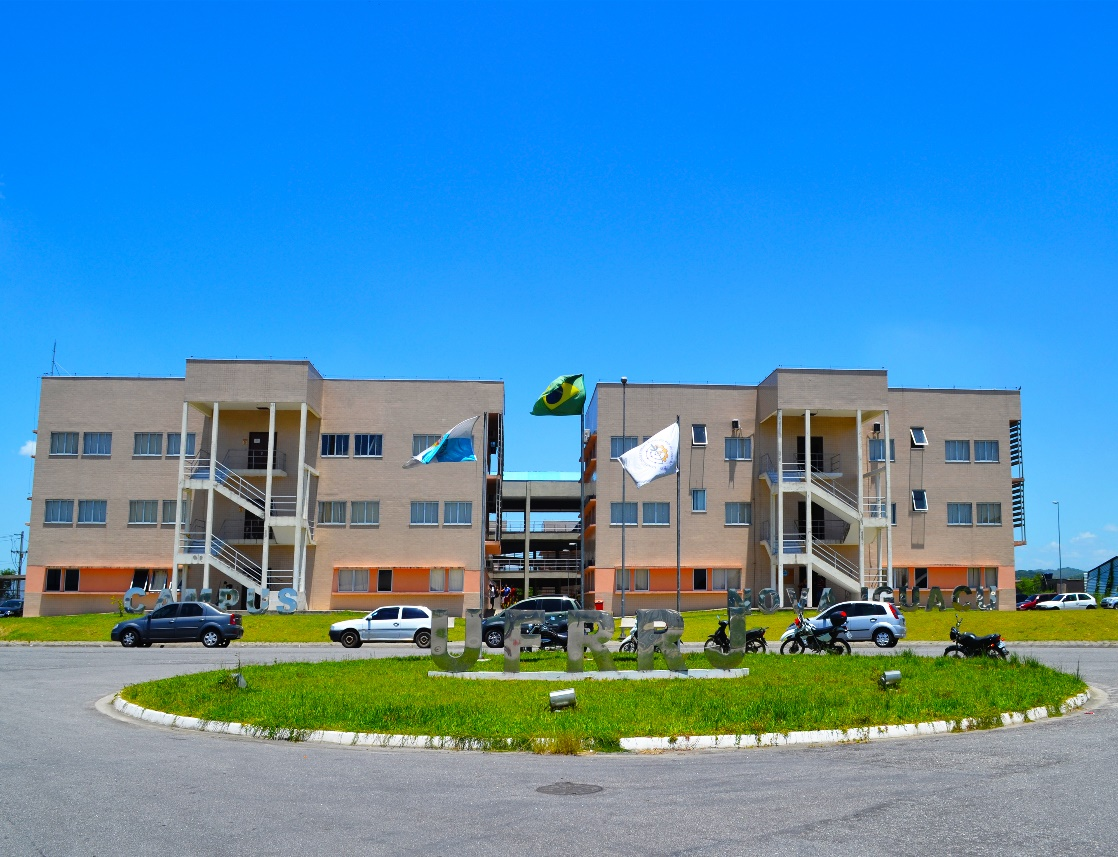
From 2006 onwards, IM’s academic-managerial activities were conducted at Monteiro Lobato Municipal School facilities, at the night shift, as courtesy by the City Hall. It was only in 2010, after the campus construction was concluded (Figure 1), that IM moved out from its temporary facility.
In 2012, this education institution’s expansion process was finally concluded, and its statute and standards were changed into what is nowadays enforced. These documents provide on the University’s structure, as observed in its article n. 6, single paragraph: Seropédica, Nova Iguaçú and Campos dos Goytacazes campi.
Nowadays, IFES offers 56 graduation courses in its three campi: Seropédica, Nova Iguaçu and Três Rios, which assist approximately 24 thousand students enrolled in its graduation courses (Universidade Federal Rural do Rio de Janeiro, 2018) (Universidade Federal Rural do Rio de Janeiro, 2019a). Nova Iguaçu Campus is located at Av. Governador Roberto da Silveira (Figure 1), Moquetá neighborhood, and offers 10 graduation courses and 2 post-graduation ones.
3.2 FAP-CI trajectory at IFES
IFES is the outcome of an articulation strategy from 2013 developed by the Financial Affairs Dean (PROAF), Student Affairs Dean (PROAES) and Extension Dean (PROEXT), along with three university elements (professors, managerial technicians and students) and family farmers, cooperatives and NGOs. Meetings aimed at mapping the local food-type offer capacity were carried out to find ways to supply Seropédica Campus’ cafeteria.
The project named “Reinforcing Family Farming at UFRRJ: opening markets and technical assistance for local development” was implemented in order to make the Food Acquisition Program operational at IFES, back in 2014. This project grew in the institution and became the University Extension Program, also known as “Reinforcing Family Farming at Baixada Fluminense and Central/Southern Rio de Janeiro State”.
Portilho et al. (2009) highlights the attention given by the program to agroecological principles, with emphasis on boosting alternative agricultural practices, knowledge exchange and direct-sales channels.
The program stood out for its agroecological principles, such as focus on more sustainable agri-food systems, which are based on plural and integrating epistemological fundamentals. The main agroecology idea lies on developing alternative agricultural practices that concern knowledge construction and sharing, on the consolidation of public policies linked to family farming and on encouraging direct sales channels. On the other hand, it also aims at motivating conscious-consumption education and at developing processes to ensure the quality and visibility of products sold by family farmers (Portilho et al., 2009, p. 360).
IFES houses two cafeterias whose budgets in 2018 were close to R$ 11,071,210.00. This money would come from the National Student Assistance Program (PNAES). Money distribution allowed implementing the institutional purchasing program through FAP at Seropédica Campus, based on estimated production ranging from 4,000 to 5,000 meals on a daily basis, and at Nova Iguaçú campus, with estimated production of 1,000 daily meals.
The university counts on the program “Reinforcing Family Farming at Baixada Fluminense and Central/Southern Rio de Janeiro State”, which aims at reinforcing family production supported by egroecological basis in UFFRJ campi’s territories. The Program’s actions are developed over six basic axes: FAP, family Faming Fair, qualification, Agronomics, conscious food consumption and local production arrangements. The university buys food to its cafeterias straight from family farmers. Its benefits for framers include the guarantee of selling their products by good prices, the official character given to their activity and organic products’ valuing. The Rural University uses the food acquisition program to promote students’ health at university cafeterias, since they provide students with high-quality, fresh, seasonal and organic food. Family farming fairs happen every week at Seropédica, Nova Iguaçu and Três Rios campi due to EMATER-RIO’s cooperation (UFRRJ, 2021).
Figure1
Nova Iguaçu Campus
Source: portal.ufrrj.br
The university issued a pilot-call in 2016 for the acquisition of family farming food types to supply the cafeterias at Seropédica campus (process n. 23083.10177/2014-51) (Universidade Federal Rural do Rio de Janeiro, 2016). It was substantiated by a social management policy aimed at collective decision-making without coercion, which involved IFES academic community, family farming collectives, NGOs and representatives from Empresa de Assistência Técnica e Extensão Rural - EMATER-RJ. The call concerned the following food types and amounts: 9,000 kg of pumpkin, 5,000 kg of cassava and 14,000 kg of cooled bananas, with estimated acquisition price of R$ 75,100.00, depending on the daily price at goods’ delivery, based on prices available in the Bulletin published by Agricultural Research Company of the State of Rio de Janeiro – PESAGRO-Rio- State Center for Rural Economy / Agricultural Market Information System (SIMA) (Santos, 2018).
Simultaneously, a movement to expand FAP in the institution rose from the articulation between the extension program and Nova Iguaçú Campus, based on process n. 23083.018519/2017-23, from July 19, 2017, (Universidade Federal Rural do Rio de Janeiro, 2019b). This process provided on the public-call publication rules for food acquisition. At that time, it aimed at supplying cafeterias at Nova Iguaçú Campus. The purchase of seven family farming food types grew in Nova Iguaçú County, and in other counties around it, was based on food amounts described in Table 1.
Call 01/2019 by Nova Iguaçú Campus used the definition of maximum acquisition prices and price search at the State Supply Center - CEASA-RJ - based on the last working day before delivery, for pricing – as its pricing methodology, just as observed at Seropédica Campus public call (01,2017).
The movement to implement FAP at the Multidisciplinary Institute aimed at replicating the positive experience lived at Seropédica and Nova Iguaçú Campi, which are urban stems of the herein assessed education institution. However, there are doubts about the success of implementing a public policy focused on family farming in university campi mainly located in urban municipalities.
According to data in the last IBGE census (Censo IBGE, 2010), Nova Iguaçú County mostly houses an urban population. Approximately 98.9% of its population (787,563 people) lives in the urban zone and only 1.1% of it (8,694 people) lives in the countryside. When it comes to the municipality’s territorial policy, Nova Iguaçú Urban Development Direction Plan (law n. 4.092, from June 28, 2011) has the specific goal of “encouraging rural activities to promote sustainable development in urban regions, and to boost family farming and agricultural activities”.
As for agricultural activities, data in the last census by IBGE (Censo Agropecuário, 2017) showed that Nova Iguaçú County has 576 agricultural establishments, within the mean area of 6.21 hectares, and 80.9% of them are linked to family agriculture. In addition, the agricultural activity in the county accounted for 5.07% of the municipal GDP, which corresponds to R$ 7,801,520.00. However, data about the county’s adhesion to FAP are not exciting. According to data available in the website Production Inclusion Platform - which makes available maps of FAP coverage countrywide, back in 2017 -, Nova Iguaçú only bought 1,329.8 kg of food (distributed among 7 food types) through FAP. These data point out how small the municipality’s adhesion to FAP is.
Table 1
List of food types and amounts estimated in Call 01.2019 – FAP Nova Iguaçú
|
Item |
Unity |
Amount |
Total price |
|
|
Banana |
Kg |
1,440 |
R$3,240.00 |
|
|
Cooled Banana |
Kg |
5,760 |
R$10,080.00 |
|
|
Sweet potatoes |
Kg |
2,880 |
R$4,900.00 |
|
|
Yam Cassava Cucumber |
Kg Kg Kg |
1,692 2,400 1,440 |
R$2,792.00 R$3,000.00 R$1,598.00 |
|
|
Okra Total |
Kg Kg |
720 16,332 |
R$1,440.00 R$27,050.12 |
Source: Adapted from Public Call n. 01/2019 – Process n. 23083.018519/2017-23.
This scenario was the background of FAP’s implementation at IFES. The Judging Commission was created by Ordinance n. 48/PROAF, from June 30, 2017, to proceed with the bureaucratic actions. This commission comprised 4 public servants, 2 in the Materials, Acquisition and Contracts Coordination (COMAC); and 2 in the Campus Cafeteria Coordination. Nevertheless, any of these 4 servants were experts in governmental purchasing procedures based on the FAP Institutional Purchasing modality. Among CJ’s competences, one finds elaborating call minutes and reference terms, licensing and classifying family farming supply proposals, and disclosing public calls’ results.
Based on provision in Item 4 of call 01/2019, the following documents had to be turned in for proposal approval: proof of register at the Individual Taxpayer Registration (CPF) or at the National Legal Entity Registry (CNPJ); Extract of Civil or Legal DAP, food-type sales project, declaration that the food types to be delivered come from ones’ own production; proof of regular situation at the Federal Treasure regarding Social Security and Service Time Guarantee Fund, copy of the statute and meeting minute of the entity’s current direction board registered at the accountable bureau. Declaration by the legal representative about accountability for controlling it associates’ individual sales limits, besides proof of capability to meet requirements in the specific legislation, whenever applicable.
CJ classified the proposals based on the prioritization cumulative criteria provided on article 7, paragraph 2 of SISAN Resolution n. 50, from 2012, namely: family farmers in Nova Iguaçú County and, subsequently, those living in other Baixada Fluminense municipalities; organic production, traditional communities, quilombolas and indigenous people, agrarian reform settlers and women’s groups.
The selected proposal would be the one providing the highest discount in the daily price of a give item, after the classification procedure. The public call took place on January 30, 2019, and it selected the proposals by two farmers: “Supplier A” (those belonging to the female sex) and “Supplier B” (those belonging to the male sex). Both suppliers were able to participate and live in Paracambi County.
“Supplier A” provided cassava (2,400 kg), cooled bananas (5,700 kg) and yam (1,692 kg) – all items with 3% discount over the price recorded at the last working day. “Supplier B”, in its turn, provided cassava (2,400 kg), cooled banana (5,760 kg), yam (1,692 kg), cucumber (1,440 kg) and okra (720 kg) – all items with 3% discount over the price recorded in the day before delivery.
Because of draw between propositions regarding cassava, cooled banana and yam, criteria V (women’s group) was applied and supplier A won the contract for these items.
However, during public call result’s outspread, Materials and Auxiliary Services (DMSA)[4] detected Supplier A’s issues with the Federal Treasure, since it was not possible issuing her Clearance Certificate of Federal Debts. The problem was reported to CJ, which gave the supplier a deadline to solve it. She did not meet the deadline set by CJ, so she lost her contract. Accordingly, the result of public call 01/2019 only had one winner, as shown in Table 2.
Table 2
Result of Public Call 01/2019
|
Supplier A |
||||
|
Item |
Demanded amount |
Offered amount |
Discount |
Total |
|
Cooled banana |
5,760 kg |
5,760 kg |
3% |
R$ 12,571.20 |
|
Cassava |
2,400 kg |
2,400 kg |
3% |
R$ 3,492.00 |
|
yam |
1,692 kg |
1,692 kg |
3% |
R$ 3,643.55 |
|
Total |
R$ 19,706.75 |
|||
Source: Process n. 23083.018519/2017-23.
4 Methodological approaches
The present study followed the literature review, exploratory, qualitative and field observation approach, based on Case Study analysis. The case study regarded the in-depth investigation of several authors who have participated in, and helped the elaboration of, Public Call 01/2019. According to Yin (2010), case study is an empirical investigation focused on contemporary phenomena within a real-life context, mainly when the limits between phenomenon and context are not clearly defined. The cut aimed at disclosing the State’s ability to implement family farming encouragement public policies, which is herein represented by UFRRJ’s Nova Iguaçú Campus.
This campus was chosen because one of the current article’s authors is one of the public servants working in it. He was in charge of implementing the program with the help of other local and headquarter servants (Seropédica). Thus, the easy access to the author’s data and immersion in the research, such as that described by Yin (2010), allowed investigating the herein assessed topic within the real context.
The method known as content analysis, suggested by Laurence Bardin, was used to analyze the collected data. Content analysis gathers many communication analysis techniques based on systematic and objective procedures applied to messengers’ goals and description. It is done to infer relative knowledge under production or reception conditions that are substantiated by quantitative and non-quantitative indicators (Bardin, 2015, p.38). According to Campos (2004), content analysis is much often adopted to assess qualitative data, since it regards a set of techniques aimed at seeking and giving meaning to documents. Based on the aforementioned author, the sense of a content analysis lies on inferring about an objective text, to the extent that it provides theoretical relevance to the method and applies a comparison, whose descriptive information on content does not have too much value.
Two servants working at Nova Iguaçú Campus cafeteria, three members of the Public Call Judging Commission (01/2019), three farmers in public call 01.2019, one trainee of the university’s extension program “Reinforcing Family Farming at Baixada Fluminense and Central-Southern Rio de Janeiro State” (Chart 1), substantiated FAP in Nova Iguaçú County, and three family farmers linked to Nova Iguaçú campus’ Family Farming Fair (FAF-Nova Iguaçú). FAF-Nova Iguaçú was launched on March 13, 2018, and it happens at Nova Iguaçú campus once a week. The fair comprises family farmers from Baixada Fluminense. Among the main products sold in these fairs, one finds cassava, avocado, pumpkin, banana, orange, lemon, okra, honey, cheese and processed products.
However, at first, option was made for interviewing FAF-Nova Iguaçú members, since they joined the meetings scheduled for September 2017, when UFRRJ/NI’s intention to proceed with both FAP-CI and the family Farming Fair in the campus was disclosed. These actors were potential participants in public call 01/2019. Nevertheless, data collected at the 3 first interviews have deeply helped clarifying the research’s general and specific aims, because FAF members did not participate in the public call. This scenario made the proposer cancel this group as research target-public.
The aims of the case study were to describe and analyze the author’s experience of implementing the Food Acquisition Program (FAP) at UFRRJ’s Nova Iguaçú Campus. The SWOT matrix (strengths, weaknesses, opportunities, threats) was used in the study, as well as other documental and bibliographic sources. According to Thompson (2002), the SWOT matrix aims at extracting conclusions, so that the study object will deal with changes and turbulences, threats and opportunities, based on the project’s strengths and weaknesses.
5 Results and discussion
5.1 Strengths
One of the strong elements linked to FAP-CI implementation at UFRRJ’s Nova Iguaçú campus lies on inter-sectoral features as the project’s main aim. According to Nascimento (2010, p. 101), inter-sectoral profile assumes the knowledge/experience combination to plan and conduct projects, programs and policies, and to reach cooperative outcomes under complex conditions.
Since its birth, the project to implement FAP-CI at IFES was feasible due to the combination of several sectors linked to Student Affairs, Financial Affairs and Extension Deans, to three university segments and to local family farming representatives. This organizational philosophy has some room in universities, and it takes into account the actions by many actors aimed at formulating proposals to reach a common goal. This philosophy was applied to Nova Iguaçú Campus’ FAP-CI implementation, as reported by a University Cafeteria servant:
The first thing done at Nova Iguaçú Campus by its Direction board, we started attending meeting with the Rural Development Council at Nova Iguaçú County. Then, we attended some trainings at Seropédica Campus, and we also went to a Public Call, we studied along with the Food Acquisition and Family Farming Program Commission at the campus, and with servants who were nominated to form it, and I joined a training about labeling, along with farmers. I made a teamwork about this study, and even prepared how FAP worked with two trainees, at the time of the extension program Reinforcing Family Farming at Baixada Fluminense. (University cafeteria Servant, interview, 2019).
It is also possible highlighting FAP-CI’s inter-sectoral profile at Nova Iguaçú Campus in the speech of a project trainee when she was asked about her role in the program and the benefits assumingly brought by the project.
... Implementation is an action demanding efforts by sectors, dialogue, constant articulation and even exchanging experiences with other universities, we saw that the need of articulating and dialoguing with others left gaps in the process. Assumingly, it would even be a great challenge to other universities to implement the program. So, trainees play key role, because they are the people making the bridge being the articulators with the managerial technician, with the university cafeteria, the one who can conduct the processes and who will mainly provide an overview of this public policy conduction. This person will articulate with the farmer in the field also thinking, helping production, and assistance to access the program. So, I believe that this role is linked to much articulation and dialogue between the sectors involved in the program. (Agronomy trainee, interview, 2019).
Actually, the very existence of the Agronomic Engineering Internship in the FAP-CI Program at Nova Iguaçú Campus points out its inseparability from Teaching, Research and Extension projects. This statement reinforces the Program’s inter-sectoral profile and features other project strengths. Academic research and studies on the ‘FAP and family farming’ topics were developed from the time the project emerged in the University, such as the studies by (Santos, 2018), (Portilho et al., 2009), (Pinto, I. S. O et al., 2020) and (Bilheiro, 2020).
It is worth highlighting that FAP conduction at UFRRJ was particularity observed during its implementation at Nova Iguaçú Campus, but this was also a way of thinking public policies in universities from their origin, because they have already led to positive outcomes.
5.2 Weaknesses
One of the weaknesses observed during project implementation lied on lack of process mapping to guide its own conduction. According to Kanaane et al. (2010, p. 137), mapping processes means getting to know and to analyze processes and their link to a top/down view, i.e., from the managerial level to the operational one. This process opens room for satisfactory gains in processes’ products and services.
Thus, a process is formed by input and output, time, resources, information and values heading towards goals to generate process improvements, such as ruling out all its unnecessary operations, gathering several activities in a single process and simplifying its non-essential operations. Accordingly, mapping a process allows rationalizing it by ruling out waste and by providing a standardized language for process treatment in organizations to make decisions based on reliability (Kanaane et al., 2010).
Therefore, this action could help mapping the FAP-CI implementation process at Nova Iguaçú campus into a flowchart. Based on (Kanaane et al., 2010), the flowchart is a technique used to map processes and provide an overview of several activities to identify elements demanding improvement actions.
Lack of process mapping and flowchart development was one of the main barriers observed by all interviewed Judging Commission members, as well as lack of expertise in working with the family farming topic.
The worst difficulty was that of not having a map, a flowchart, a previous step-by-step about how a managerial procedure would be about. We were guided by the legislation and became a problem as the process got stuck in a sector and returned, because it was not supposed to be sent there at that time. I think that this was the greatest difficulty we faced, as I remember, during project implementation. (Member I of the Judging Commission, interview, 2019).
Lack of processes’ clear flow in combination to CJ’s lack of expertise on the dynamics of contracts set through FAP were the reasons explaining the delay on bureaucratic procedures, as well as featured a project weakness. The managerial claim was issued on July 18, 2017, but the public call was only carried out on January 30, 2019.
First, it was like that, the lack of knowledge about some legal details, so the first thing we met to study the legislation, which was not simple, and although Seropédica already had some previous experience, we had a hard time with process, we faced difficulties with process details… Our lack of knowledge about how it worked... we faced difficulties to go on with the process, the process was always coming back to us. A clear process flow (Member II of the Judging Commission, interview, 2019).
Mistakes in procedural instructions are some causes for such a slow pace, as highlighted in the Opinion issued by the Federal Attorney (Procuradoria Geral da República, 2018). Other causes are lack of legal framing by the department in charge, mistakes in contact minutes, obsolete price lists, lack of signatures by authorities in charge at the time to issue a process, among others. Accordingly, it was only possible going on with the process after all these barriers were overcome.
Another weakness observed in the process lied on using the lowest price criterion to select the winning proposal. The Pilot-Call used the judgment and classification criteria provided on Resolution n. 50, from September 26, 2012, issued by the FAP Managerial Group (GGPAA), in combination to the highest rate of day-price discount, based on price search carried out in wholesales of vegetables, fruits, cereals, fish, flowers and ornamental plants disclosed by CEASA-RJ (item 13.1 of the call). The adoption of such a pricing methodology aimed at the lowest price, but this criterion is not provided on the legislation (since the FAP legislation does not address this criterion) and leads to a competition logic between family farmers. Such a competition is not in compliance with the ‘spirit’ of this public policy, which aims at cooperation and family farming encouragement, mainly among those living under socioeconomic vulnerability.
However, it is worth highlighting that the family farmer selected through the public call, stressed the positive profile of the pricing methodology used in the Pilot-Call, since it would give her some price predictability. This positive perception may have resulted from two factors: 1) she was the only one to meet all requirements in the public call, and she reached almost the maximum yearly-sales value for farmers established by law (R$20,000.00); and 2) only two-family farmers competed for the public call, and it reduced the competition’s impact.
However, from the perspective of FAP-CI’s continuity at Nova Iguaçú campus, and based on a larger number of family farmers joining the public call, this pricing methodology boosts competition between family farmers to the detriment of cooperation. This process can end up putting aside potential interested farmers and go opposite directions to this public policy’s social function. So, it could be seen as one of the projects’ weak elements.
5.3 Opportunities and Threats
The opportunities and threats linked to the FAP-CI project at Nova Iguaçú Campus regard the possibilities and limits observed in a public policy like FAP-CI when it comes to promoting family farming, encouraging short production and trading circuits, and fighting food and nutrition insecurity, based on having the Public University environment as entity triggering this process. Accordingly, the present analysis took into account agriculture and production features, and producers’ conditions in Nova Iguaçú County, as well as in the region the Campus is located in – Baixada Fluminense. It was so, because these features are common in municipalities composing this region. Thus, it is important making a fast digression to explain them.
Baixada Fluminense belongs to Rio de Janeiro Metropolitan Region; it is traditionally composed of 13 municipalities (Figure 2). Historically, during President Getúlio Vargas’ Administration, Baixada Fluminense suffered from a territorial transformation process, since it migrated from a mostly rural economy to its territory’s urbanization (Silva et al., 2020). The end of citrus crops in Nova Iguaçú and the region’s industrial growth, in addition to the modernization process taking place in Rio de Janeiro in the 1940s, expelled much of the poor population from the city, and this process made the poorest population move out to the peripheries (Maia & Rodrigues, 2009).
According to Silva et al. (2020), Baixada Fluminense’s territory is the very example of the social-unevenness plurality observed in Rio de Janeiro State, which is marked by social inequalities, lack of specific public policies, and social and economic disparities.
The marks left by this territorial change process, and the migration from the rural economy to the urban one, are clearly seen nowadays. Yet, based on data disclosed by the Agricultural Census (2017), the agricultural activity in the region still shows the prevalence of family farming establishments (2,609). This scenario involves a significant number of farmers, with or without family bonds (5,478), and the total area of 14,532 hectares of cultivated land, with emphasis on Duque de Caxias, Itaguaí, Magé, Nova Iguaçu, Paracambi and Seropédica municipalities (Table 3)
Figure 2
Map of Baixada Fluminense municipalities
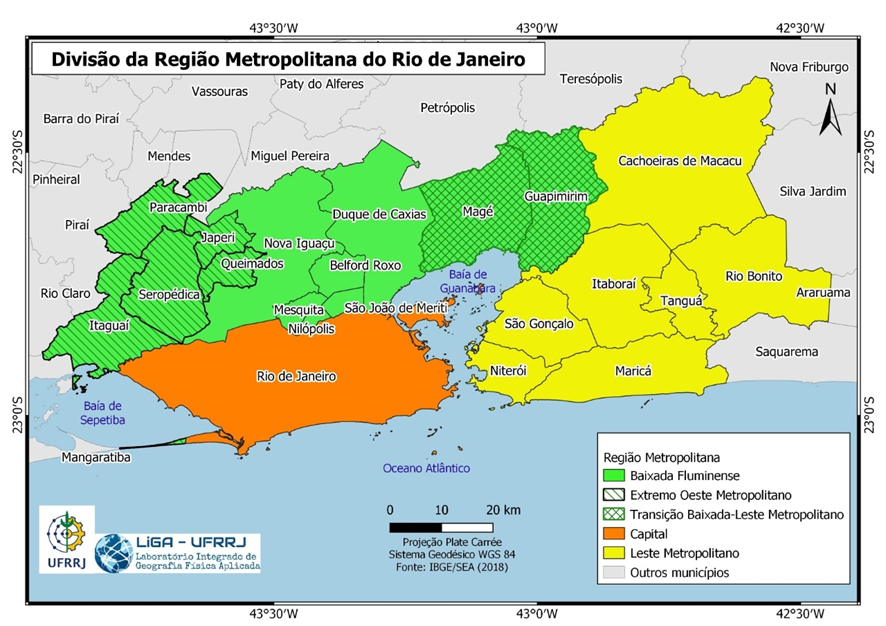
Source: Fortes et al., (2020).
Despite the low agricultural activity participation in municipalities forming Baixada Fluminense, if one pays close attention to these municipalities’ agricultural production data, it is possible seeing that they are capable of supplying part of the University Cafeteria’s demand, even within a project aimed at broadening this scenario, under greater production capacity.
Only Belford Roxo, Mesquita, São João de Meriti and Nilópolis are among the 13 municipalities forming Baixada Fluminense that do not have agricultural production data recorded for that year. All other municipalities presented agricultural production of food types matching the demand by the University Cafeteria. They could somehow be potential suppliers, and it would feature the first opportunity detected by the project.
However, still about production capacity, although it can fulfil the cafeteria’s demand, the small number of family farmers and family farmers’ Associations/Cooperatives with active DAP could compromise project growth, and it was identified as project weakness.
Table 3
Family farming at Baixada Fluminense
|
Municipality |
Number of establishments |
Total Area (ha) |
Occupied personnel[5] |
|||
|
Belford Roxo |
15 |
49 |
16 |
|||
|
Duque de Caxias |
216 |
1,530 |
216 |
|||
|
Guapimirim |
126 |
788 |
126 |
|||
|
Itaguaí |
287 |
2,375 |
287 |
|||
|
Japeri |
258 |
1,165 |
258 |
|||
|
Magé |
583 |
1,702 |
583 |
|||
|
Mesquita |
50 |
128 |
50 |
|||
|
Nilópolis |
0 |
0 |
0 |
|||
|
Nova Iguaçu |
466 |
2,045 |
466 |
|||
|
Paracambi |
207 |
1,801 |
207 |
|||
|
Queimados |
128 |
632 |
128 |
|||
|
São João de Meriti |
0 |
0 |
0 |
|||
|
Seropédica |
273 |
2317 |
273 |
|||
|
Total |
2,609 |
5,478 |
2,609 |
|||
|
Municipality |
Number of establishments |
Total area (ha) |
Occupied personnel [6] |
|||
|
Belford Roxo |
15 |
49 |
16 |
|||
|
Duque de Caxias |
216 |
1,530 |
216 |
|||
|
Guapimirim |
126 |
788 |
126 |
|||
|
Itaguaí |
287 |
2,375 |
287 |
|||
|
Japeri |
258 |
1,165 |
258 |
|||
|
Magé |
583 |
1,702 |
583 |
|||
|
Mesquita |
50 |
128 |
50 |
|||
|
Nilópolis |
0 |
0 |
0 |
|||
|
Nova Iguaçu |
466 |
2,045 |
466 |
|||
|
Paracambi |
207 |
1,801 |
207 |
|||
|
Queimados |
128 |
632 |
128 |
|||
|
São João de Meriti |
0 |
0 |
0 |
|||
|
Seropédica |
273 |
2317 |
273 |
|||
|
Total |
2,609 |
5,478 |
2,609 |
|||
|
|
|
|
|
|
|
|
Source: Agricultural Census, 2017.
Based on the report on EMATER-RJ’s activities in 2019, one can observe that this bureau was the main agent issuing documents in the State. Between 2016 and 2019, as shown in Figure 3, there was significant increase in the number of issued DAPs, there were 18,112 issued active DAP in 2019, and the Serrana (27%), Northwestern and Southern regions were the ones mostly contributing to such an increase in the state numbers.
Even if one has in mind the DAP-issuing increase context in the state, if one observes Baixada Fluminense’s municipalities, it is possible seeing a worrisome scenario. Most municipalities in the region account for a larger number of Inactive Physical and Legal DAPs, and it makes these Farmers/Associations/Cooperatives unable to access FAP. According to data provided by the Special Secretariat of Family Farming and Agricultural Development (SEAP) from April, 2021, if one gathers the 13-municipality forming the region, the total number of Active Physical DAPs reached 513, against 617 Inactive ones.
Figure 3
Number of DAPs issued by EMATER-RJ from 2016 to 2019
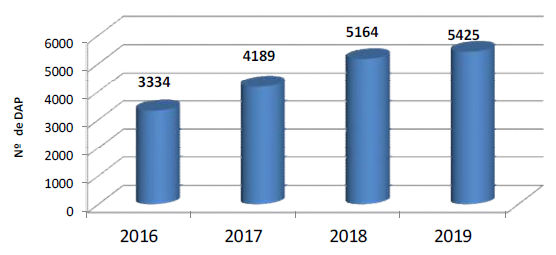
Source: Report on EMATER-RJ’s activities in 2019.
If one thinks of the total of family farmers in the region, the number of active DAPs corresponds 9.36% of this total, and this number is much smaller than the expected. Only 3 cooperatives in the 13 municipalities have active legal DAP: The family Farmers Cooperative (COOPAMESQ) of Mesquita County, which has 23 members: 20 of them have active DAP; the Mixed Association of Family Farming Rural Producers of Nova Iguaçú County, which also has members from other municipalities (Carapebus, Itaguaí, Japeri, Paty de Alferes and Tanguá), counts on 45 members and 42 of them have active DAP; and Cooperative of Family Farmers of Rio Pardo, at Paracambu County, which involves farmers from Paty de Alferes and Seropédica counties, and counts on 53 members – all of them have active DAP.
Thus, we understand threat as external element capable of having negative impact on the project, from the perspective of broadening FAP-CI in Nova Iguaçú. The prevailing number of family farmers and associations/cooperatives with inactive DAP are a threat to the project in case it is not successful in creating strategies to attract and regulate family farmers, to provide technical support and rural extension (ATER), and to encourage cooperatives and associations in the region. Assumingly, the project faced a hard time reaching family farmers in the region, mainly those under vulnerability conditions
Another threat detected during project conduction lied on high unpredictability and unfeasibility, which led to paralysis; Covid-19 pandemic (Sars-CoV-2) is a good example of it. The contract would be active for one year, until July 2020. Up to this date, FAP at Nova Iguaçú Campus had made 8 deliveries (Figure 4), and it corresponded to 26.18% of the hired value (R$ 6,461.74). It corresponded to 2,579.8 KG of food, as shown in Table 4. However, activities in the University Cafeteria[7] were canceled from March 2020, onwards, due to the pandemic, and it caused food-types’ delivery to be canceled, including the delivery of food acquired through FAP-CI.
Figure 4
Supplier 2’s deliveries to RU
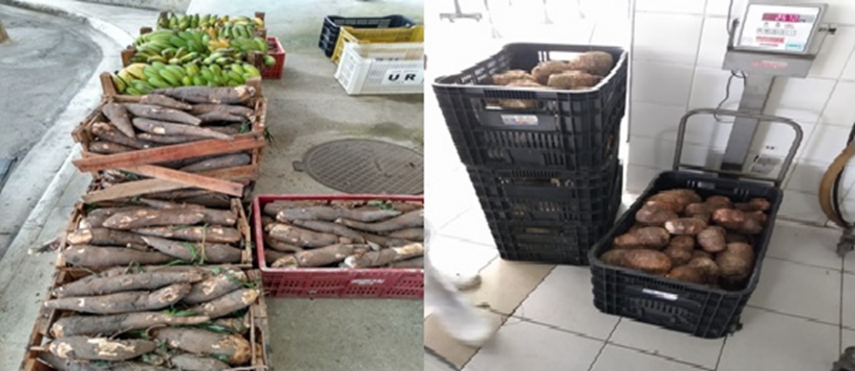
Source: the authors’ inventory.
Table 4
Public Call 01/2019 conduction
|
Item |
Demanded amount (kg) |
Delivered Amount (kg) |
Participation (%) |
Value (R$) |
|
Cassava |
2,400 |
979 |
40.79 |
1.478.26 |
|
Cooled banana |
5,760 |
1,101.6 |
19.12% |
3.044.18 |
|
Yam |
1,692 |
499.20 |
29.54% |
1.939.30 |
|
Total |
9,852 |
2,579.8 |
26.18% |
6.461.74 |
Source: Calculation Memory Call 01/2019; from 08/2019 to 03/2020.
Yet, another opportunity that has crossed the FAP-CI project at Nova Iguaçú campus regarded setting an articulation network between Rio de Janeiro State’s Education Institutions and other IFES to exchange knowledge and experiences about FAP-CI conduction. It was done to encourage other institutions to adhere to FAP. Events like the ‘I Brazilian Summit of University Cafeterias (I EBRU)’ and the ‘I Symposium on the Acquisition Program in Public Higher Education Institutions’ were attended by servants in charge of FAP-CI at Nova Iguaçú Campus. They allowed the participation of professors, managerial technicians and University Cafeteria workers to discuss and reflect about FAP’s main difficulties, barriers and benefits in their institutions, as well as about the production of academic research and workshops on this topic. Thus, establishing this network to gather other IFES was another opportunity of the herein addressed project.
6 Final Considerations
From the pilot experience perspective, Public Call 01/2019 aimed at supplying the University Cafeteria at Nova Iguaçú Campus (UFRRJ). It led to positive outcomes from the Institutional viewpoint and showed potential to encourage family farming in Baixada Fluminense, where the campus is located in. This territory is historically marked by social inequalities, lack of specific public policies, and economic and social disparities.
The SWOT matrix was adopted to investigate the projects’ strengths and weaknesses, as well as threats and opportunities. The following elements were identified as strength: inter-sectoral profile as project mark; engagement and collection of knowledge and competences held by the involved actors. Another strong project element resulted from its dialogical philosophy: connecting Teaching, Research and Extension. FAP-CI is a stem of the extension program named “Reinforcing Family Farming at Baixada Fluminense and Central-Southern Rio de Janeiro State”, which was supported by the University’s Program of Agricultural Resistance. This program led to the academic elaboration of scientific research and studies on the FAP and family farming topics.
When it comes to project’s weaknesses, the present investigation showed lack of process mapping added with CJ’s inexperience with the dynamics to hire suppliers through FAP. These gaps led to procedural mistakes and to delay in public-call conduction. The proper mapping of project processes turned into flowcharts would help reflections, ruling out waste, speeding up decision-making and on making it reliable. This scenario would have made the project faster, at all its levels. The second weakness lied on the lowest price criterion stressed in the proposal of the pilot-call’s winner. This pricing methodology ends up going in the opposite direction to the herein addressed public policy, because it generates competition among family farmers to the detriment of the cooperation highlighted in FAP.
Although with low agricultural activity expression in comparison to GDP at Baixada Fluminense, data disclosed by EMATER-RJ (Empresa de Assistência Técnica e Extensão Rural, 2020) showed that municipalities in this region would be able to catch-up with the demand for University Cafeteria food types, and this is a project opportunity. It would turn them into potential suppliers. Thus, UFRRJ Nova Iguaçú, as likely large buyer in the region, would have the potential to create trading channels connected straight to rural producers. This process would generate income and help rural FAP-CI Nova Iguaçú - UFRRJ setting an articulation network between this institution and other IFES. This connection allowed knowledge sharing among institutions, and reflections and debates about FAP-CI’s main barriers, difficulties and benefits in their institutions.
As for the crossing threats, from the project-growth perspective, it was possible diagnosing that the low rate of family farmers at Baixada Fluminense granted with Physical DAP (9.36%) and the few associations/cooperatives with active legal DAP, can impair family farmers’ access to this public policy. It would happen in case there are no strategies to attract and regulate these family farmers, to provide technical assistance and rural extension (ATER), as well as to encourage cooperatives and associations’ creation. The Covid-19 pandemic was another threat, because the need of social distancing to fight the pandemic canceled classes in the campus and, consequently, the project, on March 2020, when only 26.18% of the delivery had been done. Therefore, lack of support to FAP by the former President of the Republic stopped IFES from issuing a new call, until 2022. However, the institution intends to issue a new call at late 2023 due to the new federal administration.
Finally, the satisfactory result recorded for the pilot-project is not related to the number of participants, or to the municipality they live in, but to the benefits coming from the strengths and weaknesses shown by the SWOT matrix, which have overcome their threats and opportunities.
UFRRJ was the first public university in Rio de Janeiro State to adhere to FAP in 2016, although it did not reach the 30% rate demanded by law. Unfortunately, it witnessed its early end because of the Covid-19 pandemic in 2019. From the project growth perspective, FAP-CI Nova Iguaçú Campus showed a promising future for purchase volume and number of farmers if one has in mind the potential benefits to both the university and family farming at Baixada Fluminense. Thanks to its resilience, these farmers survived in a much-urbanized territory. By mid-2023, the new Federal Administration recreated Bolsa Família and expanded it through law n. 14.601, besides issuing Decree n. 11.476/2023 to regulate the last FAP update (BRASIL, 2023).
Studies on food acquisition programs are essential, because this is an on-going topic that demands deeper understanding about the scope of research on it, besides taking into consideration the local reality in each university. Recent studies published in 2021 and carried out in Brazilian public universities concluded that more efficient public policies must support FAP and they need to better understand the reality of each university. A study from 2021 showed that FAP implementation at Federal University of Pará faced challenges. Another study from 2022 carried out in 51 universities in Southern Brazil mapped FAP implementation in them and evidenced that 47% of these institutions only acquired food coming from family farming programs.
The present study also showed that FAP-related public policies need more effective investments to boost the program in public universities. Finally, the present research is expected to contribute to new studies in this field.
References
Arjona, S. & Pereira Souza, N. de (2003). A Universidade Federal Rural do Rio de Janeiro e o significado social da Política Pública de Expansão do Ensino Superior na Baixada Fluminense. IV Colóquio Internacional Educação, Cidadania e Exclusão: Didática e Avaliação, Goiânia.
Abarghani, M., Shobeiri, S., & Meiboudi, H. (2013). Implementation of a rural cooperative management for sustainable development for the first time in Iran. Advances in Environmental Biology, 7(7), 1937–1941.
Alotaibi, B., & Kassem, H. (2022). Analysis of partnerships between agricultural cooperatives and development actors: A national survey in Saudi Arabia. PLoS One, 17(6), 1–23.
Andifes. (2019). Relatório Pesquisa socioeconômica dos estudantes das universidades públicas brasileiras. Recuperado de: [https://www.andifes.org.br/wp-content/uploads/2019/05/V-Pesquisa-Nacional-de-Perfil-Socioeconomico-e-Cultural-dos-as-Graduandos-as-das-IFES-2018.pdf] acesso em: 04 de fevereiro de 2024.
Assis, S. (2016). Implementação do Programa de Aquisição de Alimentos, modalidade compra institucional, na Universidade Federal de Viçosa, Minas Gerais e situação de (in) segurança alimentar e nutricional dos agricultores familiares beneficiários fornecedores (Dissertação de Mestrado). Universidade Federal de Viçosa, Viçosa, MG.
Bardin, L. (2015). Análise de Conteúdo (70.ed.). Lisboa: Edições 70.
Barroso, L. (2019). As compras institucionais da Universidade Federal do Rio Grande do Sul: Dietas sustentáveis em restaurantes universitários (Dissertação de Mestrado). Universidade Federal do Rio Grande do Sul, RS.
Bilheiro, L. (2020). Experiências da venda direta da agricultura familiar na Universidade Federal Rural do Rio de Janeiro, campus Seropédica (RJ) e suas contribuições para a segurança alimentar e nutricional (Dissertação de Mestrado). Universidade Federal Rural do Rio de Janeiro, RJ.
Candemir, A., Duvaleix, S., & Latruffe, L. (2021). Agricultural cooperatives and agricultural sustainability – A literature review. Journal of Economic Research, 35(4), 1118–1144.
Campos, C. (2004). Método de análise de conteúdo: ferramenta para a análise de dados qualitativos no campo da saúde. Revista Brasileira de Enfermagem, 57(5), 611–615.
Censo Agropecuário. (2017). Resultados Definitivos Produtores. IBGE. Recuperado de: https://censoagro2017.ibge.gov.br/templates/censo_agro/resultadosagro/produtores.html
Censo IBGE. (2010). Panorama Nova Iguaçu (p. 14). IBGE. Recuperado de: https://cidades.ibge.gov.br/brasil/rj/nova-iguacu/panorama.
Decreto no 7.775, de 4 de julho de 2012. Institui o Programa de Aquisição de Alimentos. Diário Oficial da República Federativa do Brasil de 05/07/2012, p. 3, (2012). Recuperado de: http://www.planalto.gov.br/ccivil_03/_ato2011-2014/2012/decreto/d7775.htm.
Decreto no 8.473, de 22 de junho de 2015. Estabelece, no âmbito da Administração Pública Federal, o percentual mínimo destinado à aquisição de alimentos de agricultores familiares e suas organizações. Diário Oficial da República Federativa do Brasil de 23/06/2015, p. 9, (2015). Recuperado de: http://www.planalto.gov.br/ccivil_03/_ato2015-2018/2015/decreto/D8473.htm.
Duncan, M. (2010). A Construção de uma Política de Desenvolvimento: os territórios rurais no Brasil. Revista Habitus - Revista Do Instituto Goiano De Pré-História e Antropologia, 8(1), 187–223.
Empresa de Assistência Técnica e Extensão Rural. (2020). Relatório de Atividades 2019. Recuperado de: https://emater.rj.gov.br/Relatorio_de_Atividades_2019_20_08_2020.pdf.
Felício, J., & Cristofoli, F. (2004). O ressurgimento do movimento cooperativista de trabalho no Brasil. Revista Brasileira de Gestão de Negócios, 6(15), 42–48. https://doi.org/10.32888/cge.v2i1.12646
Fortes, A., Oliveira, L. de, & Sousa, G. de. (2020). A COVID-19 na Baixada Fluminense: Colapso e apreensão a partir da periferia metropolitana do Rio de Janeiro. Espaço e Economia, 18, 1–19. https://doi.org/10.4000/espacoeconomia.13591.
Giombelli, G. (2018). Transição sustentável das compras públicas de alimentos: O caso dos restaurantes das universidades federais no estado do Paraná (Dissertação de Mestrado). Universidade Federal da Fronteira Sul.
Grisa, C. (2010). As políticas públicas para a agricultura familiar no Brasil: Um ensaio a partir da abordagem cognitiva. Desenvolvimento em Debate, 1(2), 83–109.
Instituto Brasileiro de Geografia e Estatística (2017). Censo Agropecuário 2017. Brasil.
Kanaane, R. (2010). Gestão pública: planejamento, processos, sistemas de informação e pessoas. São Paulo; Atlas; 2010. XXI, 241 p. | ENSP | FIOCRUZ. Recuperado de: https://pesquisa.bvsalud.org/portal/resource/pt/ens-34894.
Lei no. 4.092, de 28 de junho de 2011. (2011). Institui o Plano Diretor Participativo da cidade de Nova Iguaçu, Atos Oficiais da Prefeitura Municipal de Nova Iguaçu, RJ, p. 1-30. Recuperado de: https://comiteguandu.org.br/conteudo/plano-nova-iguacu.pdf.
Lei nº 10.696, de 2 de julho de 2003. (2003). Dispõe sobre a repactuação e o alongamento de dívidas oriundas de operações de crédito rural. Diário Oficial da República Federativa do Brasil de 03/07/2003, p. 1. Recuperado de: https://legislacao.presidencia.gov.br/atos/?tipo=LEI&numero=10696&ano=2003&ato=3c8Azaq10dRpWT379.
Lei no 11.326, de 24 de julho de 2006. (2006) Estabelece as diretrizes para a formulação da Política Nacional da Agricultura Familiar e Empreendimentos Familiares Rurais. Diário Oficial da República Federativa do Brasil de 25/07/2006, p. 1. Recuperado de: https://www.planalto.gov.br/ccivil_03/_ato2004-2006/2006/lei/l11326.htm.
Lei no 12.512, de outubro de 2011. (2011). Institui o Programa de Apoio à Conservação Ambiental e o Programa de Fomento às Atividades Produtivas Rurais. Diário Oficial da República Federativa do Brasil de 17/10/2011, p. 1. Recuperado de: https://www.planalto.gov.br/ccivil_03/_ato2011-2014/2011/lei/l12512.htm.
Lei no 11.476, de 6 de abril de 2023. (2023). Institui o Programa de Aquisição de Alimentos. Recuperado de: https://www.planalto.gov.br/ccivil_03/_ato2023-2026/2023/decreto/D11476.htm
Lei n 14.601, 19 de junho de 2023. (2023). Institui a lei do Bolsa Família no âmbito de apoio a assistência social e combate à fome. Recuperado de: https://www.planalto.gov.br/ccivil_03/_Ato2023-2026/2023/Lei/L14601.htm
Lopes, L. (2021). Programa de Aquisição de Alimentos: uma análise do processo de Compra Institucional na Universidade Federal do Pará (Dissertação de Mestrado). Universidade Federal de Ouro Preto, Ouro Preto, MG.
Maia, P., & Rodrigues, A. (2009). A cidade (re) partida: um breve estudo sobre as emancipações da cidade de Nova Iguaçu e a formação da região da Baixada Fluminense. In I Congresso de Desenvolvimento Regional de Cabo Verde Maluf, R. S., Menezes, F., & Marques, S. B. (2000). Caderno segurança alimentar. Paris: Fhp, 5.
Marcis, J., Bortoluzzi, S., Lima, E, Costa, S. (2019). Assessment of sustainability performance of agricultural cooperative operations: a systematic literature review. Environmental Development and Sustainability, 21, 1111–1126.
Nascimento, S. D. (2010). Reflexões sobre a intersetorialidade entre as políticas públicas. Serviço Social & Sociedade, 95–120.
Oliveira, L. D. M. (2018). Avaliação do processo de implantação do programa de aquisição de alimentos na modalidade compra institucional na Universidade Federal do Rio Grande do Norte (Dissertação de Mestrado). Universidade Federal do Rio Grande do Norte, RN.
ONU. (2023). Relatório Pesquisa O panorama regional da América Latina de segurança alimentar. Recuperado de https://www.fao.org/documents/card/es/c/cc8514es.
Paula, N. (2016). Colhendo os frutos: Dificuldades e conquistas da modalidade do PAA compra-institucional em uma universidade pública (Dissertação de Mestrado). Universidade Federal do Paraná, PR.
Perin, G.; Cordeiro S. de Almeida; Spínola, P. (2021). A evolução do Programa de Aquisição de Alimentos (PAA): Uma análise da sua trajetória de implementação, benefícios e desafios, Texto para Discussão, No. 2691, Instituto de Pesquisa Econômica Aplicada, Brasília.
Pinto, I., Borges, M., & Freitas, E. (2020). PAA-CI na Rural: A implementação do Programa de Aquisição de Alimentos na UFRRJ? [Comunicação oral]. Campus Nova Iguaçu, RJ, Brasil.
Portilho, E., Santos, L., Bilheiro, L., Oliveira, S., Majerowicz, N., & Dias, A. (2009). Fortalecimento da agricultura familiar na Baixada Fluminense-RJ (Brasil): identidade camponesa e inclusão social. Porto, Faculdade Letras da Universidade Porto, 335-370.
Procuradoria Federal/UFRRJ. (2018). Parecer no 000164/2018/NCON/PFUFRRJ/PGF/AGU.
Resolução nº 50, de 26 de setembro de 2012. Dispõe sobre a sistemática de funcionamento da modalidade de execução Compra Institucional, no âmbito do Programa de Aquisição de Alimentos da Agricultura Familiar - PAA. Ministério do Desenvolvimento Social e Combate à Fome, 1-3, (2012). Recuperado de: https://www.mds.gov.br/webarquivos/arquivo/seguranca_alimentar/compra_institucional/RESOLUCAO_N50_26SETEMBRO2012.pdf.
Salgado, R. (2020). Análise expandida da atuação dos burocratas de nível de rua na implementação do Programa de Aquisição de Alimentos em universidades federais (Tese de Doutorado). Universidade Federal do Rio Grande do Norte, RN.
Salgado, R., Souza, W., & Ferreira, M. (2022). Compra institucional de produtos da agricultura familiar: avaliando a execução do Programa de Aquisição de Alimentos pelas universidades federais. Revista de Economia e Sociologia Rural, 60.
Santos, L. dos. (2018). Residência agronômica com enfoque agroecológico: O caso dos canais de venda direta na Universidade Federal Rural do Rio de Janeiro (Dissertação de Mestrado). Universidade Federal Rural do Rio de Janeiro, RJ.
Schneider, S. (2010). Situando o desenvolvimento rural no Brasil: O contexto e as questões em debate. Brazilian Journal of Political Economy, 30 (3) 511-531.
Schneider, S. & Cassol, A. (2014). Diversidade e heterogeneidade da agricultura familiar no Brasil e algumas implicações para políticas públicas. Cadernos de Ciência & Tecnologia, 31(2), 227–263.
Silva, S. (2014). A trajetória histórica da segurança alimentar e nutricional na agenda política nacional: Projetos, descontinuidades e consolidação. Texto para Discussão (TD). Recuperado de: https://repositorio.ipea.gov.br/handle/11058/3019.
Silva, P., Oliveira Junior, R., & Borges, M. S. (2020). Cenários de desigualdades territoriais no Brasil: um estudo sobre a Baixada Fluminense (RJ). Brazilian Journal of Development. 6(9), 72767-72779
Silva, R. & Nunes, E. (2023). Agricultura familiar e cooperativismo no Brasil: uma caracterização a partir do Censo Agropecuário de 2017. Revista de Economia e Sociologia Rural, 61(2), e252661.
Thompson, A. (2002). Planejamento Estratégico: elaboração, implementação e execução. Pioneira Learning.
Triches, R., Ruiz, E., Kirsten, V., & Teo, C. (2022). Compra de produtos da agricultura familiar pelos restaurantes das universidades federais no Sul do Brasil, Revista Nera (62).
Universidade Federal Rural do Rio de Janeiro. (2012) Catálogo Institucional, 2012. 32p. Recuperado de: http://institucional.ufrrj.br/ccs/files/2021/07/livreto_ufrrj_final.pdf.
Universidade Federal Rural do Rio de Janeiro. (2016a). Chamada Pública no 001/2016-GProR/PROAF. Recuperado de: https://portal.ufrrj.br/wp-content/uploads/2016/06/Minuta_do_Edital_de_chamada_pública_para_aquiçcao_de_alimentos_do_PAA.pdf
Universidade Federal Rural do Rio de Janeiro. (2016b). Plano de desenvolvimento institucional 2006-2011. Universidade Federal Rural do Rio de Janeiro. Recuperado de: https://institucional.ufrrj.br/pdi/files/2016/12/PDI-UFRRJ-2006-2011.pdf
Universidade Federal Rural do Rio de Janeiro. (2019). Programa de Fortalecimento da Agricultura Familiar UFRRJ. Recuperado de: https://institucional.ufrrj.br/agroecologia/paa/campus-nova-iguacu/.
Universidade Federal Rural do Rio de Janeiro. Plano de Desenvolvimento Institucional da UFRRJ (2023-2027). 338p. Recuperado de: https://institucional.ufrrj.br/pdi/files/2023/07/PDI-2023-2027.pdf.
World Health Organization. (2019). The state of food security and nutrition in the world 2019: Safeguarding against economic slowdowns and downturns Food & Agriculture. 2019.
Yin, R. (2010). Estudo de Caso. Planejamento e Métodos(4. ed). Bookman.
Zeng, L., Wan, J., & He, Q. (2023). Commitment of members in farmers' cooperatives in China: The role of contractual and relational governance mechanisms. PLoS ONE, 18(7), e0288925.
-----
i Servidor administrador no Instituto Multidisciplinar da UFRRJ. Mestre em Desenvolvimento Territorial e Políticas Públicas - PPGDT / UFRRJ. Universidade Federal Rural do Rio de Janeiro. Nova Iguaçu/RJ. Brasil.
ii Professor associado no Departamento de Administração e Turismo e professor permanente do Programa de P´ós-Graduação em Desenvolvimento Territorial e Políticas Públicas - PPGDT/UFRRJ. Universidade Federal Rural do Rio de Janeiro. Nova Iguaçu/RJ. Brasil.
iii Aluna bolsista Pibic 2022-2023 do Curso de Administração. Universidade Federal Rural do Rio de Janeiro. Nova Iguaçu/RJ. Brasil.
iv Aluno bolsista Pibic 2022/2023 do Curso de Administração. Universidade Federal Rural do Rio de Janeiro. Nova Iguaçu - Brasil.
[1] Changed by Decree n. 8.026/2013 and GGPAA Resolutions n. 50, 56, 64 and 73.
[2] Modality implemented by Decree n. 8.293, from August 12, 2014.
[3] It is important pointing out that the modality aimed at encouraging milk intake was also called FAP-Milk, which was implemented by states in Northeastern Brazil and by Minas Gerais State.
[4] DMSA is UFRRJ’s bureau accountable for purchasing, construction sites and services; it is in charge of following the legislation in place.
[5] The working manpower is the total of rural workers, with or without family bonds to farmers, who act in family farming establishments.
[6] The working manpower is the total of rural workers, with or without family bonds to farmers, who act in family farming establishments.
[7] After classes in the campus were active again, UFRRJ (Nova Iguaçú Campus) issued a new public call by late 2022 to supply food for the semester of 2023.