Artigo Original, Artigo Tecnológico Artigo de Revisão
Accepted: 21/06/2024
Banking rates
in Brazil: comparative analysis
of the largest financial
institutions
Tarifas bancárias no Brasil: análise comparativa das maiores instituições financeiras
Wladimir Cruz Macedo Jr.1*i, ORCID:
https://orcid.org/0000-0002-0890-1773; Sergio
Feliciano Crispim2ii, ORCID: https://orcid.org/0000-0002-4060-8315; Agnaldo Antonio
dos Santosiii
3, ORCID:
https://orcid.org/0000-0003-3205-9237.
1.
Universidade Municipal de São Caetano do Sul (USCS). Programa
de Pós-Graduação em Administração, São Caetano do Sul, SP, Brasil). E-mail: wlajunior@bol.com.br
2. Universidade Municipal de São Caetano do Sul (USCS).
Programa de Pós-Graduação em Administração, São Caetano do Sul, SP, Brasil). E-mail: scrispim@uol.com.br
3.
Professor Adjunto
do curso de Administração do campus Naviraí da Universidade Federal
de Mato Grosso do Sul (UFMS) –
Campus de Naviraí, Naviraí, MS, Brasil). E-mail: agnaldo.antonio@ufms.br
*Autor correspondente: wlajunior@bol.com.br
Abstract
The Real Plan consolidated a scenario of lower
interest rates in Brazil, implying a review of business models in the
financial sector, which underwent an intense
process of concentration. In this context,
the aim of the research
was to identify and analyze the differences between the fees for services related to individual current accounts
charged by the largest Brazilian banks in 2019 through documentary research,
focusing on secondary data, complemented by exploratory research with bank
managers. It was observed that there has been a notable evolution in the
profits of banks in Brazil, which has been driven by revenues from fees for
providing services, and that the differences in fees between banks are
relatively small, considering the large scope of services and the fact that the
sector is characterized by competitive practices. Tariffs are an important part of Brazilian
household spending, but they are not widely perceived and are difficult to
compare.
Keywords: Bank fees, Business
model, Revenue Model,
Banks Revenue.
Resumo
O Plano Real consolidou um cenário de juros mais
baixos no Brasil, implicando em revisão dos
modelos de negócio
no setor financeiro, que passou por intenso processo
de concentração. Nesse contexto
o objetivo da pesquisa foi identificar e analisar as diferenças entre
as tarifas de serviços relacionados às contas
correntes de pessoa física cobradas pelos maiores bancos brasileiros em 2019
por meio de pesquisa documental, com foco em dados secundários, complementada
por pesquisa exploratória com gerentes dos bancos. Observou-se notória evolução
dos lucros dos bancos no Brasil, que foi impulsionada pelas receitas com tarifas por prestação de serviços, e que as diferenças de tarifas entre
os bancos são relativamente pequenas, considerando-se o grande escopo de
serviços e o fato de o setor
caracterizar-se por práticas concorrenciais. As tarifas são relevantes nos
gastos das famílias brasileiras, mas não são muito percebidas e de difícil
comparação.
Palavras-chave: Tarifas Bancárias, Modelo de
Negócios, Modelo de Receitas, Receita dos Bancos.
Reference: Macedo Jr, W. C., Crispim,
S. F., & Santos,
A. A. (2025). Banking rates in Brazil:
comparative analysis of the largest financial institutions Gestão
& Regionalidade, v. 41, e20259285. https//doi.org/10.13037/gr.vol41.e20259285
1
Introduction
The
financial system plays an extremely important role in the modern economy,
concentrating the resources of savers and channeling them to investors,
allowing resources to flow through the economy. Assaf Neto (2009) analyzes the
Brazilian reality and, according to him, the banking system has undergone
several structural changes in recent times, due to the major economic
transformations that have taken place in the country. Among the changes are the
process of currency stabilization and the opening of the market, which began
the internationalization of banks. In addition, Ferreira Alves and Galegale
(2020) highlight the impact of information technology since the 1990s and
review the Technology Acceptance Model's explanations of the adoption of new
technologies, which helps to understand the expansion of new business models in
the financial sector (2020). In this sense, Le and Ngo (2020) investigated the
determinants of bank profitability in 23 countries from 2002 to 2016 and
identified that the delivery of services through new technologies increases
profitability, justifying their increasing incorporation into financial
business models.
Denardin (2007) states that the importance of banks is not restricted
to promoting financial intermediation, since they play a special role in the
Brazilian economy. By making loans, they establish an additional channel
through which monetary policy can be operationalized, helping to explain the performance of productive activity.
Benston and Smith (1976) propose a reflection based
on traditional macroeconomic analysis, which sees financial intermediaries as passive
conduits through which monetary policy is carried out.
In Brazil, there are recurring questions about the high and growing
profits of financial institutions, noting that between
2009 and 2019, bank profits
grew 162% in nominal terms and
92% in real terms, while real GDP
grew 24%. One of the main justifications is that this return is made possible
by high interest rates and disproportionate bank fees (Dantas, Medeiros, &
Paulo, 2011). In parallel with the results presented above, the technological
changes that took place during this period impacted on the cost structure,
which is passed on to consumers. Financial commodities and the way they are
packaged also change over time, as does the business model of the institutions
that produce and sell them.
Paula and Marques (2006)
state that in the early 2000s the net interest
margin was under increasing competitive pressure,
which ended up generating a decline in earnings flows in relation to costs, leading
banks to seek to increase
their non-financial income,
in particular fees and
commissions. Camargo (2009)
adds that the increase in service revenues
contributed to the continued high profits obtained by
banks after the end of the significant gains from inflation revenues in the
period prior to the Real Plan.
According to Gil and Mejía (2018),
financial inclusion plays an important role in terms of
economic growth and poverty reduction
due to inequality and is therefore an essential aspect of public policies in many
governments. In an inflationary process, the short term is the dominant
characteristic in financial decisions, leading individuals to seek mechanisms
to defend their purchasing power and assets (Savoia, Saito, & Santana,
2007). In this sense, the results indicate that financial inclusion has a positive
impact and a significant relationship with the value of GDP per capita, so that the higher the level of income that families have,
the greater their
participation in the financial system
and, consequently, the greater the degree of financial
inclusion (Gil &
Mejía, 2018). Technological, regulatory and economic
changes have increased the complexity of financial
services, on the one hand, but on the other, the population's lack of knowledge on the subject compromises the day-to-day
financial decisions of individuals and families, producing less than desired
results (Savoia, Saito, & Santana, 2007).
Banking fees in Brazil: comparative analysis of the largest
financial institutions
During so many changes, both macroeconomic and in the sector itself, a
new way for banks to generate revenue, or a new revenue model, was necessary. From 1994 onwards, with the implementation of the Real Plan, inflation
fell significantly, and at the same time nominal interest rates fell, with a drastic
impact on some of the financial institutions' sources of income, which had to be offset by other
sources, mainly fees for services. "Maintaining profit margins was also
made possible by the increase in revenue from banking services [...] some
medium-sized retail banks managed to increase the share of their gross revenue
from fees from 10% to 35%" (Camargo, 2009, p. 39).
Given
the exponential growth of this source of income, accompanied by the evolution
in the number of Brazilians with accounts at financial institutions, service
packages were created. In other
words, the user contracts several
services for a fixed price, so that he must pay
the tariff even if he hasn't used the services, and if he exceeds the
operations to which he is entitled, he will incur additional costs.
As a result of changes in the way banks can serve society,
and in parallel with the various
economic and social transformations that have taken place over time, companies
operating in the financial sector have made significant changes to their
Business Models. According to Osterwalder and
Pigneur (2010), a Business
Model describes the logic of how an organization creates, delivers and
captures value. It is divided into nine components, one of which is the Revenue
Sources or Model, and in this sense this research will focus on the revenue
model of Brazilian banks and on fees for current account services.
According to a survey carried out by Ibope Inteligência with 2,009
people across the country, 51% of them can't say exactly
how much they pay in fees for their bank accounts, even though Procon-SP advises banks to inform tariffs and fees in contracts and websites in a "clear, ostentatious and adequate" manner,
as provided for in the Consumer Code (Nascimento, 2019). Financial institutions generally
disclose the prices of tariffs and
their service packages only to meet the requirements of regulatory bodies,
in tables with dozens of services and tariffs in small
print, difficult to understand and visualize, on their websites
and at service points. This leads to confusion and doubts on the part of
customers, which were reflected, for example, in the complaints to banks
registered by Procon-SP (São Paulo State Consumer Protection and Defense
Program) in the first half of 2019. Of a total of 7,054 complaints, 2,762 were
about undue charges, in which the customer did not understand the reason for
the charge.
Given
this context, this study aims to identify and analyze the differences between
service fees related to individual current accounts charged by the four largest
publicly traded Brazilian banks in 2019. The banks analyzed were Itaú,
Bradesco, Santander and Banco do Brasil. As specific objectives, this research
sought to: a) identify the change in the banks' revenue model since the Real
Plan, based on service packages and current account tariffs; b) identify the
percentage share of revenue from current account services; and c) identify and
compare current account
tariffs for individuals in the Retail segment by categories, services
and packages.
The research is justified by the economic and social importance of the
Brazilian financial system, by the theoretical gap related to bank revenue
models associated with current
account fees, and by the strong evidence
that fee income
has become an increasingly significant part of banks' results, year
after year, based on prior consultation of the balance sheets of the companies
to be analyzed.
2 Theoretical Framework
The central theme
of this study is the bank fees and current
account service packages
of the four largest banks in Brazil, given their importance in the
banks' revenue and business models.
According to Osterwalder, Pigneur
and Tucci (2005),
many companies began to use the
term "Business Model" more frequently at the end of the 1990s due to
the great advances in Information Technology (IT) and the Internet, which
boosted the possibilities for creating business models. According to Joia and
Ferreira (2005), it was from this period onwards that this concept began to be used
with increasing frequency in
business management literature, as evidenced by bibliometric studies. One of
the blocks that make up business models is the revenue model, which in the case
of banks has tariffs as an important component, which is the subject of this research.
After
the creation of the Real Plan, the financial system was opened to foreign
capital, but, according to Freitas (1999), this did not necessarily translate
into an improvement in the quality of services
for the population. It could bring benefits
to institutional clients, in addition to the high-income segments, who are able to negotiate
rates and demand differentiated treatment, but most clients, who don't demand
sophisticated products, would remain in long queues and paying high rates.
As a result of the turbulent global
scenario experienced in the 1990s
and 2000s, and the
departure of some foreign banks, there was banking concentration in Brazil. In
addition, according to Troster (2004), the increase in the size of banks is
associated with the search for economies of scale (scale, scope and plant), or
a fall in the average cost derived from the increase in scale. This implies
that larger banks are more
profitable than smaller banks. Motta (2005) states that competition in this
industry in Brazil is intense, and some empirical studies carried out in the
country have not confirmed the hypothesis of an oligopolistic structure, although
the hypothesis of perfect competition is also ruled out, and the market can be
characterized as concentrated.
With the consolidation of the currency, the Real, and the monetary
policy instituted, the modernization process of banks
began, which is very much conditioned by the level of inflation. During the period of
hyperinflation, customers demanded agility in carrying out their transactions,
and after economic stabilization Brazilian banks began to seek cost reductions
through technology (Cavalcante, 2002).
Campbell and Frei (2010)
analyzed another important aspect of the relationship between banks and customers, which is the use of
the online channel. Banks are increasingly allocating resources to actively migrate
customers to the online banking
channel, based on the assumption that they will be able to benefit
in terms of costs, revenues
and retention. The authors
state that the main benefit
of the online banking channel is in attracting and retaining more profitable
customers, rather than increasing the profitability of customers who are already
served by other channels.
Accorsi (2014) states that consumers who are more familiar with new
technologies demand a fast and ubiquitous service and refuse to accept
complicated processes when they need a bank, emphasizing mobility and valuing
new technologies. Adding weight to this analysis, according to the FEBRABAN
Banking Technology Report (2018),
75% of banks are investing in blockchain technology, which promises major
changes in intermediation services.
In 2017, 35% of banking transactions took place via cell phone or tablet, while
internet transactions account for 57% of banking transactions in Brazil (Federação Brasileira de Bancos [FEBRABAN], 2018).
Banking fees in Brazil: comparative analysis of the largest
financial institutions
When looking at bank fees, one must consider that the banking industry
has undergone a major
restructuring since the 1980s.
Especially in developed countries, among other factors, we can highlight the decline in the net margins of financial intermediation of the largest banks and the increase in the importance of
non-interest income (Marques & Paula, 2006).
In
this sense, Mullineux and Murinde (2003) state that fees and commissions are an
example of a recurring revenue stream for banks diversifying their activities.
The growth of bank guarantee and off-balance sheet operations has further fueled
the potential of non-interest
income in generating profitability. In a complementary way, Stiglitz (2015)
argues that there is
an abuse of the financial sector's
market power, both as regards consumers making credit card transactions,
as the fees that credit and debit card companies charge merchants - usually 1
to 3% or more of the cost of the transaction - do not reflect the value of the services
provided, but rather a rent,
a monopoly of what is essentially a public good of networked payment infrastructure.
Stiroh
(2004), on the other hand, analyzed revenues in the American banking industry
between 1984 and 2001, and identified that there is evidence that
diversification can be beneficial for institutions based on more stable profits
and revenues. He adds that the American banking industry is steadily
reducing its exposure to traditional sources of income (such as income from loans)
and increasing non-traditional sources that generate income from services, fees and other types of income
not associated with credit.
On the other hand, Lima,
Matias. Quaglio and Sehn (2014), when comparing Brazilian
and US banks from 2002 to 2013, found that Brazilian banks
had higher profitability rates than US banks. This can be explained by the macroeconomic structure of each country in question,
i.e. in the United States low interest rates and large volumes operated
and, on the contrary, in Brazil high interest rates and low volumes operated.
When analyzing this in Brazil,
it can be said that the Real Plan had profound impacts
on the national banking
system, including the threat of a systemic
crisis caused by the collapse
of small and medium-sized institutions. As a result, the banking system
was forced to change its form of financing, replacing inflationary income with
income from financial intermediation, services
and tariffs, showing
itself to be agile and adapting quickly
to the new form of operation
(Corazza & Pesavento, 2000). As a result,
there was a natural concentration in the sector,
which according to Freitas and Köhler (2009) would imply the opportunity
for abuse of economic power and a consequent increase in spreads, but on the
other hand, if there were significant gains in scale, the cost could fall.
Corroborating what was said in the previous paragraph, Vian, Higa,
Santos, Negrão, Vasconcelos, Tingas, Quaresma and Salasar (2011)
consider that the factor that determines the growth of service revenues
is demand, given by the
increase in the customer base and banking transactions, which are growing year on year,
along with the exponential growth
not only of the
customer base, but also of the
use of banking services. It is also worth
noting that according to Arantes (2012), in crisis scenarios, banks seek greater
rationalization of cost components, as these are variables, they have more
control over. Revenue components, on the other hand, are the most affected in
these periods, as they depend on factors external to the banks.
On the subject of tariffs, Vian et al. (2011) state that the
establishment of their price is not limited to the remuneration of costs, as in other businesses. It also reflects
the demand for and supply of services, within the strategies and business models of each institution. Hence
not only the diversity of
tariffs that reproduces the diversity of services, but also the differences in prices charged by institutions. The remuneration of services
is what makes it possible for the
banking system in Brazil to be the sector
that invests the most in information technology, with repercussions for
society.
Corroborating the above, Rodamilans (2016) states that revenue
diversification acts positively in reducing the volatility of results, and that
between diversifying with a focus on services
and tariffs or insurance, it is preferable for banks to choose insurance, which generates the
cushion or protection expected for recurring results.
The financial sector is facing a radical transformation, taking
advantage of digital technologies to offer innovative services, the so-called
Fintechs are emerging in fields
such as asset management, loans or
insurance (Guedes & Mattos, 2019). However, in a study by
PwC called Fintech Deep Dive 2018,
out of 244 companies, 58% said they operated at a loss (Simões,
2018).
3
Methodology
According to the nature
of the data collection, this research was divided into two stages. The first is classified as documentary research
and the second as exploratory. We analyzed the four largest publicly traded banks
operating in Brazil, which for this reason have greater transparency of
information, and which will be referred to as A, B, C and D, to preserve their identities.
The work began with a documentary search for information on: a) Packages
of services for individuals,
published on the websites of the banks analyzed in this study; b) Tariffs for
services for individuals, published on the websites
of the banks analyzed in this study;
c) Tariffs for essential
services, published on the website of the Central Bank (BACEN); d) Balance
sheets of the banks analyzed in this study, published in the investor
relations area of the banks' websites; e) Regulations on tariffs
and service packages, published on the websites of the regulatory bodies and their adjacent bodies; f) News related to tariffs and packages of
banking services for individuals published in the media in general, seeking to
ensure the quality of the information by checking its origin.
Given the general objective of the research, which was to identify and
analyze the differences in fees for services
related to individual current accounts charged
by the four largest publicly
traded Brazilian banks in 2019, having the documents in hand, it was possible
to: a) Identify, from the analysis of the financial
institutions' balance sheets, added to secondary data from
regulatory bodies, what is the
percentage share of revenue from current account services in the banks'
results; b) Identify the change in the origin
of the banks' revenues and, based on the literature presented above, understand
the change in the revenue model; c) Compare the tariffs practiced by the financial institutions in a way classified by categories, types of services and retail packages.
In order to gain a better understanding of the pricing
strategy of the financial institutions analyzed in this study,
semi-structured interviews were conducted with five business unit managers from the Retail
and High Income segments based in São Paulo, from three of the four banks in the sample, As the interviews were complementary to the documentary research, four
questions were asked about the perception of managers in relation to the institutions' vision and
communication policies and incentives in relation to bank fees, and five
questions about the opinion and practices of managers in relation to the topic.
As this is a sensitive topic for organizations
and employees, the answers
were very objective, and the analysis
was organized by informant
within each topic in order to identify the main points of agreement and
disagreement. In this way, it was possible
to carry out an exploratory assessment of the opinions
of business unit managers in relation to the fees charged for services.
Banking fees in Brazil: comparative analysis of the largest
financial institutions
4 Analysis of Results
This
section presents the results of the research described above, with a view to
achieving the objective of identifying the change in the banks' revenue model
since the Real Plan in relation to service fees
The first information released, specifically related to income from
current account services, which are service packages
and individual tariffs
for each service
provided, dates from 2006 to 2009. In this sense, the
year to be considered as a basis for comparison is 2009.
Based
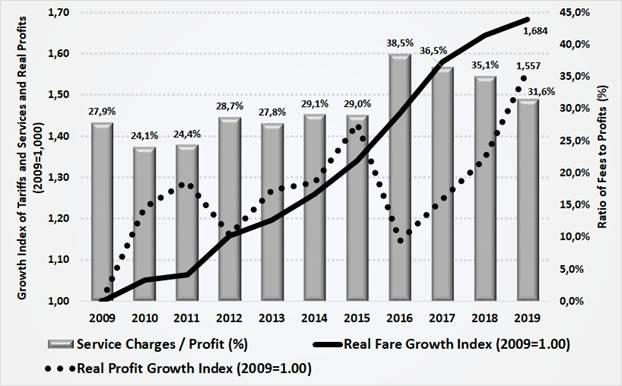
on Table 1 and Figure 1, income from current account fees has grown
continuously and consistently over time, resulting in a real variation, discounting the IPCA, of 68.4% over
the 10-year period from 2009 to 2019. In the same period, banks' real profit
grew by 55.7%, but with negative
fluctuations in some years, i.e. despite the significant real increase
in banks, service fees still grew by 8.1%.
Table 1
Evolution of Fee Income from
Current Account Services and Profits of the Four Largest Publicly Traded Banks
from 2009 to 2019
|
Year
|
Nominal Fare Growth Index (2009=1.00)
|
Nominal Profit Growth
Index
(2009=1.00)
|
IPCA (2009=1,00)
|
Real Fare Growth Index (2009=1.00)
|
Real Profit Growth Index (2009=1.00)
|
Real Growth
Rate of the Tariff/Profit Ratio
(2009=1.00)
|
Service Charges / Profit (%)
|
|
2009
|
1.000
|
1.000
|
1.000
|
1.000
|
1.000
|
1.000
|
27.9%
|
|
2010
|
1.114
|
1.291
|
1.059
|
1.052
|
1.228
|
0.857
|
24.1%
|
|
2011
|
1.200
|
1.373
|
1.128
|
1.064
|
1.291
|
0.824
|
24.4%
|
|
2012
|
1.382
|
1.345
|
1.194
|
1.158
|
1.162
|
0.997
|
28.7%
|
|
2013
|
1.514
|
1.521
|
1.264
|
1.197
|
1.270
|
0.943
|
27.8%
|
|
2014
|
1.693
|
1.623
|
1.345
|
1.259
|
1.289
|
0.977
|
29.1%
|
|
2015
|
1.995
|
1.917
|
1.489
|
1.340
|
1.430
|
0.937
|
29.0%
|
|
2016
|
2.302
|
1.667
|
1.582
|
1.455
|
1.145
|
1.271
|
38.5%
|
|
2017
|
2.574
|
1.969
|
1.629
|
1.580
|
1.246
|
1.268
|
36.5%
|
|
2018
|
2.778
|
2.211
|
1.689
|
1.645
|
1.344
|
1.223
|
35.1%
|
|
2019
|
2.967
|
2.623
|
1.762
|
1.684
|
1.557
|
1.081
|
31.6%
|
Source: Prepared
by the authors based on the banks'
websites and IBGE (2019).
Figure 1
Real Evolution of Current Account Fees and Net Income of the Four Largest
Banks
Source: Prepared by the authors based
on the banks' annual reports
and the IBGE.
It
is important to note, as shown in figure 1, that in the first three years of
the series, income from current account
fees represented 25.5% of the banks' profits, and in the last three years of the series, it
represented 34.4%, which can be considered a very significant share, especially considering that before the Real Plan it was of little significance. During
this period, banks A, B and C
extracted an average of 29.6% of total net profit, while in bank A, service
fees accounted for 59% of profit, as shown in table 2. According to Osterwalder
(2004), the revenue structure of the business model describes how the company
makes money through a variety of revenue streams, and the information presented
shows that there has been a change in the revenue structure
of the four financial institutions analyzed, with revenues derived from services gaining share in relation to traditional financial
revenues.
Table 2
Evolution of the Share of Current
Account Fees in Banks' Net Income from the 2009-11 Triennium to the 2017-19 Triennium
|
Four Largest
Banks
|
Current Account Fees / Net Profit
|
Change in Participation
|
|
2009-2011
|
2017-2019
|
%
|
pp
|
|
A
|
34.3%
|
54.5%
|
59%
|
20.2
|
|
B
|
19.0%
|
28.6%
|
51%
|
9.6
|
|
C
|
25.6%
|
32,7%
|
28%
|
7.1
|
|
D
|
21.8%
|
27.6%
|
27%
|
5.8
|
|
Total
|
25.5%
|
34.4%
|
35%
|
8.9
|
Source: Prepared by the authors based on the banks' websites.
Banking fees in Brazil: comparative analysis of the largest
financial institutions
According to Resolution No. 3,919 of November 25, 2010, financial
institutions should provide
the essential services package free of charge, which is now offered by the four
institutions in the study in the Retail segment. In addition to this package,
the Resolution stipulates that they also offer standardized service packages,
which have the same services as the previous package, but with larger amounts
for monthly use. The standardized packages, together with the essential
services packages, make up the packages available in the Retail segment.
Banks
and regulatory bodies do not disclose
the number of customers who have active contracts for each of the service
packages they sell. However, there is no active communication or incentives to contract
Essential Services, which are free. In line with this, according to a survey by the financial
education app Guiabolso, 99% of customers would save money if they
exchanged their current banking baskets for the so-called free essential
package and paid separately for individual operations (Papp, 2018).
From another
perspective, and with greater scope,
we have the Family Budget
Survey - POF, which aims to measure
the structure of consumption, spending
and household income and
makes it possible to draw up a profile of the living
conditions of the Brazilian population based on an analysis
of their household
budgets. Table 3 shows the weight of expenditure on banking
services by income bracket.
Table 3
Share of Expenditure on Banking and Other Services
in Total Expenditure by Household Income
Group in Brazil (2017/18)
|
Income and Some Expenses
|
Total Family Income Classes Total and Expenses (R$ and %V)
|
|
Total
|
Up to
1,908
|
+ from 1,908 to
2,862
|
+ from 2,862 to
5,724
|
+ from 5,724 to
9,540
|
+ from 9,540 to
14,310
|
+ from 14,310 to
23,850
|
+ from 23,850
|
|
Average Family Income (R$)
|
|
1,236
|
2,345
|
3,942
|
6,917
|
10,819
|
16,682
|
35,737
|
|
Total Expenses(R$)
|
4,649
|
1,500
|
2,350
|
3,705
|
6,326
|
9,401
|
14,872
|
27,866
|
|
Banking Services
|
R$
|
46.23
|
8.04
|
15.13
|
31.34
|
66.57
|
104.90
|
145.49
|
430.92
|
|
% V
|
0.99%
|
0.54%
|
0.64%
|
0.85%
|
1.05%
|
1.12%
|
0.98%
|
1.55%
|
|
Electricity
|
R$
|
115.36
|
65.62
|
88.14
|
117.64
|
152.75
|
183.86
|
208.94
|
260.14
|
|
%V
|
2.48%
|
4.37%
|
3.75%
|
3.17%
|
2.41%
|
1.96%
|
1.40%
|
0.93%
|
|
Landline phone
|
R$
|
7.72
|
3.02
|
6.04
|
8.76
|
10.40
|
12.80
|
13.88
|
16.79
|
|
%V
|
0.17%
|
0.20%
|
0.26%
|
0.24%
|
0.16%
|
0.14%
|
0.09%
|
0.06%
|
|
Cell phone
|
R$
|
49.42
|
16.35
|
28.17
|
45.01
|
74.76
|
97.00
|
124.23
|
216.03
|
|
%V
|
1.06%
|
1.09%
|
1.20%
|
1.21%
|
1.18%
|
1.03%
|
0.84%
|
0.78%
|
|
TV,
Telephone, Internet
package
|
R$
|
50.41
|
7.84
|
18.11
|
40.47
|
83.56
|
129.40
|
183.16
|
252.33
|
|
%V
|
1.08%
|
0.52%
|
0.77%
|
1.09%
|
1.32%
|
1.38%
|
1.23%
|
0.91%
|
Source: Adapted
from POF IBGE (2018)
Based on the IBGE's
2017-18 Household Budget Survey, spending
on banking services accounted for 0.99% of household spending,
which, although significant when compared to the
other expenses highlighted in Table 3, are not usually given much visibility by
users or highlighted by the press. In the higher income brackets, tariffs have
a greater weight, with an average of 1.2% of total spending. One possible
hypothesis for this discrepancy between the classes is that in the lower income brackets
people tend to take out more of the essential
services
package, or even not be banked at all. Table 4
compares the prices charged by the four banks for standardized packages.
Table 4
Rates for Standardized Service Packages Offered
by the Largest Financial Institutions in November 2019
|
Tarifa por Instituição
|
Financial Institution
|
Average Fare (R$)
|
Standardized Packages
|
|
I
|
II
|
III
|
IV
|
|
A
|
26.61
|
13.25
|
21.20
|
28.25
|
43.75
|
|
B
|
24.24
|
12.45
|
19.80
|
25.80
|
38.90
|
|
C
|
26.73
|
13.10
|
21.40
|
28.40
|
44.00
|
|
D
|
25.80
|
13.20
|
21.00
|
27.00
|
42.00
|
|
Média
|
25.84
|
13.00
|
20.85
|
27.36
|
42.16
|
|
Average Price of the Financial Institution in relation to the average
|
Financial Institution
|
Average Fare
|
Standardized Packages
|
|
I
|
II
|
III
|
IV
|
|
A
|
+3.0%
|
+1.9%
|
+1.7%
|
+3.2%
|
+3.8%
|
|
B
|
-6.2%
|
-4.2%
|
-5.0%
|
-5.7%
|
-7.7%
|
|
C
|
+3.4%
|
+0.8%
|
+2.6%
|
+3.8%
|
+4.4%
|
|
D
|
-0.2%
|
+1.5%
|
+0.7%
|
-1.3%
|
-0.4%
|
|
Ranking from cheapest to most
expensive
|
Financial Institution
|
Average Fare
|
Standardized Packages
|
|
I
|
II
|
III
|
IV
|
|
A
|
3º
|
4º
|
3º
|
3o
|
3º
|
|
B
|
1º
|
1º
|
1º
|
1o
|
1º
|
|
C
|
4º
|
2º
|
4º
|
4º
|
4º
|
|
D
|
2º
|
3º
|
2º
|
2o
|
2º
|
Source: Prepared
by the authors based on data published on the banks'
websites.
Based on the information presented in Table 4, some statements can be made about the differences between the prices of the
service packages charged by the four largest Brazilian banks. Bank B stood out
as the cheapest, charging below average in all four standardized packages, its
average price was 6.2% lower than the average of the banks in this study, in
contrast to Bank C, which had the most
expensive tariffs, which on average
were 3.4% higher. Bank C's
average tariff was 10% higher than Bank B's, which can be considered a
significant difference when comparing the same services. Bank D, on the other
hand, adopted a pricing policy that was more in line with the banks' average
tariffs for standardized service packages, charging on average 0.2% less than the average.
Table 5 below shows the prices for individual services, charged
when the user uses more than the amounts contracted in the service
packages.
Banking fees in Brazil: comparative analysis of the largest
financial institutions
Table 5
Rates for Individual Services Offered by the Largest
Financial Institutions in November 2019
|
Fees for Services (R$)
|
Services
|
Financial Institution
|
|
A
|
B
|
C
|
D
|
Average
|
|
Making the
register
|
30.00
|
30,00
|
30,00
|
0.00
|
22.50
|
|
Check sheets
|
1.75
|
1.75
|
1.85
|
1.80
|
1.79
|
|
Withdrawal
|
2.00
|
2.00
|
2.05
|
2.60
|
2.16
|
|
Monthly statement
|
1.40
|
1.35
|
2.50
|
3.00
|
2.06
|
|
Extract from
a period
|
1.40
|
1.35
|
2.50
|
3.20
|
2.11
|
|
Transfer by DOC/TED
|
10.45
|
10.15
|
10.50
|
10.30
|
10.35
|
|
Transfer between accounts
|
1.20
|
1.25
|
1.30
|
1.25
|
1.25
|
|
Internet banking
queries
|
0.00
|
0.00
|
0.00
|
0.00
|
0.00
|
|
Average price of the Financial
Institution in relation to the average per service
|
Services
|
Financial Institution
|
|
A
|
B
|
C
|
D
|
Average
|
|
Making the
register
|
+33.3%
|
+33.3%
|
+33.3%
|
--
|
--
|
|
Check sheets
|
-2.1%
|
2.1%
|
+3.5%
|
+0.7%
|
--
|
|
Withdrawal
|
-7.5%
|
-7.5%
|
-5.2%
|
+20.3%
|
--
|
|
Monthly statement
|
-32.1%
|
-34.5%
|
+21.2%
|
+45.5%
|
--
|
|
Extract from
a period
|
+33.7%
|
+36.1%
|
-18.1%
|
-51.5%
|
--
|
|
Transfer by DOC/TED
|
+1.0%
|
-1.9%
|
+1.5%
|
-0.5%
|
--
|
|
Transfer between
accounts
|
+4.0%
|
0.0
|
+4,0%
|
0.0
|
--
|
|
Internet banking
queries
|
0.0
|
0.0
|
0.0
|
0.0
|
--
|
|
Ranking from cheapest to most
expensive
|
Services
|
Financial Institution
|
|
A
|
B
|
C
|
D
|
Average
|
|
Making the
register
|
2º
|
2º
|
2º
|
1º
|
--
|
|
Check sheets
|
1º
|
1º
|
4º
|
3º
|
--
|
|
Withdrawal
|
1º
|
1º
|
3º
|
4º
|
--
|
|
Monthly statement
|
2º
|
1º
|
3º
|
4º
|
--
|
|
Extract from
a period
|
2º
|
1º
|
3º
|
4º
|
--
|
|
Transfer by DOC/TED
|
3º
|
1º
|
4º
|
2º
|
--
|
|
Transfer between accounts
|
1º
|
2º
|
4º
|
2º
|
--
|
|
Internet banking
queries
|
--
|
--
|
--
|
--
|
--
|
Source: Prepared
by the authors based on data published
on the banks' websites.
As
with the Standardized Packages, Bank B stood out as having the lowest rates for
Individual Services. Its price was above
average for only one service, which is Registration. It should be noted that this service
is also included
in the Service Package, and as it is only carried
out at the start of the relationship, if the customer takes out the package,
they will not pay for this service individually. As with the Standardized
Service Packages, Bank C stood out as having the highest tariffs on average,
closely followed by Bank D, which in turn had the cheapest standardized
services. Considering only recurring services, or excluding registration, Bank C had higher rates than Bank B for
all services, 85% higher for providing statements.
To obtain information related to management, which is not included in
the financial reports and is not set
out in the regulations, interviews were conducted to obtain
the opinion of general managers of
bank branches in the High Income and Retail segments of
the institutions that were the subject
of the research, regarding the issue of
tariffs. To this end, semi-structured interviews were conducted with five managers from
three different banks, two from the Retail segment and three from the High-Income segment, in an intentional sample
for convenience of access, given that the different
customer profiles can influence the types of services used and the banks'
practices.
For the Retail segment, two business unit managers from different
institutions were interviewed. When asked about the institutions' strategy with regard to current
account service tariffs and service packages, one of the managers said that the services offered in the
packages were not in line with the needs of customers and that they
would not add value, regardless of the amount paid. The other
manager said that at the institution where he works there is an effort to get approval from the regulatory
bodies for new service packages that come with other products attached, such as insurance or capitalization bonds.
Until this approval
came through, it was done
commercially, offering customers a cheaper package when they contract other services.
When
asked about the existence of targets related to current account tariffs
and service packages, the managers
said that there is no specific target, but that this revenue is extremely
relevant to the net profit indicator and is very important in the incentive program and variable
remuneration. When asked about incentives for upgrading packages, one of them said that there
is no process for this, and that it is usually done at the customer's request.
The other manager said that at his institution the incentive to upgrade the
package is conditional on changing the service segment, from Retail to High
Income, for example.
When asked about the proportion of investors and customers who
primarily demand credit from the bank,
the borrowers, the answers
showed an average
of 72.5% borrowers, with 27.5% investors. In the Retail
segment, customers only go to their managers
when they want to
reduce the amounts they pay, or when
they have been introduced to digital
banks, which don't charge for service packages.
Regarding the essential services
package, in both institutions, even though this package
is only available in the Retail segment, it is not presented to the customer at
the beginning of their relationship, the alternative only arises if the customer
asks about it, the justification being that this package
does not generate
remuneration for the institution. Finally, when asked
about the proportion of customers in the service packages, they replied
that on average 17.5% of customers are in the essential service packages, 65%
of customers are in the simplest
package in the segment, and another 17.5% are in the most complete package.
As a complement, to identify the differences and similarities between
management in the Retail and High-Income segments, three business unit managers
from two different institutions were interviewed.
Regarding
the strategy adopted by the institutions, the interviewees gave different
views. One of the interviewees said that in 2013 her institution began a
movement aimed at increasing fee collection, a movement previously seen in
foreign banks, reducing exemptions and increasing revenue. Another interviewee
said that her institution was offering a 12-month exemption on current account
fees and credit card annual fees to new customers, and that this was a reaction
to fintech’s, which offer free services to customers. In this case, the
challenge would be to generate revenue from this customer from other services
provided. The third interviewee was critical of packages. According to her, in
many cases customers don't know exactly what they have contracted and don't see the added value in this service,
since many pay for something, they don't end up
using.
They were then asked
about targets related
to current account
fees and service
packages. Only one interviewee said that there was a specific target for
service packages, but all three were unanimous in saying that this revenue
was an important factor
for the units they managed to achieve the net profit
expected by the financial institution. One of them added that the bank she worked
for didn't have a tool for monitoring this type of revenue. According to the
interviewees, net profit was one of the most important factors in their
incentive program, so that they could obtain variable remuneration for
performance.
Banking fees in Brazil: comparative analysis of the largest
financial institutions
Many clients in the High-Income segment were investors, and for this
reason some of them were exempt
from the service
package fee. When asked about
the proportion of investors
and clients who primarily demand credit from the bank, or borrowers, the answers showed an average of 38%
borrowers and 62% investors. On the other hand, when asked about the proportion
of customers who pay for the service package, the average response was 45%.
The
three interviewees had converging opinions when asked about when customers
contact their manager to talk about tariffs. For them, this happens when they
are exempt, lose their exemption and start paying,
when they are charged for an additional service, or when they
receive external information about the subject, either from friends or the
media. In all these cases, the customer's aim is to get a refund or stop paying
the charge.
When talking about
the essential services
package, all three
managers provided the same
information, that this type of package was not available at the time the account was opened in the High-Income
segment, and that it was only available in the Retail segment. One of them
provided additional information: if
the client requires it, once they
already have a relationship in the High-Income segment, they can obtain this package. Finally,
a question was asked about the proportion of customers in each of the service
packages, the essential, the simplest
and the most complete.
According to the interviewees, the answers showed a split where on average 5%
of customers have the essential service package, 28% of customers have the
simplest package and 67% have the most complete package.
5 Conclusion
On
the one hand, bank current account service fees are a significant part of
Brazilian families' spending, regardless of their income
bracket, but on the other hand, they are not widely
perceived by people due to the low level of transparency and little
exploitation by the media, as well as being difficult
to compare. Based
on the opinion of the managers of Varejo branches that the essential services
package, which is free, was not offered to customers,
and that it only became a
possibility when the customer asked, there was an indication that the
institutions analyzed took advantage of this situation. This is during a market
concentrated around large banks, which are strong in their relationship with customers due to the relatively high switching
costs they face.
Given the above context, this research had the general objective of
identifying and analyzing the differences between the fees for services related
to individual current accounts charged by the four largest publicly traded
Brazilian banks in 2019. In addition, it aimed to identify the change in the banks'
revenue model since the Real Plan, based
on service packages and current account tariffs, the
percentage share of revenue from current account services and to compare
individual current account tariffs by categories, services and packages.
The share of revenue from current account tariffs in the net profit of
the four banks surveyed over the period grew significantly, from 25.5% in the
three-year period 2009-11 to 34.4% in the three-year period
2017-19, i.e. there
was a 35% increase in the weight
of tariffs in relation to profit, indicating that
they were one of the drivers of this sector's profit growth far above that of
the economy. There was a peak of 38.5% in 2016, a year in which GDP fell by
3.3%, indicating that in crisis scenarios this type of revenue is even more
important in banks' results. It is important to note that the increase
in the importance of tariffs
in profits has occurred
in parallel with a large increase in bank profits after inflation, given that in the 25-year period from 1994 to 2019, profits had a significant
real increase of 14.7% p.a., and in the
period from 2009 to 2019 of
5.5% p.a..
Therefore, the banks analyzed in this study showed a change in the distribution of their earnings, as
a reflection of the change in their revenue model, with fees from current
account services assuming a greater share of
profits, in parallel with the sharp
drop-in nominal interest rates and reduction in spreads over the period
studied. Naturally, the pricing policy
for financial services, or the
setting of tariffs, is extremely dynamic and reflects the competitive context
in which banks operate, and to the extent that there is an increase
in the digitalization of services
and the entry of banks with more digitalized business models and lower
operating costs, there will probably be pressure to reduce tariffs or even
eliminate them.
In
addition to the above analysis, the interviews revealed that the financial
institutions were conditioning the evaluation of their managers and their
incentive programs on the unit's net profit and did not have specific
targets for fees and service
packages, although this was very important for net profit. It was also
identified that the large banks analyzed in this study were concerned about
fintechs, and in order to face them
there were already situations in which the customer was offered a one-year exemption
from fees, but this loss had to be compensated with income derived from other services that could even increase
the perception of value and customer satisfaction.
To meet the objective of identifying and comparing individual current account tariffs
by category, package and specific service, we sought to analyze items
related to current account tariffs, such as free services and exemptions. We analyzed the four largest banks,
identified as A, B, C and D, to
protect their identities. The Standardized packages were analyzed, the four
different packages that have the same services
in all the institutions, but with different prices in each of them. Bank B stood out as the cheapest, charging below average
in all four standardized
packages, and its average
price was 6.2% lower than the average
of the banks that made up the study, in contrast to Bank C which had the most expensive tariffs,
which on average
were 3.4% higher. Bank C's
average tariff was 10% higher than Bank B's, which can be considered a
significant difference given that the same services were compared. Bank D, on the other
hand, adopted a pricing policy that was more in line with the banks' average
tariffs for standardized service packages, charging on average 0.2% less than
the average.
Individual
tariffs for services were also compared, and Bank B also had the lowest
tariffs, and consolidated its position
as the bank with the most competitive service tariffs in the
sector during the research period.
Bank C also had the highest tariffs and the least
competitive tariffs. Banks A and D take turns in the intermediate positions of
tariffs for different services. Given the asymmetry of information that characterizes supply and demand in the
sector, these rate differentials are not necessarily perceived by customers.
In
both the Retail and High-Income segments, customers could be exempt from the
service packages, if they met the requirements,
such as volume of investments, or
were linked to a company that had an agreement with the financial
institution. In view of this, the managers were asked about the volume of customers who paid for the service
packages, and they replied that in the Retail segment it was
82.5% on average, while in the High-Income segment it was 45%. In view of this,
it can be said that the banks sought to collect more in fees per customer in
the Retail segment, while in the High-Income segment, the customer had the
potential to generate revenue from other bank services, according to the
opinion of the managers interviewed, given that this segment concentrated more
investor customers, while the Retail segment concentrated borrower customers.
An important reading of the data collected is that there was a
reasonable homogeneity in the prices of the service packages
and individual tariffs
made available to customers, perhaps reflecting the concentration observed
in the competitive sector. New alternatives, with different
prices, were being presented to users by the fintechs,
which in many cases provided
the services
Banking fees in Brazil: comparative analysis of the largest
financial institutions
to the customer
at no cost, charging them only for additional services. These new pricing
practices make it possible to hypothesize that the prices
charged by the traditional organizations in the sector were
arbitraged in a way that was not necessarily aligned with the costs of
operations, although in these new organizations the cost structure was also
lower.
Finally, although
the research was exploratory, there
was evidence that service fees were
an important instrument in the banks' revenue model and a fundamental component
in the composition of their profits in the period analyzed. On the other hand,
tariffs are a relatively large part of household budgets and are generally
difficult for customers to compare. In addition, given the great similarity of the services
and the small dispersion between
the amounts charged by the
institutions, it could be hypothesized that the fees for services reflected an
environment of intense competition, coupled with the fact that they represented
a significant portion of their profits. The relevance of the topic justifies
future research more focused on bank users, their perceptions and actual use of
the services offered, as well as the degree of knowledge about the amounts paid
and their relevance.
The research has helped to highlight the differences between the
service fees charged by different financial institutions and to show that the
policy of offering and pricing services related to competing accounts
is an essential component in understanding the evolution of bank
profits over the last 25 years, during which there has been a significant
increase in the weight of fees in profits. The financial sector has been
undergoing major changes due to the entry of fintech’s, and the parallel
growth of some that end up becoming
new large financial institutions, and this process should greatly influence the
pricing of services, which is naturally extremely dynamic. In this sense, there
is an opportunity to update the survey to understand how tariffs are influenced
by new business models.
References
Accorsi, A. (2014).
The bank of the future:
prospects and challenges. Revista de Administração, 49(1), 205-216.
Arantes, T. M. (2012). Efficiency of Brazilian banks and the impacts of
the global financial crisis. Master's dissertation in Business Administration,
Federal University of Minas Gerais. Belo Horizonte: UFMG.
Assaf Neto, A.
(2009). Mercado Financeiro.
São Paulo: Atlas.
Benston, G. J., & Smith,
C. W. (1976). A transactions cost approach to be the theory of financial
intermediation. The Journal of Finance, 31(2), 215-231.
Camargo, P. O. (2009). The recent evolution of the banking
sector in Brazil. [online]. São Paulo: Editora UNESP.
Campbell, D., & Frei, F. (2010). Cost Structure, Customer
Profitability, and Retention Implications of Self-Service Distribution Channels: Evidence
from Customer Behavior in an Online Banking Channel.
Journal Of Sustainable development, Boston, Massachusetts, 56(1), 4-24.
Cavalcante, L. R. (2002). Brazil's financial system: a brief
analysis of its evolution. Revista Bahia Análise e Dados, Salvador, 12(3),
199-210.
Corazza, G., & Pesavento, F. (2000). Project: Central Bank and
Financial System: crisis and banking supervision in Brazil. Proceedings of the
Scientific Initiation Room. Porto Alegre, Rio Grande do Sul, Brazil, 12.
Dantas, J. A., Medeiros, O. R., & Paulo, E. (2011). Relationship
between concentration and profitability in the Brazilian banking sector.
Revista Contabilidade & Finanças - USP, São Paulo, 22(55), 5-28.
Denardin, A. A. (2007). Information asymmetry, financial intermediation
and the monetary policy transmission mechanism: theoretical and empirical
evidence for the bank loan channel in Brazil
(1995-2006). PhD thesis
in Economics, School
of Economics, Federal University of Rio Grande do Sul.
Porto Alegre: UFRGS.
Brazilian Federation of Banks (2018). FEBRABAN Banking
Technology Survey 2018: base year 2017. São Paulo: FEBRABAN.
Ferreira Alves, Vera Lucia & Galegale, Napoleão Verardi (2020).
Banking services, information technology and Technology Acceptance Model (TAM)
- a bibliometric study. Brazilian Journal of Dvelopment, Curitiba, v.6, n.4, p
18155-18170, apr.2020.
Freitas, M. C. P. (1999). Opening
up the Brazilian banking system to foreign
capital. In: Freitas,
M.
C. P. (Org.), Abertura do sistema financeiro no Brasil nos anos 90 (pp.
101-173). São Paulo: Fundap; Fapesp; Brasília: Ipea.
Freitas, P. S., Köhler, M., & Afonso, J. R. (2009, August).
Evolution and determinants of the spread. Annex to the Preliminary Report of
the Federal Senate Committee on the Financial and Employability Crisis.
Brasília: Federal Senate.
Guedes, J. V., & Mattos, C. A. (2019). Analysis of a fintech from the taxonomy of services.
Brazilian Journal of Business,
Curitiba, 1(2), 356-369.
Brazilian Institute of Geography and Statistics (2019). Household Budget Survey - POF 2017-2018.
Available at: https://www.ibge.gov.br/estatisticas/sociais/populacao/9050-pesquisa-de-orcamentos-familiares.html?edicao=9059&t=sobre.
Joia, L. A., & Ferreira, S. (2005). Business
model: real construct or strategy metaphor?
Cadernos EBAPE.BR, 3(4), 01-18.
Le, Tu &
Ngo, Thanh (2020). The determinants of bank profitability: a cross-countryanalysis.
Central Bank Review,
v20, n.2, June
2020.
Lima, J. P. R., Matias, A. B., Quaglio, G. M., & Sehn, J. G. G.
(2014). Profitability in the banking
sector: A comparative analysis between Brazilian and North American banks.
Journal of Globalization, Competitiveness and Governance, 8 (2), 70-86.
Mejía, J. C. U., & Gil, E. (2018). Financial Inclusion in Latin America 2007 - 2015: Evidence
using Panel Data Analysis. Mediterranean Journal of Social Sciences, 9(5),
237-249.
Motta, D. A. (2005). The political economy of preferential trade
agreements: applying a non-cooperative Stackelberg game to the analysis of the
Free Trade Area of the Americas. PhD thesis in Economic Theory, Faculty of
Economics, Business Administration and Accounting, University of São Paulo. São
Paulo: USP.
Mullineux, A. W., Murinde, V. (2003). Handbook of International
Banking. USA: Edward Elgar Pub.
Nascimento, T. (2009,
July). Brazilians don't
know how much they pay in bank fees. São Paulo:
Estadão. Available at: https://economia.uol.com.br/noticias/estadao-conteudo/2019/07/15/brasileiro-nao-sabe-quanto-paga-de-tarifas-bancarias.htm.
Osterwalder, A. (2004). The Business Model Ontology: A
proposition in a Design Science Approach. Dissertation. Switzerland: University
of Lausanne.
Osterwalder, A., & Pigneur, Y. (2010). Business
model generation: a handbook for visionaries,
game changers, and challengers. New York: John Wiley & Sons.
Osterwalder, A., Pigneur, Y., & Tucci, C. L. (2005). Clarifying
business models: origins, present and future
of the concept. Communications for the Association for Information
Systems, 16(1).
Papp, A. C. (2018, November). Brazilians would save money if they
swapped bank fees for basic packages. São Paulo: O Estado de São Paulo.
Available at:
Banking fees in Brazil: comparative analysis of the largest
financial institutions
https://economia.estadao.com.br/noticias/seu-dinheiro,brasileiro-economizaria-se-trocasse-tarifa-bancaria-por-pacote-basico,70002585625.
Paula, L. F., Marques, M. B. L. (2006). Recent
Trends in Bank Consolidation in Brazil. Revista Análise Econômica, 24(45),
235-263.
Rodamilans, D. F. (2016). Is the performance of Brazilian commercial banks influenced by the
composition and diversity of their revenues?
Master's dissertation from the Professional Master's Program in
Administration at the Institute for Teaching and Research (INSPER). São Paulo:
INSPER.
Savoia, J. R. F., Saito, A. T., & Santana, F. A.
(2007). Paradigms of financial education in Brazil. Revista de Administração
Pública, Rio de Janeiro, 41(6), 1121-1141.
Simões, D. (2018,
August). 58% of fintechs operate
at a loss, research shows.
São Paulo: Época Negócios, Brazil. Available at: https://epocanegocios.globo.com/Empresa/noticia/2018/08/58-das-fintechs-operam-
no-prejuizo-aponta-pesquisa.html.
Stiglitz, J. E. (2015). The Great
Divide: Unequal Societies and What
We Can Do about Them.
New York:
W. W. Norton & Company.
Stiroh, K. J. (2004).
Diversification in banking: is noninterest income the answer? Journal of Money,
Credit and Banking, 36(5), 853-882.
Troster, R. L.
(2004). Concentração bancária. Estudos, Textos e Ensaios.
São Paulo: FEBRABAN.
Vian, A., Higa, A. P. H., Santos, A. L. L.,
Negrão, A. C. T., Vasconcelos, M. S., Tingas, N., Quaresma, S., & Salasar,
W. (2007). Tarifas Bancárias: uma Luz para Debate.
Artigo FEBRABAN. São Paulo: FEBRABAN.
i Mestre em Administração de Empresas
pela Universidade Municipal de São Caetano
do Sul, São Caetano - SP - Brasil
ii Livre Docente em Marketing pela
USP-Universidade de São Paulo. Pós-Doutorado (2008), Doutor (1994) e Mestre
(1986) em Administração pela FEA-USP. Possui graduação em Administração de
Empresas pela FEA-USP (1979) e graduação em Economia pela FEA-USP. Professor
do programa de Mestrado e Doutorado da Universidade Municipal de São Caetano
do Sul e da EACH-USP, suplente do coordenador do
curso de Marketing da EACH-USP.
iii Doutor em Administração com ênfase em Gestão Organizacional
(Administração) pela Universidade São Caetano do Sul (USCS) – São Caetano do
Sul – SP - Brasil, Mestre em Administração com ênfase em Gestão Internacional (Administração) pela Escola Superior de
Propaganda e Marketing (ESPM) e Pós-Graduado em Ciência de Dados pela
Universidade Cruzeiro do Sul (UNICSUL).