The innovation and local culture in the production of specialty coffee in Short Food Supply Chains and their impacts on environmental sustainability
A inovação e cultura local na produção de café especial em Short Food Supply Chains e seus impactos sobre a sustentabilidade ambiental
Amanda dos Santos Negreti Campos1i*, Orcid: https://orcid.org/0000-0001-7371-159X; Giuliana Aparecida Santini Pigatto 2ii, Orcid: https://orcid.org/0000-0001-9737-6036; Renato Dias Baptista 3iii, Orcid: https://orcid.org/0000-0003-2270-1230; Timóteo Ramos Queiroz4iv, Orcid: https://orcid.org/0000-0001-9327-4462
1. Universidade Estadual Paulista Júlio de Mesquita Filho, Departamento de Gestão, Desenvolvimento e Tecnologia, Programa de Pós-graduação em Agronegócio e Desenvolvimento, Tupã, São Paulo, Brasil. E-mail: amanda.negreti@unesp.br.
2. Universidade Estadual Paulista Júlio de Mesquita Filho, Departamento de Gestão, Desenvolvimento e Tecnologia, Programa de Pós-graduação em Agronegócio e Desenvolvimento, Tupã, São Paulo, Brasil. E-mail: giuliana.santini@unesp.br.
3. Universidade Estadual Paulista Júlio de Mesquita Filho, Departamento de Gestão, Desenvolvimento e Tecnologia, Programa de Pós-graduação em Agronegócio e Desenvolvimento, Tupã, São Paulo, Brasil. E-mail: rd.baptista@unesp.br.
4. Universidade Estadual Paulista Júlio de Mesquita Filho, Departamento de Gestão, Desenvolvimento e Tecnologia, Programa de Pós-graduação em Agronegócio e Desenvolvimento, Tupã, São Paulo, Brasil. E-mail: timoteo.queiroz@unesp.br.
*Autor correspondente: amanda.negreti@unesp.br; Rua Domingos da Costa Lopes, 780 – Jardim Itaipu, Tupã – SP, Brasil, Cep: 17602-496.
Abstract
Coffee, popularly known as commodities, stimulates the farmer´s interest to innovate and to add value in products aiming for lucrative. One way to add value is through Short Food Supply Chains (SFSC), innovating and valorizing product processes, with basis on local culture. The main aim of this article was to analyze innovations developed by specialty coffee producers from Garça, Brazil, as they were introduced into SFSC and their impacts on environmentally sustainable production. This is a qualitative-quantitative research, with multiple case studies. Data was collected through semi-structured interview observation and documents, and analysis was carried out using Fisher's Exact Test. The main innovations verified for insertion in SFSC are the marketing skills, technical processes used in the harvesting, and machinery acquisitions for processing and packaging products without compromising the quality of the beverage. Although producers made a strenuous effort to promote the environmental sustainability, the statistical test has confirmed that there was no association between innovations and environmental sustainability. As practical implications, this paper seeks to contribute to farmers who want to change their production by selling specialty coffees through SFSC, demonstrating the innovations and their impacts on environmental sustainability, as well as public policymakers who wish to contribute to these farmers by promoting events that generate knowledge about innovations and sustainable environmental development.
Keywords: innovation; short chain; coffee.
Resumo
Café, popularmente conhecido como commodities, estimula o interesse de agricultores a inovarem e adicionarem valor em produtos, buscando lucratividade. Uma maneira de adicionar valor é por meio das Short Food Supply Chains (SFSC), inovando e valorizando processos produtivos, com base na cultura local. O objetivo deste artigo foi analisar inovações desenvolvidas por produtores de cafés de Garça, Brasil, a medida que foram introduzidos na SFSC e seus impactos sobre a produção ambientalmente sustentável. Essa é uma pesquisa qualitativa-quantitativa, com estudo de casos múltiplos. Os dados foram coletados por meio de entrevistas semiestruturadas, observação e documentos, e a análise realizada com Teste Exato de Fisher. As principais inovações verificadas para a inserção em SFSC foram habilidades de marketing, processos técnicos na colheita, aquisições de maquinários para processar e embalar produtos, sem comprometer a qualidade da bebida. Embora os produtores tenham realizado esforços para promover a sustentabilidade ambiental, o teste estatístico confirmou que não houve associação entre inovações e sustentabilidade ambiental. Como implicações práticas, este trabalho busca contribuir para os agricultores que desejam alterar sua produção com a venda de cafés especiais por meio de SFSC, demonstrando as inovações e seus impactos na sustentabilidade ambiental, bem como para os formuladores de políticas públicas que desejam contribuir com esses agricultores, promovendo eventos que geram conhecimento sobre inovações e desenvolvimento ambiental sustentável.
Palavras-chave: inovação, cadeia curta; café.
Citation: Negreti-Campos, A. S., Pigatto, G. A. S., Baptista, R. D. & Queiroz, T. R. (2024). The innovation and local culture in the production of specialty coffee in Short Food Supply Chains and their impacts on environmental sustainability . Gestão & Regionalidade, v.40, e20249359. https//doi.org/10.13037/gr.vol40.e20249359
Financiamento: Coordenação de Aperfeiçoamento de Pessoal de Nível Superior (CAPES) - Processo CAPES/AUXPE nº 88881.640579/2021-01.
X
1 Introduction
Farmers have developed a keen interest in adding value to coffee by selling high-quality products and, consequently, improving profitability (Marescotti & Belletti, 2016). Specialty coffees “can consistently exist through the dedication of the people who have made it their life's work make quality their highest priority. This is not the work of only one person in the lifecycle of a coffee bean; specialty can only occur when all of those involved in the coffee value chain work in harmony and maintain a keen focus on standards and excellence from start to finish” (Specialty Coffee Association, 2023).
Brazil occupies first place in the world rankings of producers and exporters of coffee beans and stands second among beverage-consuming countries (Brazilian Coffee Association, 2021 [BSCA]; International Coffee Organization, 2020).
According to Ferreira and Cavaton (2023), Brazilian coffee production reached 51 million 60 kg bags in 2022, presenting an increase of 6,7%, compared to the previous year.
According to data from National Supply Company (2023), the Brazilians states that contributed the most to improved coffee productivity in terms of percentage of coffee bags are Minas Gerais (43%), Espírito Santo (33%), and São Paulo (about 10%) in 2022. The São Paulo state is one of the most traditional coffee producers, strongly influenced by the commodity (Costa, 2020). However, this scenario related to commodity coffee has changed, due to the farmer's interests to invest in the production´s quality.
In São Paulo state, coffee production is organized in two regions: Mogiana and Centro-Oeste Paulista, including small properties producing specialty coffees (Ministry of Agriculture and Livestock [MAL], 2018). In both regions there are records of Geographical Indication (GI) of coffee as a form of Indication of Origin by demonstrating a territory standing out in coffee production. The Garça city is in Midwest of São Paulo state and its region covers fifteen cities that received the GI registry at the end of 2022. The Garça region is considered one of the largest coffee production centers in the state, whose record of development is directly related to coffee production, as it is practiced by over 400 families residing in this region (MAL, 2022). This territory, due to its low humidity, allows the production of excellent quality coffee, in addition to the fact that special coffee prizes were awarded to producers in the region (Brazilian Specialty Coffee Association, 2020).
Therefore, as there is an increase in differentiation based on aspects of beverage quality and territorial appreciation, initiatives by producers from Garça and its region are related to origin identity (Dias, 2017).
Given these initiatives, it papers was sought to understand innovations carried out by the farmers inserted in SFSC, involving proximity to consumers, and reducing intermediaries. However, there is also concern about environmental aspects as SFSC farmers seek to effect changes in the face of conventional systems. Due to having localized initiatives, they aim to reconnect consumption and production revolving around shared objectives of environmental and social sustainability to devise actions aimed at reducing environmental impacts (Koutsou & Sergaki, 2020).
There are studies on understanding SFSC and their environmental aspects, such as Doernberg, Piorr, Zasada, Wascher and Schmutz (2022), while others address environmental sustainability, particularly concerning the coffee chain (Sporchia et al., 2023), in addition to those relating innovations and SFSC (Csordás, Pancsira, Lengyel, Füzesi & Felföldi, 2022). However, this research there is no research on jointly addressing innovations, SFSC, and environmental sustainability in the coffee chain, demonstrating interdisciplinary. In this sense, this paper contributes to the scientific academy to fill this research gap.
Thus, the research question of this study was: what were the innovations carried out by specialty coffee producers from Garça city, located in São Paulo state (Brazil) while acting in SFSC and their respective impacts on environmentally sustainable production? As a secondary question, we have: what cultural aspects influence the development of these innovations?
Thus, the general objective of this study was to analyze innovations developed by specialty coffee producers from Garça, Brazil, when were introduced into SFSC and their impacts on environmentally sustainable production. Its specific objectives are evaluating the cultural aspects of the micro-region of Garça in terms of coffee production, given that it is important understanding the cultural aspects and their influences on innovation; identifying innovations carried out by specialty coffee producers while acting in SFSC and to associate those innovations with environmental sustainability, under literature on SFSC sustainability.
This research sought to contribute to farmers who want to change their production by selling specialty coffees, through SFSC, demonstrating the innovations that farmers have made, based on their cultural factors and the impact of these innovations on environmental sustainability. The relevance of this paper is in its originality, linking the four research themes, SFSC, innovation, culture, and environmental sustainability in the specialty coffee context, evidencing research interdisciplinarity with topics that haven´t been addressed in previous literature.
2 Theoretical Background
2.1 Innovation and SFSC
Innovation is considered the experimentation, discovery, and adaptation of new processes, products, and forms of organization, as well as new or improved products or unique business processes that differ from previously existing ones (Dosi, 1988, Organization for Economic Cooperation and Development [OECD], 2018). The behavior of agents can be changed individually or organizationally by creatively responding to unexpected challenges (Silverberg, Dosi & Orsenigo, 1988). Brunori and Galli (2017) report that the creation of sustaining localized agri-food systems allowed agents to creatively respond to challenges in scope of food crises, as opposed to conventional systems, once products having more attractive meanings and contents were developed to arouse consumers’ interest based on social and traditional values. These food systems are known in the literature as Short Food Supply Chains (SFSC) which aim to reduce the physical distance between consumers and producers by presenting spatial proximity to the action of local farmers; reducing the number of intermediaries, connecting producers and consumers, and; increased social and cultural proximity between them by focusing on production methods, origin, local, and tradition, as GI (Doernberg et al., 2022; Sellitto, Vial & Viegas, 2018).
To Zirham and Palomba (2015) the proximity between consumers and producers promoted by SFSC enables a social connection, triggering new rules and other innovations to be implemented in organizations to serve end consumers. This new food system compels farmers to adopt new agriculture styles requiring innovations in their skills, tools, knowledge, and communications (Brunori, Rossi & Malandrin, 2011; Chrysanthi, Kitsios & Lioutas, 2019).
In this sense, when the farmers pass to sell through SFSC, many times, they change their business. Business innovation is important to thrive in the market and create a competitive advantage, in addition to contributing to increasing return on investment (Conto, Antunes & Vacaro, 2016).
2.2 Local culture and its influence on innovation
Tanko (2020) states that culture is related to habits, capabilities, language, and common habits acquired by individuals as members of society. To Garza-Rodriguez, Roca, and Villares (2020) the culture is capable of recognizing values, identity, history, architecture, and traditions. Following Terry (2011) the culture is developed by sharing ways of speaking, folk knowledge, ways of behaving, value systems, and collective self-image covering aspects of seeing the world in a particular way, but not necessarily in only one way.
Uchida et al. (2019) analyzed that there was cultural influence on agricultural production, collective learning, and concerns related to reputation, by prioritizing the harmony of a group over individual interests.
According to Wang, Schaub, Wuepper, and Finger (2023), culture-driven behavioral differences within farming populations bear important implications for agri-environmental policymaking. Culture plays a role in shaping farmers’ pro-environmental behavior such as biodiversity conservation.
To Brunori et al. (2011), appreciating local products, as well as production methods, and conservating the environment are some of the characteristics of farmers inserted in SFSC, but this insertion transation in SFSC affects the innovative practices of farmers, in their properties. As they are introduced into SFSC, they seek other internal innovations due to social and cultural relationships with consumers. Is important we highlight there are many connections between the perceptions of opportunities and local culture. By the way, the research of Liu and Almor (2016) has confirmed the strong influence of culture on entrepreneurship, which is an innovative behavior.
Local environments and local human capital nurture creative thinking and innovative skills can strengthen innovation. The local culture, as well as other local factors, can be an important part of innovation (Ucar, 2018).
2.3 SFSC and the Sustainability
When analyzing coffee production with sustainability factors and SFSC, international literature reports some contributions. Akenroye et al. (2021) analyzed barriers to the adoption of sustainable practices by small-scale coffee producers. Based on interviews with 32 small-scale coffee producers, the authors found that most interviewees indicated a lower adoption of sustainable practices due to lack of financing, and difficult compost production (scarcity of raw materials for the manufacture of organic compounds).
Guimarães et al. (2022) carried out a bibliometric assessment of the literature to understand the motivation factors and barriers to sustainable chains and, a survey was carried out with a set of Brazilian coffee stakeholders, obtaining 147 responses. The results suggest that the main motivation factors involved in the sustainable supply chain management (SSCM) of the Brazilian coffee industry are social responsibility, economic performance/improvement, regulations, and the adoption of an innovative business model. However, the barriers identified are the lack of government support and the high complexity of processes.
Umaran, Perdana, Kurniadie, and Parikesit (2022) in action research, used a co-creation approach and involved actors who contributed to the design of the most appropriate model for achieving SSCM in coffee agribusiness, in Indonesia. The results show that a co-creation approach was able to improve the performance of the coffee supply chain through the formation of a cooperative, improving coordination between stakeholders. Furthermore, the involvement of farmers provided significant contributions to the creation of alternative distribution networks, bringing multiple benefits to both farmers and consumers.
Chrysanthi, Kitsios, and Lioutas (2019) carried out studies that associated participation in SFSC and farmers' skills. They found that even though there are levels of self-perceived competition, including from those using conventional distribution, there is a willingness among farmers to participate in SFSC, due to citizenship behavior, perception of economic benefits associated with participation in SFSC, and environmental concern.
Zhu et al. (2018) reviewed 83 publications from scientific journals that use mathematical modeling techniques to solve problems in SFSC. They first identified the dimensions, such as economic, environmental, and social, focused on SFSC. They concluded that there are many significant challenges and valuable research questions that deserve consideration, such as developing new models that can integrate the three dimensions, with specific attention to consumer preferences, sustainable food supply chains globally, food hubs, temperature-controlled storage, sustainable transport, distribution, and others.
Thus, the authors express the relevance of sustainability aspects linked to SFSC, some of which are in coffee production.
The exploratory research aims to familiarize with the phenomenon to be investigated (Yin, 2015). Thus, this paper searched to familiarize with innovations developed by farmers as they are introduced into the SFSC and their impacts on environmental sustainability.
The qualitative approach will allow the research phenomenon to be well understood in the context in which it occurs (Godoy, 1995). The research phenomenon involves the innovation in the SFSC context, as well as the influence of these innovations, as their cultural aspects and their association with the environmental.
According to Yin (2015), a multiple case study was carried out, once it was in line with the present research objective (coffee farmers inserted in SFSC) to investigate and interpret respondents’ attitudes related to innovations, culture, and environmental sustainability.
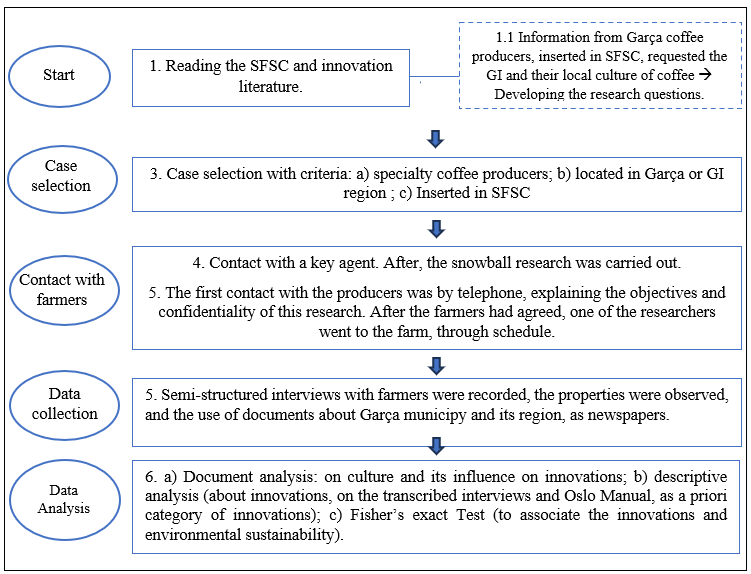
In this way, a step-by-step was conducted (Figure 1).
Figure 1
Methodological procedures
After the consulting literature and to elaborate the researcher's questions, there was case selection. The BSCA (2020) allowed the identification of the regions where specialty coffee is grown, in order to highlight initiatives undertaken by rural producers seeking to differentiate their products. The city and region of Garça stand out as one of the largest producing cities seeking historical recognition, through GI (BSCA, 2020). Besides the GI of coffee, this location was selected because there is a scarcity of studies contemplating these farmers.
The selected cases were producers residing in Garça and region that had already been introduced to SFSC. The researchers got in touch with a key agent, from Rural Union, who brokered the contact with other producers. The farmers were contacted based on the snowball, in according to Vinuto (2014), due to the studied group being characterized as being cloistered. The logic of sampling in case study research is irrelevant, according to Yin (2015). The author mentions that if the topic being researched does not require an excessive degree of certainty, the researcher can select two or three replications of the study. However, if they want a high degree of certainty, they can select five, six, or more replications of their study. Therefore, six replications of the study were selected, presenting a high degree of certainty about its results.
As a data collection instrument, observation and semi-structured interviews were performed (Appendix 1) and recorded. The interview allowed flexibility in rephrasing questions for a better understanding of farmers (Motta-Roth & Hendges, 2010). The data were described in Excel.
Data collection was carried out using documents, such as newspaper clippings and articles published by the press, according to Yin (2015). In this way, was possible to collect data about Garça city and its region regarding traditional aspects of coffee production and local culture.
For analysis, there was document evaluation, descriptive analysis, Fisher's exact test and statistical descriptive.
The document analysis consisted of identifying documents to describe the content of culture by interrelating it with scientific articles and describing the cultural influence on innovative actions carried out by respondents (Souza, Kantorski & Luis, 2011). To carry out the documentary analysis, the content described on the websites, news, and social networks of coffee associations and farmers in the city and region was analyzed. During this phase, the procedure set out by Ello and Kyngas (2007) was carried out, following three main phases. The first was preparation, in which the unit of analysis was selected, the theme being culture, by searching for words and meanings referring to the coffee tradition in the city of Garça and the region, for example, the history of its development is closely related to coffee, involving several families who have cultivated this fruit for generations. Thus, the codes, with their interpretations, were generated after reading the documents. In the second phase, this data was organized by ordering certain events according to time and their relationship to innovation. In the third phase, the results were generated, with the description of the data analyzed in the report.
After that, there was a description of the innovations, for this the researchers used the data from the recorded interviews. To analyze this data, the codes were defined as a priori categories, according to the Oslo Manual, in Table 1. This was done by preparing the documents (transcribing the interviews), organizing the data (allocating it according to pre-defined categories), and generating reports (the data analyzed was presented in table format), according to Ello and Kyngas (2007). In this way, the researchers found innovation in products and business processes in the cases studied, while acting in SFSC. For such a purpose, the Oslo Manual (OECD, 2018) was selected as groundwork, due to its clear information about concepts and categorization of innovations of products and business processes. Besides, although this Manual is widely used in large industries, the OECD (2018, p. 33) makes it clear that it can also be used for analyzing “in different countries and industries and for firms of different sizes and structures, ranging from small single-product firms to large multinationals".
The innovation variables were integrated into environmental sustainability, due to inquiry to examine innovations in products and processes that occur in organizations inserted in SFSC, as well as whether these innovations are linked to environmental sustainability in the context of SFSC. The environmental sustainability variables were selected according to the SFSC authors, due to the context of these organizations selected are inserted.
Fisher's exact test was used as a data analysis tool, to associate the innovation and environmental variables (as shown in Table 1). This technique performs an analysis between two independent qualitative variables present in a contingency table to test whether they are associated or not. The main reason for using Fisher's Exact test is that it is more suitable for qualitative research, involving six cases and categorical variables (nominal or ordinal), as it enables its application in this study. It provides a null hypothesis in which there is no association between studied variables (Connelly, 2016). A significance level of 95% was used, in which the null hypothesis will be rejected if the p-value is lower than α (0.05), i.e. there is an association between variables.
After all, the descriptive statistics allowed arranging data referring to respondents’ characteristics and their properties, as well as the innovations, and environmental sustainability variables.
Table 1
Aspects, innovation process and environmental sustainability variables
|
Aspect |
Innovation process |
Environmental sustainability (SFSC) |
Author (SFSC) |
|
Products |
The new line of products, introduction or adaptation of good or service |
New product or adaptation, such as the use of recycled materials or less use of resources |
Schmutz, Kneafsey, Kay, Doernberg and Zasada (2017); Sellito et al. (2018); Enjolras and Aubert (2018) |
|
Production of goods and services |
Change in production |
Reduction in the use of abiotic resources, pesticides, and fertilizers |
|
|
Preservation of nature, biodiversity, and landscape |
|||
|
Reduction in food losses and waste |
|||
|
Production using a wider range of crops |
|||
|
Production assisted by animals |
|||
|
Reduction in waste or effluents, reuse of water |
|||
|
Installed filters (Gas outlets) |
|||
|
Production certification |
Certified organic products |
||
|
Distribution and logistics |
Transport innovations |
Replacing vehicles, CO2 emission reduction |
|
|
Shortening spatial distance: from property to consumers and suppliers to the property |
|||
|
Shared transport |
|||
|
Storage |
Energy saving storage |
||
|
Marketing and sales |
Packaging |
Packaging reduction |
|
|
Use of recycled materials |
|||
|
Sales activity (new strategies of marketing and exposure) |
Sales approaches towards environmental aspects, local product appreciation and the origin of products |
||
|
Information Systems |
New Hardware or Software |
Technological gadgets that reduce CO2 emissions or increase efficiency |
|
|
Management |
Strategic management (mental models guiding the organization) |
The management model is more oriented towards reducing the use of resources, energy, or reusing materials |
|
|
Corporate governance |
Regulations aimed at reducing environmental impacts |
||
|
Human resource management – Training and education |
Training: more prudent use of agrochemicals |
||
|
Awareness of environmental aspects |
|||
|
External relationships with suppliers and partners |
Demands on the environmental aspect of suppliers' goods and services |
||
|
Partnerships with farmers and/or institutions |
Adaptated from: OECD (2018) and SFSC authors.
4 Results and discussions
4.1 Cultural influences on innovation
Based on documentary research, Garça, and its region have a historical relationship with coffee, occupying the territory before its existence, in 1924. Currently, according to Sylvestre and Beraldo (2018), coffee is the predominant agriculture in the city, benefiting 54% of farmers, including small property owners. It indicates the habits and capabilities that farmers researched developed related to the local culture of coffee production. These results are according to Tanko (2020), about the local culture. Coffee production is present in the habits and capabilities of the farmers.
Besides, the cultural influence on production techniques of studied coffee growers was perceived, as good production practices were adopted, in addition to collective learning about the history and culture of coffee production in the region through events and collective initiatives, as well as concern with the reputation of promoting harmony in a group who together sought to enhance the product and local reputation.
The identity and history of coffee are mentioned in the city anthem and are present in one of the architectural monuments/buildings located in the center of the municipality. This result is supported by Garza-Rodriguez et al. (2020) who observed that the coffee culture is present in the city architecture.
There are also public actions promoting the improvement of coffee quality aimed to encourage producers, such as lectures, and events. These public actions resulted in the creation of the project “GI of Coffee in the Region of Garça: appreciating and reviving history”. Thus, the farmers organized themselves collectively with institutions, creating this seal to appreciate their work and their origin. After that, in less than five years, Garça and its region conquered the GI.
The use of this seal involved innovations in properties since, if the producer wants to use it, quality standards established by the management board must be met, and the product must be stored in a specific warehouse using a QR Code to trace the origin of coffee. These innovative actions corroborate Arfini and Mancini studies (2018), that is, that an appreciation of origin, as well as the manufacturing process, compels farmers to carry out practices aimed at adding value to producers and the territory where they are inserted so that such characteristics are perceived by consumers.
The project, involving GI, was launched by the government in partnership with other institutions, such as the National Supply Company, Sebrae, and producers’ associations, to identify the best production practices, and acknowledge the origin and coffee traditions in the region. Thus, farmers residing in the city and its outskirts seek distinct production processes, such as the production of specialty coffees, appreciating production methods, and origin.
In this way, the farmers innovated, for example, there was the creation of brands and ownership exposure on products to differentiate them. Some producers have created their brands to market their products directly, through SFSC. This result is supported by Sellitto et al. (2018) when the SFSC highlights aspects of traditional, historical, and cultural origin.
Thus, it becomes relevant to better identify and understand the innovations carried out by specialty coffee farmers as they are introduced into SFSC and their respective impacts on environmental sustainability.
4.2 Innovations and SFSC
Initially, this section presents a characterization of respondents and properties to understand their contexts. As for the respondents, all are male and literate, and two of them hold a postgraduation degree. The positions occupied in properties vary between director, shareholder, business manager, and agricultural manager. As for the properties, most (5) were founded between the 1950s and 1980s, thus revealing the traditional aspects of coffee production in the city (Table 2).
Table 2
Characterization of studied properties
|
|
Foundation |
SFSC introduction year |
Area (ha) Total / Prod. |
Collaborators |
Trade methods, including SFSC forms |
Turnover (thousands of R$/year) |
||
|
A |
1972 |
2017 |
19 |
15 |
Up to 10 |
Traditional retail; social media; Sale on the property; Coffee fairs and events |
Up to 500 |
|
|
B |
1995 |
2005 |
190 |
110 |
Up to 10 |
Online Retailer; Social networks; Own stores |
Over 500 |
|
|
C |
1970 |
2017 |
50 |
40 |
Up to 10 |
Traditional and Online retail; Social networks |
Over 500 |
|
|
D |
1950 |
2017 |
43 |
40 |
Up to 10 |
Traditional Retail |
Up to 500 |
|
|
E |
1974 |
2017 |
24 |
14 |
Up to 10 |
Social media; Website, telephone, and email |
Over 500 |
|
|
F |
1980 |
2000 |
135 |
40 |
Up to 10 |
Own stores; Social networks; Food apps; website and telephone |
Uninformed |
|
|
|
|
|
|
|
|
|
|
|
The majority (4) of properties started their activities in SFSC in 2017. This result can be explained by Oliva (2018), because the Brazilian consumption of specialty coffee increased by 15% in 2017, compared to the previous year. To Santos, Cirillo, and Guimarães (2020), during the third coffee wave, the consumer´s interest in specialty coffees increased, often called “coffee lovers” and there was a public who wanted proximity with producers. This factor might have contributed to the shift in the focus of farmers towards production and direct sale to consumption, seeking differentiation and economic gains (Marescotti & Belletti, 2016). Total area and productive capacity refer to total coffee production and most farmers (5) conduct their main activity in commodity markets aiming at scale gains, i.e., besides product differentiation. Thus, 20% of specialty coffees are sold directly to consumers. Regarding production capacity, only case B stood out among the remaining cases, in addition to being the only one with most of its products (80%) marketed in direct sales.
All researched properties have turnovers of over R$ 200,000 (in 2020), which is only possible to be related to production capacity, while the number of different sales techniques is not an influential factor in this regard. This is because the largest percentage of sales is achieved in commodities markets. However, when comparing the value of a bag of coffee (60 kg) sold in the commodity market to that sold directly to the consumer, there is a minimum increase of 140% in direct sales of specialty coffee. It is worth stating that products sold directly are only specialty ones.
Regarding the diversity of the number of sales channels, the majority (5) sell through Social Networks, followed by traditional retail (3), online retail, and own stores (2). This result is in line with Negreti, Pigatto and Machado (2020), in which the use of social media, in addition to having a lower investment cost, provides a strategy to develop approximation and co-create value in the sales channel through dialogue and access to consumer opinions. Innovations carried out by farmers as they are introduced into SFSC are summarized in Table 3.
Table 3
Innovations carried out by farmers when becoming part of SFSC
|
Innovation variables |
Description |
|
|
Products / Services |
New products: roasted coffees, coffee-related products (machines, gift baskets), seedling replacement. |
|
|
New services: launching own stores, coffee shops, rental and maintenance of coffee machines, offering barista courses to the general population. |
|
|
|
|
||
|
Means of production |
Planting and management: use of organic fertilizer, natural herbicides, purchase or adaptation of machinery, such as the use of GPS. |
|
|
Grain selection: harvest time to select coffee cherries. Change to manual (case A) and mechanized (B) harvesting. Acquisition of machinery, such as a peeler. |
|
|
|
|
||
|
|
||
|
Drying: construction of a raised yard, acquisition of an automatic dryer and cooler, or switching to a wood-fired dryer. |
|
|
|
Roasting: installation and acquisition of a roaster. |
|
|
|
Grinding and packaging: acquisition of new types of machinery, such as a grinder, sealing machine. |
|
|
|
Certification: UTZ, use of traceability. |
|
|
|
Waste treatment: change in infrastructure by installing a filter and waste storage box. |
|
|
|
Transport |
Implementation of delivery, acquisition of machinery to deliver products to the consumer. |
|
|
|
||
|
Storage |
Infrastructure (new space for product storage). |
|
|
Packaging for storage (introduction or exchange of packaging). |
|
|
|
|
||
|
Sale activities (new methods of marketing and displaying products) |
Creation of own brand, new sales, and display modalities through sales on property, fairs and coffee events, and social networks, among others. |
|
|
Ads through digital influencers, and billboards in the city and region. |
|
|
|
Packaging |
Label and packaging creation. |
|
|
Strategic management |
Use of spreadsheets and systems to better manage production, financial, and sales data, among others, and the use of a field journal. |
|
|
HR Management |
Increased frequency of training related to certification, beverage quality, and customer service. |
|
|
Partnerships |
Partnerships with other farmers (associations, cooperatives). |
|
|
Suppliers (exchange of grains for agricultural inputs). |
|
Regarding the innovations of products and business processes carried out by farmers as they are introduced into SFSC, roasted coffees (cases A, B, C, D, E F) stand out in the form of powder and grains, in capsules (B) and replacement of seedlings (A, C, D, F) for crop renewal, or improvement towards mechanization and/or scale gains. These innovations were aimed at increasing the variety of items and improvements contributing to the profitability of farmers. These results are aligned with Guimarães et al. (2022), due to the main motivation factors involved in the supply chain management of coffee in Brazil, are related to economic performance.
The sale of other coffee-related items, such as accessories ranging from specific grinders to filters, is performed so that consumers can perform procedures at home and obtain the best extraction of the beverage, thus promoting pleasant consumption experiences (Costa, 2020). There were also innovations in service provision processes, such as making baskets and gifts with coffee items (B, C, F), and renting coffee machines (B, F). This result is in line with Enjolras and Aubert (2018) which, due to the increased diversity of products and services, contributes to the profitability of actors. In one case (F), a coffee shop was launched, in agreement with Torga and Spers (2020), as they mention that focusing on the quality of the drink and serving consumers directly are some aspects of coffee third-wave.
Process innovations ranged from planting to farmers' skills in selling it to consumers, and the latter demanded teaching and training farmers on how to serve consumers directly. As exposed by Carbone (2018), farmers need training and learning, especially to better serve consumers directly. The main processes of changes and improvements in cases while being introduced into SFSC concerns the selection of fruits, i.e. the most desired coffee cherries, in which there were changes to manual harvesting (A) and/or adjustments in machinery (B), new definitions of plots (D) and post-harvest periods.
The acquisition of machinery was also incorporated into process innovations, such as a tractor (A), crusher (A, C), washer, and grain selector (B, E, F), thus generating improved productivity for both regular and specialty coffees. Farmers also acquired other machinery aiming improvements for provided the public with direct sales, such as grain peelers (A), dryers (B, E), roasters (E), mills and technological packers (B; F), grinders and sealing machines (A; E), in addition to the acquisition of motorcycles (F) to deliver products directly to the consumer. Although these items have already been used in the coffee industry for quite some time, it was possible to perceive technological advances in properties resulting in innovations and process improvements in cases under study. The purchase of new machinery with incorporated technologies is in line with Zylbersztajn, Giordano, and De Vita (2020) who mentioned that these devices assist coffee farmers in improving product quality, for example by reducing the risks of human failures in identifying grain moisture and more accurate roasting.
Infrastructures were also installed to improve coffee quality, such as the construction of a suspended yard (A; B; E) and the creation of a facility for storing specialty coffees (C). As for their storage, 60 kg of jute packaging was also replaced with one made of kraft and plastic weighing 30 kg which, according to respondents, has maintained product quality and properties of the grain for longer (A; C; D; E).
Marketing innovations included the creation of private labels and packaging in all cases, as well as new ways to display products at fairs and coffee events, in addition to establishing partnerships with digital influencers to advertise private labels (C; E).
These results, concerning innovations carried out by agents, are supported by Zirham and Palomba (2015), that actors demand a series of organizational innovations while dealing with and offering products directly to consumers. Moreover, these results are aligned with Liu and Almor (2016) about the strong influence of culture on entrepreneurship, being an innovative behavior.
Among the most innovative cases are producers A and B (46%), followed by cases C and F (about 30%), and D and E (about 20%). The fact that properties A and B developed more innovations might be related to the UTZ certification which, according to Torga and Spers (2020), requires several adaptations to meet environmental and social sustainability standards in their properties.
In this sense, there was an existing integration between environmental variables and innovations carried out while being introduced into SFSC based on the respondents' answers (Table 4).
Table 4
Integration between environmental and innovation variables
|
Developed innovations |
Integration between environmental variables and innovations |
Yes (%) |
Partially (%) |
No (%) |
Fisher |
|
Products |
Product improvements have affected the environment (positively) |
67 |
17 |
17 |
1 |
|
Resource reduction or use of recycled |
83 |
17 |
|
1 |
|
|
Production |
Less use of abiotic resources |
33 |
17 |
50 |
0.6 |
|
Reduced use of pesticides/fertilizers |
33 |
33 |
33 |
100 |
|
|
Practices preserving biodiversity |
50 |
17 |
33 |
0.2 |
|
|
Reduction of food losses |
17 |
50 |
17 |
0.6 |
|
|
A wider range of crops |
|
33 |
67 |
0.6 |
|
|
Farming assisted by animals |
17 |
17 |
67 |
1 |
|
|
Waste reduction |
50 |
|
50 |
1 |
|
|
Monitoring gaseous emissions |
67 |
|
33 |
0.67 |
|
|
Installation of filters |
83 |
17 |
|
0.333 |
|
|
Water reuse |
33 |
|
67 |
0.4 |
|
|
Reused waste |
33 |
|
67 |
0.467 |
|
|
Certification |
Organic ingredients |
33 |
|
67 |
0.067 |
|
Transport |
Replacing vehicles - reducing CO2 emissions |
33 |
|
67 |
0.067 |
|
Shorter distance (property-consumer) |
33 |
|
67 |
0.467 |
|
|
Shorter distance (property-supplier) |
17 |
|
83 |
1 |
|
|
Shared transport |
|
|
100 |
1 |
|
|
Storage |
Energy reduction |
67 |
|
33 |
1 |
|
Sales |
Environmental approaches |
33 |
|
67 |
0.067 |
|
Local appreciation approaches |
83 |
17 |
|
0.067 |
|
|
Packaging |
Packaging reduction |
50 |
17 |
33 |
1 |
|
Recycled material |
17 |
|
83 |
1 |
|
|
Technology |
Technological gadgets (reduced CO2 emissions or increased efficiency) |
50 |
|
50 |
0.4 |
|
Strategic management |
Management model reducing the use of materials and energy |
100 |
|
|
0.067 |
|
Management (HR) |
Training on prudent use of agrochemicals |
67 |
|
33 |
0.5 |
|
Environmental awareness aspects |
67 |
|
33 |
0.333 |
|
|
Corporate governance |
Reduction of environmental impacts |
33 |
17 |
50 |
1 |
|
External relations |
Supplier requirements (environmental aspects) |
83 |
|
17 |
0.4 |
|
Partnerships (to production efficiency, reduction of losses) |
83 |
|
17 |
1 |
|
|
Partnerships (better use of resources) |
100 |
|
|
0.4 |
|
|
Partnerships (use of organic products) |
67 |
17 |
17 |
1 |
It was observed that 44% of respondents (≥ 4) answered ‘yes’, indicating that there were actions related to environmental sustainability, in addition to the fact that these actions are integrated with the innovation variables according to the opinions of interviewees. Variables such as a management model more oriented towards reducing the use of resources and partnerships between farmers and/or other institutions contributing to better use of natural resources resulted in 100% of respondents' answers. This result is in line with Cai and Li (2018), that eco-innovation processes constitute acquisition, integration, and environmental knowledge, which agents can share in their networks of contact groups, as well as learning eco-innovation abilities from these other agents. This result is also in line with Rennings (2000), because with the introduction of agents into the SFSC, there was greater integration and sharing of knowledge involving eco-innovation, especially on different behaviors towards reducing environmental impacts. Eco-innovation includes behaviors, ideas, products, or processes developed by all types of agents, which contribute to reducing environmental impacts or aim at ecological sustainability.
In the same way, 83% of the farmers use recycled materials, have installed filters, and have changed their external relationships, because they started demanding environmentally friendly materials from their suppliers. In the same way, they have partnerships aiming to contribute to production efficiency and reduction of losses. These results are aligned with Chrysanthi et al. (2019) even though there are perceptions of economic benefits associated with participation in SFSC, there are environmental concerns, which means efforts by farmers to contribute to the environment.
According to results demonstrated by the p-value of Fisher's Exact Test, it was found that none of the sustainability integration variables presented a value below 0.05. This result confirms the null hypothesis, i.e. there was no association between innovations carried out and environmental sustainability variables regarding the performance of producers in SFSC. This result indicates that, although there are efforts among farmers to share information about behavioral changes aiming at environmental sustainability, there is still greater concern by farmers related to adding value to make a product unique to reap economic gains. This result is in agreement with Marescotti and Belletti (2016), in which farmers' interest in adding value to coffee is often related to aspects of improving profitability. Thus, the present study indicates the need for coffee growers to make changes/innovations related to aspects of environmental sustainability since, according to Costa (2020), one of the inherent characteristics of consumer demands in defining the quality of coffee is based on sustainability and economic, social, and environmental pillars.
The fact that farmers have innovated, and these innovations are not associated with environmental sustainability may be related to some difficulties, as pointed out by Guimarães et al. (2022), such as the high complexity of processes, such as organic certification. Therefore, becomes necessary to have greater integration of innovative actions with goals related to environmental sustainability, among the cases studied.
5 Conclusion
This article aimed to analyze innovations developed by coffee producers in Garça, Brazil, as they were introduced into the SFSC and their impacts on environmentally sustainable production. The observed innovations concerns marketing skills involving customer service, as well as technical processes from harvesting to product packaging, in order not to jeopardize the quality of the beverage. However, although there are efforts made by farmers to integrate innovations with aspects of environmental sustainability, e.g. by making changes in their management models so that they become more oriented towards reducing natural resources and developing partnerships between coffee growers and other institutions in sharing information about the best use of natural resources, the statistical test used herein revealed the absence of an association between variables of innovations and environmental sustainability.
The studied producers aim to appreciate the origin of coffee and local economic development by organizing themselves collectively, including the actions of public and private bodies, being awarded the GI. The search for such differentiation is related to the creative capacity of farmers, in which local cultural factors, e.g. public actions aimed to encourage historical revival and process and product improvement, affected the environment in which farmers are inserted, who sought to innovate their internal processes and differentiate their products thereof. Thus, cultural aspects were provided in the context of the local systems themselves, which allowed the devising of creative and innovative solutions for local development.
The results obtained indicate similarities to the contributions of Akenroye et al. (2021), in the sense that the lack of financing and difficulty in producing organic compounds are also explanatory elements for the low adherence to the SFSC. Also in compliance with the results of Chrysanthi, Kitsios, and Lioutas (2019), regarding the interest in participating in SFSC, due to economic perception and environmental concern.
As practical implications, this study sought to contribute to public policymakers who wish to help coffee farmers who seek to valorize their products by selling directly to the end consumer and, at the same time, contributing to the environment. In this way, the policymakers can help farmers to innovate and contribute to the environment, for example, by promoting events that generate knowledge about innovations and sustainability environmental development. The environmental variables used in this study can be useful in the search for the promotion of local sustainable development. Besides, the practical implications of this article aim to reach farmers who want to change their production by selling specialty coffees, through SFSC, demonstrating the innovations that farmers have made, based on their cultural factors and the innovations that can contribute to environmental sustainability.
As a research limitation, it is suggested that this region should be further explored at the level of empirical tests, especially in economic terms. As further studies, it is suggested to use this research in other sectors of agribusiness and/or other coffee regions where farmers are part of SFSC.
References
Akenroye, T. O., Dora, M., Kumar, M., Elbaz, J., Kah, S., & Jebli, F. (2021). A taxonomy of barriers to the adoption of sustainable practices in the coffee farming process. Journal of Cleaner Production, 312(127818) 1-13.
Arfini, F. & Mancini, M.C. (2018). Synergies between localized agri-food systems and short supply chains for geographical indications in Italy. In Kalfagianni, A. & Skordili, S. (Org.), Localizing global food: short food supply chains as responses to agri-food system challenges, (1a. ed., Cap. 7, pp. 42- 71). London, LDN: Routledge.
Associação Brasileira da Indústria de Café. (2021). O café brasileiro na atualidade. Tudo de café. https://www.abic.com.br/tudo-de-cafe/o-cafe-brasileiro-na-atualidade.
Brazilian Specialty Coffee Association. (2020). About BSCA. https://bsca.com.br/a-bsca.
Brunori, G. & Galli, F. (2017). Filiera corta e politiche alimentari: quali scenari? Agriregionieuropa, 13(50), 1-4.
Brunori, G., Rossi, A. & Malandrin, V. (2011). Co-producing transition: innovation processes in farms adhering to solidarity-based purchase groups in Tuscany, Italy. International Journal of Soc. Ag. Food, 18(1), 28-53.
Cai, W. & Li, G. (2018). The drivers of eco-innovation and its impact on performance: Evidence from China. Journal of Cleaner Production, 176(1), 110-118.
Carbone, A. (2018). Foods and places: comparing different supply chains. Agriculture Review, 8(6), 2-12.
Chrysanthi, C., Kitsios, F. & Lioutas, E. D. (2019). Short food supply chains: the link between participation and farmers´competencies. Renewable agriculture and food systems, 35(6),1–10.
Companhia Nacional de Abastecimento. (2023). Série histórica das safras. https://www.conab.gov.br/info-agro/safras/serie-historica-das-safras/itemlist/category/895-cafe-total-arabica-e-conilon.
Connelly, L.M. (2016). Fisher´s exact test. Medsurg Nursing, 25(1), 58-61.
Conto, S. M., Antunes Jr. & Vaccaro, G. L. R. (2016). A inovação como fator de vantagem competitiva: estudo de uma cooperativa produtora de suco e vinho orgânicos. Gestão & Produção, 23(2), 397 – 407.
Costa, B.R. (2020). Brazilian specialty coffee scenario. In L. F. De Almeida & E. Spers (Org.), Coffee Consumption and Industry Strategies in Brazil (1a. ed. Cap. 3, pp. 51-64). Cambrige: Woodhead Publishing.
Csordás, A., Pancsira, J., Lengyel, P., Füzesi, I. & Felföldi, J. (2022). The Potential of Digital Marketing Tools to Develop the Innovative SFSC Players’ Business Models. Journal of Open Innovation: Technology, Market, and Complexity, 8(3), 122-136.
Dias, F. (2017). Cafeicultura regional dá um grande passo em busca da sua real valorização. Associação Comercial e Industrial de Garça. https://www.garcaonline.com.br/2017/10/cafeicultura-regional-da-um-grande-passo-em-busca-da-sua-real-valorizacao.
Doernberg, A., Piorr, A., Zasada, I., Wascher, D. & Schmutz, U. (2022). Sustainability assessment of short food supply chains (SFSC): developing and testing a rapid assessment tool in one African and three European city regions. Agriculture and Human Values, 39(3), 885-904.
Dosi, G. (1988). The Nature of the Innovative Process. In G. Dosi, C. Freeman, R. Nelson, G. Silverberg & L. Soete (Org.), Technical Change and Economic Theory (1a. ed., pp. 221-238). London: Pinter Publishers.
Economic Cooperation and Development. (2018). Oslo Mannual 2018: guidelines for Collecting, Reporting and Using Data on Innovation. https://www.oecd.org/science/oslo-manual-2018-9789264304604-en.htm.
Enjolras, G. & Aubert, M. (2018). SFSC and the issue of sustainability: a case study of French fruit producers. International Journal of Retail & Distribution Management, 46(2), 194-209.
Ferreira, L., T. & Cavaton, T. (2022). Safra dos Cafés do Brasil totaliza 50,92 milhões de sacas de 60kg de café em 2022. Embrapa. https://www.embrapa.br/busca-de-noticias/-/noticia/77216868/safra-dos-cafes-do-brasil-totaliza-5092-milhoes-de-sacas-de-60kg-de-cafe-em-2022.
Garza-Rodríguez, F., Roca, E. & Villares, M. (2020). Cultura local y regeneración urbana: un caso de estudio en Monterrey. Estudios Demograficos y urbanos, 35(3), 761-801.
Godoy, A. S. (1995). Pesquisa qualitativa: tipos fundamentais. Revista de Administração de empresas, 35, 20-29.
Guimarães, Y. M., Eustachio, J.H.P.P., Filho, W. L., Martinez, L. F., Valle, M. R., & Caldana, A. C. F. (2022). Drivers and barriers in sustainable supply chains: the case of the Brazilian coffee industry. Sustainable Production and Consumption, 34 (1), 42-54.
International Coffee Organization. (2020). Coffee production by exporting countries. http://www.ico.org/trade_statistics.asp.
Koutsou, S. & Sergaki, P. (2020). Producers’ cooperative products in short food supply chains: consumers’ response. British Food Journal, 122(1), 198-211.
Liu, Y., & Almor, T. (2016). How culture influences the way entrepreneurs deal with uncertainty in inter-organizational relationships: The case of returnee versus local entrepreneurs in China. International Business Review, 25(1), 4-14.
Marescotti, A. & Belletti, G. (2016). Differentiation strategies in coffee global value chains through reference to territorial origin in Latin American countries. Culture & History Digital Journal, 5(1), 1-14.
Ministério da Agricultura, Pecuária e Abastecimento. (2018). Café no Brasil. Café. https://www.gov.br/agricultura/pt-br/assuntos/politica-agricola/cafe.
Ministério da Agricultura, Pecuária e Abastecimento. (2022). INPI reconhece Região de Garça como Indicação Geográfica para café. Instituto Nacional da Propriedade Industrial.
Motta-Roth, D. & Hendges, G. R. (2010). Produção textual na universidade. São Paulo, SP: Parábola.
Negreti, A.S., Pigatto, G. & Machado, J.G.C. (2020). Restaurantes orientais e suas estratégias sobre seus canais de marketing. Revista Gestão Organizacional, 13(3), 140-161.
Oliva, G. (2018). Consumo de café especial aumentou em até 15% em 2017, diz Associação Brasileira de Cafés Especiais. G1. https://g1.globo.com/mg/sul-de-minas/grao-sagrado/noticia/consumo-de-cafe-especial-aumentou-em-ate-15-em-2017-diz-associacao-brasileira-de-cafes-especiais.ghtml.
Rennings, K. (2000). Redefining innovation d eco-innovation research and the contribution from ecological economics. Ecological Economics, 32(2), 319 – 332.
Santos, P. M. D., Cirillo, M. Â., & Guimaraes, E. (2021). Specialty coffee in Brazil: transition among consumers' constructs using structural equation modeling. British Food Journal, 123(5), 1913-1930.
Schmutz, U., Kneafsey, M., Kay, C. S., Doernberg, A. & Zasada, I. (2017). Sustainability impact assessments of different urban short food supply chains: examples from London, UK. Renewable Agriculture and Food Systems, 33(6), 518–529.
Sellitto, M.A., Vial, L.A. & Viegas, C.V. (2018). Critical success factors in Short Food Supply Chains: case studies with milk and dairy producers from Italy and Brazil. Journal Cleaner Production, 170(1),1361-1368.
Silverberg, G., Dosi, G. & Orsenigo, L. (1988). Innovation, diversity and diffusion: a self- organisation model. The Economic Journal, 98(393), 1092-1054.
Souza, J., Kantorski, L. P. & Luis, M. A. V. (2011). Análise documental e observação participante na pesquisa em saúde mental. Revista Baiana de Enfermagem, 25(2), 221-228.
Specialty Coffee Association. (2023). What is Specialty Coffee? https://sca.coffee/research/what-is-specialty-coffee.
Sporchia, F., Caro, D., Bruno, M., Patrizi, N., Marchettini, N. & Pulselli, F.M. (2023). Estimating the impact on water scarcity due to coffee production, trade, and consumption worldwide and a focus on EU. Journal of Environmental Management, 327(1), 116881-116892.
Sylvestre, E. & Beraldo, P. (2018). De olho no campo - referência em café há 94 anos, Garça vive novo boom e quer se tornar polo nacional até 2025. https://spark.adobe.com/page/TCz6saFwtlKVN/.
Tanko, M. (2020). Is farming a belief in Northern Ghana? Exploring the dual-system theory for commerce, culture, religion and technology. Technology in Society, 63(101339), 1-7.
Terry, E. (2011). A ideia de cultura. São Paulo, SP: Unesp.
Torga, G.N. & Spers, E.E. (2020). Perspectives of global coffee demand. In L. F. De Almeida & E. Spers (Org.), Coffee Consumption and Industry Strategies in Brazil (1a. ed. Cap. 2, pp. 21-49). Cambrige: Woodhead Publishing.
Ucar, E. (2018). Local creative culture and corporate innovation. Journal of Business Research, 91(1), 60-70.
Uchida, Y., Takemura, K., Fukushima, S., Saizen, I., Kawamura, Y., Hitokoto, H Koizumi, N. & Yoshikawa, S. (2019). Farming cultivates a community-level shared culture through collective activities: examining contextual effects with multilevel analyses. Journal of personality and social psychology, 116(1), 1-14.
Umaran, T., Perdana, T., Kurniadie, D., & Parikesit, P. (2022). Co-creation approach in designing a sustainable coffee supply chain (a case in bandung regency, West Java, Indonesia). Sustainability, 14(1), 476.
Vinuto, J. (2014). A amostragem em bola de neve na pesquisa qualitativa: um debate em aberto. Revista Temáticas, 44(22), 203-220.
Wang, Y., Schaub, S., Wuepper, D., & Finger, R. (2023). Culture and agricultural biodiversity conservation. Food Policy, 120, 102482, 1-19.
Yin, R. K. (2015). Estudo de Caso: Planejamento e métodos. Bookman editora.
Zhu, Z., Chu, F., Dolgui, A., Chu, C., Zhou, W. & Piramuthu, S. (2018). Recent advances and opportunities in sustainable supply chain: a model-oriented review. International Journal of Production Research, 56(17), 5700-5722.
Zirham, M. & Palomba, R. (2015, September). Innovation and multi functionality of female agriculture in the Short Food Supply Chain. Four Campania Region Case Studies. In 7th International Conference on Informatic and Technonolgy in Agriculture, Food and Environment. Hellenic Association of Information and Communication Technology in Agriculture, Food and Environment (HAICTA), Kavala, Greece.
Zylbersztajn, D., Giordano, S.R. & De Vita, C.L.R. (2020). Farm innovation: nine cases of Brazilian coffee growers. In L. F. De Almeida & E. Spers, Coffee Consumption and Industry Strategies in Brazil (1a. ed. Cap. 7, pp. 125-48). Cambrige: Woodhead Publishing.