The challenges of Handcraft Management and its contributions to Local and Regional Development
Os desafios da Gestão no Artesanato e suas contribuições para o Desenvolvimento Local e Regional
Junio Soares dos Santos1*, Orcid: https://orcid.org/0009-0000-9966-9000 ; Jaqueline Guimarães Santos2, Orcid: https://orcid.org/0000-0001-8455-1659 ; Mariana Teodoro dos Santos3, Orcid: https://orcid.org/0009-0007-3399-5947 ; Erondina de Farias Meira4, Orcid: https://orcid.org/0009-0000-0712-2340
1. Universidade Federal de Pernambuco, Caruaru/PE, Brasil. E-mail: junio.santos@ufpe.br
2. Universidade Federal da Paraíba, João Pessoa/PB, Brasil. E-mail: jsantos.adm@gmail.com
3. Universidade Federal da Paraíba – João Pessoa/ PB, Brasil. E-mail: mariana.ttsantos@gmail.com
4. Universidade Federal de Pernambuco- Caruaru/PE, Brasil. E-mail: erondina.meira@ufpe.br
Abstract
Ordinary management is an important topic in the field of management and its use has been widespread in applied social sciences. Thus, this study aimed to analyze how ordinary management is characterized in the daily lives of artisans linked to the association ARTESAL and their contributions to local and regional development. Regarding methodological procedures, qualitative research was carried out, using semi-structured interviews and non-participant observation, in addition to the focus group, such as data collection techniques. The data, in turn, were analyzed based on the content analysis technique. The main results of the research point to the use of some ordinary management practices by artisans linked to the craft association studied, such as reciprocity, solidarity, and appreciation of exchanges. However, from a critical look at the phenomenon, we observe that the way in which the association is conducted exerts some force of standardization of some management processes, consistent with capitalist production models characterized by standardization and massification.
Keywords: Crafts; artisans; Ordinary management.
Resumo
A gestão ordinária é um tema importante no campo da gestão e seu uso tem sido difundido nas ciências sociais aplicadas. Por isso, este estudo teve como objetivo analisar como a gestão ordinária se caracteriza no cotidiano dos artesãos vinculados à associação Artesal e quais são as suas contribuições para o desenvolvimento local e regional. No que se refere aos procedimentos metodológicos, foi realizada uma pesquisa de abordagem qualitativa, utilizando a entrevista semiestruturada e a observação não participante, além do grupo focal, como as técnicas de coleta de dados. Os dados, por sua vez, foram analisados a partir da técnica de análise de conteúdo. Os principais resultados da pesquisa apontam para a utilização de algumas práticas de gestão ordinária por artesãos e artesãs vinculadas à associação de artesanato estudada, tais como reciprocidade, solidariedade e valorização das trocas. Contudo, a partir de um olhar crítico para o fenômeno, observamos que a forma como a associação é conduzida exerce alguma força de padronização de alguns processos de gestão, condizentes com os modelos de produção capitalistas caracterizados pela padronização e massificação.
Palavras-chave: Artesanato; Artesã(o); Gestão ordinária.
Citation: Santos, J. S. dos, Santos, J. G., Santos, M. T. dos & Meira, E. de F. (2024). Os desafios da gestão no artesanato e suas contribuições para o desenvolvimento local e regional. Gestão & Regionalidade, v. 40, n. Especial: Regionalidade e desenvolvimento: o papel da gestão , e20249380. https//doi.org/10.13037/gr.vol40.e20249380
1 Introduction
In Brazil, handcraft production has become a strategy to promote human, cultural, social, and economic development, through handcraft practice developed on people’s daily lives, to praise the communities’ identities or regions and uplift the cultural heritage, and to keep the memory of traditional practices alive. Likewise, it reinforces the communal bonds, since handcraft is transmitted from generation to generation, promoting the preservation of local traditions and cultural identity. (Grangeiro & Silva Júnior, 2020; Gonçalves, Grangeiro & Silva Júnior, 2018).
Handcraft, as a cultural manifestation full of history and representativeness, demands from Administration Sciences to recognize that its characteristics are beyond production chains, production costs, performance assessment or increase in earnings. For this reason, the studies of Anthropology Sciences are needed as a subject which studies culture and society (Ortiz, 2020) to understand handcraft’s cultural significance and to emphasize its connection with identity and local tradition, being not just economic, but a cultural product as well.
The fact that Administration, in most cases, approaches handcraft from an economic perspective may neglect the potential it has for other local areas and history propagation, both for those who produce the pieces and for those who share the place that is the inspiration to the representation of those pieces (Marquesan & Figueiredo, 2014). Therefore, is relevant for Administration studies to recognize handcraft as a legitimate cultural manifestation, avoiding the insertion of standardization and massification processes, adopting more sensible and participatory approaches involving different ways of management that works guided by the context in which they are inserted (Carmo et al., 2023).
We can’t deny handcraft is a source of employment and income generation to the local or region in which it is produced, as well as it integrates inseparably to tourism, since touristic activity is the creator of the handcraft market (Violin, 2022). The activity involves more than 8,5 million of people in Brazil, the majority being composed by women who live from their own production. The field represents approximately 3% of the Gross Domestic Product (GDP) driving about R$ 50 billion a year (Sebrae, 2022). That is why it is an activity that contributes to the regional development (Alves, 2014).
Especially in Brazilian Northeast, handcraft is one of the richest cultural manifestations and has a wide range of production, in which different techniques and materials are used in each state. In Pernambuco, particularly, woodcut, fabric painting, objects with shells, hammocks, basketries stand out, as well as clay production (Santana & Copolla, 2021). Thus, handcraft production highlights its contribution to Pernambuco’s economy, “[...] generating employment, incomes, and opportunities to thousands of people. This activity propels tourism, at the same time inserts itself and values local productive arrangements” (Cordeiro, 2022, p. 4).
However, despite the cultural, social, and economic importance of handcraft, we call attention to the difficulties handcraft production is facing on the maintenance of its activities before the capitalist production models characterized by standardization and massification (Cezar & Fantinel, 2018). An example of that is presented by Souza et al. (2020), specifically concerning the challenges and changes on work practices at Alto do Moura’s handcraft, located on Caruaru – PE.
In such context, we argue that the ordinary management is one of the appropriate ways of management to the business emerged from. Ordinary management is distinguished in different ways from the conventional and dominant management methods in the organizational context. In other words, it is the management practiced by the regular men and women on their business, in many cases, family business, in the social relationships they develop on the organization/administration of their business. (Carrieri, et al., 2018). Such relationships develop on people’s daily lives, in which tactics and strategies are built to survive against the adversities, in view of the dominant practices operated by standardized systems that restrict every way of practices and/or knowledges that do not fit in the functional and rational perspective of management (Certeau, 2014).
Therefore, is from ordinary management that small businesses develop themselves and are found, mostly, in peripheral contexts, like the craftsmen and craftswomen from the Artisans’ Association of Altinho (ARTESAL), a town located on the countryside of Pernambuco, approximately 158 km from Recife, its capital. Currently, the association has around 25 artisans who create their pieces, from lace clothes and kitchen sets to fabric toys, among other items, and sell it through the association.
It is important to stand out the relevance of studies that explore the ordinary management of peripheral business, that, despite the difficulties imposed by the context, resist and ensure the perpetuation of activities, which contribute to the local and regional development, since the reunion of people in an association is capable strengthen the handcraft activity, generating employments and incomes, as well as highlight the local culture. Hence, we stress the originality on investigating craftsmen and craftswomen work organized in association, with multifaceted characteristics, which allows us to unfold the different organizational ways.
Thus, this study aimed to analyze how ordinary management is characterized in the daily lives of artisans linked to the association ARTESAL and their contributions to local and regional development. For this purpose, qualitative research was conducted, using semi-structured interviews and non-participant observation, in addition to the focus group, such as data collection techniques. The data, in turn, were analyzed based on the content analysis technique.
By focusing on peripheral business, this research pursues to fill the gap on the existing literature, offering a vision to the management practices of the artisans’ association business, as well as to the community studied, which is fundamental to economic and cultural development of the region. Their voices and experiences are often minimized to escape Administration’s mainstream, which tends to be concentrated on models and practices attributed to the industrial context. Moreover, this research contributes to progress in the area by eliciting the practices of crafts’ management, which may add to the appreciation and preservation of traditional knowledges, resulting in a positive impact on cultural identity and on economic local development, as well as enhance an alternative view to crafts’ management and other organizational ways based on cultural, social, and economic diversity of the organizational context.
Under this gaze, in addition to the introductory section, this work is divided into five sections, in which we present the theoretical frame of reference, based on the main authors that discuss the ordinary management and handcraft. On the following section, we exhibit the methodological procedures used in the research, subsequently, the results and the analysis and finally, the final considerations.
Handcraft is an activity that carries a rich cultural and social background, both to those who acquire these productions and to the craftsmen or craftswomen themselves, because it perpetuates the history and the representativeness present on each piece, for this reason, the handcraft activity is part of the “[…] subsistence of the identities and cultural traditions” (Keller, 2014, p. 327).
It is not uncommon, the inspirations to make the handcraft emerge from the daily life. This is because the handcraft master’s portray in their art elements from their daily lives, where they live and strengthen their ties, characterizing an identity construction from the different origins of handcraft. Thus, the Brazilian handcraft production is classified, from its origins, as traditional handcraft; popular art, Indigenous handcraft; quilombola; as cultural reference; and a contemporary concept (Brasil, 2018).
The handcraft has its cultural but also economic importance, that is why it has become an agenda for debate and public policies (Moraes, Seraine & Barbosa, 2020). To foster its consolidation as economic field of strong impact on communities’ development, the Brazilian Handcraft Program (PAB) was established in 1991 which had updates over the years e nowadays is linked to the Ministry of Development, Industry, Market and Service (MDIC). The PAB is composed by national coordination and 27 state co-ordinations, to guarantee the representativeness and particularities from all the States and from the Federal District (Brasil, 2023).
According to data from the Brazilian Service of Support for Micro and Small Enterprises (Sebrae), Brazil presents “[…] around 8,5 million artisans, the majority being composed by women who live from their own production. The field represents approximately 3% of the Gross Domestic Product (GDP) driving about R$ 50 billion a year. And around 60% of the artisans have the handcraft activity as their main source of income (Sebrae, 2022; 2023). Furthermore, handcraft is a great potential to touristic attractions in many locations, that is why it contributes on driving tourism in different areas (Cavalcante & Vasconcelos, 2022). Therefore, it is possible to ensure that handcraft contributes to local and regional development from different Brazilian regions (Ramos, Muylder & Freire, 2014).
In the Northeast, for example, handcraft employs local workforce, explores the cultural wealth of the region, “[…] being directly related to touristic activities, since it is one of the main attractions to the visitors” (Banco do Nordeste, 2002, p. 9). The Northeast Bank has contributed to strengthen the handcraft activities through specific credit lines (Valente Junior, Alves & Santos, 2022), as well as Sebrae, which affirm that Northeast handcraft combines Indigenous, African, and European techniques, using materials as natural fiber and wood on pieces that reflect the local culture (Sebrae, 2022).
Each state from Northeast region present peculiarities. Specially in Pernambuco, the handcraft carries a relevant cultural background, emanating from popular knowledges and performances; for example, it is recognized for the clay art developed by the then Master Vitalino, who, in addition to other handcraft practices, passed it from generation to generation until now (Souza et al., 2020).
In Pernambuco, there are locations where handcraft activity has had such significant outcomes that their names are practically inseparable from reference production: Caruaru “the Capital City of Figurative Art”, Bezerros “the City of Papangus” and Passira “the Land of Manual Embroidery”, are examples of cities that have geographical identities marked by cultural and financial production of handcraft. The intensity of these activities has settled in in such a way on boosting local economies that managed to increase the condition and status of its products. If then it could be interpreted as only functional, decorative, folkloric products, belonging to a past surpassed by modernity, today it is interpreted as cultural components and representative symbols of its locations (Silva, 2018, p. 22).
To strengthen the artisan activity on the state, the Program of Handcraft of Pernambuco (Pape) was created in 2008, whose purpose is to “[…] promote the development of the handcraft field of the State and value the artisan of Pernambuco through actions and public policies, strengthening the Production Chain of local handcraft”. Among the main actions developed by the program, are the coordination of two Centers of Handcraft of Pernambuco (Recife e Bezerros) and the Handcraft’s Unity of Movement, as well as the support to the participation of artisans on both national and international handcraft local fairs. (Artesanato de Pernambuco, 2023).
Besides, the program coordinates the National Fair of Handcraft Business (Fenearte). Considered the biggest handcraft fair from Latin America, it is an opportunity of business to craftsmen and craftswomen from Pernambuco, consisting in a fair that occurs annually. In its latest edition, on July of 2023 315 thousand of visitors participated, setting the record of a financial driving that resulted in 2,5 thousand workstations and in an economic impact of R$ 52 million in the state (Artesanato de Pernambuco, 2023).
Among the municipalities from Pernambuco which have the handcraft as an important economic activity, we highlight Altinho/PE, located on the countryside, counts on a population estimated on 22.990 of people (IBGE, 2020). About the economic activities developed in the town, there are family’s small business, ranging from market, confections, clothing store, domestic utilities, etc., where the handcraft is another important activity which contributes both to the cultural perpetuation and to the income spawn to the families that perform this activity and sell their pieces on the free fair weekly.
Another space of local handcraft production and marketing is the association ARTESAL (Artisans’ Association of Altinho), where are concentrated other craftsmen and craftswomen from the town, counting on 25 members, women being most of it. Therefore, the “[…] handcraft is an important activity on the economy of many regions in Brazil and women have a fundamental role on this field, because they represent the majority of artisans in the country” (Menezes, 2017, p. 63).
Thus, the challenges of management that characterize small businesses developed from the handcraft are several, most part of it are family business, relationships based on trust, business absent from formality with selling registers completely manual, so that “[…] business practices are tried on the daily life, often by individuals that move away from the stereotype of ‘business men’ from the mainstream” of Administration (Vale & Joaquim, 2017, p. 1).
In this context, we consider that the management developed by craftsmen and craftswomen is ordinary. Although the tension and pressure of the dominant capitalist way of production on the handcraft (Keller, 2014; Marquesan & Figueiredo, 2014; Souza, et al., 2020), the handcraft activity in the peripheral context resists and carry on its ways of doing business in an ordinary manner, with an ordinary management, in accordance with the following discussion.
2.1 The ordinary management of handcraft small business
The management of small businesses emerged from the handcraft has characteristics, so that “[…] handcraft is not made without management, because the management of this form of organization exists; however, it differs from the instrumental management of large private companies, since handcraft management is an ordinary type” (Siqueira, Silva & Silva, 2021, p. 114).
The ordinary business is a kind which follows the contrary path of the management models that dominate the mainstream of Administration. Its practice happens through the image of an individual who applies strategies according to the situations that occur on their daily life. Thus, it differs from the management present on the formal organizational environments, on account of being a management.
[…] which flees from the management parameters by focusing on the regular men daily life, who manages ordinary businesses. By dealing with ordinary management, it does not matter talking about the large, global, international businesses. What matters is working on the daily life of the small family merchant […] (Carrieri et al., 2014, p. 2).
It is interesting to elicit the different forms of management by the fact that Administration itself, as a social applied science, focus on the search of knowledge about a management that reveals itself as new and constant, i.e., it follows exactly the idea of innovation on management forms and activities performance. On the other hand, it makes the “[...] traditional knowledges, other rationalities beyond the traditional and other forms of management beyond the object of scientific modern knowledge, to be forgotten, left behind, or yet silenced” (Carrieri et al., 2014, p. 3).
For this reason, ordinary management presents itself as an alternative to the forms of management that determine parameters to be followed, as a set of requirements necessary so that other businesses are validated. However, it becomes necessary to emphasize that this discussion is not concerned just on businesses as physical structures, but rather on individuals that are part of these businesses and in addition to their income acquisition, can continue their history and their family members’. Consequently, “[…] on the raising of ordinary management, individuals gain voices, elaborate texts, speeches, speak, narrate, tell their stories to us, and reach the relevance that traditional approaches do not give them” (Carrieri et al., 2014, p. 2).
Other important concepts to the discussion of ordinary management are the “daily life” and “ordinary man”, this one being understood as ordinary woman, since they are most part on the activity and management of handcraft (Menezes, 2017; Sebrae, 2023). Such concepts are the base of the theoretical frame of reference. The daily life is changeable and is the space of action, which is historically lived, constructed, and reconstructed, where happens the management and the relationships are established (Gouvêa, Cabana & Ichikawa, 2018). That is why “[...] the daily life as a study category cannot be understood as something naturalized, but it must be interpreted as a production of human action, expressing the social relations” (Carrieri et al., 2018).
On the other hand, ordinary woman is the one who uses the artifacts willing on her daily life to the business survival. She is also the “[…] regular [woman] which creates strategies and tactics to the survival of her business and her family” (Carrieri et al., 2018, p. 5). These strategies and tactics, according to Certeau (2014) – another relevant author to the literature discussed –, can be understood as movements accomplished to reach the objectives of complying the daily life needs and activities.
Based on the above considerations, is possible to perceive how management and women, both ordinary, walk side to side on the confrontation of the models that standardize and shape forms of business. The ordinary woman takes on the attitude previously mentioned, not to become completely passive of acceptance of what is imposed to her, because there is no point, for example, in a proposal of modernization to her service manner or cash register, if she does not find meaning on what is presented. It does not mean that there is always resistance to changes or that there is not space to modernity on traditional establishments, on the contrary, most of what is innovative can be used.
In fact, what makes the innovative and modern introduced into the traditional format is the adaptation present in its context. For example, the owner of a handcraft store can have a system that manages the receipt, the entrance, and the outlet of handcraft pieces on her stock and, even so, still prefer to write down the inflows and outflows of the goods’ sales, because that is the format which makes sense for her type of business. Therefore, that ordinary woman is a “[...] cultural [consumer] in the moment in which interacts with artifacts, makes use of them under her needs. The ‘ways of doing’ transform the practices, modifying the operation on what is imposed by the dominant social order” (Machado et al., 2008, p. 4). This is because of the intrinsic connection between the peripheral commerce and the culture and local traditions, which perform a vital role on the preservation of the patrimonial heritage and the empowerment of the regional identity (Santos et al., 2017).
Thus, it is possible to remark the connection proposed by this benchmark with the handcraft activity (Machado, Silva & Fernandes, 2020), so, as mentioned, handcraft is an activity which demands freedom to express the creativity of those who make it, so that they can put into practice the knowledges and the techniques passed on by their families. Business that work based on the standardization and mass production might not be suitable for accession by the artisans because it could eliminate the individuality and the meaning on each piece produced, mainly in the view of the fact that it is bear the fabric and local traces in which they are made. Besides, the marketing forms are far from the standard advocated by the mainstream management.
Therefore, ordinary management is appropriate to the context of handcraft production and marketing, by its essence and criticism on the functional perspective of organizations, where procedures must be standardized and framed into organizational norms, which, in turn, pull the individuals away from their reality (Carrieri et al., 2018). Once more, issue on the meaning of perform the action must be present for both executor of the action and to the context it is part of, since this organizational context is the daily lives of people who produce the handcraft.
On the following section, we present the methodological procedures of this research.
3 Methodological Procedures
This research has a qualitative approach, as it is suitable for the study of social phenomenon, that, given its characteristics of being changeable, demand almost always new forms of interpretation, according to Flick (2009), who states that “[…] the qualitative research is of particular relevance to studies of social relationships due to the pluralization of life spheres” (Flick, 2009, p. 20).
The early part of the development of this research counted on a bibliographic search about what is discussed regarding the handcraft issues and the ordinary management, aiming to bring a deepening on the addressed concepts. This research has served also as inspiration to the creation of analytic categories, specifically some papers from Carteau and Carrieri, which contributed to the understanding of the “daily life” concept and of how the “ordinary man” behaves before the challenges imposed by the businesses taking place on the association Artesal.
The second stage was the field research held with the craftswomen who compose the Association Artesal, located at Altinho/PE. To the understanding of the daily life of the association, the researcher walked up to the town, to stablish an initial contact with the director and to know the space and enable the accomplishment of this research. Such opportunity allowed the participation in a meeting, making possible to present the focus of the research and stablish informal contacts and conversations, outlining the stage of exploratory research. After this contact, there were new backwards to Artesal and, in this opportunity, informal conversations were carried out with some of the craftswomen and an interview with the director.
The first phase of the research happened in July of 2022. On this stage, is important to mention that the data collection was done after two techniques, the semi-structured interview, based on an instrument of collection elaborated according to the theoretical frame of reference, as the non-participating observation registered on the field diary (Minayo, 2007).
The second stage of the research was done to the deepening of the data collected on the previous stage, to embrace more people linked to the association. In this case, we used the focal group as collection technique, concerning a type of interview in dept accomplished collectively with focus on understanding this phenomenon (Oliveira & Freitas, 2010). This technique has been widely used on social and applied sciences and has grown in the Administration field (Ribeiro et al., 2021). Therefore, the focal group occurred with six craftswomen, in February of 2023. The Table 1 presents the research participants and their pseudonyms, to ensure their anonymity.
|
Interviewee |
RELATION WITH ARTESAL |
CODE |
|
Interviewee 1 |
President of the Association |
I1 |
|
Interviewee 2 |
Craftswoman |
I2 |
|
Interviewee 3 |
Craftswoman |
I3 |
|
Interviewee 4 |
Craftswoman |
I4 |
|
Interviewee 5 |
Craftswoman |
I5 |
|
Interviewee 6 |
Craftswoman |
I6 |
|
Interviewee 7 |
Craftswoman |
I7 |
Table 1
Research participants
Besides, we used pictures as instrument of data collection to enable a higher understanding of the object analyzed apart from the verbal data can expose the reality investigated. After the data collection, the next step was the data systematization and the transcription of the interviews. We emphasize that the time of interviews resulted in almost three hours, apart from the informal conversation that were not recorded. The transcript material, in a word document, resulted in seven pages.
The data analysis was anchored on the theoretical frame of reference, using the content analysis technique, which according to Bardin (2011), “[…] is a set of techniques from communication analysis which uses systematic procedures and objectives of description of the messages’ content” (Bardin, 2011, p. 42). This analysis technique is often used on qualitative studies by providing a deeper understanding of the social phenomenon.
From the field material – interviews transcriptions, pictures, and notes of the field diary – and from the analytical development inherent to the process of data analysis, four analytic categories emerged: handcraft production, marketing, autonomy of the decisions inherent to the association and its contributions to local and regional development, which are discussed on the following section.
4 Characterization and contextualization of handcraft production on Artesal
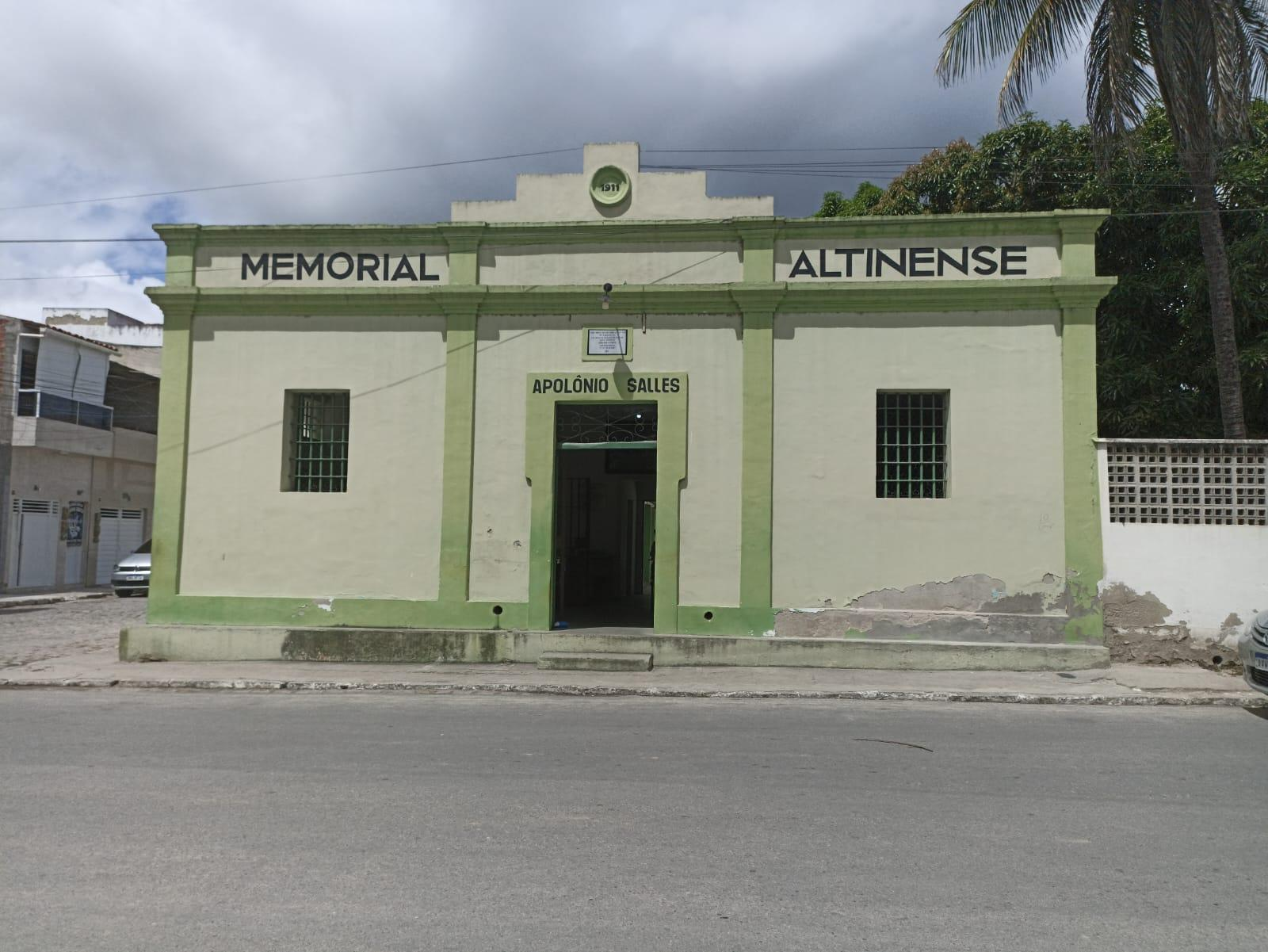
The association relies on 25 members, where only two of them are men, and is hosted on the Altinense Memorial Apolônio Salles. It works as room to alignment meetings of demands inherent to its functioning, besides the confection, exhibition, and marketing of the handcraft products. Its organization counts on a director responsible for the bureaucratic issues and a planning to the participation on local and regional handcraft fairs, in addition to preparing agendas to the meetings, administration of the financial and material resources. There are periodical meetings to debate the association maintenance, the financial results of the month and the definition of the days and hours that each one will be responsible for the place, in both cleaning and sales management.
In addition to the performance on the Altinense Memorial (see Figure 1), Artesal also carry through local handcraft fairs, which are organized and promoted by the associated artisans on behalf of the dissemination of their arts and attraction of outlooks to the region. These events usually take place at the town’s public square or at the free fair, because it has a higher number of people. Such events are important to contribute to continue the local handcraft production.
The association performs as a bond between the artisans and the consumer of the local art from Altinho – PE, as well as from the neighboring cities that visit the town on the events organized by Artesal, since it concentrates the produced pieces on a place that serves as a reference point to find and sell the artisans’ arts, but also as a proper space for the approach between the artisans and the appreciator of their arts. Beyond these points, it symbolizes the place where the artisans receive the right recognition for their productions and with it, they achieve a complementation on their incomes, enabling them to drive the municipality local economy.
Figure 1
Headquartes of the Altinense Mememorial, where Artesal takes place
The linking process with the association, as mentioned by the director, happens through the evaluation she does of a piece, observing if it is in accordance with de characteristics of local handcraft. Furthermore, is important to mention that there is, monthly, a rate payment of association which costs R$7,00 to the maintenance of Artesal, but the commitment of the artisan does not end with this payment, there is also a meeting that happens every month to discuss strategies of functioning and planning the activities of the month.
For that matter, is valid to quote Nicoletti (2018), who presents the changes brought by the Industrial Revolution on the ways of manufacturing production, considered the opening moment to new methods, techniques, and organizational models. However, the author indicates that
[...] the handcraft object carries feelings of permanence and singularity by keeping part of its millennial characteristics as the domain of the making and the working, the transmission of knowledge through orality, the complete control of the productive process and its strong bond with the territory since it is the representation of the local culture (Nicoletti, 2018, p. 33).
Thus, we noticed the importance of the handcraft products to the maintenance of the local culture. For this reason, the association process of an artisan on Artisal depends on the evaluation of a prior approval of the piece, so that the originality of the handcraft local products can be kept. But there is a fact to be observed: the propensity to the standardization of the pieces imposed by the director of the association, who is the responsible for the evaluation of the products, since there is a kind of standard or format which are expected to be found in the piece after its finalization.
It is pertinent to emphasize that even though the organization has traces of the subjectivity of those who constitute it, the accession process of a new artisan should not be consisted on evaluate just characteristics of the produced piece or on the type of material being handled, much less on using a “model” or “inspiration” to be followed in the attempt of defining an expectation to the piece, considering it acceptable or not acceptable. An evaluation in holistic way would be more interesting, observing the intrinsic technique, material, knowledge, and ability of doing handcraft. Nevertheless, the justification given by the director was based on the idea of proceeding with this format as an attempt of maintaining just handcraft products from the region to continue local tradition and culture. Still, we highlight the standardization that can result of this evaluation form.
For the management processes, although there is the possibility of modifying organizational processes, we observed that the members of Artesal prefer to proceed with what is applied on the routine, “the notebook” by instance, to register the sales’ inflows and outflows. According to the craftswomen, the notebook fulfils the expected in terms of financial management, which make the use of an Excel spreadsheet unnecessary.
We draw attention to the management of the association, which is shared by every person that is part of it, though it has a director who guide it. Therefore, the artisans are divided by shifts (morning and afternoon) to be at Artesal as responsible for the activities of exhibitions and sales of the pieces, as the manufacturing of it.
The interviewees I5 and I6 consider the association’s current functioning interesting, because they can be close to the director and with each other, what also promotes their participation on moments of information’s exchange or ideas about how to organize, for example, the exhibition of the products, how they are going to move and carry the pieces to an event, inside or outside the town. The I6 finds important the exchange on the association “[…] because I can go to so and so [referring to the director] and talk about a different idea for us to try here” (Excerpt from interview I6)
The interviewees I2 and I3 consider the relationships between the associated artisans personal and direct, so it is possible that one craftswoman warns another about the quality of her piece or about other information inherent to the association’s maintenance and the artisan’s activity in general, according to the excerpts: “[…] if there is something that needs to be improved, or a sewing that needs to be remade, we go and say it to the person” (Excerpt from interview I2). On the other hand, I3 claimed: “[...] and, for example, if there was a request for a piece that expired, we go and say ‘look, so and so, bring us more of that piece because it expired” (Excerpt from interview I3).
It is important to note that the members perceive a reception of their contributions as associated artisans of Artesal and that there is the interest of helping on the maintenance of this place as whole, so they are not there just to sell their products. Resting on the used theory, this is one of the main motivations of the ordinary woman: to find and to claim for her space through her tactics.
The responsibility sense also is present as a key point so that Artesal perpetuated itself as an important economic activity of Altinho – PE. The activities of organization and cleaning of the place, exhibition of the products, cash book register, and other things, are under the responsibility of all members, which are distributed on days of the week so they can be responsible for such assignments in the day they were appointed to. In other words, interpersonal relations and with collaborative aiming, are the basis to the good functioning of the place studied. And it is exactly on these moments that “[...] the cooperation between the craftswomen can result on benefits as exchange of knowledges, resources sharing and improvement of productivity and quality of the products” (Mota et al., 2017, p. 37).
The marketing of the handcraft pieces take place at the association, located on the downtown, on the building in which the Municipal Memorial functions. The pieces are made from several materials, from the fabric of the kitchen cloths, the lace, and renaissance clothes, to the goat leather – the association’s flagship, according to I1’s speech.
We look at the goat leather as Altinho’s flagship, as the study made by the city hall and by SEBRAE. Because Altinho started on a farm where the farmer fostered animals. We make […] bags with this goat leather for our history, right?!” (Excerpt from interview I1)
It is possible to notice that the main pieces are produced with goat leather, a characteristic animal from the region, that is part of the citizens’ daily lives. This refers to what Silva (2016) claimed: is from the daily life that inspirations to make handcraft emerge. Unlike of what is preached by mainstream management, in which entrepreneurs must elaborate previous studies to observe the feasibility of their businesses and the potential customers’ taste, the handcraft practice search from inspirations and materials on their daily lives.
Handcrafts consist of representation through symbols of the local daily life, and that reinforces the roots of those who learned with their ancestors to give form and color to the materials. The Sebrae Center of Reference of the Brazilian Handcraft – CRAB, points out that these productions provide the opportunity of working on their native places and generating income, which provides identity and cultural knowledges appreciation (CRAB, 2023).
The handcraft from Altinho – PE is an essential pillar of social inclusion and appreciation of the regional culture, that offers the livelihood for many families. The handcraft production many times involve techniques transmitted from generation to generation, providing opportunities to the local artisans on selling their creations, generating not only an increase on the family income, but also the appreciation and preservation of the cultural practices. In that way, Altinho’s handcraft is not only an artistic expression, but a fundamental economic branch that boosts local development, provides the town’s cultural identity, and contributes to the region’s socioeconomical sustainability. On the following section, we will clarify about how the ordinary management is made on the businesses produced by the association.
4.2 The ordinary management on Artesal and its contributions to local and regional development of Pernambuco
The artisan activity demands a longer time to craftswoman creativity by the dynamics present on the pieces confection. Considering that most of the producers are women, the research participants emphasized that the handcraft production is developed at their own households, as well as the association scope. The fact that the production is made on their household spaces can be linked to what Silva (2016) says about the absorption of the elements from the countryside daily life, such as their neighborhood, their families, their conversations etc., which are strongly portrayed on the pieces by most part of the craftswomen.
Still regarding the production made by everybody on the association, I2, I6 and I7 interviewees highlighted that work from home has a beneficial flexibility, because it does not restrict the artisan process and helps to keep the individuality of each piece, different from the mass production, by instance, in which many pieces are made at the same time in a certain space of time and, as emphasized by I3, on handcraft, each piece must be unique and are unlikely to be the same.
Even though this is not the aim of this work, there is not how to ignore the women’s role before the challenges of managing the household activities and the ones from the professional market. To M Montenegro et al. (2013, p. 56) “[...] craftswomen have to deal many times with the artisan work, the household responsibilities and looking out for their children, which can be stressful and harmful for their productivity and income”. Consequently, we stress that the local flexibility of handcraft production is good to the members associated, and that enable the persistence of the handcraft practices, which converts the house into workplace, where work, family and business are interweaved.
As previously mentioned, the promotion and marketing of the products take place at the association and in regional and national fairs, in which Artesal participates, as Fenearte, the biggest handcraft fair of Latin America. Moreover, in May of 2023, the Fenearte’s president visited the association’s head office and talked about the fair, that had as subject “The earthenware craftswomen”, a strong type of handcraft produced at Altinho – PE, in accordance with Figure 2.
Figure 2
Visit of the Fenearte’s president at Artesal in May/2023
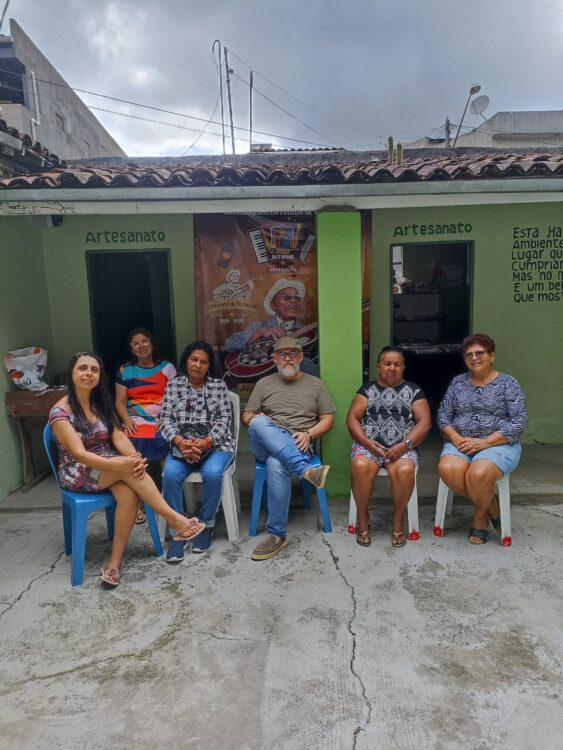
Source: Altinho – PE City Hall News Portal.
The participation on fairs is an important room for handcraft’s cultural promotion, as well as for a higher marketing of the handcraft pieces. One aspect to be pointed out is the cooperation on the marketing of the handcraft products, because when a customer requires a certain piece with a specific material, the craftswoman herself indicates another craftswoman able to offer the required product. The cooperation can be considered another aspect that marks ordinary management, in the sense of understanding that, even though each member has to sell their piece, the support from one to the other does not cease to exist and also attract benefits to one another. The daily lives relationships established between ordinary men (Carrieri et al., 2014) are those present in the functioning of Artesal.
This form of business, marked by the direct contract between artisan-customer, helps to build loyalty by the customer, who identifies with the type of business, so ‘[…] the personal contact is important to establish a relationship of trust between the artisan and the customer, that can result on loyalty and recommendations to new customers” (Mendes et al., 2019, p. 93).
Another aspect that should be highlighted is the importance of the craftswomen organized in association. According to I1, the association is claimed as an utmost importance to the artisans for the representativity provided to the category at Altinho – PE. It is through this association that the associated members’ rights are ensured and gain power, according to her statement:
“[...] since it is an association, I have the contact of all of them and it becomes a family with the same purpose of helping each other, promote our work, we have a lot of talents where we sell the piece, make an order to the partners […]” (Excerpt of interview I1)
Is from the association that the handcraft activity is strengthened, making the view to handcraft easier and the search for maintenance resources of Artesal, as the participation on Fenearte and other fairs.
As for the general registers of the business, as the cash inflows from sales and the several costs of the association for instance, are done manually on a notebook. The interviewees I1, I3 and I5 reported that the inflows and outflows are registered on a “cash book”, according to this model: name of the artisan who made the piece, its costs and payment method. This is another strong characteristic of ordinary businesses that do not have any technological tool for its management, so that the tools used are adapted according to the needs of the place, in a way that those involved find meaning on the manner they conduct their businesses. An example of it, is I3’s speech: “[...] is good to make it that way because the money we earn, we go and write down here [in reference to a notebook that was on her hands] whose it is and when you see the person the first thing you do is delivering it” (Excerpt from the interview I3).
Once more, I6 reaffirmed that the way the sales are registered turns the financial organization easier, since according to her, it is practical to sell the piece of a certain artisan and soon after, write down the sale cost, the percentage withdrawn from the association and repost the money to the craftswoman that made the piece. When asked about the possibility of inclusion of a spreadsheet to the cash register, again, I6 said “[…] that they could give it a try, but, since it is this way [referring to the tradition of the notebook notes], is better to let it how it is” (Excerpt from interview I6). The interviewees I1 and I4 reinforce that the current format, i.e., the notes on the notebook, the sale based on trust and the delivery of the money of a sale on hands, is more appropriated to the association’s dynamics, since it strengthens their relationship with their audience and with the director.
Those reports uncover the lack of worries concerning the incorporation of a functional instrumentalization to the business, since the traditional form of notes on a notebook paper is enough to register the businesses accomplished. Therefore, we highlight other characteristic from ordinary business, the non-racing to modernization, because by and large, the most important is to perform activities that have meaning to those who make it.
Other category emerged from the data is the autonomy in the decision-making process of the association. As previously quoted by I1, there are meetings every month, where the members associated discuss the planning of Artesal and have the proper space to manifest their opinions, always considering what is pertinent to a good development and the permanence of the association’s activities. The interviewee still enhances that there is not any type of political interference on those decisions.
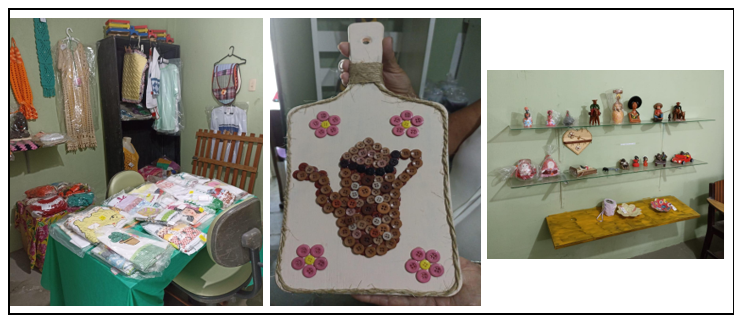
After that, we present some registers of the place where the association is located, as well as the piece exposed there. Figure 3 shows the front of the association and its interior, a cozy space to visitation with a kind of park and view to the paintings about regional daily life, in addition to some pieces (see Figure 4) which were exhibited when the research happened.
Figure 3
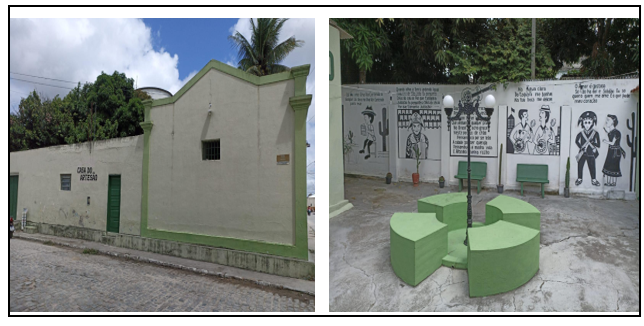
External and internal environment of Artesal
Figure 4
Handcraft products sell in Artesal
From the data collected, is possible to notice traces of the ordinary management, because Artesal develop its activities from the daily life, it means that it happens according to the arising needs they rectify. It does not refer to lack of planning or management, but to other form of manage business. The context of handcraft activity demands non-programmed actions, that are not solved by standardized and previously stablished solutions. The Table 2 present some traces of the ordinary management observed.
Table 2
Ordinary mangement traces in Artesal
|
ORDINARY MANAGEMENT TRACES IN ARTESAL |
|
|
Registers of the associated members of Artesal. |
It is used as a handmade carnet, where the monthly contribution of each craftsman and craftswoman is registered. |
|
Registers of inflows and outflows of the pieces. |
It is used a notebook where are noted the financial inflows and outflows, as well as the payment method of the pieces’ sales. Moreover, is also mentioned the name of the craftswoman who made the piece. |
|
Collective work on the handcraft production. |
The pieces are produced followed by inspirations and exchanges between the craftswomen, so it is not established a schedule. |
|
Storage of the handcraft pieces. |
There is not necessarily a storage of the pieces, but the ones which are not exhibited in the association are stored on the craftswomen houses due to the small space the association has. |
|
Information sharing and experiences exchange. |
The exchanges take place through the biweekly or monthly meetings made in the association, in addition to the ones made in other moments and on their daily lives, since they live next to each other. |
|
Promotion, marketing and communication with the customers. |
Besides the association’s space, the craftswomen rely on the social network’s resources (WhatsApp and Instagram) to promote and sell, as well as to maintain a communication with the customers. Also, the face-to-face exchange is sustained. |
|
Reciprocity, solidarity and appreciation of the exchanges. |
Although the association has its direction, there is not a formal division of tasks. They are encouraged to reciprocity and exchange of materials, and experiences between the craftswomen, in addition to the shared sale of the handcraft pieces. |
Considering that ordinary management is characterized by the daily life of the business, Table 2 offers reflections and learnings for the existing knowledge about the pluriverse of forms of business management that distance themselves from bureaucratic and capitalist organizations and constitutes an interesting counterpoint and addition to the characterizations of dominant ways of managing.
Characteristics such as non-hierarchical division of tasks, sense of responsibility, proactivity, daily improvisation to control inflows and outflows and for meetings, artisans' concern with their companions' pieces, sharing finishing information, concern about dividing tasks, interest in maintaining the customer close to the pieces and the town's history can be presented as those predominant in this type of business, which relies on people's trust and commitment to move forward with the artisanal association.
Regarding the contribution of the handcraft activity to local development, the importance of organizing artisans in an associative form is notable, to contribute to the strengthening of the activity. Furthermore, considering the socioeconomic context of the municipality, we consider that the activity contributes economically. This follows what happens in other municipalities in Pernambuco, as Cordeiro (2022) pointed out. For the author, handcraft production occupies an increasingly prominent place as a structuring element of Pernambuco’s economy, generating employment, income, and opportunities for thousands of people (Cordeiro, 2022, p. 4).
Pernambuco builds imaginaries that reaffirm its culturally emancipated stance, therefore, consuming art is a contribution that goes beyond local identification, but rather is one of the ways in which artisans are able, economically speaking, to continue their pieces, purchasing materials, participating on events, and improving their knowledge. In Altinho, it is possible to see this relationship when I1 and I4 talk about the extra income they earn from their activity in the association, income that can be transformed into personal investment or participation in local handcraft fairs.
In addition to its artistic-cultural importance, handcrafts have become, over the years, a relevant segment of economic activity in the State and, thinking about transforming art into a source of income for artisans, the Government of the State of Pernambuco has invested in handcraft commercialization actions, through the Pernambuco Handcrafts Program (Pape), an example of which is Fenearte.
Events of this magnitude represent a great opportunity not only to preserve local cultural identity, but also to generate jobs and income opportunities for many residents. 2018 was the 8th year in which the municipality of Altinho participated in Fenearte, showing its commitment to local artists in this important artistic and cultural showcase. The municipality's stand exhibited and sold leatherwork, recycling, embroidery, gourd and woodwork, marble dolls and fuxico[1] dolls, among other products (Altinho City Hall News Portal, 2018).
In 2021, craftsmen and craftswomen from Altinho/PE once again participated in the fair that paid homage to the Armorial Movement, an artistic-cultural initiative created by the writer Ariano Suassuna, responsible for creating high art through the elements and richness of local popular culture. At the Altinho stand, various types of handcrafts made from leather, fabric, wood, etc. were on display. (Altinho City Hall News Portal, 2021). In 2023, Altinho participated again and was honored with the Fenearte 2023 theme.
Ordinary management in the artisanal context becomes fundamental for maintaining the essential activities of the business, whether financial, production and marketing of the pieces produced, or with the promotion of handcraft practice itself. It is also through it that the organization can achieve its objectives so that all its members can be included through the equitable distribution of responsibilities. Furthermore, the type of management practiced by the association has allowed the search for training opportunities, partnerships, and participation in events, contributing to the growth of artisans and the continuity of artisanal activity, which encourages local and regional development. It is important to draw attention to the fact that the work contributes to the debate on the Sustainable Development Goals (SDGs), mainly SDG 8, SDG 10, and SDG 17, when it discusses forms of business and management based on the principles of environmental sustainability, social and economic aspects based on handcraft practices in a peripheral context.
Through the work of associations, as in the case of Artesal, craftsmen and craftswomen gain greater representation for their collective interests in a more effective way and can also have access to resources and infrastructure that they would not be able to access individually, such as workspace, equipment and shared materials and financial assistance for the sale of pieces at regional handcraft events (Fenearte, by instance).
Thus, in terms of economic development, Artesal's work gains relevance through the sale of pieces at fairs and exhibitions in the town itself, in addition to major nationally known events, which contribute to reaching consumers of local art, obtaining an important source of income. The strengthening of handcraft activities also contributes to the local economy, as this income is used in local businesses, driving other economic sectors in the region.
5 Final Considerations
From the conducted research, we found some principles of ordinary management, such as reciprocity, solidarity, and appreciation of exchanges, which are essential for the continuity of artisanal activities, in most cases, carried out by women who are often considered marginal in the Administration mainstream.
Carrying out this work made it possible to understand how ordinary management is characterized and present in peripheral organizations, which have operating peculiarities specific to their context. Through this approach, we reinforce the importance of carrying out research that gives voice and values the history of individuals and businesses that are on the margins and present characteristics different from the functionalist industrial context.
From the specific point of view of the association, from a critical look at the results, we highlight a propensity for the standardization of pieces imposed by the director of the association, as a kind of standard or desired format of the piece is expected after its completion, However, this is not a standardization in the sense of industrial production. Another point to be highlighted is the influence that the market imposes on craftswomen, as some pieces are produced not by their inspiration, but by greater market demand.
Handcrafts in Altinho – PE proved to be an important way both to preserve its cultural identity and to boost the local economy. The city's handcraft production, whether through embroidery, ceramics, leather, or other traditional techniques, not only offers unique pieces full of history, but also generates employment opportunities for local residents. Furthermore, crafts are important to attract tourists and, by valuing and investing in the artistic and manual skills of its members, Artesal not only provides a source of income, but also preserves and celebrates its artisanal knowledge, in addition to contributing to the reach of some of the SDGs, such as SDG 8, SDG 10 and SDG 17.
As we have seen, research based on the daily practices of ordinary subjects can present important results and produce marginalized knowledge that escapes the hegemonic conceptions of Administration studies, helping to encourage researchers to adopt new perspectives of doing science, in addition to enhancing an alternative view on the management of handcrafts and other organizational forms based on the cultural, social and economic plurality of the organizational context, in order to understand the pluriverse of management expression. Therefore, this study provided reflections on the actions of practical subjects who develop alternative ways of conceiving management.
It is worth highlighting the importance of the topic being addressed academically during the training of future organizational managers in management training courses. Knowledge of different business models points to the plurality of a professional who is willing to work in different types of businesses.
As a suggestion for future research, we recommend carrying out similar studies in other handcraft associations, to enable comparisons and expand knowledge on this topic. Research that adopts the theoretical perspective of ordinary management can contribute to the understanding of issues that are silenced and neglected by mainstream research in Administration, promoting the development of an alternative view to the functionalist research paradigm.
References
Alves, G. L. (2014). Arte, artesanato e desenvolvimento regional: temas sul-mato-grossenses. Campo Grande, MS: Editora UFMS.
Artesanato de Pernambuco. (2023). Portal do Artesanato. Recuperado de https://www.artesanatodepernambuco.pe.gov.br/pt-BR/artesanato-de-pernambuco.
Banco do Nordeste. (2002). Ações para o desenvolvimento do artesanato do Nordeste. 2. ed. Fortaleza: Banco do Nordeste.
Bardin, L. (2011). Análise de conteúdo. São Paulo: Edições 70.
Brasil. Portal do Artesanato Brasileiro (2023, novembro, 7). Recuperado de: https://www.gov.br/empresas-e-negocios/pt-br/artesanato
Carmo, J. de O. dos S., Gomes, J. E. De L.; Oliveira, R. C. R.; Melo, M. G., Costa, C. E. S., & Silva, V. (2023). A extensão em Administração: experiências a partir do componente “antropologia das organizações” em tempos de covid-19. Revista Eletrônica Extensão em Debate, 12(13), 1-8.
Carrieri, A. de P., Perdigão, D. A., & Aguiar, A. R. C. (2014). A gestão ordinária dos pequenos negócios: outro olhar sobre a gestão em estudos organizacionais. Revista de Administração (FEA-USP), 698-713.
Carrieri, A. de P., Perdigão, D. A., Martins, P. G., & Aguiar, A. R. C. (2018). A Gestão Ordinária e suas práticas: o caso da Cafeteria Will Coffee. Revista de Contabilidade e Organizações, 12, 141-359.
Certeau, M. (2014). A invenção do cotidiano: 1. Artes de fazer. 22.ed. Petrópolis: Editora Vozes.
Cordeiro, E. J. C. (2022). O consumidor na cadeia produtiva do artesanato. Relatório de realização de atividades do Projeto Cultural Consumidor na Cadeia Produtiva do Artesanato – 1600/18. FUNDARPE, Pernambuco.
Faria, A. M., & Silva, A. R. L. (2017). Artesanato nos estudos organizacionais: a literatura brasileira de 2006 a 2015. Espírito Santo.
Figueiredo, M. D. de. (2014). O Artesanato enquanto Prática e Materialidade: Argumento para Pensar a Dimensão Estética e a Perspectiva do Embodiment nos Estudos Organizacionais. Revista Interdisciplinar de Gestão Social, 3(1), 189-205.
Figueiredo, M. D. & Marquesan, F. F. S. (2014). Artesanato, Arte, Design... Por que Isso Importa aos Estudos Organizacionais? Revista Interdisciplinar de Gestão Social 3 (3), 127-143.
Flick, U. (2009). Introdução à pesquisa qualitativa. Porto Alegre: Artmed.
Gonçalves, M. E. V., Grangeiro, R. da R., & Silva Júnior, J. T. (2018). O Perfil do Artesão e de sua Produção na Cidade de Várzea Alegre –Ceará. Revista Multidisciplinar e de Psicologia, 12 (41), 530-550.
Gouvêa, J. B., Cabana, R. de P. L., Ichikawa, E. Y. (2018). As histórias e o cotidiano nas organizações: uma possibilidade de dar ouvidos àqueles que o discurso hegemônico cala. Revista Brasileira de Estudos Organizacionais, 5(12), 297-347.
Grande, M. M., Padilha, V., Pain, B. F., & Florian, F. J. de S. (2012). Da Tradição à Modernidade: O Savoir-faire do Mestre de Ofício na Produção da Cerveja e da Cachaça Artesanais. Revista Interdisciplinar de Gestão Social, 1(3), 25-48.
Grangeiro, R. da R., & Silva Júnior, J. T. (2020). Carreira e Artesanato: A Trajetória Profissional de Uma Família de Artesãos. Revista Interdisciplinar De Gestão Social, 8(3), 145-168.
Keller, P. (2014). O artesão e a economia do artesanato na sociedade contemporânea. Política
& Trabalho, (41), 323-347.
Machado, F. C. L., Silva, A. R. L., & Fernandes, T. A. (2020). The Ordinary, Cultures, and Management: The Organizing Processes within the Handicraft Sector in Piúma (ES), Brazil. Organizações & Sociedade, 27(95), 644-673.
Machado, R. C., Chropacz, F., & Bulgacov, Y. L. M. (2020). Epistemologia de Certeau e sua Contribuição para os Estudos Baseados em Prática em Organizações. Revista Ciências Administrativas, 26(2), 1-10.
Marquesan, F., & Figueiredo, M. D. (2014). De artesão a empreendedor: a ressignificação do trabalho artesanal como estratégia para a reprodução de relações desiguais de poder. Revista de Administração Mackenzie, 15(6), 76-97.
Menezes, J. A. S. (2017). A participação das mulheres no artesanato brasileiro: uma análise da realidade do estado do Ceará. Revista Brasileira de Pesquisa em Turismo, 11(1), 62-79.
Minayo, M. C. S. (2007). Trabalho de Campo: Contexto de Observação, Interação e Descoberta. In S. F. Deslandes, R. Gomes, & M. C. S. Minayo (Eds.), Pesquisa social: teoria, método e criatividade (26. ed., pp. 61-77). Petrópolis: Vozes.
Moraes, M. D. C. de, Seraine, A. B. M. dos S., & Barbosa, C. (2020). Artesanato e políticas públicas no Brasil:: uma trajetória entre economia e cultura. Conhecer: Debate Entre O Público E O Privado, 10(25), 159–182.
Ortiz, R. I. (2020). A histórica relação entre arte e antropologia: múltiplos olhares, dilemas e perspectivas. Revista de História,11(22), 182-212.
Oliveira, M., & Freitas, H. (2010). Focus group: instrumentalizando o seu planejamento. In C. K. Godoi, R. Bandeira-de-Mello, & A. B. Silva (Eds.). Pesquisa qualitativa em estudos organizacionais: paradigmas, estratégias e métodos (2. ed., pp. 325-346). São Paulo: Saraiva.
Pernambuco - CRAB. (2023). Artesanato de Pernambuco. Centro de Referência do Artesanato Brasileiro. Recuperado de https://crab.sebrae.com.br/artesanato-brasil/artesanato-de-pernambuco/pernambuco/.
Portaria nº 1.007/SEI (2008). Institui o Programa do Artesanato Brasileiro, cria a Comissão Nacional do Artesanato e dispõe sobre a base conceitual do artesanato brasileiro. Brasília. Recuperado de: https://www.in.gov.br/materia/-/asset_publisher/Kujrw0TZC2Mb/content/id/34932949/do1-2018-08-01-portaria-n-1-007-sei-de-11-de-ju
Prefeitura Municipal de Altinho. (2018). Artesanatos de Altinho são comercializados na 19a Fenearte. Recuperado de https://altinho.pe.gov.br/v1/artesanatos-de-altinho-sao-comercializados-na-19a-fenearte/.
Prefeitura Municipal de Altinho. (2021). Artesãos de Altinho marcam presença na 21ª Fenearte. Recuperado de https://altinho.pe.gov.br/v1/artesanatos-de-altinho-sao-comercializados-na-19a-fenearte/.
Prefeitura Municipal de Altinho. (2023). Presidente da Fenearte visita o Memorial Altinense. Recuperado de https://altinho.pe.gov.br/v1/presidente-da-fenearte-visita-o-memorial-altinense/
Ramos, G. M. P. D., Muylder, C. F., & Freire, D. A. L. (2014). O artesão e o empreendedorismo: um estudo bibliométrico da produção acadêmica em eventos Enanpad de 1999 a 2008. Revista Metropolitana de Sustentabilidade, 4(1), 76-94.
Ribeiro, A. C., Demo, G., & Santos, C. D. (2021). Grupo Focal: aplicações na pesquisa nacional em Administração. Pretexto, 22(2), 108-128.
Rodrigues, P. R., Araujo, C. F. R., & Cassanego Júnior, P. V. (2023). Marketing empreendedor e as redes de relacionamento nas pequenas empresas do ramo alimentício artesanal de Sant’ana do Livramento. Revista Livre de Sustentabilidade e Empreendedorismo, 8 (3), 87-124.
Santana, M. F. (2020). Trajetória do artesanato brasileiro: perspectiva das políticas públicas (Dissertação de Mestrado). Universidade de Brasília, Brasília, DF.
Serviço Brasileiro de Apoio às Micro e Pequenas Empresas (SEBRAE). Artesanato vive movimento de crescimento de demanda e do número de profissionais cadastrados (2022). Recuperado de: https://agenciasebrae.com.br/cultura-empreendedora/artesanato-vive-movimento-de-crescimento-de-demanda-e-do-numero-de-profissionais-cadastrados/.
Sebrae. (2023). Data Sebrae. Recuperado de: https://datasebrae.com.br/artesanato/
Silva, A. J. da. (2016). Mulheres vestidas de barro e os sentidos da produção de mestras artesãs da comunidade do Alto do Moura em Caruaru/PE (Dissertação de Mestrado) Universidade Federal de Pernambuco, Recife, PE.
Silva, R. K. A. da. (2018). Práticas artesanais fomadoras de paisagens culturais: um olhar sobre a sustentabilidade (Dissertação de Mestrado). Universidade Federal de Pernambuco, Recife, PE.
Siqueira, E. S., Silva, F. C. L., & Silva, M. H. (2021). Informalidade e Resistência Cultural: o Trabalho das Artesãs do Alto Do Moura, Caruaru – PE. Revista Brasileira de Estudos Organizacionais, 8(1), 87-118.
Sousa, J. R. F., Sá, M., Souza, D. C., Silva, S. K.(2020). Novos Modos de Fazer Artesanato e Desafios à Manutenção Econômica no Alto do Moura do Século XXI. REAd. Revista Eletrônica de Administração 26(3), 557–585.
Souza Neto, B. de, Diniz, D. M., & Silva, A. S. (2021). Viradores e suas Virações: a prática cotidiana de um empreendedor artista de rua. Revista Interdisciplinar de Gestão Social, 9 (3).
Valente Junior, A. S., Alves, M. O., & Santos, C. R. C. (2022). Banco do Nordeste do Brasil: 70 anos de contribuição para o desenvolvimento regional. Fortaleza: Banco do Nordeste do Brasil.
Vieira, I. E. N. S. (2018). Manifestações Culturais de Saubara-BA: Contribuições para preservação do Ecossistema Manguezal (Dissertação de Mestrado). Universidade Federal da Bahia, Salvador, BA.
Violin, F. L. (2022). Turismo como criador de mercado para o artesanato em Mato Grosso do Sul. Interações, 23(2), 575–594.
------------
[1] Fuxico handcraft is made up of several small bundles of clothes that, when sewn together, give rise to flowers of different colors.