Received: 16/01/2024
Accepted on:23/09/2024
Cultural Entrepreneurship and Handicrafts: the case of the Central Markets of Aracaju
Empreendedorismo Cultural e Artesanato: o caso dos Mercados Centrais
de Aracaju
Luiz Felipe Batista Morato1i, ORCID: https://orcid.org/ 0009-0006-2091-6261; Gracyanne Freire de
Araujo²ii, ORCID: https://orcid.org/0000-0002-7303-8793; Rosinadja
Batista dos Santos Morato³iii, ORCID: https://orcid.org/0000-0002-0160-8478; Tais
Alexandre Antunes Paes4 iv ,
ORCID: https://orcid.org/ 0000-0001-9200-5922
1. Universidade Federal de Sergipe, Dep. Relações Internacionais, São Cristóvão, Sergipe,
Brasil. E-mail: moratolfb@gmail.com
2. Universidade Federal de Sergipe, Dep. Administração, São Cristóvão, Sergipe,
Brasil. E-mail: gracyanne@gmail.com
3. Universidade Federal de Sergipe, Dep. de Computação, São Cristóvão, Sergipe,
Brasil. E-mail : rosinadja@yahoo.com.br
4.
Universidade Federal
de Sergipe, Dep. de Turismo,
São Cristóvão, Sergipe, Brasil. E-mail: taletunes@yahoo.com.br
Resumo
O empreendedorismo cultural
vem consolidando-se como campo de estudos e, nesta pesquisa, está associado à produção de artesanato como prática cultural. O
objetivo deste artigo é compreender a
relação entre empreendedorismo cultural e artesanato, avançando na perspectiva
da construção simbólica da prática artesanal. Para tanto, foram tomados como
objeto de estudo os Mercados Centrais de Aracaju, espaços de apresentação da
cultura sergipana, adequados para esta pesquisa. Usando abordagem qualitativa, foram realizadas entrevistas semiestruturadas com comerciantes de artesanato dos mercados e artesãos
fornecedores, para entender
a visão deles sobre empreender por meio da cultura, material estudado
pela análise da narrativa. Registros fotográficos e observação direta também
foram utilizados. Os achados apontaram que os comerciantes dos mercados
participam da cadeia de disseminação da cultura do artesanato sergipano nos mercados - mas sem
produzirem efetivamente - e na manutenção dos laços culturais. Concluiu-se que
no âmbito do empreendedorismo cultural, o artesanato tem um grande potencial
para empreendedor como atividade cultural, sob um enfoque na criatividade e na
inovação, aperfeiçoando o trabalho do artesão e mantendo seu caráter simbólico.
Mesmo assim, há carência de ações nos mercados que estabeleçam o reconhecimento dos artesãos enquanto
empreendedores culturais e guardiães de uma
cultura secular.
Palavras-chave: empreendedorismo cultural; artesanato; Mercados Centrais de Aracaju.
Abstract
Cultural entrepreneurship has been consolidated as a field of study and, in this research,
this concept was associated with the production of handicrafts
as a cultural practice, in the context of municipal markets
of Aracaju and producer workshops in Santana do São Francisco/SE. The aim was
to investigate the practices of artisans,
the dynamics of craft trade and
its production, associated with cultural entrepreneurship. Using a qualitative and exploratory approach,
semi-structured interviews
were conducted, based on narrative analysis, with craft traders from the
markets and artisan suppliers, as well as photographic records and direct observation. The findings showed that market
traders participate in the chain of dissemination of craft culture, but without
entering into the production process and maintaining the cultural ties that permeate the
creation of a piece, which
is the role of the artisan. It was concluded that there is a lack of
actions to recognise artisans as entrepreneurs and guardians of a centuries-old
culture.
Keywords: Cultural Entrepreneurship; Craftsmanship; Central Markets.
Citation: Morato, L. F. B., Araujo, G. F., Morato, R. B. S. & Paes, T. A. A. (2025). Cultural Entrepreneurship
and Handicrafts: the case of the Central Markets of Aracaju. Gestão &
Regionalidade, v. 41, e20259420. https//doi.org/10.13037/gr.vol41.e20259420
1 Introduction
Entrepreneurship can be defined as the attempt to
provoke, through individual or collective action, the emergence of new
economic, social, institutional and cultural means (Campos, 2021). This concept
is closely related to culture (Dimaggio, 1982; Davel & Cora, 2016; Marins
& Davel, 2020), which forms the values that direct a community's activities
(Julien, Marchesnay & Machado, 2010). Culture can direct these activities
towards cultural production, based on the symbolic
nature of its products, thus fostering entrepreneurial practice (Guerra & Paiva Júnior, 2015). Therefore, cultural
entrepreneurship can be understood as a confluence between entrepreneurship and culture, which
has been established as a field
of study within the area of entrepreneurship (Hausman
& Heinze, 2016; Essig, 2017; Araujo &
Barbosa, 2019; Lounsbury & Glynn, 2019). Despite the consolidation
process (Loy & Ageson, 2018), understanding the singularities of
entrepreneurship in culture and arts requires a better understanding in order
to boost studies on cultural entrepreneurship (Göleç & Maksudunov, 2019;
Neves & Davel, 2021).
Academic production on cultural entrepreneurship has grown in recent decades
(Chang, Potts & Shih, 2021; McMullen, Ding & Li, 2021). Studies
include the importance of the topic
in materialising symbolic
and economic capital
(Townley & Gulledge,
2015); on creativity and innovation (Hausmann & Heinze, 2016); as well as
reflecting cultural entrepreneurship as an instrument for entrepreneurial
action through cultural and social values (Lange, 2018); and incorporating
research in the public sector for the development of public policies (Brooks,
Vorley & Gherhes, 2022; Fazlagić, Sulczewska-Remi & Loopesko, 2021). However, little has been
discussed about cultural entrepreneurship from the perspective of artistic
logics (Marins & Davel, 2020), especially the spaces/organisations
(Petrova, 2018) where arts are presented and
constituted, such as markets, which are considered environments of cultural
familiarity and identity
(Canclini, 1983).
In the context
of this research, the concept of craftsmanship is presented as an aspect
of identity, which is configured as a manual form of art and a possible
means of income for the communities involved (Castilho, Dorsa, Santos &
Oliveira, 2017). Craft practices are closely linked to culture and have
a symbolic character for all stakeholders in the process, whether consumers of
craft product or the artisans themselves (Beling, Fantineli, Cancelier &
Vargas, 2020).
The objects of this study were the markets Thales Ferraz
and Antônio Franco, located in the centre of Aracaju, the capital of the
Brazilian State of Sergipe. These markets are characterised as an important
cultural and tourist environment for the State, as they bring together various
practices related to culture, especially handicrafts (Leite, 2019). Therefore,
municipal markets are an important environment for bringing value to practices
related to cultural entrepreneurship. Based on the initial findings, the
research was directed towards the problem of the present study: What is the
relationship between cultural entrepreneurship and handicrafts from the
perspective of the symbolic construction of the handicraft practice?
In this context, the course of the work specifically
involved getting to know the space where the primary field of research is
located: the Central Markets; understanding the entrepreneurial logic
between the dynamics
of the handicraft trade and its production: who only makes it, who
makes it and sells it, who only sells it, and where these relationships are
established. The secondary field of the exploratory research focused on the
space where handicrafts are produced - the city of Santana do São Francisco,
always bordering aspects of cultural entrepreneurship.
This research is justified by the scarcity of material
that addresses the relationship between cultural entrepreneurship and
handicrafts (Machado, 2013; Davel & Cora, 2016; Castilho et al.,
2017), as well as the importance of bringing value to the cultural
aspects of the people of Sergipe
through greater visibility.
Given these aspects, in order to analyse relevant studies
on the subject, a search was carried out in Capes journals using the keywords
"Cultural Entrepreneurship", "Cultural Entrepreneurship and
Crafts" and "Entrepreneurship, culture and crafts", with a
reference period of 5 years
considering studies in the area
of Applied Social Sciences
that could contain any of the terms mentioned. The first keyword indicated a total of 70 articles, the second 5
articles and the third 30 articles were found.
Analysing the abstracts, objectives, methodologies and research results
for the keyword "Cultural Entrepreneurship", of the 70 studies
indicated, only 1 work showed a specific relationship with the topic
under analysis, the title of which was "Trends and
opportunities for entrepreneurs in the Amapá
handicraft sector" (Santana
et al., 2023).
In the search for the second
keyword, 1 of the 5 articles presented was related to the topic under study,
with the same title as mentioned above. For the third keyword, of the 30 articles listed, only 1, entitled
"Arts and Crafts: For the Promotion of an Ecosystem of Culture, Knowledge,
and Entrepreneurship" (Leon, Torre & Ramirez, 2020), showed any
relation to the present study.
The aim of this article is to understand the
relationship between cultural entrepreneurship and handicrafts from the perspective of the symbolic
construction of the craft
practice. The methodology follows a qualitative and exploratory approach, with semi-structured
interviews with craft market traders and artisan suppliers to understand their vision of cultural entrepreneurship, as well as photographs
and direct observation. The material from the interviews was analysed using
narrative analysis. As a contribution, an integrated understanding of the relationship between
cultural entrepreneurship and handicrafts was drawn up and discussed. In addition, the work presents
an overview of the interviewees' commercial activities
and their challenges.
2 Entrepreneurship and culture: an important relationship
For Campos (2021, p. 245), entrepreneurship is "the
effort to create new economic, social, institutional and cultural environments,
through several individuals or just one individual". According to Carvalho
et al. (2017, p. 634), "entrepreneurship is an economic, cultural,
psychological and sociological phenomenon linked to the emergence
of new business
prospects". It is worth highlighting the concept presented by Lounsbury and Glynn (2001),
who conceive entrepreneurship as being part of the cultural and symbolic domain.
From the point of
view of these concepts, the presence
of culture can be seen as an integral part of the concept of entrepreneurship.
Therefore, entrepreneurship cannot be only associated
with the process of establishing companies (Lounsbury & Glynn, 2001;
Julien, Marchesnay & Machado, 2010). For Machado (2013), entrepreneurship
is a multidisciplinary field which should be joined with the fields of
administration, economics, tourism, anthropology, among others. Therefore,
entrepreneurial practice can be analysed from a broader perspective, seeking a more comprehensive definition that does not exclude its effects and motivations (Guerra
& Paiva Junior,
2015). Lounsbury and Glynn (2001) present a definition that
conceives entrepreneurship as an area that aims to understand how the processes
of innovation and creation take place, focusing on the entrepreneurial subject and the consequences of their actions.
Therefore, this article seeks to
understand the symbolic dimension of entrepreneurship,
which can manifest itself in different ways depending on the society in which
it is practised and based.
With regard to culture, Pereiro and Fernandes (2018)
present a series of concepts that dialogue with each other to form a broad
understanding of the term. In general terms, culture consists of a set of
practices, values, beliefs and customs of a given society. Although not
intrinsic, it is assimilated during the process
of 'enculturation', in which individuals internalise the social context of their group during childhood
(Pereiro & Fernandes, 2018).
According to Julien, Marchesnay and Machado (2010, p.
357) and Machado (2013, p. 18), culture is "defined by customs",
which guide the individual and collective practices of a society, as well as entrepreneurial practices. It is from this causal
relationship that culture
builds its relationship with entrepreneurship. Thus, the cultural
aspects of a society have a great influence on the actions of its
entrepreneurs, since their beliefs, interests and perspectives are conditioned by culture. By understanding this relationship as constant, it is possible
to define a concept that encompasses the dynamics
between entrepreneurship and culture. This brings us to Cultural Entrepreneurship. Reflecting on this concept,
Davel and Corá (2016) point out that, although the interrelationship
between entrepreneurship and culture is the subject of many studies, the same
attention is not paid to the integration of these two concepts. Cultural
Entrepreneurship should therefore be analysed in greater depth in order to
understand its particularities.
2.1
Cultural entrepreneurship and its particularities
As already mentioned, cultural entrepreneurship is a confluence of entrepreneurship and culture, which means that this
theoretical perspective aims to analyse the relationship and implications of culture in entrepreneurial practice
(Guerra & Paiva Junior, 2015; Davel & Cora,
2016), as seen in Figure 01.
Figure 01: Particularities of Cultural
Entrepreneurship
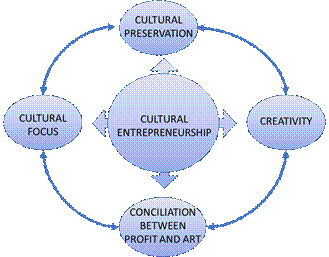
Source: own elaboration
To understand it from this perspective,
it is possible to draw up explanations based on its peculiarities. We can start
by analysing one of them: the focus on culture.
It is possible to state that the focus on
culture is the central characteristic of cultural entrepreneurship, since culture is the foundation
on which the entrepreneurial practices
of a
given
society are developed (Lounbury & Glynn, 2019). Contributing to this
observation, Machado (2013, p. 17)
argues that "culture represents a conscious scheme
of values that guide the daily activities of a community or society, introducing a symbolic order that corresponds to meaning". When assessing which direction is given to entrepreneurial practice
based on culture, Lounsbury and Glynn (2019)
note that culture
is transposed from micro-relationships,
based in the individual sphere, to
macro-relationships, in the collective sphere. Consequently, this symbolic
transposition reinforces the notion of collectivity through entrepreneurial
practice, strengthening a group's identity ties with a productive activity born
within the cultural sphere. This
reveals the next particularity of cultural entrepreneurship: the preservation
of culture.
It is in this sense that Marins and Davel (2020) reveal a
cultural logic applied to entrepreneurship. This vision, from which cultural
entrepreneurship originates, is concerned with cultural transmission based on
collective relationships, which enables to preserve a particular practice -
which can even happen unconsciously (Aquino, Xavier & Muniz, 2022). The
social environment thus becomes the
ideal stage for cultural transmission,
as it comprises symbolic exchange
relationships from the production process to the consumption process
(Bendassoli, Wood Jr., Kirschbaum, & Cunha, 2009; Davel & Cora, 2016; Beling
et al, 2020). According to Araújo and Barbosa
(2019), cultural entrepreneurship, based on social relationships, stimulates
the next particularity to be analysed: creativity.
As Marins and Davel (2020)
point out, corroborating Carvalho et al. (2017), the creative
industries cannot be understood without their relationship with art. This
implies that the production process engendered by the creative industries is dependent on the artistic
aspect of production (Marins & Davel, 2020, p. 122). Therefore, the
cultural entrepreneur can be understood as an
artist, who directs their production
with not only financial needs and gains
in mind, but also their
subjectivity. By employing creativity in the production process, the act of
cultural entrepreneurship makes innovation a common consequence of this particularity (Davel & Cora, 2016; Marins & Davel, 2020; Campos, 2021). This creative
aspect, combined with the
innovative aspect of cultural entrepreneurship, provides the opportunity for
the last feature highlighted: the reconciliation of profit and art.
This dual role of
cultural entrepreneurship is its
most complex characteristic. How can cultural activity, attached to
entrepreneurship, maintain its symbolic meaning and not exclusively surrender
to the logic of capital? To answer this question, we must first problematise the damaging potential
of capitalist logic for cultural
practices. In this sense, Karl Polanyi's thought elucidates the idea
that capitalist practices, in their industrial process, have the potential to
degrade culture through the "disintegration of the cultural
environment" (Polanyi, 2000, p. 191) of a given
society. This process
takes place when the logic
of production is orientated
solely towards profit, which allows for its symbolic emptying.
However, as Campos (2021, p. 245) points out, cultural
entrepreneurship "can be visualised as an activity that does not deny the
economic dimension but has culture as its orientation and purpose". Thus,
the role of the cultural entrepreneur is reframed, and characterising them as an artist (Davel
& Cora, 2016). Marins and Davel (2020)
can contribute to this understanding by stating that "the entrepreneur is a creator of economic value who must balance these objectives with
cultural values to produce development [...], economic, creative and social
results" (Marins & Davel, 2020, p. 118). From this reframed role of a
cultural entrepreneur, it is possible to draw a clearer perspective with regard
to reconciling profit with art in the production process.
This is where the aforementioned peculiarities dialogue
most deeply. Creativity, for example, represents a way of reconciling the
artistic aspect of cultural entrepreneurship, producing innovation. In this sense, the creative industry
can be understood as the environment
in
which this reconciliation takes place. It is in this environment
that the cultural entrepreneur,
endowed with symbolic social values, produces a form of artistic expression, creating identity (Davel &
Cora, 2016) - not only with their product, but also with the environment
itself: the creative industry.
Furthermore, thinking about the role of
the entrepreneur in reconciling these artistic and
economic aspects of production, Davel and Cora (2016, p. 378) state that the
understanding of cultural entrepreneurship refers to the incorporation of
artistic and cultural qualifications, with the need for multiple skills
such as management techniques, understanding the manufacturing process,
having a creative vision, imagination and other qualities.
From what has been said throughout this session, cultural
entrepreneurship can be understood as a particular concept, endowed with its
own characteristics, such as its focus on culture, cultural preservation,
creativity and the reconciliation of profit and art. Based on this theoretical observation, the next topic
of this paper
will reflect on the specific
role of handicrafts within this dynamic,
understood as a cultural product that can manifest the particularities of
cultural entrepreneurship in its production process, strengthening the symbolic
ties between producer and product.
2.2
Craft culture
Crafts can be conceptualised as the manual transformation
of raw materials using techniques that involve cultural, identity and symbolic
aspects, combined with skill and creativity (Lima, 2017; Vieira, 2014) of those
who carry out the activity, known as 'artisans'. Preserving the tradition of handicrafts not only guarantees the perpetuation of the craft,
but also maintains emotional ties to the practice, as well as memories, techniques and solidarity between artisans (Lima, 2017). This
builds a symbolic dimension, both for artisans, their families and the
community, which is moulded around this practice.
Silva (2016) contributes to this perspective by stating
that handicrafts are a cultural activity imbued with aesthetic and symbolic
value. This dual meaning of the practice of handicrafts consequently constitutes a complexity. Thus,
it would be insufficient to analyse the practice of handicrafts by looking at these facets
in isolation, being necessary to reconcile both aspects in order to understand them
satisfactorily. This is due to the
fact that the symbolic and
aesthetic elements of handicrafts also serve "the interests of consumer
society" (Silva, 2016, p. 123). So, it is necessary to
understand their economic potential.
Therefore, the subsistence aspect of handicrafts implies
this complex dimension, since the product of handicraft labour is no longer
used only by those who produce it, since it has come to guarantee subsistence
through exchange. The product of the craftsman's labour thus becomes a commodity, endowed
not only with use values,
but also with exchange values
(Marx, 2017). A problem arises from this commodity configuration. Reis
(2016) denounces this problem when he states that the logic
of commercialising cultural
production, from the point of view
of profitability, tends to harm the creation
of symbolic values, which renders the artisan's practice meaningless. According to Reis
(2016), it is understood that, as a consequence of this logic, handicrafts are
gradually being replaced by machine-made crafts. This process standardises
production as large-scale, which "consolidates a cycle that retains the
autonomy of the craftsman, distancing him from an emancipatory
perspective" (Reis, 2016, p. 22).
Reflecting on the emptying of the symbolic
meaning of the artisan's activity, the author presents
the concept of the 'atomistic entrepreneur', which refers to a "type of
embodied entrepreneur who is conceived as an isolated
and individualistic being" (Reis, 2016, p. 22). This conception of the artisan as an individualised entrepreneur completely breaks with the original communal character of symbolic
craft production. Practices become mere reproductions of the
standard imposed
by the logic of commercialisation, and popular knowledge
loses its symbolic value, becoming merely technical.
Thus, cultural entrepreneurship, when applied to craft practices, should
reconcile the pursuit of profit with cultural preservation.
3 Methodology
This study is characterised as qualitative and
exploratory, based on the concept of triangulation, using multiple data
collection techniques (Angrosino, 2009; Flick, 2009). Interviews, direct
observation and photographic records were used to gather data and gain a better
understanding of the phenomenon.
Thirteen semi-structured interviews were carried out with craft traders in the municipal markets during the exploratory
phase of the research. The interviewees were selected by accessibility from a
total of 22 establishments. The interviews were conducted face-to-face, using a
structured script. Each interview lasted around 30 minutes. Subsequently, four
open-ended interviews were conducted with artisans (suppliers) in the
municipality of Santana de São Francisco, using
the snowball technique. The interviews were recorded with the consent
of the interviewees and transcribed. This data collection technique enabled a better understanding of what the interviewees know, believe, hope, feel, wish, intend to do or have done (Gil, 1999), which helped to understand the
actions of artisans and craft traders in terms of the production and marketing
of their products, as well as listening to their accounts
of experience. In this way, it was possible to understand their
vision of cultural entrepreneurship in order to broaden the understanding of
the relationship between cultural entrepreneurship and handicrafts.
Three observation visits
were made: the first to the markets,
in the exploratory phase of the research, to observe the working dynamics
of the traders; the second
to the specific location of
the craft trade within the markets; and the third to the place where the
products are made. During direct observation, which involved visits
to the interviewees' workplaces, it was possible to observe the activities
carried out by artisans and associate them with the interviewees' discourse on the surroundings. This context also gave researchers the opportunity to formulate
new conceptual bases related to the research problem (Vergara, 2009).
Photographic records were taken in conjunction with the
observation phase. This technique has the potential to reveal information about
contextual relationships that is sometimes missing from field notes
or interview data (Kunter & Bell, 2006). Thus, researchers recorded moments in the study
that could serve to complement the actions or speech of the interviewees. It is worth noting that the field research period covered the months
of January to May 2022, when the markets
had only restarted their operations
after the Covid-19 pandemic.
In the process of analysing the data, the narrative
analysis technique was used, which gives the empirical material as a whole
greater attention in the relationship between the individual stories of the
cultural entrepreneurs and the means of investigating their entrepreneurial
actions that constitute reality (Riessman, 2008; Gubrium & Holstein, 2009;
Kim, 2016; Gabriel, 2018). This stage was structured in three cycles: (1)
familiarisation of all the material collected, which provided an overview and
an indication of the main categories that emerged from the empirical research;
(2) analysis of the semi-structured interviews and direct observations, based
on what the interviewees narrated about their work activities with handicrafts;
(3) analysis of the images recorded by the researchers, which considered the
interviewees' actions in terms of handicraft production and product
presentation.
4 Aracaju's markets: origin,
importance and handicrafts
At the beginning of the 1920s, the demand for a market
that would meet the needs of Aracaju's population was growing (Filgueiras,
2019). Aracaju's newest market was built with modern architecture for the time, and was named 'Antônio
Franco', after the businessman and politician Antônio do Prado Franco, who made
the financial loan for the construction of the building (Silva, 2009; Lima, 2010; Filgueiras, 2019). As the city of Aracaju grew, the market's
movement intensified and Antônio Franco's structure became insufficient to accommodate
the commercial movement. In 1947, the then mayor of Aracaju
signed a partnership with the State
government to start building an auxiliary market,
named after industrialist Thales Ferraz (Neto, 2019). At the end of the 1990s, work began on another market,
the Albano Franco market - now
Maria Virgínia Leite Franco market - which opened in the end of September 1998 (Filgueiras, 2019).
Aracaju's Municipal Markets are currently made up of
Antônio Franco, Thales Ferraz and Maria Franco Markets, being an important
cultural and commercial centre for the city. While Antônio Franco Market is
characterised as a tourist-oriented shopping centre, Thales Ferraz Market
splits its space between gastronomy and handicrafts, and Albano Franco Market
includes the fruit and vegetable
sector (Filgueiras, 2019; Neto, 2019).
The present analysis
will focus on the first two, where the handicraft traders are located.
As defined in the methodology, the research progressed in
three stages. The first exploratory, to get to know the field, and the others
involving image recording, active observation and interviews with traders from
Thales Ferraz and Antônio Franco Markets and artisans from Santana de São
Francisco, carried out in person and transcribed in a field diary. It was not
possible to specify an average duration for the interviews because, due to the
work dynamics of the interviewees, interruptions and breaks were frequent.
The interview script was structured around the theme of
Cultural Entrepreneurship, seeking to understand the traders' relationship with
their craft, the difficulties they face, the origin of their products and
possible innovations in the sales process. In addition, questions were asked
about the traders' motivation in working with the
sale of handicrafts, how they see the continuity of their activity and
the difficulties faced in selling handicrafts in the market. More objectively,
they were also asked about changes in the marketing and publicity process, and whether/how the government encourages the profession of these traders.
In this section,
the main impressions of the groups interviewed will be presented,
understanding the markets as a place to resell handicraft products and not
their production.
4.1
Thales Ferraz Market
Thales Ferraz market is located between Maria Virgínia
Leite Franco and Antônio Franco markets. Its area is predominantly used to sell ceramic handicrafts, straw, religious items and medicinal herbs (Leite,
2019). It is organised around
a series of stalls that house craft shops
(Filgueiras,
2019). It was possible to observe that the
market does not have many craft shops, but those that do occupy most of the
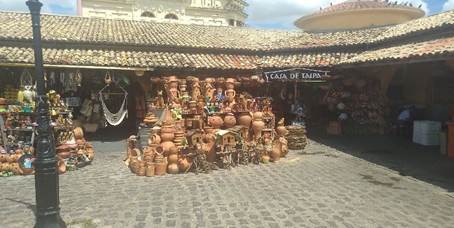
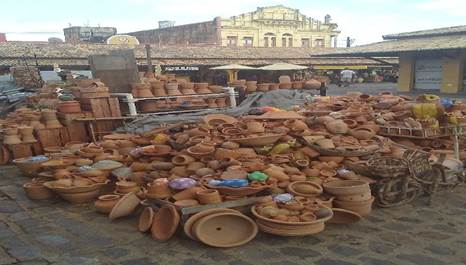
stalls. Ceramic handicrafts predominate. The pieces can be seen on display in
front of the shops, which stand out in the internal landscape.
Figure 02: Taipa stalls’s
house
Source: Field record (2022).
Regarding the traders' motivation, the most frequent
response was that financial need led them to choose their profession. Regarding the traders' opinion
on continuing their activity,
most of them complained about a series of problems, especially during the
pandemic. One of the difficulties they reported was obtaining handicraft
products. Before, there was no need to look for products in the countryside, as
they were brought to the market free of charge. However, with the pandemic, traders were forced to travel
to other municipalities to pick up the
products, adding the expense of travelling to the marketing process.
Regarding the difficulties of selling handicrafts at the
market, Thales Ferraz Market traders said that despite the difficulties of
publicising the market, the handicrafts sell well, especially ceramic products.
Regarding the origin of the products, a common thread was revealed: most of the straw, wood and clay handicrafts sold at Thales
Ferraz Market come from
the countryside of the State of Sergipe. The straw and wood products come from
places like Itabaianinha, Simão Dias, Lagarto, Tobias Barreto and Pirambu. With
regard to ceramic handicrafts, the municipality of Santana do São Francisco was
mentioned by all traders.
Another important finding,
which will be explored further
in the section on the Antônio
Franco Market, concerns
products that originate
in cities in other states
(mainly Recife, Caruaru and Alto do Moura, in the State of
Pernambuco) and are sold in the market as if they were products originating
from the State of Sergipe.
With regard to marketing and publicity, an
interesting context emerged. Most traders have adapted to technological
changes, mainly because of the pandemic. WhatsApp and Instagram are
the digital platforms they use the most to publicise their work and attract buyers, especially for orders, which has
grown since the Covid-19 pandemic. As for government incentives to keep their
businesses going, traders were unanimous in saying that they do not receive any
incentives, according to the following statements: "We do not receive any,
the government should at least publicise the market to tourists, but it does
not."; "There is no incentive, it just gets in the way."
Figure 03: Ceramics as the dominant craft at Thales
Ferraz Market
Source: Field
record (2022).
4.2
Antônio Franco
Market
The main difference between Thales Ferraz Market and
Antônio Franco Market undoubtedly lies on the
character of the products sold. While at Thales Ferraz Market the vast majority of products are handmade,
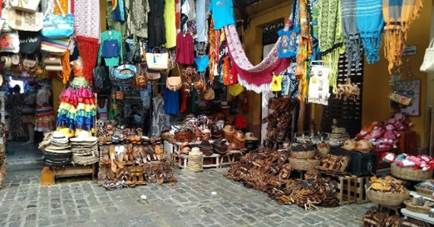
made from clay, straw and wood (Leite, 2019), at Antônio Franco Market,
handmade and industrialised products are mixed together. This reality is in line with what Beling et al. (2020,
p. 27) point out. Taking Canclini's (1983) perspective, stating that "the
market for handicraft products is no longer specific to handicrafts, other
articles are inserted for commercialisation that are not made by the
artisans".
When asked about entrepreneurship, traders in both
markets emphasised the financial 'need' as a motivator
for entering the handicraft trade. Nonetheless, three of
the establishments are inherited
businesses, two at Antônio Franco Market and one at Thales Ferraz Market,
characterising a family
tradition. With regard
to concerns about continuing the business, despite reservations about the rise in the price of materials for resale, the majority of those interviewed responded positively about
continuing their commercial activities, and even mentioned the expansion of their
audience, due to the increase in the number of orders
and requests via social
networks, despite the pandemic.
Regarding the hurdles faced in
the process of selling artisanal products, traders had different views. Some stated
that: "It is only difficult, when we think it is"; "I do not struggle, I am a good salesman".
On the other hand, others complained about the low flow of people in the market due to the pandemic
and the consequent increase in product
prices, which brought
a negative reaction from customers. According to a report: "[...]
prices have increased, and people are finding it strange".
Regarding the origin of
the products sold, in all
situations, the municipality of
Santana do São Francisco was highlighted as the main supplier of clay pieces,
along with the municipalities of Aquidabã and Propriá, which are in the same
region. Embroidery products come from Divina Pastora, and straw baskets and
sieves come from Itaporanga, Pirambu and Simão Dias.
At this stage of the
research, the problem raised in
the previous section was confirmed, as handicraft products originated from other
municipalities, especially those sold at Antônio Franco Market, with many even
coming from outside the State of Sergipe. Various locations were mentioned, such as Fortaleza
(Ceará), Itabuna (Bahia),
Maceió (Alagoas), and even some municipalities in Minas Gerais. The
city of Caruaru (Pernambuco) stood out the most. These products are sold in the markets along with those from the interior of the
State, and there is no clear difference between them. Thus,
an unaware tourist
often purchases the products assuming they are from Sergipe, when in
reality they may come from another State.
Figure 04: Presence of industrialised products
at Antônio Franco
Market
Source: Field
record (2022).
With regard to the marketing and
publicity process, the majority of traders in Antônio Franco Market said that
nothing had changed in recent years, and that there had been no innovation in
the process of publicising products, even after the pandemic. Similar to Thales
Ferraz Market, traders
were also unanimous in saying that they do not receive any government
incentives. Among the comments, three stand out: "I am encouraged to
give up every day"; "The help is from God"; "It
helps to break us, the government makes everything difficult".
4.3
Santana de
São Francisco and ceramic handicrafts
The exploratory phase confirmed that there are no
craftspeople in the municipal markets, which was fundamental in leading
researchers to investigate the origin of the products sold at the markets.
The handicraft products
that stand out the most and are sold the most in the markets are ceramic products, and the
place most often mentioned as the origin of these products was the municipality of Santana do São Francisco. Therefore, the need to visit the town arose as the
artisans from Santana do São Francisco are in fact the artisans of the markets,
as the products there were made from their own hands.
The municipality of Santana do São Francisco is located
in the north-west of Sergipe. The first records of local development date back
to the beginning of the 20th century, when Fazenda Carrapicho was founded. The
need to acquire household utensils and the ease of working with the region's
soil led the families of the employees
of the Carrapicho farm to make
the first manual artefacts out of clay (IBGE, 2022),
allowing them to find an alternative way to
make ends meet (Canclini, 1983).
Handicrafts soon spread throughout the region, generating
jobs and income for local inhabitants and
becoming a very important economic practice, as well as an important
cultural expression for the local population. The farm grew due to the arrival
of new inhabitants looking
for work in the region and became the former village of Carrapicho, linked
to the municipality of Neópolis. In
1989, it was emancipated and named Santana do São Francisco, with just over
7,000 inhabitants, with handicrafts being its most important economic activity
(IBGE, 2022). More recently, with Law No. 8.981, of 24 February 2022, the municipality was given the title of
'Sergipe’s Capital of Clay Handicrafts' (Government of Sergipe, 2022).
4.4
The production of ceramic handicrafts
The pottery of Santana do São Francisco is classified, according to Vieira (2014, p. 45), as
terracotta, "clay baked in a kiln, unglazed, although sometimes
painted". It is generally subsistence work and is developed through precarious and informal labour.
Ceramic handicrafts in
Santana are an artistic activity, imbued with aesthetic, symbolic and cultural
value. It is closely related to the history of the municipality and its
inhabitants, being passed down from generation to generation, linking them in a
profound way to the practice of handicrafts. The daily life of the Santana
community is permeated by the various processes of this symbolic production,
from collecting clay from the São
Francisco river to selling it at the municipality's
Handicrafts Centre. In this way, the cultural entrepreneur from São Francisco,
based on the focus given to culture by cultural entrepreneurship (Machado, 2013; Lounsbury & Glynn 2019), preserves the cultural practices
of their community, even if unconsciously (Aquino, Xavier & Muniz, 2022),
while exercising their profession and guaranteeing their income (Marins &
Davel, 2020; Campos, 2021).
|
|
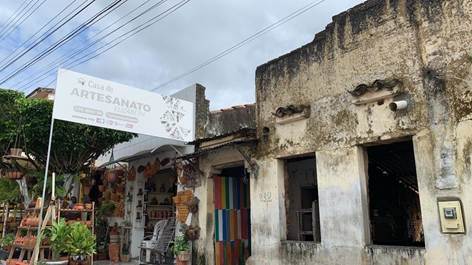 |
Figure 05: Facade of a handicraft production house
Source: Field
record (2022).
The handicraft production houses, as they are called in
the town, have a rustic, unsanitary structure, with poor lighting
and ventilation. All the pieces
are created 'from
scratch', as artisans say - which is apparent evidence of the creative
process inherent in craft practice (Vieira,
2014; Reis, 2016)
and cultural entrepreneurship (Davel & Cora, 2016; Marins
& Davel, 2020; Campos,
2021). Most of the pieces are made to order, using images or descriptions that
customers send by mobile phone as a reference. This exchange of information, as well as the
creativity
of the artisan, gives rise to a prototype, which serves as the basis for the
mass reproduction of several
identical pieces. After the pieces
have been fired, a
stage that helps
the composition and hardening
of the clay, they go through the finishing process
with painting and final touches.
During the visit
to the production houses, it was observed
that artisans strongly
focused on the manual activity. The dialogue between artisans was short
and monosyllabic, with rare moments when they took their eyes off the pieces,
working with dexterity and hard. Mobile phones are used all the time, both as a
tool for communicating with clients, suppliers and middlemen, and as an instrument that contributes to the creation
of the pieces, by searching for images and artefacts that act as a reference for the
production.
Although they are created 'from scratch', a large part of
the production process is characterised by a mass reproduction of the
prototypes, which can be religious, decorative or identity objects
from the region
(fishermen, farmers, etc.).
Of particular note is the reproduction
of a man with a large foot,
known as a 'pezão' - made by the famous
Santana artisan José Roberto
Freitas, known as 'Beto Pezão'
- an emblematic and representative image for the State of Sergipe
and of Santana do São Francisco itself. Not much innovation was observed in the
creation of the pieces, but rather a process of mass reproduction that ends up making up a market
saturated with similar products. The creativity of the process was
applied to the production of the prototype,
which served as an example
for making others.
This means that the pieces
were being produced to meet a
demand, rather than necessarily meeting any creative endeavours throughout
their production. Thus, it creates a large-scale reproduction model - which was
marked by creativity. Only some of the craftswomen stood out for moulding small,
differentiated clay pieces from 'things that come
to mind', as they themselves put it, in contrast to the predominant process of large-scale
reproduction of prototypes - which still denotes the creativity involved in the
process (Vieira, 2014; Reis, 2016; Lima, 2017).
|
|
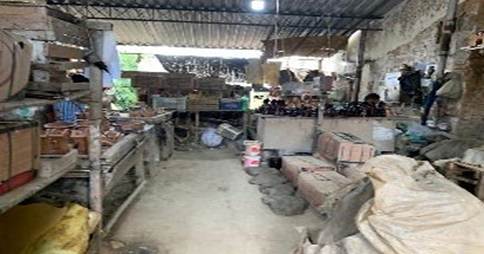 |
Figure 06: Inside a production house
Source: Field
record (2022).
At the entrance
to the town is 'Edilson
de Oliveira Forte'
Crafts Centre, opened
in 1996, which houses more
than 60 craftspeople, most of them women. Traders who sell at the centre are
relatives of artisans from the production houses. Some artisans also sold at
the centre, though spent most of their
time working in their own homes - such as the production house - or in the city's only Crafts Cooperative.
The pieces sold at the Handicrafts Centre are very
different from those seen in the production houses and the cooperative, with their finishing
and painting being more refined.
In addition, it is important to note that there is almost no craft
production inside the centre, but rather the display and sale of ready-made
pieces. Most of the pieces sold there were commissioned. Each trader's space is divided
up into stands where their products are displayed.
An interesting observation is the use of the PIX payment tool as a form of
payment.
From the above, it was possible to exercise strong
dialogues between theory and practice. The empirical
analysis, for example,
allowed practical observation of the dynamics
of enculturation, as described by Pereiro and Fernandes (2018),
present in the social context
of the municipality of Santana do São Francisco, as well as making it possible to affirm that an artisan of Santana do São Francisco
is a cultural entrepreneur. This is due to the fact that their
activity is not merely
an economic practice,
but is imbued with a symbolic charge
(Silva, 2016; Castilho et al., 2017), involving
and moving the entire community around them (Lima, 2017).
5 Cultural Entrepreneurship and Handicrafts: discussions and contributions
The field research enabled a practical observation of
the dynamics of enculturation - described by Pereiro
and Fernandes (2018)
- present in the social context of the municipality of Santana do São Francisco, as well as enabling to attest that
Santana's artisans are cultural entrepreneurs. This is due to the
fact that their activity is not
merely an economic practice, but is imbued
with a symbolic charge (Silva,
2016; Castilho et al, 2017),
involving and moving
the entire community around them (Lima, 2017).
Marins and Davel (2020, p. 117-8), when theoretically
listing possible concepts for cultural entrepreneurship, bring up terms that
relate directly to artisans of Santana do São Francisco: innovation,
creativity, risks and uncertainties, work and management. Although much of the
production is not done in an innovative or creative way, being a mere large
scale reproduction, it is not possible to deny the existence of a creative
aspect in the production of handicrafts in the municipality. These traits, which
are present in the handicraft production process in Santana do São Francisco, differ from what was found
among traders at Thales Ferraz and Antônio Franco markets.
The market trader is not a cultural entrepreneur, as
creativity and innovation, crucial points for defining
this concept (Davel & Cora, 2018; Marins; Davel, 2020; Campos, 2021), are not present in the purely
commercial dynamics revealed. Another problem encountered was the 'invasion' of industrialised
products (Canclini, 1983; Beling et al, 2020) in the market environment.
This reality ends up 'devaluing' handmade work, which loses space in an
environment where it should be prominent. This imposes risks not only on the
sale of handicrafts in the markets, but also on the
production itself, as it directly influences the profitability of the activity,
and consequently the prospects of future generations, who are crucial for the continuity of handicraft work.
In this regard, this article makes three contributions to
research, one to the practice of cultural entrepreneurship and two of a theoretical nature, which should
be taken into account in order to deepen the studies and
practical impacts of cultural entrepreneurship as an incipient field. Firstly,
as a practical implication, this study can, based on its results,
provide public policy managers (Vitória & Emmendoerfer, 2021) linked to municipal and/or state departments in the field of
culture and commerce with tools to draw up programmes to promote
entrepreneurial activity, with a focus on preserving cultural activities, such
as craft production. The situation revealed by the empirical research shows
that, both in the Central Market and in Santana do São Francisco, handicraft
products are suffering from a process of discrediting. Such process
tends
to reduce the potential of the production and marketing activity due to both
the unfavourable outlook for the continuity of the practice in the community that surrounds it and the dispute
over spaces (which are intended to be geared towards cultural appreciation) for
its marketing.
The second contribution, of a theoretical nature,
concerns the advance in studies on cultural entrepreneurship, highlighting its
focus on handicrafts. In this way, new avenues of research can be broken down
to add to research efforts on the subject of cultural entrepreneurship, which
is still in its infancy (Marins & Davel, 2019). In addition, it opens space
for reflection on the problem of the trend towards emptying the symbolic
character of artisanal activity, discussed in this paper. The third contribution,
which involves the particularities of cultural
entrepreneurship identified in the theoretical framework (the focus on
culture, the preservation of culture, creativity and the reconciliation of
profit and art), opens new possibilities for multidisciplinary approaches (Neves & Davel, 2022), involving
studies in areas such as
anthropology, sociology and economics.
6 Conclusions
The aim of this study was to understand the relationship
between cultural entrepreneurship and handicrafts, assessing the symbolic
construction of the craft practice.
The object of study was Aracaju's central markets: Thales Ferraz Market
and Antônio Franco Market, considered to be spaces filled with cultural goods,
represented by diversified handicrafts and visited by tourists and local
people. Moreover, the municipality of Santana de São Francisco, the centre of
origin of the ceramic handicraft
products sold in the markets was also focus of this
study. This objective was achieved given
the strong relationship between the themes, through
the theoretical production developed, as well as the findings made in the field,
which will contribute to future discussions and analyses involving both
subjects.
As far as the theoretical field is concerned, knowledge
about the concepts, characteristics and peculiarities of the relationship
between cultural entrepreneurship and handicrafts was developed through
empirical research. The exploratory research revealed that the
commercialisation of handicrafts in the markets investigated is not carried out
directly by their producers, but by traders (or middlemen) who take part in the
chain of dissemination of the handicraft culture,
though without entering
into the production process and the maintenance
of the cultural ties that permeate the creation and
production of a handicraft. The details of the artisans' activities were analysed
through field research in the town of Santana do São Francisco, the main
supplier of ceramic handicrafts in Sergipe.
With regard to the systematisation of entrepreneurial actions
that stimulate the creativity
of artisans, the reality found was a lack of effective actions from the
government and artisan associations to establish the recognition of these producers
as entrepreneurs and guardians of a
secular culture associated with the life of the riverside dweller.
In particular as the clay used in production is associated with the type
of soil found in that region.
In this regard,
this article has contributed to two fields:
the theoretical and the practical. In the theoretical field, it
has advanced the concepts of cultural entrepreneurship and its relationship with handicrafts, given that there have been few recent
publications on the subject.
In the field of cultural entrepreneurship, handicrafts have great
entrepreneurial potential as a cultural activity, focusing
on creative and innovative issues,
perfecting the work of artisans
who can enhance the possibilities of making their craft profitable while
maintaining its symbolic character.
As far as the practical field is concerned, this study
reveals two problems that leave room for
further research into municipal markets in general and markets in the city of Aracaju in particular. The first is
the absence of artisans in the markets, which is a limitation of this study,
and the second is the presence of industrialised products that share space with
artisanal products. Both problems could be addressed and explored in greater
depth in future studies, which could add even more information in the context
of the markets researched and other central markets in Brazilian municipalities
with tourism potential. It also offers new possibilities for thinking about market
management and reviewing strategies for mobilising craft production as a way of
revitalising culture and its symbolic meanings.
In view of the methodological limitation, the research
used qualitative methodologies, preventing any generalisation of the
results presented herein. However, other studies based on other markets
could use a quantitative methodology with the use of statistical tests.
References
Aquino, A. L. M.; Xavier, A. R. & Muniz, K. R. A. (2022).
Sustainable cultural entrepreneurship of indigenous women of the Kanindé people
of Aratuba, Ceará.
Revista Cocar, 17(35), 1-18. Retrieved from https://periodicos.uepa.br/index.php/cocar/article/view/5960
Araujo, G. F. & Barbosa,
M. A. S. (2019) Buzinaços, cânticos e shows:
o empreendedorismo cultural na tradicional Festa do Caminhoneiro de
Itabaiana-Sergipe. Teoria e Prática em Administração, 9(2), 35-51. Recuperado de https://doi.org/10.21714/2238-104X2019v9i2-
43250
Angrosino, M. (2009). Ethnography
and participant observation. Porto Alegre: Artmed. Bendassolli, P. F., Wood Jr, T., Kirschbaum, C., & Cunha, M. P. (2009).
Creative Industries:
definition, limits and possibilities. Revista de Administração de Empresas, 49, 10-18. Retrieved from https://periodicos.fgv.br/rae/article/view/36013
Beling, H. M., Fantineli, D. G., Cancelier, J. W. & Vargas, D. L. (2020, 17 November).
Handicrafts,
identity and income generation: the case of the
village of progresso, Caçapava
do Sul/RS. Geography, Teaching & Research, 24(39) 1-35.
Retrieved from https://doi.org/10.5902/2236499442052
Brooks, C., Vorley,
T., & Gherhes,
C. (2022). Entrepreneurial ecosystems in Poland:
panacea, paper tiger or Pandora's box. Journal of Entrepreneurship
and Public Policy, 8(3), 319-338.
Canclini, N. G. (1983). Popular cultures in capitalism. São Paulo: Ed. Brasiliense.
Campos, I. (2021). Cultural entrepreneurship and festivity: an
ethnography of the São João festival in Porto,
Portugal. International Journal
of Folk Communication, 19(42) 241-265.
Retrieved from https://doi.org/10.5212/RIF.v.19.i42.0012
Carvalho, C. M. B., Cutrim,
K. D. G. & Costa,
S. R. (2017). Cultural entrepreneurship and tourism: perspectives for the development of creative
industries in the Madre Deus neighbourhood, São Luís (Maranhão, Brazil). Bulletin
of the Emílio Goeldi Museum of Pará. Human Sciences, 12(2), 629-646.
Castilho, M. A., Dorsa, A.
C., Santos, M. C.
L. F. & Oliveira, M. M.
G. (2017). Crafts
and local knowledge in the context of local development. Interactions,
18(3), 191-202.
Chang, Y. Y., Potts, J., & Shih, H. Y. (2021). The market
for meaning: a new entrepreneurial
approach to creative industries dynamics.
Journal of Cultural
Economics, 45(3), 491-511.
Davel, E. & Cora, M. A. J. (2016). Cultural
entrepreneurship: culture as discourse, creation and symbolic consumption. Cultural
Policies in Review, 9(1) 363-397.
Davel, E. P. B., Paiva Júnior, F. G. (2019).
Festival, culture and cultural entrepreneurship: an Introduction. Theory and Practice in Management, 9(2),
iii-ix. Retrieved from https://doi.org/10.21714/2238-104X2019v9i2-46427
Dimaggio, Paul (1982).
Cultural Entrepreneurship in nineteenth-century Boston:
the creation of on organisational base for high culture for America. Media, Culture and Society, 4,
33-
50. Retrieved from https://doi.org/10.1177/016344378200400104
Esig, L. (2017, May). Same or different?: The "cultural
entrepreneurship" and "arts entrepreneurship" constructs in European and US higher education. Cultural Trends, Tempe, 26(1), 1-13. Retrieved
from https://doi.org/10.1080/09548963.2017.1323842
Fazlagić, J.; Sulczewska-Remi, A., & Loopesko, W. (2021). City policies to promote
entrepreneurship: a cross-country comparison of Poland and Germany. Journal
of Entrepreneurship, Management and Innovation, 17(2), 159-185.
Filgueiras, A. R. S. (2019). The Aracaju
Municipal Market and its times:
beginning, loss and reinvention (1926-2000). (Dissertation). Master's in History,
Federal University of Sergipe,
São Cristóvão-SE.
Flick, U. (2009). Introduction to
qualitative research (3). São Paulo: Artmed, 2009 . Gabriel, Y. (2018). Stories Narratives. In: Cassel, C., Cunliffe, A. L., Grandy, G. (Org.),
The
SAGE handbook
of qualitative business
and management research
methods. (Chap. 5). London: SAGE.
Gil, A. C. (1999).
Methods and techniques of social research. São Paulo: Atlas.
Göleç, A., & Maksudunov, A. (2019). A fuzzy methodology for local entrepreneurial culture evaluation: evidence from post-soviet Kyrgyzstan. South
African Journal of Industrial Engineering, Bishkek, 30(1), 110-23.
Gubrium, J. F. & Holstein, J. A. (2009).
Analysing narrative reality.
Thousand Oaks: Sage Publications.
Guerra, J. R. F. & Paiva Júnior, F. G. (2015, September). Cultural
production and entrepreneurship: a critical
approach from the perspective of the culture
circuit. In Proceedings of
the 39th ANPAD Meeting, Belo Horizonte, MG.
Hausmann, A., & Heinze, A. (2016). Entrepreneurship in the cultural
and creative industries: insights from an emergent
field. Artivate: A Journal
of Entrepreneurship in the Arts, 5(2), 7-22.
IBGE (2022). Santana
do São Francisco. Cities. Retrieved from https://cidades.ibge.gov.br/ brasil/se/santana-do-sao-francisco/historico
Julien, P. A., Marchesnay, M. & Machado, H. V. (2010).
Interdisciplinary research in entrepreneurship and SMEs: towards an
entrepreneurial theory that takes cultural differences into account. Revista Gestão e Planejamento,11(2), 355-368.
Retrieved from https://revistas.unifacs.br/index.php/rgb/article/view/1587
Kim,
J. H. (2016). Understanding narrative inquiry. Los Angeles: Sage
Publications. Kunter, A., Bell, E. (2006). The promise and potential of visual organisational research.
Retrieved from https://doi.org/10.3917/mana.093.0177
Lange, B. (2018). The Paradox Between
Individual Professionalisation and Dependence on Social Contexts and
Professional Scenes. In: Innerhofer, E., Pechlaner, H., & Borin, E. (Eds.) Entrepreneurship in Culture and Creative Industries: Perspectives from Companies and Regions. (85-98). Cham:
Springer https://doi.org/10.1007/978-3-319-65506-2_6
Law no. 8.981, of 24 February
2022. (2022).
Grants the Municipality of Santana
do São Francisco the title of
"Sergipana Capital of Clay Handicrafts". Retrieved from https://al.se.leg.br/Legislacao/Ordinaria/2022/O89812022.pdf
Leite, S. (2019, 17 October). Thales
Ferraz Market: a mix of shapes, colours,
aromas,
flavours and
knowledge. Retrieved from https://lugaresdememoria.com.br/2019/10/mercado-thales-ferraz-uma-mistura-de-formas-cores-aromas-sabores-e-saberes.html.
Leon, M. J. A., Torres, I., & Ramírez, F. (2020). Arts and Crafts: for the Promotion of an Ecosystem of Culture, Knowledge, and Entrepreneurship. The
International Journal of Interdisciplinary Cultural Studies,
15(1), 1-11. Retrieved from https://10.18848/2327-008X/CGP/v15i01/1-11.
Lima, G. V. (2017). Cultural entrepreneurship revealing the identity of quilombola artisans: a study in the community of
Conceição das Crioulas. (Dissertation) Master's in Business Administration,
Federal University of Pernambuco, Recife-PE.
Lima, N. (2010, 26 July).
History of the central market shows urban evolution. Aracaju News Agency. Retrieved from https://www.aracaju.se.gov.br/index.php?act=leitura&
codigo=42533
Lima, S. M. (2002).
Sanitation and hygiene
as signs of a modern URBS:
a brief reading of the urban evolution of Aracaju. TOMO (5),181-202
Retrieved from https://doi.org/10.21669/tomo.v0i0.4999
Loy, A., & Ageson,
T. (2018). Creative economy entrepreneurs: from Startup to Success.
Santa Fe: Global Centre for Cultural Entrepreneurship.
Lounsbury, M. & Glynn, M. A. (2001, May). Cultural
entrepreneurship: stories, legitimacy, and the acquisition of resources. Strategic Management
Journal, 22, 545-564. Retrieved
from https://ssrn.com/abstract=1830380
Lounsbury, M. & Glynn, M. A. (2019). Cultural
Entrepreneurship: a new agenda for the study
of entrepreneurial processes
and possibilities. Cambridge: Cambridge University Press.
Machado, H. P. V. (2013). Entrepreneurship, opportunities and culture: selection of cases in the Brazilian context. Maringá:
Eduem.
Marins, S. R., & Davel, E. P. B. (2019). Entrepreneurship as
Practice: Cultural entrepreneurship in the festive practice
of Bahian pagode. Revista Teoria e Prática
em Administração, 9, (2). 14-34. Recuperado de https://doi.org/10.21714/2238-104X2019v9i2-43231
Marins, S. R.,
& Davel, E. P. B. (2020). Cultural and artistic entrepreneurship: paths of
academic research. Revista Pensamento Contemporâneo em Administração, 14(4), 115-
140. Retrieved from https://doi.org/10.12712/rpca.v14i4.46268
Marx, K. (2017). Capital:
critique of political
economy (Book I, 2. ed.) São Paulo:
Boitempo, 2017.
Mcmullen, J. S., Ding, A. W., & Li, S. (2021). From cultural
entrepreneurship to economic entrepreneurship
in cultural industries: the role of digital serialisation. Journal of Business
Venturing, 36(6), 106-157.
Neto, O. F. (2019, 29 August). 70 years of the Thales Ferraz
Municipal Market. Expressão Sergipana. Retrieved
from https://expressaosergipana.com.br/70-anos-do-mercado-municipal-thales-ferraz/
Neves, J. N. R. & Davel, E. P. B. (2021). The territoriality of
entrepreneurship: perspectives and challenges for cultural entrepreneurship. Gestão & Regionalidade, 37(112), 269 -284. Retrieved from https://doi.org/10.13037/gr.vol37n112.6941
Neves, J. N.
R. & Davel, E. P.
B. (2022). The territoriality of cultural entrepreneurship: the identity experience of the Ilê Aiyê cultural bloc. Journal
of Administration, Society and Innovation, 8(1), 23-49. Retrieved from https://doi.org/10.20401/rasi.8.1.609
Pereiro, X. &
Fernandes, F. (2018). Anthropology and tourism:
theories, methods and praxis.
Vila Real: Pasos.
Petrova, L. (2018). Cultural Entrepreneurship in the Context
of Spillovers Within
the Cultural and Creative
Industries: the case of design practice for social change. Innerhofer E.,
Pechlaner H., Borin E. (Eds) Entrepreneurship in Culture and Creative
Industries. 197-
211. Cham: Springer.
https://doi.org/10.1007/978-3-319-65506-2_11
Polanyi, K. (2000). The
great transformation: the origins
of our time (9th ed.). Rio de Janeiro: Campus Publishing House.
Reis, W. C. (2016). Creating symbolic value
in quilombola handicrafts in Moju, Pará: a study in the field of cultural
entrepreneurship from the perspective of Stuart Hall's Reception Theory. (Thesis). Doctorate in Business Administration, Federal University of Pernambuco, Recife.
Riessman, C. K. (2008).
Narrative methods for the human sciences. Los
Angeles: Sage Publications.
Santana, A. M., de Moraes, É. C.
M., Oliveira, A. C., & Tavares,
K. P. (2023). Trends and opportunities for entrepreneurs in
the Amapá handicraft sector: a conjuncture analysis. Cadernos de Gestão e
Empreendedorismo, 11(2), 1-18.
Silva, C. H. M. (2009).
Political public space and urbanity: the case of Aracaju
city centre.
2009. (Thesis). PhD in
Architecture and Urbanism, Federal University
of Bahia, Salvador. Silva, E. K. R. (2016).
Handicrafts: merchandise,
value and fetish. ModaPalavra E-periódico,
9(18), 120-143.
Townley, B.; Gulledge, E. (2015). The
Market for Symbolic Goods: Translating Economic and Symbolic Capitals in
Creative Industries. In C. Jones, M. Lorenzen, & J. Sapsed (Eds.), The
Oxford Handbook of Creative Industries (119-135). Oxford: Oxford University
Press.
Vergara, S. C. (2009). Data
collection methods in the
field. São Paulo: Atlas.
Vieira, G. S. O. (2014). Handicrafts: identity and labour (Thesis). PhD in Sociology, Federal University of Goiás, Goiânia,
2014. Retrieved from http://repositorio.bc.ufg.br/tede/handle/tede/4583
Vitória, J. R. & Emmendoerfer,
M. L. (2021). Public policies
on culture. Salvador, BA: Motres.
i Bacharelando
em Relações Internacionais pela Universidade Federal de Sergipe (UFS),
associado ao Departamento de Relações Internacionais do Campus São Cristóvão,
Sergipe, Brasil.
ii Doutora em Administração pela
Universidade Federal da Bahia (UFBA), Salvador, Bahia, Brasil. Pesquisadora
visitante (doutorado sanduíche) na Copenhagen Business School (CBS) -
Dinamarca. Membro do coletivo de pesquisa Organização, Cultura e Arte (OCA-CNPq)
e do Núcleo de Estudos Interdisciplinares em Gestão e Organização (NIGO-CNPq).
iii Doutoranda em Sociologia e acadêmica em Sistemas
de Informação pela Universidade Federal
de Sergipe (UFS), associada ao Departamento de
Computação do Campus São Cristóvão, Sergipe, Brasil.
iv Mestre em Gestão Organizacional e Bacharela em Turismo pela Universidade Federal
da Paraíba - PPGA / UFPB