Recebido em: 10/12/2024
Aceito em: 28/03/2025
Sustainability
indicators for municipalities in the ABC Paulista region: are they meeting the
sustainable development goals?
Indicadores de sustentabilidade nos municípios do ABC Paulista: em cumprimento aos objetivos de desenvolvimento
sustentável?
Alessandra Negrão Elias Martins1i, ORCID:
https://orcid.org/0009-0005-0216-2868; Rogério de Oliveira2ii, ORCID: https://orcid.org/0009-0007-5441-8858; Raquel
da Silva Pereira3iii, ORCID: https://orcid.org/0000-0001-6656-080X
1. Universidade Municipal de São Caetano
do Sul (USCS), São Caetano do Sul,
SP, Brasil. E-mail: alessandra.martins@uscsonline.com.br
2. Universidade Municipal de São Caetano
do Sul - USCS. São Caetano
do Sul, SP, Brasil.
E-mail: rogerio.oliveira@online.uscs.edu.br
3.
Universidade Municipal de São Caetano
do Sul - USCS. São Caetano
do Sul, SP, Brasil.
E-mail: raquelpereira2030@gmail.com
Resumo
Este artigo apresenta estudo sobre os
Objetivos de Desenvolvimento Sustentável (ODS), no cumprimento das metas da
Agenda 2030 da Organização das Nações Unidas (ONU) e como estão sendo cumpridos
nos municípios da Região do ABC Paulista. Objetivou-se comparar a situação dos
municípios a partir de dois indicadores de sustentabilidade: o Índice de
Desenvolvimento Sustentável das Cidades – Brasil (IDSC-BR) e Objetivos de
Desenvolvimento Sustentável – Brasil
(ODS-BR). A metodologia envolve o levantamento em dados secundários, dos indicadores supracitados nas sete
cidades que compõem essa região. Na análise, faz-se a comparação da situação de
cada município em relação a cada ODS e em relação aos demais municípios da
região. Os resultados permitem afirmar que, independentemente da origem das
matrizes, há um alinhamento, entre os municípios, no que se refere aos avanços
em relação aos ODS, às demandas
ambientais, aos fatores,
aos atributos e aos
indicadores de desempenho dos ODS das sete cidades.
Palavras-chave: Objetivos de Desenvolvimento Sustentável. Indicadores
municipais de sustentabilidade. Região
do ABC Paulista.
Abstract
This article presents
a study on the
Sustainable Development Goals (SDGs), the fulfillment of the Goals of the 2030 Agenda of
the United Nations (UN) and how they are being fulfilled in the seven municipalities of the ABC Paulista Region.
The aim was to compare the situation of the municipalities using two
sustainability indicators: the
Sustainable Development Index for
Cities - Brazil (IDSC-BR) and the Sustainable Development Goals - Brazil
(SDG-BR). The methodology involves collecting secondary data on
the IDSC-BR and SDG-BR sustainability indicators from the seven cities
that make up this region. The analysis compares the situation of each
municipality in relation to each SDG and in relation to the other
municipalities in the region. The results show that, regardless of the origin
of the matrices, there is an alignment between the municipalities in terms of
progress in relation to the SDGs, environmental demands, factors, attributes
and performance indicators of the SDGs of the seven cities.
Keywords: Sustainable Development Goals. Municipal
sustainability indicators. ABC Paulista Region.
Referência: Martins, A. N. E.,
Oliveira, R., & Pereira, R. S. (2025). Sustainability indicators for
municipalities in the ABC Paulista
region: are they meeting the sustainable development goals? Gestão & Regionalidade, v. 41, e20259879. https//doi.org/10.13037/gr.vol41.e20259879
1
Introduction
Sustainability occurs when the responsible
use of social, environmental, and
economic development resources is observed, taking into account generational
preservation in their utilization (Vieira, 2019).
Thus, it involves
multiple dimensions beyond
those mentioned above, namely, institutional, ethical, and collaborative aspects,
with repercussions for daily well-being that are inseparable from
implications for urban life and the management of these processes (Phillip Jr.
& Bruna, 2019; Vieira, 2019).
Discussions related to sustainability
management have been addressed in United Nations global conferences, such as:
the United Nations Conference on the Human Environment (Stockholm, 1972); the
United Nations Conference on Environment and Development and the Earth Summit (Rio de Janeiro,
1992); the Conference of the Parties
to the United Nations
Framework Convention on Climate Change (Kyoto, 1997); the United
Nations Conference on Sustainable Development – Rio+20 (Rio de Janeiro,
2012); the Conference of the Parties to the United Nations Framework Convention
on Climate Change (Paris, 2015), among other examples (Oliveira, 2019).
The document titled Our Common Future,
elaborated in the Brundtland Report developed in 1987 by the World Commission
on Environment and Development (WCED) of the United Nations (UN), established
the concept of sustainable
development by emphasizing generational protection of present and future needs through the responsible use of technologies, social organization,
environmental resource use, and biosphere protection (UN, 1987). The Brundtland
Report (UN, 1987) reinforced the environmental agenda as a central issue in
international governance, grounded in the necessary impact and interrelation
between local, global, and regional spheres, by highlighting the
interdependence of ecological, cultural, heritage, and economic matters
(Oliveira, 2019).
The UN's 2030 Agenda (2015) outlines the guidelines for advancing the dimensions of sustainability.
Accordingly, to fulfill this Universal Agenda,
17 Sustainable Development Goals (SDGs) were established, to be
implemented through 169 targets as a means of realizing fundamental human
rights for present and future generations. With global repercussions and
impacts on the world population, achieving the predetermined targets requires
urgent, collective, and collaborative efforts, with progress to be analyzed at
both macro and micro levels, including their effects on territorial dynamics.
To fulfill the targets set by the SDGs, actions
are undertaken at the municipal
level, and their efficiency
is assessed through municipal indicators. These indicators serve as a relevant
tool for urban management planning and monitoring. They make it possible to
measure and evaluate whether public policies are being properly implemented, support
decision-making processes, allow for the dissemination of results, and enable
comparisons with other municipalities. This makes them significant for analyzing regional
development in line with the SDG targets (Sarubbi & Moraes,
2019).
In this regard, Dunder and Araújo
(2020), in their research on regional development, examined the correspondences
between the actions of the Participatory Regional Multi-Year Plan of the ABC Paulista Region
and the fulfillment of the SDGs. They adopted a comparative
analysis between the multi-year plan and the 2030 Agenda and observed
satisfactory results demonstrating regional development aligned with global
development goals.
The 2030 Agenda entails significant
changes throughout this decade concerning the foundational dimensions of a more sustainable form of development, with repercussions for the
entire global population. Therefore, studies that map how the SDGs are being
implemented, what advances have been made, and what challenges remain in
ensuring human rights and quality of life for all in a universal manner are of
great relevance.
This study
aims to compare municipal progress regarding the SDGs using two relevant sustainability
indices: the Sustainable City Development Index – Brazil (IDSC-BR) and the
Sustainable Development Goals – Brazil (SDG-BR), focusing on the ABC Paulista
Region, which comprises the following municipalities: Santo André, São Bernardo
do Campo, São Caetano do Sul, Diadema, Mauá, Ribeirão Pires, and Rio Grande da
Serra.
This research is justified by the
scarcity of publications that comparatively analyze, based on sustainability indicators, the progress in fulfilling municipal SDGs,
especially within the specified region. By presenting illustrative studies on the topic, it is expected that this work will contribute to the advancement
of scientific knowledge concerning the urgent issue of “Sustainable
Development” at the regional level, and also support public managers in this
region in identifying gaps and opportunities
for the effective implementation of the
SDGs and the fulfillment of the 2030 Agenda. The article proceeds with
the literature review, methodological aspects, analysis of results, discussion
of findings, and final considerations.
2
Theoretical
Framework
The concept of sustainability involves
at least three dimensions: economic, environmental, and social (Arantes &
Pereira, 2021). Thus, it is understood that for a municipality to be considered
sustainable, it must address these dimensions in a balanced and inseparable
manner. Within the dimensions of sustainability, several environmental issues
are included, such as green procurement, sustainable buildings, public
transportation networks using renewable energy sources, proper disposal of
solid waste and liquid effluents, and mitigation of greenhouse gas emissions. There are also economic and social issues,
such as the socioeconomic vulnerability of
populations lacking adequate access to fundamental social rights related to
education, decent housing, employment, among others. These vulnerabilities are
often reflected in insufficient public safety, among other aspects that require
proper development (Cortese, Kniess, & Maccari, 2019). These aspects
naturally involve economic concerns, both from the perspective of public
management and from that of private sector leaders.
Ignacy Sachs (1993), in a seminal work
on sustainable development, argues that its dimensions are interconnected and cannot be addressed in isolation. He warns against
solutions that are insufficient or even harmful in the long term,
emphasizing the relevance of a comprehensive approach that considers multiple
dimensions to achieve sustainable and equitable development.
Jeffrey Sachs (2017), in his book The
Age of Sustainable Development, reinforces this concept. Among the three
dimensions considered fundamental, the environmental dimension focuses on
mitigating environmental impacts and preserving natural resources; the social
dimension refers to human well-being, equity, and social
justice; while the economic dimension is concerned with creating
economic systems that are viable in the long term. This involves
the
pursuit of inclusive economic growth that generates decent
jobs and does not exhaust natural resources in an unsustainable manner.
In this context, and in light of the
urgency surrounding issues that demand a more rational and sustainable form of development, the UN published
the 2030 Agenda
in 2015 and established the following 17 SDGs:
1 –
no poverty; 2 – zero hunger and sustainable agriculture; 3 – good health and well-being; 4 – quality
education; 5 – gender equality;
6 – clean water and sanitation; 7 – affordable and clean
energy; 8 – decent work and economic growth;
9 – industry, innovation, and infrastructure; 10 – reduced
inequalities; 11 – sustainable cities and communities; 12 – responsible
consumption and production; 13 –
climate action; 14 – life below water; 15 – life
on land; 16 – peace, justice, and strong
institutions; 17 – partnerships for the goals and means of implementation (UN,
2015, n.p.).
Lima and Ribeiro (2023) analyzed the
influence of the SDGs on the field of Social Sciences, particularly in relation
to the promotion of well-being and inclusive development; internal and external support;
the specific aspects
of each country in implementing innovation; territorial engagement; alternative strategies; changes
in quality of life and shared governance; global supply chains; and the
relevance of education in responsible management. Based on a bibliographic coupling
map with co-citation analysis of selected
articles, the authors identified seven clusters addressing:
corporate civil responsibility in the field of social sciences applied to SDG
development; the interdependence among Sustainable Development Goals;
investigation of the 17 SDGs; the role of multinational corporations in SDG
development; "influences of stakeholder pressure on organizations to develop Corporate Social Responsibility
policies and practices"; challenges to SDG implementation; the importance of the private
sector in implementing the SDGs; and education in responsible
management, aligned with the Principles for Responsible Management Education
(PRME) (Avelar, Farina & Pereira, 2022) in relation to the SDGs.
Consistent with the reviewed
literature, sustainable urban management plans must also integrate municipal agencies working
on related themes and consolidate relevant information. Such planning should be
developed through a systemic approach, strategically structured to promote
integration and ensure participation. Projects should be designed for
implementation in the short, medium, and long term, with continuity guaranteed
and the possibility of establishing goals that can be gradually achieved over
time, along with public access to the monitoring of these targets (Negreiros
& Abiko, 2019).
Cities
are composed of both urban and natural
spaces, with boundaries often defined by natural constraints. Therefore,
their analysis requires a broad, systemic approach to both urban
and natural environments (Martins &
Cândido, 2015). Sustainability indicators map and assess
the interdependence among these sustainability dimensions, which also
encompass aspects of municipal management related to sustainability (Silva,
Rebouças, Abreu & Ribeiro, 2018).
To achieve a global agenda, local
actions are required for the implementation and realization of the SDGs. In
this regard, the local and urban sphere becomes fundamental, serving as a site
of experimentation and goal fulfillment through integrated and context-sensitive actions
directed at the population, specific
localities, and regional
particularities
(Vieira, 2020). Although
the rules and targets are general in nature, they must be aligned with the context of
sustainable regional development.
Frey, Torres, and Jacobi (2020) analyzed
the SDGs in relation to the São Paulo macrometropolis and identified several
challenges for public managers, particularly regarding the need for greater
progress due to the low adherence to Brazil's national
targets for achieving the
SDGs. They emphasized the need for profound changes, ongoing critical
discussion, and the development of illustrative studies to strengthen the
applicability of the 17 SDGs in the context
of the São Paulo macrometropolitan region, so that strategies, especially those aimed at addressing increasingly frequent
ecological crises, can be created.
Considering the automobile manufacturing
plants still strongly present in the region under study, companies seek to
align economic and environmental dimensions in the development of their
activities, while also addressing “concerns about the social aspect of
sustainability” (Scur & Heinz, 2016, p. 290). These findings reinforce the
fundamental dimensions underpinning the concept of sustainability: economic,
environmental, and social (Cortese et al., 2019).
With regard to sustainability education,
there are still challenges in understanding the discipline related to
sustainability and its practical implications, particularly in undergraduate
programs such as Business Administration. Developing a systemic and
interdisciplinary approach is essential (Ávila, Santos & Vieira, 2015;
Avelar, Farina & Pereira, 2022). The inclusion of Sustainability as a
discipline within the field of
Social Sciences is fundamental to
the development of the SDGs, as reinforced by Avelar, Silva-Oliveira, Farina & Pereira
(2022) and Lima and Ribeiro (2023).
Regarding municipal management, studies
show that the municipalities in the ABC Paulista Region still depend on
external energy resources (Agostinho, Almeida, Gianeti & Sevegnani, 2017).
Additionally, some municipalities are more vulnerable than others, experiencing
interdependent economic and climate-related impacts, such as heavy rainfall,
notably in Diadema and Mauá (Valverde, 2017). These issues reinforce the
interdependence between urban spaces and natural environments, with boundaries
imposed by natural conditions, and their implications for sustainability, which
must be considered at both municipal and regional
levels (Martins &
Cândido, 2015; Silva et al., 2018; Negreiros
& Abiko, 2019).
For example, regarding
solid waste management and the shared
responsibility between micro
and small enterprises and municipal public authorities, excluding industrial
and healthcare waste, there remains a gap between the proposals and the actual
practices implemented by the respective
social actors (Picchiai & Senigalia, 2019). An analysis of solid waste management in the
municipalities of Santo André, São Bernardo do Campo, and São Caetano do Sul
revealed varying results and performance levels, despite challenges in
implementation, with the municipality of Santo André
standing out positively in comparison to the others (Frata & Tonelli, 2018).
According to Oliveira, Trindade, and Pereira (2013), 56%
of the ABC Paulista Region consists of watershed and environmental protection areas, which complicates the establishment of
sanitary landfills. Currently, only the municipality of Santo André has a
public sanitary landfill, while the remaining municipalities in the region
rely on a single private
landfill located in the municipality of Mauá. For the biodegradation process of solid waste, the use of biogas
represents a renewable energy source, and in this regard, the implementation of thermoelectric plants in the region could
be a viable option (Candiani & Vieira, 2021).
Although sustainability is a global demand,
it is implemented through local
and regional agendas (Vieira,
2020). In other words, integrated local actions tailored to territorial
specificities are essential in promoting regional progress and aligning with
the global SDG agendas.
3 Methodology
This research is exploratory in nature
and adopts a qualitative approach (Creswell, 2014). It began with a literature review
related to the dimensions of sustainability
in the region and, subsequently, secondary data were collected from two municipal SDG indicator platforms: the Sustainable City Development Index – Brazil
(IDSC-BR) and the Sustainable Development Goals Index – Brazil (SDG
Index Brazil).
For the literature review conducted
using the database of the Coordination for the Improvement of Higher Education
Personnel (CAPES), the selected period ranged from January 2015 to December
2023. The focus was to analyze the progress and challenges in the development of sustainability dimensions in relation to the fulfillment of the SDGs in the ABC
Paulista Region, using
the descriptors “ODS
Região ABC Paulista” (SDG ABC Paulista
region) and “Objetivos de Desenvolvimento Sustentável ABC” (Sustainable Development Goals ABC). The
inclusion criteria were articles published in journals during the selected
period, and the exclusion criteria were articles without
open access and those unrelated to the overall
theme of this study. A total of
35 publications were found, from which seven articles were selected
that jointly addressed the descriptors (SDGs, ABC Region),
thus highlighting the research gap to be explored.
In a second
stage, the scores
achieved by each municipality were collected individually for each of the SDGs, using
the IDSC-BR and the SDG Index Brazil. This enabled not only a comparison between
the municipalities but also an assessment of the results
of the ABC Paulista Region
in relation to the national outcomes for each of the SDGs.
The Sustainable City Development
Index – Brazil (IDSC-BR) is produced by the Instituto Cidades Sustentáveis
(Sustainable Cities Institute) under the Sustainable Cities Program, in
partnership with the Sustainable Development Solutions Network (SDSN). It is
supported by the Brazilian Center for Analysis and Planning (Cebrap) and
financed by the CITinova Project. The methodology was developed by the SDSN
network, an initiative of the United Nations. The IDSC-BR assesses the distance
to achieving the Brazilian targets established for the SDGs across the 5,570
Brazilian municipalities. The index uses 100 indicators based on public
administration performance (IDSC-BR, 2024). It applies
a scale from 0 to 100, interpreted as a
percentage (IDSC, 2024).
The other index used, the SDG Index
Brazil, is produced by the Brazilian Institute of Geography and Statistics
(IBGE) with the aim of monitoring the progress of the SDGs within Public
Administration so that public policies can be created to support the
achievement of the 2030 Agenda (IDSC-BR, 2024). The next section presents
an analysis of the municipalities in the ABC Paulista Region based on the two
sustainability indicators selected for this study.
4 Results Analysis
The analysis of the seven municipalities in the ABC Paulista Region
using sustainability
indicators—IDSC-BR, which includes specific data, and data provided by IBGE and
by Performance per SDG—enabled the construction of Table 1 (IDSC-BR, 2024).
This table presents a representation of the level of development of the
municipalities in relation to the
17 SDGs, using a percentage-based classification. According to the
IDSC-BR, there are no municipalities in Brazil with scores above 60 points, a
level considered “high,” and 40% are classified at a “low” level of SDG
development (IDSC-BR, 2024).
Table 1
IDSC-BR measurement indicators in
the seven municipalities of the ABC Paulista region
|
IDSC-BR
|
General Index
(% out of 100)
|
|
Diadema
|
50.31
|
|
Mauá
|
52.90
|
|
Ribeirão Pires
|
51.34
|
|
Rio Grande
da Serra
|
52.16
|
|
Santo André
|
40.41
|
|
São Bernardo do Campo
|
54.20
|
|
São Caetano do Sul
|
63.42
|
Source: IDSC-BR
(2024, n.p.)
Table
1 shows that, with the exception of Santo André,
all other cities
are above 50% in
terms of progress toward meeting the targets, according to the IDSC-BR index in
2024.
When
researching SDG indicators used to assess
whether municipalities are progressing
or not, the indicators presented in Table 2 were identified. Additionally, to
assess Brazil’s overall situation in relation to the SDGs, the SDG Index Brazil
was used.
Table 2
SDG
Brazil measurement indicators by IBGE
|
SDG Brazil
|
254 Indicators
|
Percentage (%)
|
|
Produced
|
120
|
47.24
|
|
Under analysis/construction
|
73
|
28.74
|
|
No data
available
|
51
|
20.08
|
|
Not applicable to Brazil
|
10
|
3.94
|
Source: IBGE, 2024, n.p.
Table 2 shows that, when the analysis is
broadened to include all municipalities in Brazil, the “Produced” general index
does not reach 50% of the target. This indicates that the seven municipalities
of the ABC Paulista Region are slightly more advanced when compared to the
national index.
Figures
1 through 14 below present
the status of each
of the SDGs in each of the
seven municipalities in the ABC Paulista Region, highlighting both
strengths and areas requiring attention. These figures use the IDSC-BR index as
of January 2024 as a reference.
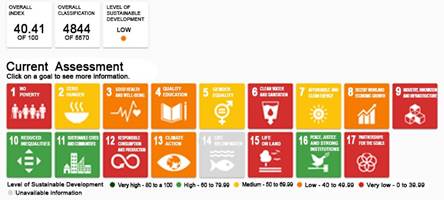
Figure 1
IDSC - Santo André
Source: Translated from IDSC-BR (2024,
n.p.)
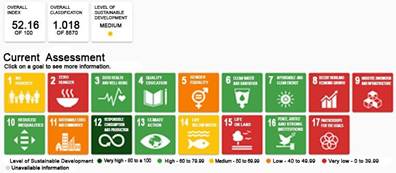
The city of Santo André presents a level
considered low, with good and very good performance in the SDGs marked in shades of green, indicating progress
as the color deepens. The city
shows positive highlights in SDGs 10, 11, and 16. However, there is still a
need for greater development in the SDGs represented in yellow, orange, and
red, which also intensify according to the level of concern. The gray color,
representing SDG 14, indicates that this particular goal does not apply to the
municipality.
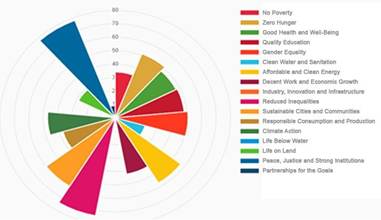
Figure 2
Performance by SDG - Santo André
Source: Translated from IDSC-BR (2024, n.p.)
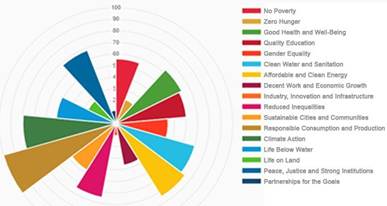
In the radar chart, it is possible to
observe the extent to which each SDG has been addressed in the city, with a
percentage-based representation of the progress made or still required for each goal.
In Santo André,
the greatest progress
is seen in SDG 16 – Peace,
Justice, and Strong Institutions. Conversely, the SDGs showing the least progress
in this radar chart are SDG 9 – Industry, Innovation, and
Infrastructure, along with SDG 14 – Life Below Water.
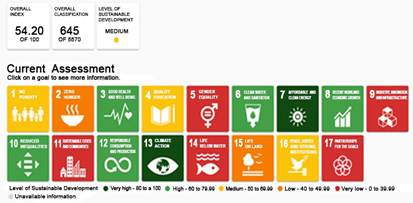
Figure 3
IDSC - São Bernardo
do Campo
Source: Translated from IDSC-BR (2024, n.p.)
Continuing the analysis of strengths and
areas for improvement using the IDSC-BR indicator, the city of São Bernardo do
Campo reaches a level considered medium, with good and very good performance
in the SDGs marked in shades
of green, indicating progress as the
color deepens. The city stands
out in SDGs 3, 6, 7, 8, 10, 12, and 13. However, there remains a need for further development in the
SDGs represented by yellow, orange, and red, which also intensify in tone
according to the degree of concern.
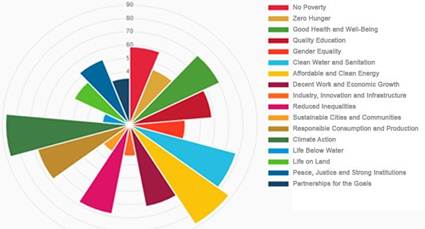
Figure 4
Performance by SDG - São Bernardo do Campo
Source: Translated
from IDSC-BR (2024, n.p.)
In the radar chart shown in Figure 2, it is possible to observe the extent to which the SDGs have been addressed in
the city, with a percentage-based representation of the progress made or still
required for each goal. In this case, positive highlights include SDGs 7 and
13, while SDGs 9, 11, and 14 show the lowest levels of progress.
Figure 5
IDSC - São Caetano do Sul
Source: Translated from IDSC-BR (2024, n.p.)
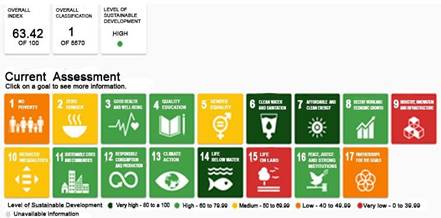
The city of São Caetano do Sul reaches a
level considered high, with good and very good performance in the SDGs marked
in shades of green, indicating progress as the color deepens. The city stands
out in SDGs 3, 4, 6, 7, 8, 11, 12, 13, 14, and 16. However,
there is still a
need for further
development in the SDGs represented by yellow, orange,
and red, which also
intensify in tone according to the level of concern.
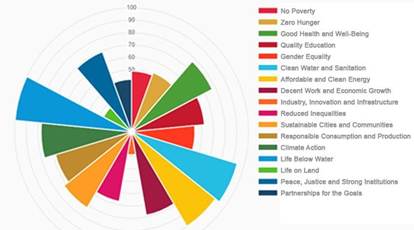
Figure 6
Performance by SDG - São Caetano do Sul
Source: Translated from IDSC-BR (2024, n.p.)
The radar chart
clearly shows the extent to which SDGs 6, 7, and 14 have been addressed
in the city, while also highlighting, in percentage terms, the need for greater
efforts toward SDGs 9 and 15.
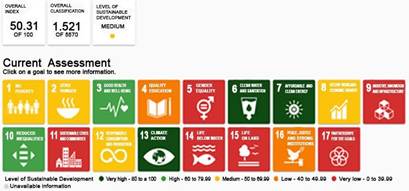
Figure 7
IDSC Diadema
Source: Translated from IDSC-BR (2024, n.p.)
The city of Diadema reaches a level
considered medium, with good and very good performance in the SDGs represented
in shades of green, indicating progress as the color deepens. The city shows positive
highlights in SDGs 3, 6, 7, 10, and
13. However, there is still a need for further development in
the SDGs marked in yellow, orange, and red, which also intensify in tone
according to the level of concern (Figure 7).
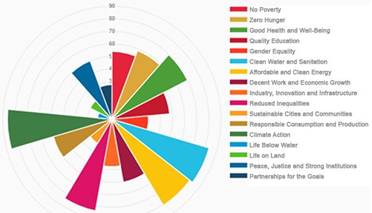
Figure 8
Performance by SDG – Diadema
Source: Translated from IDSC-BR
(2024, n.p.)
In the case of Diadema, the radar chart
shows that SDGs 13, 6, and 7 achieved the greatest progress, respectively. On
the other hand, SDGs 14, 15, and 11 displayed the lowest performance levels in
the city (Figure 8).
Figure 9
IDSC –Mauá
Source: Translated
from IDSC-BR (2024, n.p.)
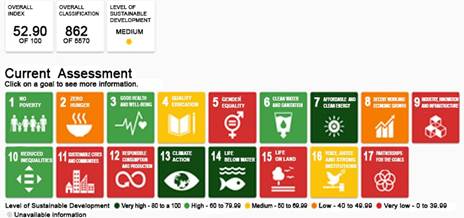
The municipality of Mauá reaches a
level considered medium, with good and very good performance in the SDGs represented in shades of green,
indicating progress as the color deepens. The city shows positive
highlights in SDGs 1,
3, 6, 7, 10, 13, and 14. However, there is still a need for
further development in the SDGs marked in yellow, orange, and red, which also
intensify in tone according to the level of concern.
Figura 10
Performance by SDG - Mauá
Source: Translated from IDSC-BR (2024, n.p.)
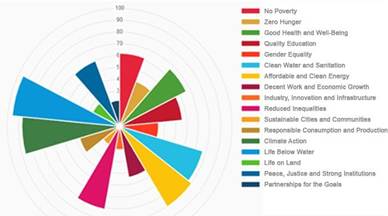
The radar chart for Mauá shows that the city performed
best in SDGs 15, 14, 7, and
6. In contrast,
SDGs 10, 17, 8, and 15 showed the weakest performance levels.
Figura 11
IDSC - Ribeirão
Pires
Source: Translated
from IDSC-BR (2024, n.p.)
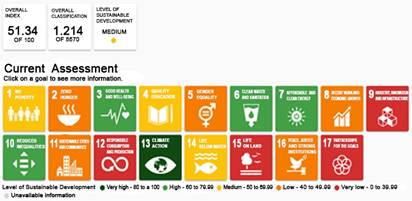
The city of Ribeirão Pires reaches a
level considered medium, with good and very good performance in the SDGs represented in shades of green, indicating progress as the color deepens. The city stands out in SDGs
3, 6, 7, 10, and 13. However, there is still a need for further development in
the SDGs marked in yellow, orange, and red, which also intensify in tone
according to the level of concern.
Figure 12
Performance by SDG - Ribeirão Pires
Source: Translated from IDSC-BR (2024, n.p.)
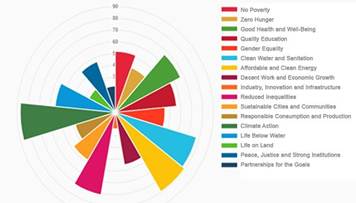
In
Ribeirão Pires, the radar chart shows
the best performance in SDGs 13, 7, and 6, while the weakest results are
observed in SDGs 9, 17, and 15.
Figura 13
IDSC – Rio Grande da Serra
Source: Translated from IDSC-BR (2024, n.p.)
The city of Rio Grande da Serra reaches
a level considered medium, with good and very good performance in the SDGs represented in shades of green,
indicating progress as the color deepens. The city shows positive highlights in
SDGs 3, 4, 6, 7, 10, 12, 13, and 16. However, there is still a need for further
development in the SDGs marked in yellow, orange, and red, which also intensify
in tone according to the level of concern.
Figure 14
Performance by SDG - Rio Grande
da Serra
Source: Translated from IDSC-BR (2024, n.p.)
Concluding the analysis of the radar
charts, it is observed that in the case of Rio Grande da Serra, the city shows
its strongest performance in SDG
12 – Responsible Consumption
and Production, and its weakest in SDG 9 – Industry, Innovation, and
Infrastructure, possibly due to the presence of environmental preservation
areas within the municipality.
Aiming to provide a more accurate
comparative understanding among the seven municipalities, the greatest progress
was observed in SDG 13 – Climate
Action, while the least
progress was seen in SDG 9 – Industry, Innovation, and Infrastructure.
Additionally, to offer an overview
of the national context, Figures
15 and 16 present
Brazil’s situation in relation to each of the SDGs, grouped according to IBGE
(2023).
Figure 15
Brazilian Indicators for the Sustainable Development Goals (Summary
of Global Indicator
Production by Goal)
Source: Translated from IBGE 2024 n.p.
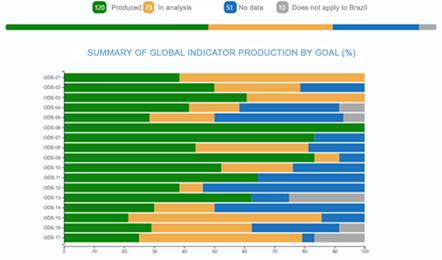
The analysis of Figure 15 reveals notable
progress in relation
to SDG 6 – Clean
Water and Sanitation, although it is widely acknowledged that much
remains to be done in this area in Brazil. For several other SDGs, the absence
of sufficient data prevents a more accurate analysis. Viewed from another
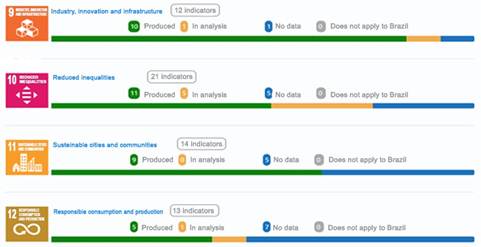
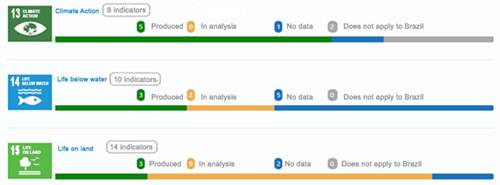
perspective, Figure 16 presents the status of each Goal along with the number
of indicators used for each SDG.
Figure 16
Brazilian Indicators for the
Sustainable Development Goals (Status
by Goal)
Source: Translated from IBGE 2024, n.p.
When analyzing the overall index for
each SDG provided by IBGE, as shown in the consolidated national data in Figure
16, it becomes clear that much has already been accomplished in relation to the
SDGs. However, a considerable effort is still required, as the 2030 Agenda is
approaching a decisive moment, with only six years remaining.
This context reveals both progress and
weaknesses in meeting the SDG targets established by the country, particularly
within the studied geographic area, the ABC Paulista Region.
Among the seven cities analyzed, with
the exception of Santo André, all others have achieved scores above 50% (Table
1), placing them above the national SDG Index, which stands at 47.20% for
indicators classified as “produced” (Table 2). It is worth noting that São
Caetano do Sul ranks first in the state of São Paulo, according to the IDSC-BR
indicator (Figures 5 and 6).
Other noteworthy points include SDG 9
(Industry, Innovation, and Infrastructure), which is generally considered
satisfactory at the national level. However, in the ABC Paulista Region, the situation
is less favorable, indicating the need for further
development to align with
other regions of the country. Conversely, with regard to SDG 10 (Reduced
Inequalities), the opposite is observed,
the region is more advanced
in this area compared to others in the country (Table 3).
Table 3
Comparison Between IDSC-BR
Index (Seven Municipalities of the ABC Paulista Region) and SDG-BR (Brazil)
|
SDG
|
1
|
2
|
3
|
4
|
5
|
6
|
7
|
8
|
9
|
10
|
11
|
12
|
13
|
14
|
15
|
16
|
17
|
|
SBC
|
|
|
|
|
|
|
|
|
|
|
|
|
|
|
|
|
|
|
SCS
|
|
|
|
|
|
|
|
|
|
|
|
|
|
|
|
|
|
|
STA
|
|
|
|
|
|
|
|
|
|
|
|
|
|
|
|
|
|
|
DIA
|
|
|
|
|
|
|
|
|
|
|
|
|
|
|
|
|
|
|
MAU
|
|
|
|
|
|
|
|
|
|
|
|
|
|
|
|
|
|
|
RPI
|
|
|
|
|
|
|
|
|
|
|
|
|
|
|
|
|
|
|
RGS
|
|
|
|
|
|
|
|
|
|
|
|
|
|
|
|
|
|
|
BRA
|
|
|
|
|
|
|
|
|
|
|
|
|
|
|
|
|
|
Source: Prepared by the authors
Table
3 provides a comprehensive overview of the status
of each SDG in each of the
seven municipalities, with color coding based on the IDSC-BR (Figures
1 to 14): red indicates very poor performance,
orange poor, yellow fair, and green good/very good. Additionally, it is possible to
compare the status of each of these cities with the national context by
referencing the SDG-BR index (Figures 15 and 16).
5 Discussion of Results
Based
on the data collected from the IDSC-BR
and SDG-BR sustainability indicators across the seven
municipalities of the ABC Paulista
Region, and from the comparative analysis of each city’s performance regarding the development of
each SDG—as well as in relation to
the other municipalities in the region—the results reveal that, regardless of
the source of the analyzed indicators, there was a degree of alignment, almost
a standardization, among the municipalities. This alignment is related to
shared progress in SDG development, common environmental demands, and the factors, attributes, and performance indicators observed across the
seven cities.
This confirms the relevance of the
issues highlighted by Lima and Ribeiro (2023). Municipal-level challenges
reflect those at the state and national levels, emphasizing the difficulties in
implementing the SDGs across all spheres—federal, state, and municipal—and the necessary
interdependence for their development, given the urgency
of implementing all 17
SDGs in time to meet the 2030 Agenda. In line with the reviewed literature
(Oliveira, Pereira & Trindade, 2013; Vieira, 2020; Frey et al., 2020; Cândido &
Martins, 2015; Silva et al.,
2018; Abiko & Negreiros, 2019), it is clear that there is a need for
progress in nearly all SDGs.
Thus, although the municipal indices
analyzed are above the national
average for the SDG Index and
show particular strength in SDG 10 (Reduced Inequalities), SDG 9 (Industry,
Innovation, and Infrastructure) still falls behind national implementation levels due to regional characteristics. Therefore,
considerable progress is still needed for the full implementation of the SDGs
in the municipalities of the ABC
Paulista Region, as well as in other municipalities across Brazil, to meet the
targets of the 2030 Agenda.
In this regard, the results highlight
the importance of aligning and uniformly implementing all SDGs across
the municipalities in the region.
This reinforces the broader need for municipalities throughout the
country to advance in the concept of sustainability by developing the SDGs
across multiple dimensions (Cortese et al., 2019). Accordingly, the various
dimensions of sustainability and the different SDGs must be developed in an
interconnected manner in order to achieve fully sustainable and equitable development (Sachs, 1993).
6
Final
Considerations
This article aimed to compare municipal
progress in relation to the SDGs using the sustainability indices
IDSC-BR and SDG-BR
across the seven
municipalities that comprise
the ABC Paulista Region. Regardless of the source of the indicators, it
was found that there is alignment, almost a standardization, among the
municipalities in terms of strategies, environmental demands, and the factors, attributes, and performance indicators across the three dimensions: environmental,
economic, and social.
Based on the information presented, the sustainability indicators selected for this study revealed
both strengths and challenges to be addressed by the municipalities, with
potential impacts on their
sustainable development. In light of this
reality, the results indicate
that, even when considering the different indicators analyzed, there is
alignment and standardization among the municipalities regarding SDG progress,
environmental demands, and performance indicators across the seven cities. In
summary, the municipalities share both challenges and advances that stem from
the characteristics of the ABC Paulista Region and its regional development
dynamics.
These reflections are echoed in the
theoretical field, where authors emphasize that sustainability encompasses
multiple dimensions and highlight the challenges of implementing the SDGs
comprehensively and uniformly within specific territories. These issues were
reinforced by the observed interdependence among municipalities,
natural boundaries, and the need for sustainable urban management.
Among
the limitations identified, despite the evaluation using 100 indicators to monitor municipal performance, it was not possible to cover all dimensions of the intended
goals due to the lack of data from official public
sources. There is a need for greater investment in administrative statistical systems to ensure
the availability of key data for monitoring the SDGs. Another
limitation of the index relates to the reference year of certain indicators.
Due to the lack of updates, some of the data used are relatively outdated. This
highlights the importance of investing in more recent and regularly updated
data.
Additionally, the use of the arithmetic mean across all indicators, assigning equal weight to each, may obscure
priority areas, especially when a municipality performs well in most
indicators but faces significant challenges in one or two specific
areas. This phenomenon draws attention to the issue of substitution or compensation in
composite indices.
In light of the above, this research
does not conclude the discussion but instead points to the need for further comparative studies on regional development and territorial progress in implementing the
SDGs across the multiple dimensions of sustainability. Such efforts may
contribute to more regionally focused analyses and broader national research.
References
Agenda 2030. Índice de Desenvolvimento Sustentável das Cidades/Brasil. (2024).
Disponível em https://www.cidadessustentaveis.org.br/institucional/pagina/agenda2030.
Arantes, M. V. C., & Pereira, R. S. (2021). Análise
crítica dos 10 anos de criação e implementação
da Política Nacional
de Resíduos Sólidos
(PNRS) no Brasil. Revista Liceu On-Line, 11(1),
48-66.
Avila, A. D. S., Santos,
J. A. C., & Vieira, A. M. (2015). A construção de uma visão sistêmica
na formação do administrador: a perspectiva do egresso sobre a disciplina
sustentabilidade. Revista Gestão & Sustentabilidade Ambiental, [S.
l.], 4(1), 289–312.
DOI: 10.19177/rgsa v4e12015289-312. Disponível em https://portaldeperiodicos.animaeducacao.com.br/index.php/gestao_ambiental/article/vie w/2402.
Avelar, A. B. A.,
Farina, M. C., & Pereira, R. S. (2022). Principles for responsible
management education-PRME: Collaboration among researchers. The International Journal of Management
Education, 20(2), 100642.
Avelar, A. B. A., Silva-Oliveira, K. D. D., Farina, M. C., & Pereira, R. S. (2022).
Contribution of PRME in education, research, and outreach
in Brazilian higher
education institutions. International Journal of Sustainability in
Higher Education, 23(2), 283-300. Cortese, T. T. P., Kniess, C. T., &
Maccari, E. A. (2017). Cidades inteligentes e sustentáveis.
São Paulo: Manole.
Creswell, J. W. (2014).
Investigação qualitativa de pesquisa:
escolhendo entre as cinco
abordagens. Tradução: Sandra Mallmam da Rosa: Porto Alegre: Penso.
Frey, K., Torres,
P. H. C., Jacobi, P. R., & Ramos, R. F. (Orgs.). (2020). Objetivos do
desenvolvimento sustentável:
desafios para o planejamento e a governança ambiental na
Macrometrópole Paulista. EdUFABC.
Instituto Brasileiro de Geografia e Estatística
- IBGE. (2023). Indicadores de desenvolvimento sustentável: Coordenação
de Recursos Naturais e Estudos Ambientais [e] Coordenação de Geografia. Rio de Janeiro.
IDSC.
(2023). Índice de Desenvolvimento Sustentável das Cidades/Brasil. Disponível em https://idsc.cidadessustentaveis.org.br/introduction.
SDG
Transformation Center. (2023). O Índice de Desenvolvimento
Sustentável das Cidades - Brasil
(IDSC-BR). Instituto Cidades Sustentáveis & Sustainable Development
Solutions Network: São Paulo & Paris.
Disponível em https://www.sdgindex.org/reports/indice-de-desenvolvimento-sustentavel-das-cidades-brasil/ .
Lima, A. A., & Ribeiro,
T. L. S. (2023). Mapeamento dos Objetivos de Desenvolvimento
Sustentável Pesquisa em Ciências Sociais: Uma Análise Bibliométrica.
Revisão do Journal of Lifestyle and SDGs, [S. l.], e01562. DOI:
10.37497/2965-
730X.SDGsReview.v3. n00.pe01562. Disponível em https://periodicosalumniin.org/LifestyleJournal/article/view/1562 .
Martins, M. F., & Cândido, G. A. (2015). Modelo de
avaliação do nível de sustentabilidade urbana:
proposta para as cidades brasileiras., Revista Brasileira de Gestão Urbana, 7(3). https://doi.org/10.1590/2175-3369.007.003.AO09. Disponível em https://www.scielo.br/j/urbe/a/R33R37Bb8ZSjRrbTtsN63Mm/#
Nações Unidas Brasil.
(2023). Objetivos de Desenvolvimento Sustentável. Disponível em: https://brasil.un.org/pt-br/sdgs
Negreiros, I., & Abiko, A. K.
(2019). Normalização técnica para cidades e comunidades sustentáveis. In: Philippi
Jr, A. C., & Bruna
G. (2019). Gestão urbana e sustentabilidade. Barueri: Manole.
E-book. ISBN 9788520462935. Disponível em https://integrada.minhabiblioteca.com.br/#/books/9788520462935/
Oliveira, E. C., Trindade, F. H., & Pereira, R. S.
(2013). Políticas Públicas Indutoras do Desenvolvimento Sustentável Local: Um
Estudo Sobre o Programa Município Verde Azul
na Região do Grande ABC. Administração Pública
e Gestão Social, [S. l.], 7(3), 109–119.
DOI: 10.21118/apgs. v7i3.4493. Disponível em https://periodicos.ufv.br/apgs/article/view/4493.
Oliveira, S.V.W.B.
D., Leoneti, A., & Cezarino, L. O. (2019). Sustentabilidade: princípios e estratégias. Editora Manole.
Organização das Nações
Unidas. (1987). Relatório da Comissão
Mundial Sobre o Meio
Ambiente e Desenvolvimento. Nosso Futuro Comum. Disponível em: https://www.are.admin.ch/are/en/home/media/publications/sustainable-development/brundtland-report.html
Organização das Nações Unidas. (2015). Objetivos de Desenvolvimento Sustentável. [S. l.: s.
n.]. Disponível em https://brasil.un.org/pt-br/sdgs
Phillip Jr, A.,
& Bruna, G. C. (2019). Gestão urbana e sustentabilidade. Editora
Manole. Picchiai, D., & Senigalia, F. (2019). Gestão de Resíduos
Sólidos Integrada às
Responsabilidades
das Micro e Pequenas Empresas e do Poder Público Municipal. Desenvolvimento
em Questão, [S. l.], 17(49), 112–135. DOI:
10.21527/2237-6453.2019.49.112-135. Disponível em https://www.revistas.unijui.edu.br/index.php/desenvolvimentoemquestao/article/view/84 33.
Puga Sarubbi, M., & Schmidt Bueno de Moraes, C. (2019).
Avaliação comparativa de metodologias de indicadores para a sustentabilidade urbana. Cadernos Zygmunt Bauman,
8(18). Disponível em: https://periodicoseletronicos.ufma.br/index.php/bauman/article/view/10243
Sachs,
I. (1993). Estratégias de transição para o século
XXI. In: Bursztyn, M. Para
Pensar o Desenvolvimento
Sustentável. São Paulo: Brasiliense.
Sachs, J. (2017). A Era
do Desenvolvimento Sustentável. São Paulo: Actual.
Scur, G., & Heinz, G. (2016). A dimensão
ambiental no contexto
da estratégia de operações
de montadoras do ABC paulista. RBGN - Revista
Brasileira de Gestão
de Negócios, [S. l.],
18(60), 290–304. DOI: 10.7819/rbgn. v18i60.2195. Disponível em https://rbgn.fecap.br/RBGN/article/view/2195 .
Sevegnani, O. F., Gianetti,
B. F., Agostinho, O. F. O., & Almeida, C. M. V. B.
(2017).
Avaliação do potencial capacidade municipal de carga
e comércio. Revista de Produção
Mais Limpa, 153(1), 425.
Silva, J. F. B. A., Rebouças, S. M. D. P., Abreu, M. C. S., & Ribeiro, M. C. R. (2018).
Construção
de um índice de desenvolvimento sustentável e análise espacial das
desigualdades nos municípios cearenses. FGV EBAPE. Revista de Administração Pública, Rio de Janeiro 52(1),149-168.
Disponível em https://www.scielo.br/j/rap/a/ywT6s5TkkNfkVWfLcsMrByd/?lang=pt&format=pdf
Valverde, M. C. (2017). A interdependência entre vulnerabilidade climática e socioeconômica na
região do ABC Paulista. Ambiente & Sociedade, 20(3), 39-60.
Vieira, I. C. G. (2019).
Abordagens e desafios
no uso de indicadores de sustentabilidade no contexto amazônico. Ciência e
Cultura, 71(1), 46-50.
Vieira, D. (2020).
ODS e a importância local.
In: Frey, K., Torres, P. H.C., Jacobi, P. R., &
Ramos, R. F. (Org.). Objetivos do desenvolvimento sustentável: desafios para
o planejamento e a governança ambiental na Macrometrópole Paulista. Santo
André: EdUFABC, 31-39.
Vieira,
L. C., & Candiani, G. (2021). Potencial energético de resíduos
sólidos urbanos na Região do Grande ABC Paulista. Revista
Ibero-Americana de Ciências Ambientais, 12(2), 328-342.
i Doutoranda
em Administração na Universidade Municipal São Caetano do Sul- USCS, Professora
na Unisênior da Universidade Municipal de São Caetano do Sul- USCS.
ii Mestrando em
Administração. Formado em Administração, Pós-Graduado em Administração da
Produção, Pós-Graduado em Logística Empresarial.
iii Doutora em Ciências Sociais (2003) e Mestre em Administração (1999),
ambos pela PUC/SP. Especialista em Administração de Recursos Humanos, pela
Escola Superior de Administração de Negócios - ESAN (1988) e Licenciada Plena
por meio do Curso de Formação de Professores (ESQUEMA I) pela Faculdade de
Tecnologia de São Paulo - FATEC/SP (1992). Bacharel em Administração de
Empresas, pela Universidade São Judas Tadeu - USJT (1984).