 Source: Prepared by the authors
DOI: 10.13037/gr.vol36n108.5522
INTELLECTUAL CAPITAL COMPONENTS: INFLUENCE ON ASSET SPECIFICITIES IN AGRIBUSINESS BUSINESS DOWNSTREAM OPERATIONS
COMPONENTES DE CAPITAL INTELECTUAL: INFLUÊNCIA NAS ESPECIFICIDADES DE ATIVOS NAS OPERAÇÕES DE JUSANTE DE EMPRESAS DO AGRONEGÓCIO
Victor Galindo de Mello1
ORCID: https://orcid.org/0000-0003-3458-9071
Deisy Cristina Corrêa Igarashi2
ORCID: https://orcid.org/0000-0001-6603-9846
Vinicius Galindo de Mello3
ORCID: https://orcid.org/0000-0002-2094-0847
(Universidade Estadual de Maringá)1, 2
(Universidade Tecnológica Federal do Paraná)3
ABSTRACT
The intellectual capital (IC) is gaining prominence both in academic studies as in the business context. When evaluated the development of these elements, the Brazilian agribusiness stands out. Some difficulties are being addressed by studies linked to the transaction cost economics (TCE), resembling mainly with asset specificities. This study aims to understand how the influence of the components of intellectual capital in the formation of asset specificity in the downstream transactions of Brazilian agribusiness, especially in the southern region. The quantitative method demonstrated relevant to the objective with the companies listed in the Exame M&M 2016, in which a multiple linear regression was performed. The results indicate that three components of IC (human, relational and structural capital) are present in the context of agribusiness, but only the structural component has been shown to be significant for the formation of asset specificities. Through this result, managers can identify points of specificities, which can be work in order to carry out efficient transactions.
Keywords: Intellectual Capital. Asset Specificities. Agribusiness.
RESUMO
O capital intelectual (CI) está ganhando destaque tanto em estudos acadêmicos quanto no contexto empresarial. Avaliando o desenvolvimento desses elementos, destaca-se o agronegócio brasileiro. Dificuldades estão sendo abordadas por estudos ligados à economia de custos de transação (ECT), assemelhando-se principalmente às especificidades dos ativos. Este estudo visa compreender como a influência dos componentes do capital intelectual na formação da especificidade de ativos nas operações de jusante do agronegócio brasileiro, especialmente na região sul. O método quantitativo demonstrou relevância para o objetivo com as empresas listadas no Exame M&M 2016, em que foi realizada uma regressão linear múltipla. Os resultados indicam que três componentes do CI (capital humano, relacional e estrutural) estão presentes no contexto do agronegócio, mas apenas o componente estrutural se mostrou significativo para a formação das especificidades dos ativos. Por meio desse resultado, os gestores podem identificar pontos de especificidades, que podem ser trabalhos para realizar transações eficientes.
Palavras-chave: Capital Intelectual. Especificidades de ativos. Agronegócio.
1 INTRODUCTION
The current context of the Brazilian economic situation requires that even more organizations manage efficiently the use of knowledge and other intangibles elements belonging to organization (Antunes & Martins, 2002; Dorce, Cavalheiro, & Gimenes, 2017; Silveira, Schnorrenberger, Gasparetto, & Lunkes, 2017). Considering organizational resources, the intangible elements does not decrease with the activity, they tend to develop (Adler, 2001). Antunes and Martins (2002) expressed that the use of knowledge with available technologies produces intangible benefits, developing intellectual capital (IC). Studies on the theme come addressing the terms intangible assets, intellectual capital and knowledge-based assets as they are interconnected (Rodgers, 2007). Thus, this article adopted the term intellectual capital to characterize these forms of assets involving the knowledge.
In 90s, several authors have sought to understand how the intellectual capital was composed in organizations, developing categories of analysis (Bontis, 1998; Edvinsson & Malone, 1998; Molodchik, Shakina, & Barajas, 2014; Reilly, 1996; Saint-Onge, 1996; Stewart, 1998; Sveiby, 1998). Studies developed by Edvinsson and Malone (1998), Stewart (1998) and Sveiby (1998) feature recognized structures as a way of understanding the intellectual capital. This structure designed by the authors share as components of intellectual capital mainly human capital, structural capital and relational capital (Edvinsson & Malone, 1998; Stewart, 1998; Sveiby, 1998).
On a similar period presented in the literature, the Brazilian institutional environment for agribusiness sought to strengthen a process of technological development. Mainly favored with the creation of the Brazilian Company of Agricultural Research Corporation (Embrapa) in 1973 and the National Agricultural Research System (SNPA) in 1992, which led to increased competitiveness (Scolari, 2006; Vieira Filho, 2014). Agribusiness production chain is of greater relevance in terms of technological development (Vieira Filho, 2014). This development reflects the results obtained in the GDP (gross domestic product) on which presented a growth of 4.48% in 2016, contrasting with the indentation of 3.6% of GDP in 2015 (CEPEA, 2016).
Intellectual capital management presents some difficulties as in the establishment of property rights, in providing equivalent information between agents and procedures, cultures and expertise (Edvinsson & Malone, 1998; J. Martins & Alves, 2010; Stewart, 1998; Sveiby, 1998). Difficulties resemble studies related to the transaction cost economics (TCE) (Williamson, 1985, 1991). Considering the transaction attributes, Williamson (2010) considers that the specificity of assets holds great importance in the understanding of governance structures. Thus, we propose the following research question: what is the influence of the components of intellectual capital in the formation of asset specificity in the downstream transactions of agribusiness companies? To direct the study to answer to the question, the research was outlined a goal for the research, which aims to understand how components of intellectual capital influence on the formation of asset specificity in the downstream transactions of agribusiness companies.
Analysis of intellectual capital becomes relevant as a way of generating knowledge and technological development, and improve organizational results, mainly for agribusiness (Scolari, 2006; Vieira Filho, 2014). The article aims to ascertain how is composed the intellectual capital in enterprises of Brazilian agribusiness, especially in the southern region in order to assist managers to improve the intellectual capital within the agro-industries and generate more efficient transactions. Studies related to the management of intellectual capital was developed using the theories of transaction costs, analyzing the IC as an asset that must be aligned to the governance structure in order to conduct transactions more efficient (Adler, 2001; Grant, 1996; Liebeskind, 1996; Peyrefitte, Golden, & Brice, 2002). Although the search for efficient governance structure for the capital, so far has not been verified the influence of these elements in the formation of asset specificities.
2 COMPONENTS OF INTELLECTUAL CAPITAL
The intellectual capital (IC) is understood as the stock or flow of knowledge within an organization, being in financial values (Edvinsson & Sullivan, 1996; Solitander & Solitander, 2010). Carayannis (2005, p. 3) presents intellectual capital as “an agglomeration of explicit and tacit knowledge, coded information and intrinsic know-how”. The IC has a vital importance on the business performance (Vogt, Kreuzberg, Degenhart, Junior, & Biavatti, 2016). According to the authors, corporations that invest on intellectual capital or on the development of technology researches tend to stand out for their intangible assets.
The structure of IC currently recognized was proposed by Edvinsson and Malone (1998), Stewart (1998) and Sveiby (1998). Composed mainly of three components, the human capital (CH), relational (CRel) capital and structural capital (EC). Some subcomponents were developed, the human capital being divided between the skills of managers (CG) and the capacities of human resources (CRH). Structural capital was divided into ability of innovations (CI), and the ability of internal process (CPI). Relational capital was separated into capabilities of networks (CR) and loyalty and reputation to the consumer (LR) (Molodchik et al., 2014).
Human capital comprises the development of the skills, expertise and competences of the company (Edvinsson & Sullivan, 1996). Reilly (1996) presents human capital related to the skilled workforce. Human capital increases in two ways, by obtaining the prior knowledge of new employees, and through the development of knowledge for the employees in the company (Stewart, 1998). In studying tacit knowledge, Saint-Onge (1996) shows that this type of knowledge materializes through the mentality of individuals, with beliefs, biases, values and assumptions. Thus, by adding the opinions, values, and individual norms in an organization, the organizational culture is formed (Saint-Onge, 1996). Human capital represents a source of innovation and strategic renewal of the organization (Bontis, 1998).
Another component of the IC is the structural capital. According to Edvinsson and Malone (1998, p. 32), it represents "the empowerment framework and the infrastructure that supports human capital. [Includes also] physical systems used to convey the intellectual knowledge". Bontis (1998) characterizes structural capital as the mechanisms and structures of the organization used to support workers in pursuit of both intellectual and general performance for the business. The author shows that through structural capital, it is possible to measure and develop intellectual capital within the organization. The essence of structural capital is organizational routines (Bontis, 1998).
Finally, the third component of the intellectual capital is the relational capital. Relational capital, or as Stewart (1998) features, customer capital represents the relationship with customers and suppliers. Sveiby (1998, p. 129) supports when submitting this form of capital as "external" structures, which must manage "the flow of knowledge in the relationships between customers and suppliers". These intangibles include knowledge related to customers, suppliers, government, and industrial associations (Bontis, 1998). Several studies (Bontis, 1998; Edvinsson & Malone, 1998; Molodchik et al., 2014; O’Donnell & O’Regan, 2000; Reilly, 1996; Stewart, 1998; Sveiby, 1998) presented elements that make up the components of intellectual capital. Each component of the intellectual capital exposed characteristics, such as the difficulty in establishing properties rights and the impossibility of equivalent information between agents, which resemble the formation of characteristics of assets specificities in transactions, which are covered by the TCE.
3 ASSETS SPECIFICITIES
Economic theories requires understanding the relationship between the companies, the effects of market structures, the behavior and the economic performance (Joskow, 2004). An alternative proposal to the understanding of market functioning was the new institutional economics (NEI) (Coase, 1937; Williamson, 1985, 1991, 2010). With the proposal of Williamson (1985), the concept of the company related to the production function has been replaced by the concept of firm as governance structure. With this, institutions would have the purpose of minimizing transaction costs (Williamson, 1985).
The purpose of the theory of transaction costs is to identify what type of governance structure, the organization could carry out transactions more efficiently (Williamson, 1985). As forms of governance structure, TCE details market forms, hybrids, and vertical integration (Williamson, 1985, 1991). Transactions generate costs due to contractual and organizational risks, which are related to the transactional attributes and behavioral assumptions (Williamson, 1985). When working with the behavioral assumptions of man, Williamson (1985) divides the two assumptions: limited rationality and opportunism.
Considering the attributes of the transaction, three elements are listed: uncertainty, frequency and asset specificity (Williamson, 1985). Asset specificity has played an important role in determining the most effective governance structure (Williamson, 2010). Specific assets are "specialized assets that cannot be relocated without sacrifice of productive value, in the case of the contract be interrupted or prematurely terminated" (Williamson, 1985, p. 54). Farina (1999, p. 156) corroborates that "assets are specific if the return associated with them depends on the continuity of a specific transaction." The value of the specific asset comes from the transaction (Pohlmann, Aguiar, Bertolucci, & Martins, 2004).
As soon as there are investments in specific assets, the relationship between buyer and seller can become totally or almost exclusively (Pohlmann et al., 2004). The choice of governance structure is established through a function between governance costs and the intensity of specific asset, to provide lower cost transactions (Williamson, 1991). There are six forms of specific assets, namely: physical, human, locational, dedicated, branded and temporal (Williamson, 1985, 1991).
The specificity of location concerns the location in the mediations of productive units. Because of the immobility of assets, installation costs or re-location are great influence in inventory and transportation costs (Williamson, 1985, 1991). Physical asset specificity refers to the physical investment held by a party involved in the relationship that becomes indispensable to the same (Williamson, 1985, 1991). According to (De Vita, Tekaya, & Wang, 2011), this investment in a specific physical asset is made for a given transaction and would have few alternatives for use outside of it. The design can influence on the value of an asset and make it difficult to use in another transaction (Pohlmann et al., 2004).
The specificity of human capital matches for the specific human capability for a particular activity (e.g., tacit knowledge). This specificity arises through learning-by-doing process (Williamson, 1985, 1991). Zaheer and Venkatraman (1995) show that this specificity refers to the degree to which a firm's knowledge, skills and experience are specific to the requirements to negotiate with another firm. The specificity of dedicated assets comprises a dependency relationship between the investment and the return because of the dedication to an agent or specific activity (Williamson, 1985, 1991). This specificity refers to assets "in which agreements were made for a particular transaction, which expects a long-term relationship" (De Vita et al., 2011, p. 334).
Brand asset specificity comprises the representation of the mark, that is, the value embedded in the well transacted (Williamson, 1985, 1991). A transaction in which the brand has "direct and high effect on the firm's overall performance can be described as a high specificity of brand asset" (De Vita et al., 2011, p. 335). The specificity of time corresponds to the importance of the time for which a transaction is performed, and the value of assets linked to time, as in newspapers and agricultural products (Masten, Meehan, & Snyder, 1991; Williamson, 1985, 1991).
The first five forms of asset specificity (physical, human, dedicated, locational and brand) create bilateral dependence and adds risk of hiring, having according to Williamson (1991, p. 282) "a central role in conceptual and empirical work of TCE". According to Williamson (2010, p. 681–682), “transaction cost economics has many applications, not only in the field of industrial organization, but within most of the fields applied to economics, strategy, organizational behavior , marketing, finance [...]” and has been developing more and more in the last 30 years. According to the author, any problem can be reformulated as a contracting problem and through the study of these, generate advantages with the economics of transaction costs (Williamson, 2010). Farina (1999, p. 158) adds that in order to avoid “loss of rigor in the analysis, it is necessary that the transaction groups have common attributes”. Features presented by intellectual capital express alignment with the formation of asset specificity provided by TCE. In this sense, Adler (2001), Grant (1996), Liebeskind (1996) and Peyrefitte et al. (2002) come using the theory of transaction costs associated with other theories in an attempt to efficiently manage these types of asset.
4 THEORETICAL CONVERGENCES AND PROPOSITIONS
Human capital (CH) consists of every ability, knowledge, skills and individual experiences of individuals belonging to the organization, compounding the capacities of human resources and management skills (Edvinsson & Malone, 1998; Molodchik et al., 2014). This component represents the qualified workforce (Reilly, 1996). The ability of human resources represents the mentality, beliefs, values and biases of individuals present in the organization (Saint-Onge, 1996). The management capability represents the ability to inspire and enable the generation of strategic knowledge (Molodchik et al., 2014).
As the company develops knowledge, skills and experience for a given transaction, more specifics become human assets (AtiEsp) (Zaheer & Venkatraman, 1995). This statement is aligned to the emergence of human asset specificity introduced by Williamson (1985) from the process of learning-by-doing, which develops a knowledge specific to a particular activity. In this way, the study lists the following proposition:
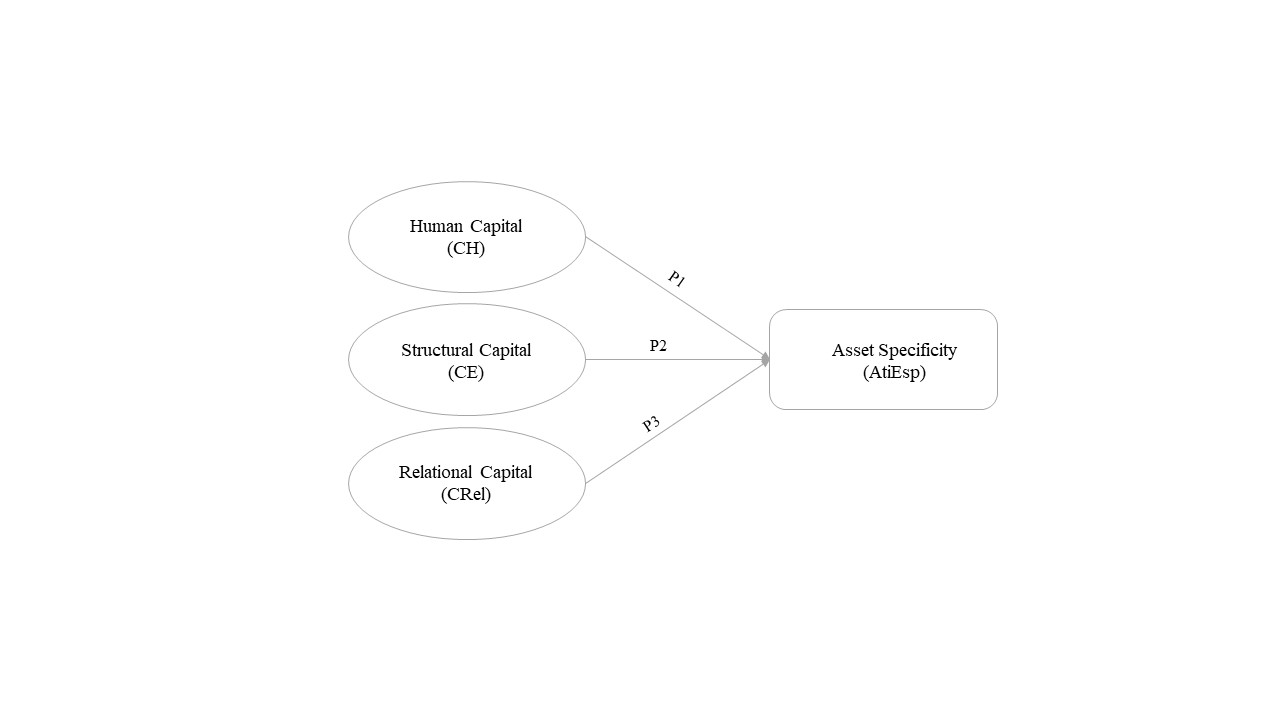
P1 – The human capital influences positively on formation of asset specificity.
Structural capital (CE) represents the entire infrastructure and mechanisms that support organizational activities, which includes capabilities in internal processes and innovation capacities (Bontis, 1998; Edvinsson & Malone, 1998; Molodchik et al., 2014). The capacity in internal processes include systems, instruments and practices that leverage the skills and knowledge flow (Edvinsson & Malone, 1998). While the ability of innovation contains the investments in research and development, number of patents developed, the time allocated to research, awards for innovation (Molodchik et al., 2014).
Investments in internal processes and innovations result in asset specificities, mostly dedicated and physical (AtiEsp), which may influence transactions. The specific physical assets refer to the investment in particular components for particular transactions (De Vita et al., 2011; Williamson, 1985). The specificity of dedicated assets refers to the establishment of dependence between investment and return on an agent or specific activity (Williamson, 1985, 1991).
P2 – The structural capital influences positively on formation of asset specificity.
Relational capital (CRel) is presented by Sveiby (1998) as being formed by the relationship with customers and suppliers, brands, and even the company's own image, being composed by the capacity of networks and consumer loyalty and reputation (Molodchik et al., 2014). The consumer loyalty and reputation comprises the relationship formed with our clients, with the own brand reputation indicator, the proportion of sales and satisfaction (Molodchik et al., 2014; Stewart, 1998). The capabilities of networks represent the company's relationship with other organizations, through associations, participation in events, clients and suppliers for brokering transactions (Molodchik et al., 2014).
The characteristics of the components of the relational capital can be associated with some specifics of assets, including the brand specificity, dedicated and locational (AtiEsp). The brand specificity refers to the representation of the mark, being the value embedded in the well which is transacted (Williamson, 1985, 1991). Dedicated asset specificity includes relationships with other organizations and the formation of networks, which generate dependency of return on investment for the dedication of an agent or specific activity (Williamson, 1985, 1991). In the case of locational specificity, the location in the mediations of productive units, the possibility of relationships with other organizations in the chain, the costs of installation and location influence the locational specificities to transaction (Williamson, 1985, 1991).
P3 – The elements of relational capital influence the formation of asset specificity.
The procedure for the determination of which components of IC influence on formation of asset specificity in the empirical context are presented in the methodological procedures.
5 METHODOLOGICAL PROCEDURES
As a methodological option, the quantitative method presented better chance of understanding the objective proposed. Richardson (2012, p. 70) identifies the quantitative method as a research method which “is characterized by the use of quantification both in the mode of information collection and in the treatment of them by means of statistical techniques”. The quantitative method seeks to ensure accuracy in the data, exempting interpretations, and then making inferences possible (Richardson, 2012). The research is classified as a descriptive study, which tries to understand what the influence of components of intellectual capital in the formation of asset specificity for downstream transactions of the companies under investigation. It was determined the sectional/transversal cut, and as unit of analysis the agribusiness companies in the South Brazilian region identified by the Exame Melhores e Maiores (2016). We opted for the Exame Melhores e Maiores as an important magazine in the national context on disclosure of companies that stood out during the year, in this case, the company that were featured in the Brazilian agribusiness.
The sample is composed of 112 agribusiness companies established in the southern region of Brazil. Data collection occurred through accessibility, where are selected the companies willing to participate in the research. The survey conducted by Exame (2016) observed that companies located in the southern region showed higher profitability among other Brazilian regions. Moreover, as shown by Exame (2016) the most important criterion used by the magazine to classify the selection of the best agribusiness companies was profitability, and in case of a tie between the companies, this criterion prevailed over the others. Companies are distributed in the States of Paraná, Santa Catarina and Rio Grande do Sul, being respectively 39, 19 and 54 companies. Theoretical propositions follow the concepts presented in the studies on the intellectual capital and asset specificity. Figure 1 presents the theoretical model proposed.
The data are collected through questionnaires. The construction of quantitative data collection instrument occurred through the literature based on asset specificity (De Vita et al., 2011; Williamson, 1985, 1991) and intellectual capital (Cassol, Gonçalo, & Ruas, 2016; Edvinsson & Malone, 1998; Gracioli, Godoy, Lorenzett, & Godoy, 2012; Molodchik et al., 2014; Stewart, 1998; Sveiby, 1998). The questionnaire is composed of 56 variables, being 14 of human capital, 09 of structural capital, 12 of relational capital and 21 of specificities of assets (physical, human, dedicated, locational and brand). Table 1 shows a sample of variables used in this research and its measurement.
Table 1- Variables sample and measument
|
Variables |
Measurement |
||
|
Human Capital |
Human Resources Capacity |
CRH1 |
Employees participate in the decision of the transaction. |
|
CRH2 |
Transaction employees are creative and take initiatives in the negotiation process. |
||
|
CRH4 |
Employees who conduct negotiations have a high level of training / qualification. |
||
|
Management Capacity |
CG1 |
Managers responsible for negotiations have highly qualified with expertise in the area of operation. |
|
|
CG3 |
Managers responsible for negotiations have experience in other companies operating in the same segment. |
||
|
CG4 |
In case of replacement of managers, the company encourages the promotion of employees of the organization itself. |
||
|
Structural Capital |
Internal Process Capability |
CPI1 |
Recently, there has been an increase in investment in new methods and systems to conduct the negotiations. |
|
CPI3 |
Updates to the organization's processes lead to reduced losses and waste. |
||
|
CPI5 |
The information system provides all employees who conduct the negotiations with the information necessary for their performance. |
||
|
Innovation Capability |
CI1 |
Investment in product and process research and development (R&D) has increased over the past 3 years. |
|
|
CI2 |
The company is patenting its designs |
||
|
CI3 |
The company recently received innovative performance awards in products, processes, service, etc. |
||
|
Relational Capital |
Loyalty and Reputation |
LR1 |
Customers are pleased with the service of the staff responsible for the negotiations. |
|
LR5 |
Customers are satisfied with price and quality. |
||
|
LR6 |
The order quantity remains constant even with price changes. |
||
|
Network Capacity |
CR1 |
Partnerships with suppliers and customers are strong. |
|
|
CR2 |
Suppliers are in specific regions. |
||
|
CR4 |
Company usually participates in regional associations in the places where they have headquarters. |
||
|
Asset Specificity |
Human Specific Asset |
AH2 |
When there is any specific demand, the company hires temporary employees to meet the demand. |
|
AH5 |
The company seeks to deliver benefits to the employee family, and these benefits impact production / performance. |
||
|
Physical Specific Asset |
AF1 |
The company invests every year in the updating of the equipment destined to the manufacture of the commercialized products. |
|
|
AF2 |
Without investments in equipment for production, the company loses space in the market. |
||
|
Dedicated Specific Asset |
AD1 |
The company seeks to invest in the expansion of the structure due to specific customer requests. |
|
|
AD3 |
Modifications recently made to the organization were due to legal changes or some standard. |
||
|
Brand Specific Asset |
AM2 |
The company's brand demands a large amount of investment annually. |
|
|
AM3 |
The company's brand is the highlight in relation to similar products sold by other companies. |
||
|
Location Specific Asset |
AL1 |
Currently the company is in a strategic location. |
|
|
AL2 |
Customers buy from where the business is located. |
||
Source: Adapted from Cassol, Gonçalo and Ruas (2016), De Vita, Tekaya and Wang (2011), Edvinsson and Malone (1998), Gracioli et al. (2012), Molodchik, Shakina and Barajas (2014), Stewart (1998), Sveiby (1998) and Williamson (1985; 1991).
The measurement of the data was performed through the five-point Likert scales, as shown by Malhotra (2001) from 1 (I strongly disagree) to 5 (I completely agree). Studies of Cassol et al. (2016), De Vita et al. (2011) e Gracioli et al. (2012) support in validation of scales used by the questionnaire. The online platform Qualtrics was adopted to draw up the instrument of collection, and also as a way to direct the emails for administrative and commercial managers of the companies under investigation from August to October/2017. Administrative/Commercial managers were adopted as respondents. The collection instrument seeks to obtain an overview of the agribusiness companies of the southern region identified in the Exame Melhores e Maiores (2016) as a way of visualizing the management of intellectual capital and the presence of specific assets in the companies' transactions.
Figure 1- Model of theoretical propositions
Source: Prepared by the authors
After getting the answers, it has been calculated the averages of each variable of human, structural and relational capital, and specificity of physical assets, human, dedicated, locational and brand. The results of these variables were grouped into their respective components of intellectual capital, in the human capital (CH), the structural capital (EC) and the relational capital (CRel). Averages of each variable of asset specificity were grouped in the item asset specificity (AtiEsp) which received the general average of these variables.
The results were tabulated and analyzed with support of SPSS software. Following Hair, Anderson, Tatham and Black (2005) and Martins and Domingues (2014), the multiple linear regression of the data. For multiple linear regression, regressions were conducted between the components of intellectual capital and asset specificity. In this case, the enter method was adopted, in which all the independent variables were kept in the model. Tests to determine the multicolinearity, autocorrelation, heteroscedasticity and normality were applied in order to determine the adequacy of the model for the variables.
6 RESULTS
Considering the 112 agribusiness companies in the South region, the total of 43 companies return the questionnaires, Only 3 did not accept to participate in the study, and the rest are distributed among the States, as follows: 18 companies of Parana, 8 companies of Santa Catarina, 14 companies of Rio Grande do Sul. This analysis aims to identify the influence of each component of intellectual capital on the formation of asset specificity in transactions of agribusiness companies listed on the Exame Melhores e Maiores (2016). The enter method was used to perform the regression of variables of intellectual capital on asset specificity.
Checking the level of explanation of the model, the value of adjusted R² was 0.669 (Table 2), which means that the variables that make up the intellectual capital explain only 66.9% of assets identified in the study specifics. It is considered the level of explanation of the model to medium. Intellectual capital has relevance to the formation of asset specificity, it represents more than a half of the formation of intellectual capital in this study. However, it can be identified that there are other variables, which can be of intellectual capital or not, that correspond to 33.1% of the IC.
Table 2- Coefficient of model’s determination.
|
Model |
R |
R² |
Adjusted R² |
|
1 |
0.833 |
0.695 |
0.669 |
Source: primary data
Confirming this, Table 3 presents the ANOVA, which represents the global significance of the model through the test F. When checking Table 2, it is possible to identify which the model is statistically significant. The significance level of the F-test (27.307) was lower than 0,001. In other word, it represents that the null hypothesis can be rejected, therefore the components of intellectual capital have influence on the formation of asset specificity.
Table 3 - Analysis of variance.
|
Model |
Sum of squares |
Degrees of freedom |
Average of squares |
(F) |
sig. |
|
|
1 |
Regression |
6.339 |
3 |
2.113 |
27.307 |
0.000 |
|
Residual |
2.786 |
36 |
0.077 |
|
|
|
|
Total |
9.125 |
39 |
|
|
|
|
Source: primary data
As a result, the Table 4 presents coefficients  of intellectual capital variables to the model using the enter method. In this way, the following equation represents the model:

To analyze the signals from the model (Table 4), variables identifies that two of them present positive signs and one expose a negative sign. This result indicates that by investing in the variables belonging to the human and structural capital, asset specificity in transactions of agribusiness companies tends to increase. Considering the studies of Edvinsson and Malone (1998), Sveiby (1998) and Stewart (1998), the investment on human and structural capital tends to increase the specification of determined equipment and process or even the competences of determined employee. Therefore, the found result on the CE and CH corresponds on the proposition 1 and 2, that both human and structural capital influence positively on the formation of asset specificity.
Comparing standardized coefficients, the components of structural capital (0,691) have more influence than the human capital (0,214) on the formation of asset specificity. However, considering the coefficient of relational capital, it presents an inverse influence on formation of asset specificity in the companies under study, in other words, when increased the investment on the relational capital, the asset specificity tends to decrease. Considering the company relationship with others, like companies participation in association, the relationship with consumers and suppliers, more opened the company tend to be, and then, less specificities tend to be formed in its transactions. Therefore, analyzing the proposition 3, the inversed was found, that the relational capital influences negatively on the formation of asset specificity.
By analyzing the t test on the individual coefficients it is possible to check that only the value of the CE is higher than the values of t set for 95% confidence, in this way one can reject the hypothesis that the coefficients are equal to zero for the variable. The values of the t test are shown in table 4. Although the human and relational capital characteristics presented by Bontis (1998), Edvinsson and Malone (1998), Molodchik, Shakina and Barajas (2014), Reilly (1996), Saint-Onge (1996), Stewart (1998) and Sveiby (1998) suggest the possibility of asset specificity formation according to Williamson (1985, 1991), in this study it was not possible to identify significance for the results of these components. In the case of structural capital, these components have a positive influence on the formation, following the proposition that structural capital is positively related to the formation of asset specificity in the transactions.
The CH and CRel are important for the intellectual capital and certain characteristics of them assist in the formation of asset specificities, but the coefficients of these variables showed no significance to the model. Therefore, it can be inferred that only the CE could influences on the formation of asset specificity in the southern agribusiness companies on Exame Melhores e Maiores (2016). These results are in accordance with the conclusions of Vogt et al. (2016), exposing that in Brazil, organizations tend to concentrate and invest on fixed assets. Considering an expressive number of companies on agriculture and industrialized sector, these segments are strongly dependent on tangible resources, as machines and structure.
Table 4 - Model Coefficients and significance.
|
Model |
Non-standard coefficients |
Standardized coefficients |
t |
sig. |
|||
|
(B) |
Standard Error |
Beta |
|||||
|
1 |
(Constant) |
0.952 |
0.482 |
|
1.974 |
0.056 |
|
|
CH |
0.265 |
0.198 |
0.214 |
1.341 |
0.188 |
||
|
EC |
0.480 |
0.098 |
0.691 |
4.900 |
0.000 |
||
|
CREL |
-0.041 |
0.149 |
-0.040 |
-0.274 |
0.786 |
||
|
|
|
|
|
|
|
|
|
Source: Primary Data
In this is case the results found the human and relational capital indicate elements of intellectual capital demonstrated to explain 66.9% of the asset specificities identified in the study. It is considered that one factor contributing to this result is the segment studied. As observer by Oliveira (2018), this sector constantly seeks improvement, with investments in technologies, training of personnel, and adding value to the product. From these results, it is considered that other segments may result in different findings from those presented here, as well as the analysis of other elements in the composition of the questionnaires.
7 DISCUSSION AND CONCLUDING REMARKS
The intellectual capital is a relevant theme in studies over the last decades, in order to understand the influence of these assets in organizations (Araujo, Mottin, & Rezende, 2013; Dorce et al., 2017; Silveira et al., 2017). Considering the studies associated with TCE, the intellectual capital is being seen as an asset that must be aligned to the governance structure, in order to conduct transactions more efficient (Adler, 2001; Grant, 1996; Liebeskind, 1996; Peyrefitte et al., 2002). In order to achieve the objective proposed by article, regressions of the components of intellectual capital in the formation of active specific was held. The model presented is significant, however the IC explain only 66.9% of assets identified in the study specifics. In this way, the relevance of the components of IC in the formation of asset specificity was identified, however other elements, of intellectual capital or not, could influence on the formation of asset specificities.
By analyzing the model, only the component of structural capital reported significant. Although the human and relational capital presented by Bontis (1998), Edvinsson and Malone (1998), Molodchik et al. (2014), Reilly (1996), Saint-Onge (1996), Stewart (1998) and Sveiby (1998) suggest the possibility of formation of asset specificity according to Williamson (1985, 1991), this study could not identify significance to the results of these components as a whole. In the case of structural capital, these components have positive influence on the formation, followed by the proposition that the structural capital is positively related to the formation of asset specificity.
The study helps on empirical mode with the identification of elements of significant intellectual capital in the formation of asset specificity in the context of agribusiness companies in the South region of Brazil. These components can be developed in organizations for being more efficient. As theoretical contribution, the study showed the influence of components of intellectual capital in the formation of asset specificity. It is distinguished by analyzing the intellectual capital that both human capital, structural capital and relational capital are interrelated (Gracioli et al., 2012). In this way, although only the structural capital performed significant formation of asset specificities, the other components are important for the management of intellectual capital.
Some limitations have become challenging in the course of the research. Considering the geographical layout of enterprises, the distances between them as relevant point on the limitations of the study, as a way of establishing a physical contact. Another limiting factor was the availability of some companies in the study. Were intended for two months for the collection of quantitative data. After several telephone and e-mail contacts, 40 companies replied the questionnaires with a timely manner to carry out analyses of data in this research.
Finally, it is observed that the intellectual capital may be present in different types of companies, in future research that assess the influence of intellectual capital in the formation of asset specificity in different sectors. From the results, another relevant aspect for future research is to check the influence of other elements in the formation of asset specificities. This proposal would allow so much agribusiness firms, like other sectors of the economy, can understand the formation of asset specificity and carry out your transactions more efficiently.
REFERENCES
Adler, P. S. (2001). Market, Hierarchy, and Trust: The Knowledge Economy and the Future of Capitalism. Organization Science, 12(2), 215–234. https://doi.org/10.1287/orsc.12.2.215.10117
Antunes, M. T. P., & Martins, E. (2002). Capital Intelectual : Verdades e Mitos. Revista Contabilidade & Finanças, (29), 41–54.
Araujo, R. P. de, Mottin, A. P., & Rezende, J. F. de C. (2013). Gestão do conhecimento e do capital intelectual: mapeamento da produção acadêmica brasileira de 1997 a 2011 nos encontros da ANPAD. Organizações & Sociedade, 20(65), 283–301. https://doi.org/10.1590/S1984-92302013000200006
Bontis, N. (1998). Intellectual capital : an exploratory study that develops measures and models. Management Decision, 36(2), 63–76.
Carayannis, E. G. (2005). Measuring intangibles: Managing intangibles fot tangibnles outcomes in research and innovation. Fuel and Energy Abstract, 46(2), 1–36.
Cassol, A., Gonçalo, C. R., & Ruas, R. L. (2016). Redefining the Relationship between Intellectual Capital and Innovation: The Mediating Role of Absorptive Capacity. BAR - Brazillian Administration Review, 13(4), 1–25. https://doi.org/10.1590/1807-7692bar2016150067
CEPEA. (2016). PIB do Agronegócio Brasileiro. Recuperado 1 de abril de 2017, de http://www.cepea.esalq.usp.br/br/pib-do-agronegocio-brasileiro.aspx
Coase, R. H. (1937). The nature of the firme. Economica, 4(16), 386–405.
De Vita, G., Tekaya, A., & Wang, C. L. (2011). The many faces of asset specificity: A critical review of key theoretical perspectives. International Journal of Management Reviews, 13, 329–348. https://doi.org/10.1111/j.1468-2370.2010.00294.x
Dorce, L. C., Cavalheiro, R. T., & Gimenes, R. M. T. (2017). Capital Intelectual: Uma Análise Bibliométrica da Produção Científica Brasileira Intellectual Capital: A Biliometric Analysis of Brazilian Scientific Production. Revista FSA, 14(3), 28–54. https://doi.org/10.12819/2017.14.3.2
Edvinsson, L., & Malone, M. S. (1998). Capital Intelectual: Descobrindo o valor real de sua empresa pela identificação de seus valores internos. São Paulo: Makron Books.
Edvinsson, L., & Sullivan, P. (1996). Developing a model for managing intellectual capital. European Management Journal, 14(4), 187–199. Recuperado de http://www.sciencedirect.com/science/article/pii/0263237396000229
Exame Melhores e Maiores. (2016). Melhores & Maiores: as 1000 maiores empresas do Brasil.
Farina, E. M. M. Q. (1999). Competitividade e coordenação de sistemas agroindustriais: um ensaio conceitual. Gestão & Produção, 6(3), 147–161. https://doi.org/10.1590/S0104-530X1999000300002
Gracioli, C., Godoy, L. P., Lorenzett, D. B., & Godoy, T. P. (2012). Intellectual Capital: an Innovative Tool in the Search for Competitive Advantage. Review of Administration and Innovation - RAI, 9(4). https://doi.org/10.5773/rai.v9i4.778
Grant, R. M. (1996). Toward a knowledge-based theory of the firm. Strategic Management Journal, 17, 109–122.
Hair, J. F., Anderson, R. E., Tatham, R. L., & Black, W. C. (2005). Análise Multivariada de Dados. Porto Alegre: Bookman.
Joskow, P. L. (2004). New Institutional Economics: a report card. In Conference of International Society of New Institutiona Economics. Budapest, Hungary.
Liebeskind, J. P. (1996). Knowledge, strategy, and the theory of the firm. Strategic Management Journal, 17, 93–107.
Malhotra, N. K. (2001). Pesquisa de marketing: uma orientação aplicada (3o ed). Porto Alegre: Bookman.
Martins, G. A., & Domingues, O. (2014). Estatística Geral e Aplicada (5o ed). São Paulo: Atlas.
Martins, J., & Alves, S. (2010). THE IMPACT OF INTANGIBLE ASSETS ON FINANCIAL AND GOVERNANCE POLICIES : A LITERATURE REVIEW. Portuguese Journal of Management Studies, 15(1), 87–108.
Masten, S. E., Meehan, J. W., & Snyder, E. A. (1991). The Costs of Organization. Journal of Law , Economics, & Organization, 7(1), 1–25.
Molodchik, M. A., Shakina, E. A., & Barajas, A. (2014). Metrics for the elements of intellectual capital in an economy driven by knowledge. Journal of Intellectual Capital, 15(2), 206–226. https://doi.org/10.1108/JIC-08-2013-0091
O’Donnell, D., & O’Regan, P. (2000). The structural dimensions of intellectual capital : Emerging challenges for management and accounting. Southern African Business Review, 4(2), 14–20.
Oliveira, E. C. de. (2018). Panorama do cultivo e produtividade da cana-de-açúcar na mesorregião de Assis/SP: safras 2003/04 a 2014/14. Gestão & Regionalidade, 34(101), 168–183. https://doi.org/10.13037/gr.vol34n101.4179
Peyrefitte, J., Golden, P. A., & Brice, J. J. (2002). Vertical integration and economic performance: a managerial capability framework. Management Decision, 40(3), 217–226. https://doi.org/10.1108/00251740210420165
Pohlmann, M. C., Aguiar, A. B. de A. B. De, Bertolucci, A., & Martins, E. (2004). Impacto da especificidade de ativos nos custos de transação, na estrutura de capital e no valor da empresa. São Paulo. Revista Contabilidade & Finanças, (Edição Especial, jun.), 24–40. https://doi.org/10.1590/S1519-70772004000400002
Reilly, R. F. (1996). The valuation of intangible assets. Managing Intellectual Property, 26–40.
Richardson, C. J. (2012). Pesquisa Social: métodos e técnicas (3o ed). São Paulo: Atlas.
Rodgers, W. (2007). Problems and resolutions to future knowledge-based assets reporting. https://doi.org/10.1108/14691930710742808
Saint-Onge, H. (1996). Tacit knowledge the key to the strategic alignment of intellectual capital. Planning Review, 24(2), 10–16.
Scolari, D. D. G. (2006). Inovação tecnológica e desenvolvimento do agronegócio. Revista de Política Agrícola, (4), 59–73.
Silveira, S. K. R., Schnorrenberger, D., Gasparetto, V., & Lunkes, R. J. (2017). Abordagens de avaliação de ativos intangíveis: uma revisão da literatura. Revista Catarinense da Ciência Contábil, 16(47), 9–25. https://doi.org/10.16930/2237-7662/rccc.v16n47p9-25
Solitander, M., & Solitander, N. (2010). The sharing, protection and thievery of intellectual assets: The case of the Formula 1 industry. Management Decision, 48(1), 37–57. https://doi.org/10.1108/00251741011014445
Stewart, T. A. (1998). Capital Intelectual (12o ed). Rio de Janeiro: Elsevier.
Sveiby, K. E. (1998). A nova riqueza das organizações: gerenciando e avaliando patrimônios de conhecimento (3o ed). Rio de Janeiro: Campus.
Vieira Filho, J. E. R. (2014). Políticas públicas de inovação no setor agropecuário : uma avaliação dos fundos setoriais *. Revista Brasileira de Inovação, 13(1), 109–132.
Vogt, M., Kreuzberg, F., Degenhart, L., Junior, M. M. R., & Biavatti, V. T. (2016). Relação entre intangibilidade, desempenho econômico e social das empresas listadas nas BM&FBOVESPA. Gestão & Regionalidade, 32(95), 71–89. https://doi.org/10.13037/gr.vol32n95.2741
Williamson, O. E. (1985). The economic institutions of capitalism. New York: Free Press. https://doi.org/10.5465/AMR.1987.4308003
Williamson, O. E. (1991). Comparative Economic Organization: The Analysis of Discrete Structural Alternatives. Administrative Science Quarterly, 36(2), 269–296. https://doi.org/10.2307/2393356
Williamson, O. E. (2010). American Economic Association Transaction Cost Economics : The Natural Progression. The American Economic Review, 100(3), 673–690.
Zaheer, A., & Venkatraman, N. (1995). Relational governance as a n interorganizational strategy: a n empirical test of the role of trust in economic exchange. Strategic Management Journal, 16, 373–392.
________________________________
Victor Galindo de Mello1
Mestre em Administração, Universidade Estadual de Maringá (doutorando em Administração PPA/UEM) – Brasil. E-mail: victmello@gmail.com
Deisy Cristina Corrêa Igarashi2
Doutora em Engenharia de Produção, Universidade Estadual de Maringá (professora PPA/UEM) – Brasil. E-mail: deisyigarashi@gmail.com
Vinicius Galindo de Mello3
Mestrando em Engenharia de Produção, Universidade Tecnológica Federal do Paraná (mestrando PPGEG/UTFPR) - Universidade Tecnológica Federal do Paraná – Brasil. E-mail: vinicius.g.mello@gmail.com
Data de submissão 31/07/2018
Data de Aceite :13/12/2019