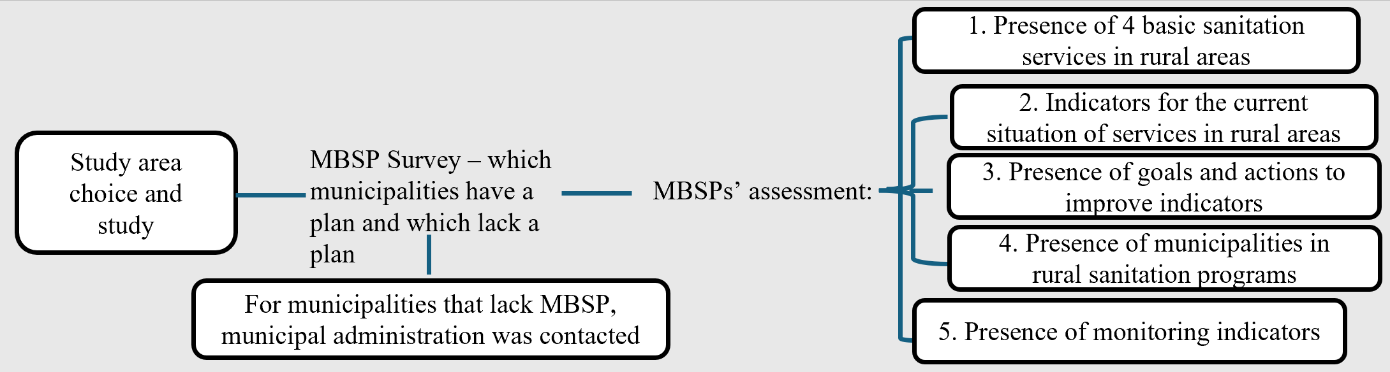
Flowchart of the research stages.
Rural areas in Municipal Basic Sanitation Plans of Metropolitan Basins in Ceará, Brazil
O rural nos Planos Municipais de Saneamento Básico das Bacias Hidrográficas Metropolitanas do Cear
Laura Baccetto Ajala1, Orcid: https://orcid.org/0000-0002-3062-475X; Marcelle Maria Gois Lima2, Orcid: https://orcid.org/0000-0002-5405-9302; Mariana Rodrigues Ribeiro dos Santos3, Orcid: https://orcid.org/0000-0001-8966-4783
1. Universidade Estadual de Campinas/ UNICAMP - Limeira - SP – Brasil. E-mail: l219861@dac.unicamp.br
2. Universidade Estadual de Campinas/ UNICAMP - Campinas - SP -Brasil. E-mail: m229250@dac.unicamp.br
3. Universidade Estadual de Campinas/ UNICAMP - Campinas - SP – Brasil. E-mail: mrrs@unicamp.br
Abstract
Basic sanitation is essential for environmental preservation, human health, and economic development. According to the Brazilian legislation, the State is responsible for ensuring access to adequate basic sanitation—not only in urban areas, but also in rural areas. In turn, Municipal Basic Sanitation Plans (MBSPs) are important tools for public policies on sanitation. Thus, this research sought to assess the presence of and approach to rural areas in the MBSPs of Metropolitan Basins in the state of Ceará, Brazil. The work involved a bibliographic and documental review. The MBSPs of the cities belonging to the studied basin were analyzed and it was observed that, unlike other regions of the country, most MBSPs studied addressed rural areas, bringing, especially, a diagnosis of the rates of attendance of the sanitation services for these areas and proposing specific programs and actions for each reality.
Keywords: public policies; rural sanitation; river basin; universalization.
Resumo
O saneamento básico é fundamental para a preservação do meio ambiente, para a saúde humana e para o desenvolvimento econômico. De acordo com a legislação brasileira, é dever do Estado garantir o acesso ao saneamento básico adequado, não só em áreas urbanas, mas também em áreas rurais. Por sua vez, uma importante ferramenta de política pública de saneamento é o Plano Municipal de Saneamento Básico (PMSB). Assim, esta pesquisa teve por objetivo, analisar a presença e a abordagem dada ao rural nos PMSB das Bacias Hidrográficas Metropolitanas do Estado do Ceará. O trabalho envolveu revisão bibliográfica e documental. Foram analisados os PMSB das cidades pertencentes à bacia estudada e foi observado que, diferentemente de outras regiões do país, a maioria dos PMSBs estudados abordaram o rural, trazendo, especialmente, um diagnóstico dos índices de atendimento dos serviços de saneamento para estas áreas e propondo programas e ações específicas para cada realidade.
Palavras-chave: políticas públicas; saneamento rural; bacia hidrográfica; universalização.
Citation: Ajala, L. B., Lima, M. M. G., & Santos, M. R. R. (2025). Rural areas in Municipal Basic Sanitation Plans of Metropolitan Basins in Ceará, Brazil. Gestão & Regionalidade, v. 41, e20258929. https//doi.org/10.13037/gr.vol41.e20258929
1 Introduction
Basic sanitation, according to the Law No. 11,445/2007, is defined as the set of operational facilities, public services and infrastructure for water supply, sewage, urban cleaning and solid waste management, and urban rainwater drainage and management. Additionally, it can be understood as a set of measures and actions geared toward modifying or preserving environmental conditions (Instituto Trata Brasil, 2012).
Thus, basic sanitation provides the population with quality of life via health promotion, disease prevention, improved productivity of the population, and guarantee of soil and water quality. Furthermore, access to basic sanitation services is ensured by the Brazilian Constitution, as a fundamental right (Brasil, 2019b).
In turn, Law No. 14,026/2020, which updates the legal framework for sanitation, establishes, among its principles, universalization, seeking to gradually expand access to sanitation services. This principle advocates that everyone should have access to quality water in sufficient quantity according to their needs, to sewage collection and treatment, garbage collection and treatment, and proper management of rainwater (Instituto Trata Brasil, 2012). Another principle found therein is that of equity, aiming at reducing injustices and inequalities among the population.
The Law also determines, as already established by Law No. 11,445 of 2007, the development of Municipal Basic Sanitation Plans (MBSPs), mandatory for all municipalities in Brazil. These plans must follow the same principles of the aforementioned Laws, particularly the principle of universalization, that is, they must contain objectives and goals for improvement and achievement of universal access to sanitation services in the municipality. To achieve this principle, urban and rural areas of the municipalities must be contemplated in the MBSPs (Instituto Trata Brasil, 2012).
However, the lack of basic sanitation in rural areas in Brazil reinforces a specific reality of such areas, showing several situations of precarious or totally lacking services in these areas, with consequent negative impacts on the population (Brasil, 2019a). This results from the major difference in the action of the public administration, which employs greater effort in urban areas than in rural areas, which are considered as secondary (Brasil, 2019a; Brasil, 2019b). Rural areas are often disregarded by the local government and, in several cases, are not contemplated in Municipal Sanitation Plans (Lima, 2021).
This leads to the following research question: how do Municipal Basic Sanitation Plans address rural areas? To assess this issue, we selected the MBSPs of Metropolitan Basins in the state of Ceará, Brazil. Thus, the general objective of the study was to assess the presence of rural areas in the plans under analysis. We note the following specific objectives: assessing the presence of the four basic sanitation elements in the plans; determining whether programs and projects geared toward rural areas are provided for, in addition to the presence of goals and actions to improve indicators; and assessing the presence of indicators to monitor the actions indicated in the plans.
Studying the presence of and approach to rural areas in Municipal Basic Sanitation Plans of municipalities in Metropolitan Basins is relevant to understand possibilities for governments to approach rural areas. Notably because, in addition to the state of Ceará being a reference in relation to rural sanitation, with successful programs and projects such as the São José Project and the Integrated Rural Sanitation System (SISAR), municipalities also have their responsibility regarding the universalization of access to sanitation services, being the providers of such services. Thus, municipalities also have the responsibility to know about the local reality of rural areas, the service provision index, in addition to the responsibility of developing programs that best meet the identified demands.
2 Literature Review
2.1 Sanitation in Brazil
With continental dimensions, extensive rural territories, and great regional differences of a natural and cultural nature, directly reflecting the concept of rurality (Roland, Tribst, Senna, Santos, & Rezende, 2019), Brazil presents a challenging and still insufficient framework for basic sanitation services. This challenge stems both from these differences and from the numbers of sanitation services presented in the country even today.
According to data released by the National Sanitation Information System (SNIS) (Brasil, 2021), 84.2% of the Brazilian population, about 177 million inhabitants, have access to the water supply network. Regarding sewage collection and treatment, the numbers correspond to 55.8% of the population served by a network, that is, 117.3 million, while 51.2% of the generated sewage is treated. These numbers are not separated between rural and urban, but they already indicate that there is still a long road ahead to achieve the universalization proposed by the National Sanitation Policy.
Note that, based on Federal Law No. 11,445 of 2007, Art. 3, basic sanitation corresponds to the set of services, infrastructures, and operational facilities related not only to water supply and sewage, but also to urban cleaning and solid waste management and urban rainwater drainage and management—unlike many countries where sanitation is essentially related to the first two components. Observing the topics addressed, the attention to urban areas and the very perspective of universalization designed by the Law, considering only units linked to water supply and sewage networks, reinforce the challenge of including rural areas in sanitation planning (Dirven et al., 2011; Roland et al., 2019), as usually perceived in planning practices in Brazil (Santos & Ranieri, 2018).
2.2 Rural areas in MBSPs
Law No. 11,445 of 2007, amended by Law No. 14,026 of 2020, is considered the legal framework of the sanitation sector in Brazil. This regulation established that all municipalities must have a Municipal Basic Sanitation Plan (MBSP) or be included in an area of regionalized provision. This plan is considered a “planning instrument for the provision of public basic sanitation services” (Instituto Trata Brasil, 2012, p. 10, free translation), in addition to being a condition for access to federal resources earmarked for the sanitation sector (Brasil, 2019b).
Therefore, according to the aforementioned Laws, municipalities are originally responsible for public sanitation services and must create local basic sanitation policies. Thus, they must develop Municipal Basic Sanitation Plans, which must include the objectives and goals for the universalization of sanitation services, in addition to programs and actions that lead to the fulfillment of these goals (Instituto Trata Brasil, 2012). Therefore, the plan must be formulated on the basis of the analysis of the municipal situation, seeking to improve it, defining the goals to be achieved and how each basic sanitation sector will operate (Instituto Trata Brasil, 2012).
In addition, there is the possibility of providing sanitation services in a regionalized manner, that is, when there are providers operating in more than one municipality or region. In this format, regionalized basic sanitation services may comply with the regional sanitation plan prepared for the municipalities addressed (Brasil, 2020). Considering that, in order for the entire area of the municipality to be served and for universal access to sanitation services to be achieved, it is necessary that both urban and rural areas be covered in the Municipal Basic Sanitation Plan (Ferreira et al., 2019).
However, many MBSPs have not addressed the rural areas of municipalities, lacking effective data on the situation of these localities in relation to the sanitation sector (Pereira & Heller, 2015; Lima, 2021). Therefore, there is no diagnosis for the region nor planning of any solution that reaches these areas (Associação Brasileira de Engenharia Sanitária Ambiental [ABES], 2018). According to Brasil (2019a), this is often due to some specific conditions of these regions, such as:
- geographical dispersion;
- political and geographical isolation of localities and their distance from city halls;
- location in an area that is difficult to access, whether by land or river;
- financial or personnel limitation of the municipalities, which hinders the execution of sanitation services;
- lack of strategies to foster social participation and empowerment of these populations;
- lack or insufficiency of public policies for rural sanitation, at the municipal, state or federal levels (Brasil, 2019a, p. 32).
These conditions help explain the obstacles faced in the provision of sanitation services in rural areas, but the State should not use these issues as justifications for little or no work in these areas (Brasil, 2019a).
Concomitantly, there is difficulty in defining rural areas, which leads to neglect in relation to these places (Roland, Tribst, Senna, Santos, & Rezende, 2019). The first historical evidence of the lacking definition of rural areas is found in Law No. 311 of 1938, which provides for the territorial division of the country, with no mention of rural areas, only providing the definition of urban areas.
In addition, Law No. 5,172 of 1966, which provides for the national tax system, in article 32, defines that urban property is one that has two of the indicated improvements built or maintained by the government:
I - curbs or paving, with rainwater channeling;
II - water supply;
III - sanitary sewage system;
IV - street lighting network, with or without posting for home distribution;
V - elementary school or healthcare unit within a maximum distance of 3 (three) kilometers from the property considered.
Considering that, according to this regulation, it is clear that urban areas are defined as those that have, among others, sanitation services. On the other hand, it is also established that rural properties are those located outside the urban area of the municipality. That is, the rural area becomes a by-product of the urban, without considering the specific characteristics of the locality (Instituto Brasileiro de Geografia E Estatística [IBGE], 2017), in addition to showing a notion that the rural area is a place that does not have basic sanitation services.
Thus, the lack of an official definition of rural areas does not properly reflect the characteristics of these places, affecting public policies, such as the development of plans and programs, which prioritize only urban areas (Roland et al., 2019). Historically, this has contributed to the precariousness or lack of sanitation services in rural areas (Brasil, 2019a).
Thus, it is understood that the delimitation of both rural and urban areas is relevant for the management and planning of the territory (IBGE, 2017), in addition to being important for the design and execution of public policies, “for the achievement of greater effectiveness of actions geared toward rural populations” (Roland et al., 2019, p. 16, free translation).
According to the IBGE (2017), there are eight possible situations of classification of census sectors, three of them urban and five rural. This classification seeks to meet the demand for public policies in rural areas, which now have more refined characterizations, changing the understanding of rural areas as urban byproducts to a definition that provides the singularities of each locality (IBGE, 2017; Brasil, 2019b).
Even so, it is clear that the public sanitation policies designed by municipal authorities show major discrepancies between urban and rural areas, considering rural areas as secondary in relation to governmental work (Brasil, 2019b). However, this inequality in the provision of sanitation services results in no compliance with the principle of universalization provided for in the legal framework for sanitation (Instituto Trata Brasil, 2012; Brasil, 2019b).
2.3 Rural sanitation in Ceará
The state of Ceará, located in the northeastern region of Brazil, has the hot semi-arid tropical climate as its predominant climate. This climate is characterized by high temperatures, scarce and irregular rainfall, making the region subject to drought phenomena. The state’s rivers are mostly seasonal and insufficient, and in more adverse situations, the rivers are dry throughout the year, and one of the government’s major concerns is the availability of quality water in good quantity for its population (Ceará, 2016; Ceará, 2021).
However, the state’s rural population has received low priority from the state government for decades, for example, being dependent on water trucks, small reservoirs, wells, and other alternative sources for water supply (Ceará, 2021). In order to reach this population and improve sanitation service provision rates, several programs were established and promoted the “installation of Simplified Water Supply Systems in rural areas” (Ceará, 2021, p. 46, free translation). Some of them will be detailed below.
2.3.1 SISAR
Created in 1996, the Integrated Rural Sanitation System (SISAR) is a non-governmental, non-profit organization under private law, and is considered a successful model (Araújo and Alves, 2016; Rocha, 2013). SISAR was developed through initiatives by the state government of Ceará, with financing from the German bank Kreditanstalt für Wiederaufbau (KFW).
The program aims to improve negative basic sanitation indicators and provide sustainability to water supply projects in rural areas. Such projects were established by state programs, such as systems installed by the Companhia de Água e Esgoto do Ceará (CAGECE), with the purpose of increasing their useful life (Araújo & Alves, 2016; Rocha, 2013).
SISAR is formed by the shared management of affiliated community associations in rural regions with 50–250 families, which are responsible for taking care of sanitation services, ensuring the operation and maintenance of these systems (Rocha, 2013). Shared management occurs through local operation, in which an operator performs maintenance on the sanitation systems. In addition, the technical executive team performs more complex operations for system maintenance and water quality control, for example (Rocha, 2013).
Through CAGECE1,the program model was expanded to the entire state of Ceará and has eight units, each corresponding to a basin. Only the Sobral unit has the sewage service operated by SISAR, and in the other seven units, SISAR only operates the water supply service (SISAR, 2021; Rocha, 2013). In Metropolitan Basins, the program is called SISAR Fortaleza and the model serves 17 municipalities—about 48,649 people (SISAR, 2022).
2.3.2 Fresh Water Program
Created in 2004 by the Brazilian Ministry of the Environment, and now coordinated by the Ministry of Regional Development, the Fresh Water program aims to install, recover and manage desalination systems in diffuse rural regions, Covering the sustainable use of groundwater, which mostly includes brackish or saline waters (Ceará, 2020; Ceará, 2021a; Brasil, 2020).
In Ceará, the program “is executed through a federal agreement, entered into by the Ministry of the Environment and the state government, through the Department of Water Resources” (Ceará, 2020, p. 33, free translation). This program is considered an adaptation to climate change, since there is an increase in the occurrence of extreme events such as droughts in the region (Ceará, 2021a). In Metropolitan Basins, the program installed desalination systems in 33 rural communities, serving 1,591 families (Ceará, 2020, p. 33-34).
2.3.3 São José III Project
Also called the Sustainable Rural Development Project, the São José Project aims at sustainable rural development, through the well-being of rural communities and the strengthening of family farming (Ceará, 2020; Rocha, 2013). It is funded by the government of the state of Ceará and the International Bank for Reconstruction and Development (IBRD), and its beneficiaries are mainly farmers who carry out agricultural and non-agricultural activities in rural areas (Rocha, 2013).
The localities served are those that need expansion or implementation of drinking water distribution systems and simple sanitary sewage systems, and have the “objective of supporting the State’s efforts to universalize access to drinking water and sanitary sewage in rural areas” (Ceará, 2020, p. 22, free translation).
In addition, this project is one of the sources of funds for new systems that want to join the SISAR Project (Rocha, 2013, p. 24). In Metropolitan Basins, the São José Project, from 1994 to 2020, served 21 municipalities in the basin with works for supply systems and sanitary modules (Ceará, 2020).
With these programs installed in rural regions, the state of Ceará is considered “the pioneer in the country in the methods for water resource management and sanitation regulation, in addition to rural sanitation organization” (Ceará, 2021, p. 46, free translation), with an innovative management system.
However, even with these programs, state indicators still show that outreach rates are still far from universalizing sanitation services (Ceará, 2021). Thus, it is important that municipal authorities act through Municipal Basic Sanitation Plans, in conjunction with these programs, to seek to improve sanitation rates in rural areas.
3 Methodology
This research employed a qualitative and descriptive approach that began with the study of the theoretical framework to support the study. In this stage, the four basic sanitation services were studied and addressed: water supply, sewage, solid waste management, and urban and rainwater drainage. In addition, the obligation of having MBSPs, their importance and the presence of rural areas in MBSPs were studied.
The study area was chosen based on Federal Law No. 9,433 of January 8, 1997, which establishes that the territorial unit for the planning of water resource management must be the basin. Therefore, the entire area of the Metropolitan Basins was studied, instead of only the metropolitan area of Fortaleza.
Then, we collected secondary data, particularly on MBSPs of municipalities in the Basins, on official websites—usually of municipal governments. Municipalities that had not made the plans available on their websites were also contacted via email or telephone to request such document.
After collecting each MBSP, we assessed whether rural areas were addressed in the plans for each sanitation service. In addition, we assessed the presence of indicators of the current situation and monitoring of the implementation of basic sanitation actions in rural areas.
The method adopted here is similar to that of Santos, Guides, Lima and Santos (2020), who studied the Municipal Basic Sanitation Plans of two river basins: the Piracicaba, Capivari and Jundiaí (PCJ) Rivers Basins, being considered the metropolitan area of Campinas and the Paraíba do Sul River Basin. The data collected were organized in charts, facilitating the reading of the general overview of the basin regarding the design of municipal sanitation plans. Subsequently, the results were compared with the literature.
Figure 1 summarizes the steps taken in the development of this research.
Figure 1
Flowchart of the research stages.
Source: Prepared by the authors.
3.1 Characterization of the study area
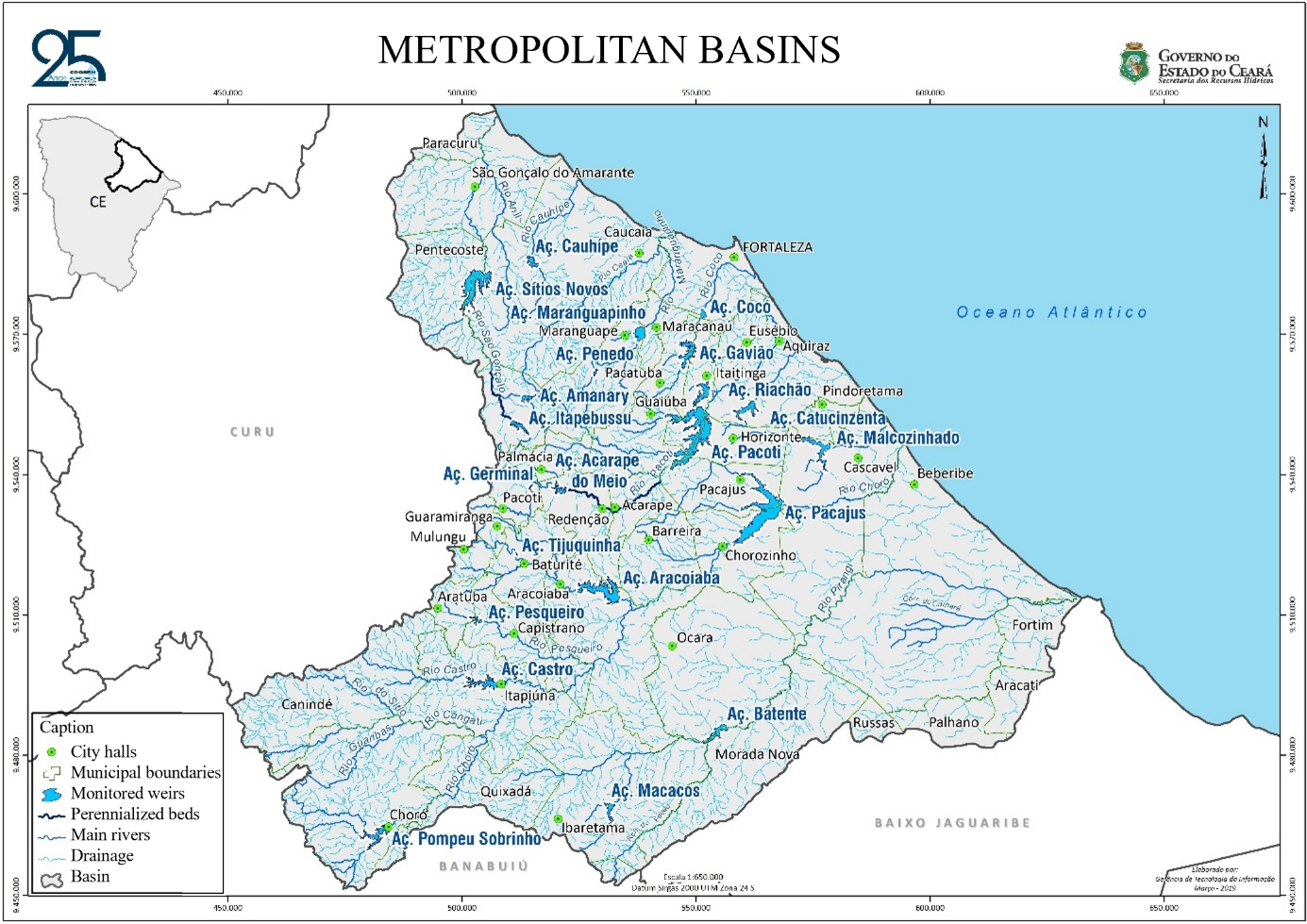
The Metropolitan Basins comprise 16 independent basins, with a drainage area of 15,085 km², which corresponds to 10.18% of the territory of Ceará (Ceará, 2022). They include 31 municipalities: Acarape, Aquiraz, Aracoiaba, Aratuba, Barreira, Baturité, Beberibe, Capistrano, Cascavel, Caucaia, Choró, Chorozinho, Eusébio, Fortaleza, Guaramiranga, Guaiúba, Horizonte, Ibaretama, Itaitinga, Itapiúna, Maracanaú, Maranguape, Mulungu, Ocara, Pacajus, Pacatuba, Pacoti, Palmácia, Pindoretama, Redenção, and São Gonçalo do Amarante (Ceará, 2022).
Figure 2 shows the basin map, indicating its components and municipalities covered.
Figure 2
Map of metropolitan basins.
Source: Ceará (2019).
In this region is the largest consumer center in the state, which is the Metropolitan Area of Fortaleza. In the municipalities studied, the proportion of rural population ranges from 70% to 0% for the municipalities of Eusébio and Fortaleza (Ceará, 2020). The study area holds an heterogenous economic activity and has great emphasis on the tertiary and secondary sectors. The Gross Domestic Product, considering 2012 data, ranges from 30,000 to 40 million reais approximately, and the municipalities Human Development Index is between 0.577 and 0.754 (Ceará, 2018).
4 Results and Discussion
Based on the analysis of the Municipal Basic Sanitation Plans, we obtained the results presented in Chart 1.
Chart 1
Analysis of MBSPs of municipalities in the metropolitan basins.
|
Municipality |
MBSP |
Agreement for development of plan with municipal governments |
Does it address rural areas? |
Evaluated the four services |
Evaluated rural areas |
Programs and projects for rural areas |
Monitoring with indicators |
|
|
1 |
Acarape |
Yes (2019) |
ARCE, CAGECE and APRECE |
Yes |
Yes |
Except drainage |
Yes |
No |
|
2 |
Aquiraz |
Under development |
- |
- |
- |
- |
- |
- |
|
3 |
Aracoiaba |
Under development |
- |
- |
- |
- |
- |
- |
|
4 |
Aratuba |
Yes (2012) |
ARCE, CAGECE and APRECE |
Yes |
Except drainage |
Except drainage |
Yes |
Yes |
|
5 |
Barreira |
Yes (2012) |
ARCE, CAGECE and APRECE |
Yes |
Except drainage |
Except drainage |
Yes |
Yes |
|
6 |
Baturité |
Yes (2021) |
CAGECE |
Yes |
Water supply and sewage only |
No |
No |
No |
|
7 |
Beberibe |
Yes (2016) |
FUNASA |
Yes |
Yes |
Except drainage |
Yes |
No |
|
8 |
Capistrano |
Yes (2019) |
ARCE, CAGECE and APRECE |
Yes |
Yes |
Except drainage |
Yes |
No |
|
9 |
Cascavel |
Not found |
- |
- |
- |
- |
- |
Yes |
|
10 |
Caucaia |
Yes (2014) |
Ministry of Cities (current Ministry of Regional Development) - Caixa Econômica Federal |
Yes |
Yes |
Except solid waste and drainage |
No |
No |
|
11 |
Choró |
Yes (2013) - Preliminary version |
ARCE, CAGECE and APRECE |
Yes |
No data for drainage |
Except drainage |
No |
No |
|
12 |
Chorozinho |
Yes (2021) |
CAGECE |
Yes |
Water supply and sewage only |
Water supply and sewage only |
Yes |
No |
|
13 |
Eusébio |
Not found |
- |
- |
- |
- |
- |
No |
|
14 |
Fortaleza |
Yes (2014) |
CAGECE |
No |
Yes |
No |
No |
No |
|
15 |
Guaramiranga |
Yes (2019) |
ARCE, CAGECE and APRECE |
Yes |
Except drainage |
Except drainage |
Yes |
No |
|
16 |
Guaiúba |
Yes (2021) - Preliminary Report |
CAGECE |
Yes |
Water supply and sewage only |
Water supply and sewage only |
Yes |
No |
|
17 |
Horizonte |
No |
- |
- |
- |
- |
- |
- |
|
18 |
Ibaretama |
No |
- |
- |
- |
- |
- |
- |
|
19 |
Itaitinga |
Yes (2020) |
CAGECE |
Yes (small population) |
Supply and sewage only |
No |
No |
No |
|
20 |
Itapiúna |
Yes (2019) |
ARCE, CAGECE and APRECE |
Yes |
Yes |
Except drainage |
Yes |
No |
|
21 |
Maracanaú |
Yes (2020) |
ARCE and CAGECE |
Yes (small population) |
Water supply and sewage only |
No |
No |
No |
|
22 |
Maranguape |
Yes (2021) - Preliminary Report |
CAGECE |
Yes |
Water supply and sewage only |
Water supply and sewage only |
Yes |
No |
|
23 |
Mulungu |
Yes (2012) |
ARCE, CAGECE and APRECE |
Yes |
Except drainage |
Except drainage |
Yes |
Yes |
|
24 |
Ocara |
No |
- |
- |
- |
- |
- |
- |
|
25 |
Pacajus |
Yes (2019) |
CAGECE |
Yes |
Water supply and sewage only |
Water supply and sewage only |
Yes |
No |
|
26 |
Pacatuba |
Yes (2021) |
CAGECE |
Yes (but based on IBGE data) |
Water supply and sewage only (urban + rural treatment) |
Based on IBGE data - water supply and sewage |
Yes |
No |
|
27 |
Pacoti |
Yes (2019) |
ARCE, CAGECE and APRECE |
Yes |
Except drainage |
Except drainage |
Yes |
No |
|
28 |
Palmácia |
Yes (2019) |
ARCE, CAGECE and APRECE |
Yes |
Yes |
Except drainage |
Yes |
No |
|
29 |
Pindoretama |
No |
- |
- |
- |
- |
- |
- |
|
30 |
Redenção |
Yes (2017) |
CAGECE |
Yes |
Water supply and sewage only |
Water supply and sewage only |
No |
No |
|
31 |
São Gonçalo do Amarante |
Yes (2021) |
CAGECE |
Yes |
Water supply and sewage only |
Water supply and sewage only |
No |
No |
Source: Prepared by the authors.
By analyzing Chart 1, it was found that, of the 31 cities belonging to the Metropolitan Basins, 25 cities (80.7%) have a Municipal Basic Sanitation Plan. Of the 25 plans, 23 were found in this research, and only the plans of the municipality of Cascavel and Eusébio were not found. Of these 23 municipalities, only the city of Fortaleza did not mention the rural area, since it does not have a rural area. The other municipalities had at least a small mention of the rural area in their MBSPs.
According to the Ministry of Cities, a survey was carried out in 2017 in relation to the country’s Municipal Basic Sanitation Plans. In the survey, it was found that, in the MBSPs of Brazilian municipalities, there is little attention and approach to rural areas, with discreet mentions in the plans and not paying attention to the specificities of these areas (Brasil, 2017). Contrary to what the ministry demonstrated, the cities in the river basin studied here do not follow this pattern, as most of the plans analyzed have a clear approach to rural areas, data survey on the current situation, and attention to the specificities of these areas.
As established by Law No. 14,026/2020, there is the principle of universalization, which is also one of the principles of the National Basic Sanitation Plan and the National Rural Sanitation Program, and which must be present and advocated in the MBSPs. This can be defined as equal access for all Brazilians, without any barrier, to all sanitation services (Brasil, 2019b; Brasil, 2020).
By analyzing the MBSPs, it was observed that in many of them this principle was present, as in many plans it was reported that without access to sanitation services in rural areas, the universalization of the municipality had not yet been achieved. Considering this, we have as an example the city of Acarape, which even having 100% water supply service in urban areas, had 84.5% coverage rate in the rural area, thus not achieving universalization.
In addition, of the 23 plans, 19 contained information on service provision situations in rural areas, mainly on water supply and sewage. This demonstrates the effort on the part of the government to include rural areas in its policies.
Despite that, none of the plans analyzed achieved the universalization in the municipality, but all intend to achieve it in the future, with the help of goals to be achieved for increasing service provision rates. A pattern was also found in the plans, showing that the service provision rates in urban areas were higher than those in rural areas. Similarly, we found a pattern that showed highest rates of water supply, followed by sanitary sewage, then solid waste management, and finally and with the lowest service provision rate, drainage.
It was observed by Ferreira et al. (2019), who studied the MBSPs of the Basins of the Piracicaba, Capivari and Jundiaí rivers and the Paraíba river, in relation to water supply—which was also observed in this study in the municipalities of the Metropolitan Basins—, that the rural areas can be served both by individual solutions and by collective solutions, such as the supply network. In the MBSPs studied here, it was found that most solutions present were individual, the most common being the use of cisterns to collect rainwater, and the use of wells and water trucks. Of the 23 plans found, 19 contained specific data for rural areas.
As for sanitary sewage, Roland et al. (2019) mention the same possibility of using individual or collective solutions, even in rural areas, depending on their characteristics. In the study on the Metropolitan Basins, it was observed that the most common solutions were rudimentary tanks and septic tanks. Here, of the 23 plans found, 19 had specific data on sewage in rural areas.
As observed by Santos et al. (2020) in the MBSPs of the Paraíba do Sul Basin, in São Paulo, the plans addressed solid waste management and urban cleaning, in a manner similar to that seen in the MBSPs of the Metropolitan Basins. In the plans analyzed, programs were found for the closure of dumps, availability of landfills, expansion of waste collection, among others. Of the 23 plans found, 12 had data on solid waste management and 10 had data specific to rural areas.
In addition, as was also observed by Santos et al. (2020) in relation to drainage and rainwater management, in many plans there was characterization without deepening of this service, which was also observed in the MBSPs of the Metropolitan Basins. Of the 23 plans analyzed, only seven referred to drainage, commenting on macro and micro drainage and their extension. It was also found that Aratuba and Barreira do not have gallery systems for drainage. Only the Fortaleza MBSP had concrete data on urban drainage and no plan had specific data for rural areas in relation to drainage[1].
In general, it was observed in the plans studied, as well as by Santos et al. (2020), that the most present services, with a greater diagnosis study and a greater number of programs and projects to increase rates, were water supply and sewage services. It was also observed the existence of 7 plans that addressed only these two services.
However, it was observed in the MBSPs of the Metropolitan Basins that not all municipalities provided for effective and specific solutions for rural areas; as reported by Pereira and Heller (2015), who studied 18 municipalities around the country and their respective Municipal Basic Sanitation Plans. In the Metropolitan Basins, only 15 municipalities developed specific programs and projects for these areas, and the solutions most emphasized by the plans for water supply were: 1. Expand coverage to serve households with cisterns (14 plans); 2. Expand coverage to provide new hydrometered connections (nine plan); 3. Prepare executive projects to meet short-, medium-, and long-term goals (eight plans) and 4. Conduct training for maintenance and proper use of cisterns (seven plans).
Regarding sanitary sewage, the most recurrent solutions in the plans studied for rural areas were: 1. Expand coverage to serve households with individual systems - septic tank, sinkhole or other equivalent solution (seven plans); 2. Implement a program to encourage and disseminate the importance of proper destination of sewage (six plans) and 3. Expand coverage with individual systems for households with and without toilets (five plans).
Regarding solid waste management, no specific programs and projects were observed for the rural area, and only the municipality of Itapiúna prepared a specific solution for the rural area. Regarding rainwater drainage and management, no plan prepared specific solutions for rural areas, with the most common solutions being the development of executive projects for urban rainwater drainage and management systems.
Therefore, as observed in Chart 2, as a means to increase these rates and respect the specificities of rural areas, municipalities participate or have participated in programs and projects geared toward rural areas, as shown in Figure 2. Of the 31 cities, seven do not participate in any program (22.6%), 3 participate in 1 program (9.7%) and 21 participate in 2 or more programs (67.7%). It is noted here that these programs were created as a response to the problems that rural areas face, as a way to improve the quality of life of the population (Silva, Nogueira, Andrade, Silveira, and Rezende, 2019).
Chart 2
Municipalities participating in the São José, Fresh Water, and SISAR Projects (2020 data)
|
Municipality |
São José Project |
Fresh Water Program |
SISAR |
|||||
|
Participating or have participated in the project? |
Period/Year |
Participating in the program? |
Number of families served |
Participating in SISAR? |
Total connections (total) |
Active Connections (total) |
||
|
1 |
Acarape |
Yes |
2000 to 2010; 2019 |
No |
- |
Yes |
162 |
126 |
|
2 |
Aquiraz |
No |
- |
No |
- |
Yes |
794 |
272 |
|
3 |
Aracoiaba |
Yes |
2001 to 2010 |
Yes |
369 |
Yes |
354 |
254 |
|
4 |
Aratuba |
Yes |
1994 to 2004 |
No |
- |
Yes |
157 |
133 |
|
5 |
Barreira |
Yes |
1998 to 2000; 2001 to 2010; 2011 to 2012. |
Yes |
131 |
Yes |
461 |
361 |
|
6 |
Baturité |
Yes |
1994 to 2011 |
No |
- |
Yes |
303 |
226 |
|
7 |
Beberibe |
Yes |
1999; 2019 |
No |
- |
Yes |
2048 |
1847 |
|
8 |
Capistrano |
Yes |
1995 2000 to 2010; 2011 to 2019. |
No |
- |
Yes |
1367 |
895 |
|
9 |
Cascavel |
Yes |
2000 to 2003 |
No |
- |
Yes |
2052 |
1529 |
|
10 |
Caucaia |
Yes |
1995 to 2000; 2001 to 2005; 1994 to 2000; 2001 to 2010; 2011 to 2019. 2015; 2016 |
No |
- |
Yes |
238 |
197 |
|
11 |
Choró |
No |
- |
Yes |
198 |
Yes |
915 |
651 |
|
12 |
Chorozinho |
Yes |
2003 to 2005 |
Yes |
122 |
No |
- |
- |
|
13 |
Eusébio |
No |
- |
No |
- |
No |
- |
- |
|
14 |
Fortaleza |
No |
- |
No |
- |
No |
- |
- |
|
15 |
Guaramiranga |
No |
- |
No |
- |
No |
- |
- |
|
16 |
Guaiúba |
Yes |
2010 to 2019 |
No |
- |
Yes |
739 |
632 |
|
17 |
Horizonte |
Yes |
1999 to 2006; 2011 |
No |
- |
Yes |
61 |
38 |
|
18 |
Ibaretama |
Yes |
1995 to 200; 2001 to 2010; 2012 to 2018; 2012 to 2017; 2017 |
Yes |
203 |
Yes |
1895 |
1531 |
|
19 |
Itaitinga |
No |
- |
No |
- |
No |
- |
- |
|
20 |
Itapiúna |
No |
- |
Yes |
263 |
Yes |
438 |
309 |
|
21 |
Maracanaú |
No |
- |
No |
- |
No |
- |
- |
|
22 |
Maranguape |
Yes |
2001 to 2010; 2011 to 2016 |
No |
- |
Yes |
2380 |
1798 |
|
23 |
Mulungu |
Yes |
1998 to 2000 2012 |
No |
- |
Yes |
198 |
151 |
|
24 |
Ocara |
Yes |
2000 to 2010; 2012 to 2018; |
Yes |
305 |
Yes |
5202 |
4154 |
|
25 |
Pacajus |
Yes |
1998 |
No |
- |
No |
- |
- |
|
26 |
Pacatuba |
No |
- |
No |
- |
No |
- |
- |
|
27 |
Pacoti |
Yes |
1998 to 1999 2000 to 2008; 2015 to 2018 |
No |
- |
Yes |
708 |
450 |
|
28 |
Palmácia |
Yes |
2015 to 2018 |
No |
- |
Yes |
623 |
458 |
|
29 |
Pindoretama |
No |
- |
No |
- |
No |
- |
- |
|
30 |
Redenção |
Yes |
1997 to 1998; 2002 to 2008; 2011 to 2019. |
No |
- |
Yes |
1451 |
1058 |
|
31 |
São Gonçalo do Amarante |
Yes |
1995 |
No |
- |
No |
- |
- |
Source: Prepared by the authors, adapted from CEARÁ, 2020.
With the participation of municipalities in these programs, there is a positive impact on service provision rates. As seen in the rural community of Cristais, in Ceará, studied by Alves and Araújo (2016), we have the example of SISAR in the municipalities studied in this research, providing progress in access to water in their rural areas.
As seen in the municipality of Redenção, it was reported in its MBSP that the water supply rates in the rural area of the municipality’s seat district operated by SISAR are 80%, with 100% of the residences hydrometered, and these rates are higher than in the areas not operated by SISAR. Thus, we have a good example of the operation of the programs created by the state government and that make a difference in the service provision rates of the municipalities.
However, not all total SISAR connections in the municipalities are active, that is, the inhabitants have SISAR connections, but do not use its service, as was also observed by Araújo and Alves (2016). The authors justify the non-use of SISAR connections due to cultural issues of the residents, who may not understand the importance of the system and who end up choosing other sources of supply, remaining in conditions of water susceptibility.
Thus, it can be observed that the state of Ceará stands out from other Brazilian states by being concerned not only with the sanitation of urban areas, but also with rural areas, as found in the studied plans of the Metropolitan Basins. This concern is seen by the successful state programs and projects, which provide concrete results to improve service provision rates and that can be replicated in other Brazilian states, respecting the contexts of each region (Silva et al., 2019). These programs and projects are focused and based on universalizing rural sanitation in an integrated manner, in addition to improving the quality of life of the population living in these areas (Silva et al., 2019).
In addition, the focus also on rural areas is seen in the municipalities that have characterization and diagnosis of the service provision rates, with a high rate of presence of rural areas in the plans, unlike other Brazilian municipalities, as found by the research carried out by the Ministry of Regional Development (2017) and by Santos et al. (2020). Moreover, it is important for municipalities to participate in programs to increase service provision rates toward universal access to sanitation services, providing greater quality of life to the population.
5 Conclusions
The analysis of the Municipal Basic Sanitation Plans of municipalities in the Metropolitan Basins of Ceará enabled determining the presence of descriptions of the actions of sanitation services specific to rural areas, with the exception of drainage, in addition to determining which of these actions are the most recurrent in the plans for each sanitation service. It also enabled determining the existence of indicators to assess the current situation of rural areas, with the sanitation service provision rates in these regions.
Of the 23 MBSPs analyzed, only the city of Fortaleza did not mention rural areas. In addition, of the 23 plans, 19 contained information on service provision situations in rural areas, mainly on water supply and sewage.
It was found in this research that the service provision rates of urban areas were higher than those of rural areas in the analyzed Basin. It was also found the pattern that the highest rates were, in sequence: of water supply, sewage, solid waste management, and drainage.
It was observed that most water supply solutions present were individual, the most common being the use of cisterns to collect rainwater, in addition to the use of wells and water trucks. It was also observed that, of the 23 plans found, 19 had specific data on sewage in rural areas and the most recurrent solutions in the plans analyzed for rural areas were: the expansion of coverage to serve households with individual systems – septic tank, sinkhole or other equivalent solution; the implementation of a program to encourage and disseminate the importance of proper destination of sewage, and the expansion of coverage with individual systems for households with and without toilets.
As for solid waste, programs were present to close dumps, make landfills available, expand waste collection, among others, with 12 plans having data on solid waste management and 10 with specific data for rural areas. Regarding drainage, of the 23 plans, only 7 referred to drainage and none had specific data or propositions for rural areas.
As a limitation for this study, we note the difficulty of finding some plans, which were not easily accessible on the internet. In addition, it is important to note that contact with some city halls in an attempt to obtain their MBSP, when unavailable on the city's website, also proved difficult.
Thus, the research presents as contributions the understanding of how rural areas are addressed in MBSPs in the Metropolitan Basins, standing out from other regions of the country, and knowledge on the success of the state rural sanitation programs, which serve as an example for other states of the country, and which can be replicated to obtain concrete data of increased service provision rates as observed in Ceará. It also shows an example of concern with the universalization of sanitation rates, both in urban and rural areas.
However, there is still much to be studied on the topic of rural sanitation. For future research, studies on the monitoring indicators of MBSPs are suggested, in order to determine whether the universalization of sanitation services is being achieved in rural areas. Furthermore, studies can compare the results obtained in other basins in the state of Ceará.
Acknowledgements
The authors thank Espaço da Escrita – Pró-Reitoria de Pesquisa – UNICAMP – for the language services provided.
References
Araújo, F. T. V., & Alves, F. G. C. (2016). Sistemas de abastecimento em comunidades rurais do semiárido: a implantação do SISAR em Cristais, Cascavel, CE. Revista Tecnologia, Fortaleza, v. 37, n. 1, p. 78-86, jun. 2016. Recuperado de https://periodicos.unifor.br/tec/article/view/5695/0
Associação Brasileira de Engenharia Sanitária Ambiental (ABES). (2018). Termo de referência: Plano de saneamento rural municipal. Recuperado de http://abes-sp.org.br/arquivos/tr_versao_final_diagramado.pdf
Brasil. Ministério das Cidades. Secretaria Nacional de Saneamento Ambiental. (2017). Panorama dos Planos Municipais de Saneamento Básico no Brasil. Brasília, Ministério das Cidades.
Brasil. Ministério da Saúde. Fundação Nacional da Saúde (Funasa). (2019a). Programa nacional de saneamento rural. Brasília: Funasa.
Brasil. Ministério de Desenvolvimento Regional. Secretaria Nacional de Saneamento. (2019b). Plano nacional de saneamento básico. Brasília, Ministério do Desenvolvimento Regional.
Brasil. Ministério de Desenvolvimento Regional. (2020). Programa água doce. Recuperado de https://www.gov.br/mdr/pt-br/assuntos/seguranca-hidrica/programa-agua-doce/programa-agua-doce-1
Brasil. Ministério das Cidades. Sistema Nacional de Informações sobre Saneamento. (2021). Panorama do Saneamento Básico no Brasil -2021. Regatado de: https://www.gov.br/cidades/pt-br/acesso-a-informacao/acoes-e-programas/saneamento/snis
Ceará. Instituto de Pesquisa e Estratégia Econômica do Ceará. (2016). Características geográficas, recursos naturais e meio ambiente. Recuperado de http://www2.ipece.ce.gov.br/publicacoes/ceara_em_numeros/2016/territorial/01_Caracteristicas_Geograficas.pdf
Ceará. Governo do Estado do Ceará. (2018). Relatório de diagnóstico ambiental das Bacias Metropolitanas - Elaboração do Plano de Segurança Hídrica das Bacias Hidrográficas Estratégicas do Acaraú, Metropolitanas e da Sub-Bacia do Salgado. 2018. Recuperado de https://portal.cogerh.com.br/wp-content/uploads/2018/10/Relatorio%20Diagnostico%20Ambiental%20das%20Bacias%20Metropolitanas.pdf
Ceará. Companhia de Gestão dos Recursos Hídricos. (2019). Metropolitanas. Recuperado de: https://portal.cogerh.com.br/mapas/metropolitanas/
Ceará. Assembleia Legislativa do Estado do Ceará. Conselho de altos estudos e assuntos estratégicos. (2020). Caderno das bacias hidrográficas metropolitanas: Informações sobre o saneamento básico [livro eletrônico]. Fortaleza: INESP. 2020. Recuperado de file:///C:/Users/mariana%20santos/Downloads/CADERNO%20DAS%20BACIAS%20HIDROGR%C3%81FICAS%20METROPOLITANAS%20-%20Informa%C3%A7%C3%B5es%20sobre%20Saneamento%20B%C3%A1sico.pdf
Ceará. Secretaria dos Recursos Hídricos. (2021a). Programa água doce - PAD. Recuperado de https://www.srh.ce.gov.br/programa-agua-doce-pad/
Ceará. Assembleia Legislativa do Estado do Ceará. (2021b). Cenário atual do saneamento básico no Ceará [livro eletrônico]. Fortaleza: Assembleia Legislativa do Estado do Ceará, INESP. Recuperado de https://www.al.ce.gov.br/index.php/component/phocadownload/category/118-pacto-saneamento-basico?download=1533:publicacao-1-cenario-atual-do-saneamento-basico
Ceará. Governo do Estado do Ceará. Secretaria dos Recursos Hídricos. (2022). Comitê das Bacias Hidrográficas Metropolitanas. 2022. Disponível em: <https://www.srh.ce.gov.br/comite-das-bacias-hidrograficas-metropolitanas/>.
Dirven, M.; Perico, R. E.; Sabalain, C.; Rodríguez, A.; Baeza, D. C.; Peña, C.; Faiguenbaum, S. (2011). Hacia una nueva definición de “rural” con fines estadísticos en América Latina. Documento de proyecto n. 397. Santiago de Chile: CEPAL, 2011. 109 p.
Ferreira, L. A. F., Ribeiro, P. S. C., Andrade, I. C. M., Guides, R. M., Santos, L. O. L., Cruz, L. M. O., Santos, M. R. R., & Rezende, S. (2019). Saneamento rural no planejamento municipal: lições a partir do Programa Nacional de Saneamento Rural (PNSR). Revista DAE, São Paulo, v. 67, n. 220, p. 36-51, maio/ago. 2019. Recuperado de http://revistadae.com.br/artigos/artigo_edicao_220_n_1827.pdf
Instituto Brasileiro de Geografia e Estatística (IBGE). (2017). Classificação e caracterização dos espaços rurais e urbanos no Brasil. Rio de Janeiro: IBGE. Recuperado de https://biblioteca.ibge.gov.br/visualizacao/livros/liv100643.pdf
Instituto Trata Brasil. (2012). Manual do saneamento básico. São Paulo: Instituto Trata Brasil. Recuperado de https://tratabrasil.org.br/wp-content/uploads/2022/09/manual-imprensa.pdf
Lei n. 311, de 2 de março de 1938. (1938). Dispõe sobre a divisão territorial do país, e dá outras providências. Rio de Janeiro, RJ. Recuperado de https://www2.camara.leg.br/legin/fed/declei/1930-1939/decreto-lei-311-2-marco-1938-351501-publicacaooriginal-1-pe.html
Lei n. 5.172 de 25 de outubro de 1966. (1966) Dispõe sobre o Sistema Tributário Nacional e institui normas gerais de direito tributário aplicáveis à União, Estados e Municípios. Brasília, DF. Recuperado de http://www.planalto.gov.br/ccivil_03/leis/l5172compilado.htm
Lei n. 11.445, de 5 de janeiro de 2007. (2007). Estabelece as diretrizes nacionais para o saneamento básico. Brasília, DF. Recuperado de http://www.planalto.gov.br/ccivil_03/_ato2007-2010/2007/lei/L11445compilado.htm
Lei n. 14.026, de 15 de julho de 2020. (2020). Atualiza o marco legal do saneamento básico. Brasília, DF. Recuperado de http://www.planalto.gov.br/ccivil_03/_ato2019-2022/2020/lei/l14026.htm
Lima, M. M. G. (2021). O PMSB e os desafios da universalização do saneamento em áreas rurais. (Dissertação de Mestrado). Universidade Estadual de Campinas, Campinas, Brasil.
Pereira, T. S. T., & Heller, L. (2015). Planos municipais de saneamento básico: avaliação de 18 casos brasileiros. Revista Engenharia Sanitária e Ambiental, v. 20, n. 3, p. 395 - 404, jul/set. 2015. Recuperado de https://www.scielo.br/j/esa/a/Cvq8JLGJrnwLdtkpn4Yq96N/?format=pdf&lang=pt
Rocha, W. S. (2013). Estudo de caso do sistema integrado de saneamento rural (SISAR) no Brasil. Nota Técnica do Banco Interamericano de Desenvolvimento (BID). Recuperado de https://publications.iadb.org/publications/portuguese/document/Estudo-de-caso-do-sistema-integrado-de-saneamento-rural-(SISAR)-no-Brasil.pdf
Roland, N., Tribst, C. C. L., Senna, D. A., Santos, M. R. R., & Rezende, S. (2019). A ruralidade como condicionante da adoção de soluções de saneamento básico. Revista DAE, São Paulo, v. 67, n. 220, p. 15-35, nov. 2019. Recuperado de http://revistadae.com.br/artigos/artigo_edicao_220_n_1828.pdf
Santos, L. O. L., Guides, R. M.; Lima, M. M. G., Santos, M. R. R. (2020). Planos Municipais de Saneamento Básico das bacias hidrográficas dos rios Piracicaba, Capivari and Jundiaí (PCJ) e Paraíba do Sul (tradução nossa). In Anais do Congresso Internacional de Engenharia Ambiental & 10a Reunião de Estudos Ambientais. Porto Alegre, RS, Brasil.
Santos, M. R. R.; Ranieri, V. E. L. (2018). Deficiências e desafios do planejamento territorial de áreas rurais no brasil. Revista Rural & Urbano, Recife. v. 03, n. 01, p. 02 – 21, 2018. Recuperado de: https://periodicos.ufpe.br/revistas/index.php/ruralurbano/article/view/241066
Silva, B. B., Nogueira, C. D., Andrade, M., Silveira, R. B., & Rezende, S. (2019). Evidenciando experiências positivas em saneamento básico: visões do Programa Nacional de Saneamento Rural (PNRS). Revista DAE, São Paulo, v. 67, n. 220, p. 69-86, nov. 2019. Recuperado de http://revistadae.com.br/artigos/artigo_edicao_220_n_1825.pdf
Sistema Integrado de Saneamento Rural (SISAR). (2022). Área de atuação. Recuperado de http://www.sisar.org.br/institucional/unidades-de-negocio/
[1] According to Law No. 14,026/2020, public drainage encompasses only that provided for urban areas. However, according to FUNASA (2019), drainage should be provided for urban and rural areas, considering this service essential, especially for the immediate surroundings of houses, since, with the occurrence of rains, flooding and erosion processes also occur.