The importance of territory in defining social enterprises from urban peripheries
A importância do território na caracterização dos negócios de impacto socioambiental em periferias
Filippe Barros1i*, Orcid: https://orcid.org/0000-0002-3443-2405; Guilherme Rocha Formicki2ii, Orcid: https://orcid.org/0000-0002-2611-7181; Renato Czarnotta3iii, Orcid: https://orcid.org/0009-0000-4422-0484
1. Universidade de São Paulo, Faculdade de Economia e Administração, São Paulo, São Paulo, Brasil
2. Universidade de São Paulo, Faculdade de Arquitetura e Urbanismo, São Paulo, São Paulo, Brasil
3. Universidade de São Paulo, Faculdade de Economia e Administração, São Paulo, São Paulo, Brasil
Abstract
Assuming that there is a lack of consensus in defining social enterprises and given the acknowledged heterogeneity of these ventures, this work aims to understand to what extent the characteristics of socio enterprises adhere to the context of urban peripheries. By running a multiple case study with the companies Enjoy Alimentação Orgânica and Jaubra, it was possible to identify that, although the characteristics of social enterprises can provide entrepreneurs in urban peripheries with greater legitimacy before different audiences, these characteristics are poorly adherent to the context of these territories. This article contributes to the debate about the need for consensual definitions, which may foster future models that apply to different realities. In a managerial context, it is proposed that, if acknowledged as social enterprises, these businesses may have their legitimacy reinforced and, consequently, their outcomes and the local ecosystem in urban peripheries will be fostered.
Keywords: social entrepreneurship; urban peripheries; social enterprises.
Resumo
A partir da falta de consenso para se definirem os negócios de impacto social e dada a reconhecida heterogeneidade dos empreendimentos sociais, este trabalho tem como objetivo compreender em que medida as características dos negócios de impacto socioambiental são aderentes ao contexto dos territórios populares periféricos. Com um estudo de casos múltiplos das empresas periféricas Enjoy Alimentação Orgânica e Jaubra, identificou-se que embora as características de negócios de impacto socioambiental possam proporcionar aos empreendedores em periferias uma maior legitimidade perante diversos públicos, estas são pouco aderentes ao contexto dos territórios populares. Este artigo contribui com o debate sobre a necessidade de definições consensuais, que favoreçam a construção de futuros modelos aplicáveis às distintas realidades. Gerencialmente, propõe-se que, a partir do reconhecimento dos negócios como soluções de impacto socioambiental, pode-se potencializar a legitimidade destas organizações e, consequentemente, dos resultados dos negócios e do ecossistema de impacto nas periferias.
Palavras-chave: empreendedorismo social; periferias; negócios de impacto socioambiental.
Citation: Barros, F., Sobrenome, Formicki, G. R., & Czarnotta, R. (2024). A importância do território na caracterização dos negócios de impacto socioambiental em periferias. Gestão & Regionalidade, v. 40, n. Especial: Regionalidade e desenvolvimento: o papel da gestão, e20249345. https//doi.org/10.13037/gr.vol40.e20249345
1 Introduction
Social entrepreneurship is not a novel topic, even though it arouses growing interest among academics and professionals due to the possibility of promoting social changes through an organization or business (Austin, Stevenson & Wei-Skillern, 2006; Martin & Osberg, 2007; Oliveira, 2004). In this context, social enterprises, organizations that seek to be financially sustainable while creating socio-environmental value (Barki, 2015; Barki, Rodrigues & Comini, 2020; Fischer, 2014), emerge.
In literature and the practical sphere, it is possible to find different ways to refer to and characterize these enterprises (Comini, Barki & Aguiar, 2012; Barki, 2015; Barki, et al., 2020b). In Brazil, an example of this conceptual proposition results from the efforts of the Alliance for Impact Investments and Businesses (the Alliance, in our translation, or Aliança pelos Investimentos e Negócios de Impacto, in Portuguese). The Alliance launched in 2015 and updated in 2019 a publication that aimed to systematize the main characteristics of a social enterprise (ICE & Pipe Social, 2019).
However, discussions on definitions and typologies of social enterprises are still recurrent in the literature and among professionals in the field, especially given that the real need for a consensus on this subject is still being discussed (Barki et al., 2020b). Additionally, the heterogeneity of social entrepreneurs is evident, especially when considering the profile and particular challenges of entrepreneurs from urban outskirts or peripheries (Barki, Salusse, de Campos, Rocha & Stephan, 2023). Therefore, the objective of this article is to understand to what extent the characteristics of social enterprises adhere to the context of such areas. This objective is guided by the proposition that the territory influences how social entrepreneurship manifests itself. Therefore, when analyzing enterprises in these areas, defined here as areas resulting from poverty and segregation, but also diversity and market opportunities, it is important to consider the context in which these businesses are located (Barki et al. 2020a).
In order to achieve this goal, a multiple case study was conducted, which included primary and secondary data collection on the Enjoy and Jaubra enterprises. The results of this research allow us to understand that the characteristics of social enterprises addressed by the literature need to be understood within the context in which these organizations are inserted. However, the recognition of these characteristics by entrepreneurs and other actors favors the legitimacy of social enterprises in peripheries and, potentially, the formation of local ecosystems for new organizations to emerge and for current social enterprises to be strengthened.
2 Theoretical Framework
The following theoretical framework will be divided into two parts, in which social enterprises and entrepreneurship in the peripheries of São Paulo are conceptually discussed.
2.1 Socio-environmental entrepreneurship and social enterprises
Social enterprises are organizations that combine socio-environmental value with solutions that also seek financial viability, and can be formalized as private companies, civil society organizations, or even included in government organizations (Alter, 2007; Bocken, Fil & Prabhu, 2016; Defourny & Nyssens, 2017; Fischer, 2014; Yunus, Moingeon & Lehmann-Ortega, 2010). In Brazil, an important effort to conceptualize these ventures was proposed by the Alliance. Thus, a definition that has been disseminated in the country is the one according to which
social enterprises are enterprises that have the clear intention of addressing a socio-environmental problem through their main activity (be it their product/service and/or their form of operation). They act according to market logic, with a business model that seeks financial returns, and are committed to measuring the impact they generate (ICE & Pipe Social, 2019, p. 30, our translation).
Additionally, the Alliance proposes four criteria to consider in a social enterprise: (1) intentionality of solving a social and/or environmental problem, (2) social and/or environmental solution as the organization's main activity, (3) acting according to market logic (seeking financial return), and (4) commitment to the generated outcomes and impact (ICE & Pipe Social, 2019).
2.1.1 Intended social and/or environmental impact
Despite emerging to address a socio-environmental problem, these businesses require a mindset from their managers that is different from that needed to manage an initiative that depends on charity and donations (Yunus et al., 2010). Furthermore, social enterprises have goals other than maximizing profit or personal financial gain for the entrepreneur, such as reducing poverty and achieving social justice, among others (Gonçalves, Carrara & Schmittel 2016; Yunus, 2008; Yunus et al., 2010). This balance between the purpose of the organization and the need for financial viability makes the mission of these ventures multifaceted, encompassing different elements of social and/or environmental outcomes and different stakeholders (Wilson & Post, 2013). Also, multiple partnerships and relationships with communities are important for generating socio-environmental outcomes and financial results (Goyal, Bruno & Kapoor, 2014).
According to Alliance, the first criterion for social enterprises is their intended impact. However, according to the Alliance work, this intentional aim needs to be explicit and evident in the mission or purpose of these ventures (ICE & Pipe Social, 2019), a requirement that has not been seen in other works in the literature.
2.1.2 Main business activity
The second criterion for a social enterprise highlighted by the Alliance is that the solution that creates social and/or environmental outcomes is the core activity of the organization. According to ICE and Pipe Social (2019), in the same way that the social enterprise emerges with the explicit intention of addressing a social and/or environmental demand, the solution to this demand must be the core activity of such business and must not be a specific action of social or environmental responsibility. Therefore, we can say that social enterprises have financial results and social and/or environmental outcomes in an intrinsic way, which characterizes their hybrid aspect and can bring challenges to their management (Battilana & Dorado, 2010; Comini, 2016; Santos, Pache & Birkholz, 2015).
It is interesting to emphasize that, if the core activity of a business provides the social and/or environmental outcomes, these enterprises use market mechanisms to fill in a blank space left by governments and traditional companies (Gonçalves et al., 2016; Wilson & Post, 2013). However, it may demand to design or restructure business models and value chains (Wilson & Post, 2013).
As a counterpoint to the perspective of ICE and Pipe Social (2019), Alter (2007) and Comini (2016) present a perspective according to which the alignment between social and/or environmental outcomes and the business activities that generate financial results is not dichotomous. For Alter (2007), ventures can overlap between the core activity and the intended outcomes. Despite that, social and/or environmental outcomes and business activity can weakly overlap or even not connect, a scenario in which business activity generates revenue, and this revenue enables these social and/or environmental outcomes (Alter, 2007; Comini, 2016).
2.1.3 Operating in market logic
The search for generating own revenue through the sale of products and/or services is the third criterion of a social enterprise highlighted by the Alliance. According to this characteristic (ICE & Pipe Social, 2019), social enterprises must seek financial results, and this does not imply that these organizations are formalized as companies or as civil society organizations (Alter, 2007; Comini, 2016; Yunus et al., 2010).
This criterion reinforces the view that social enterprises are designed to operate like any other business, with products, services, consumers, markets, growth, revenues, etc., including the intent of achieving social and/or environmental outcomes (Yunus, 2008; Yunus et al., 2010). This is a way to reduce the risks of a model based on philanthropy and to be more efficient in resolving society's demands since businesses can recover their costs and reinvest in their growth (Santos et al., 2015; Wilson & Post, 2013; Yunus et al., 2010). Nonetheless, there are discussions in the literature about whether or not to distribute dividends to shareholders of social enterprises (Comini, 2016; Defourny & Nyssens, 2017).
Finally, it can be highlighted that acting with the market logic may also require adaptations on the part of the organizations. Often, the simple replication of market practices and a look at financial returns may not be consistent with the pace of social enterprises (Halme, Lideman & Linna, 2012).
2.1.4 Commitment to monitoring the generated outcomes and impact
The fourth criterion brought forth by the Alliance is the commitment to monitoring the social and/or environmental outcomes and impact. According to this characteristic, social enterprises must be clear about the transformation they intend to generate and must sustain indicators that help monitor their outcomes and impact (ICE & Pipe Social, 2019). Despite all this, monitoring the outcomes and impact can be challenging for social enterprises (Comini, 2016).
This type of organization often needs to deal with reporting demands from multiple stakeholders (Arena, Azzone & Bengo, 2015; Barraket & Yousefpour, 2013; Smith, Gonin & Besharov, 2013). Added to this is the challenge of being clear about what outcomes are sought by organizations (Arena et al., 2015; Comini, 2016), contemplating a perspective of financial, social and/or environmental performance, and institutional legitimacy (Bagnoli & Megali, 2011). However, by measuring performance and the generated outcomes and impact, the organization can benefit from organizational learning and better relationships with stakeholders (Barraket & Yousefpour, 2013; Ormiston, 2019). Below, Table 1 consolidates the theoretical framework regarding the characteristics of a social enterprise.
Table 1
Summary of social enterprises’ characteristics
|
Characteristic (ICE & PIPE Social, 2019)
|
Elements for analysis |
Sources |
|
intent of solving a social and/or environmental problem |
|
Gonçalves et al. (2016); Goyal et al. (2014); Wilson & Post (2013); Yunus (2008); Yunus et al. (2010) |
|
impact solution is the core activity of the organization |
|
Alter (2007); Battilana & Dorado (2010); Battilana (2019); Comini (2016); Santos et al. (2015); Wilson, Post (2013);
|
|
aim financial return, operating with the market logic
|
|
Alter (2007); Comini (2016); Defourny & Nyssens (2017); Halme et al. (2012); Santos et al. (2015); Wilson & Post (2013); Yunus et al. (2010)
|
|
commitment to monitoring the generated outcomes and impact |
|
Arena et al. (2015); Bagnoli & Megali (2011); Barraket & Yousefpour (2013); Comini (2016); Ormiston (2019); Smith et al. (2013)
|
2.2 Entrepreneurship in favelas and peripheral areas of São Paulo
When applied to favelas and peripheral areas, the debate on social entrepreneurship must be conducted taking into account the adoption of traditional nomenclatures and typologies which, although still under construction, are the product of an exercise by subjects mostly from more affluent areas (Barki et al., 2023). It is not our goal to propose here a typology of social enterprises applicable to urban peripheries. Nevertheless, the next paragraphs, which outline topics whose guiding thread is socio-environmental entrepreneurship in favelas and peripheral areas, bring about a discussion that, we hope, will deepen the debate on social enterprises run by residents of these areas.
2.2.1 Favelas and peripheries in São Paulo
The determination of what constitutes favelas and urban peripheries is part of an effort made largely by subjects occupying the center of knowledge production, on whose margins lie most of the residents of Brazilian cities. Different lines of authors constructed notions of periphery based on ideas such as exclusion, delinquency and precariousness. Among researchers focused on such notion, Yvonne Mautner (1999), who uses the term points out two characteristic approaches, stating that
In São Paulo, peripheries have a specific meaning. It reflects the dual perspective that common sense attributes to urban spaces. Geographically, it means the fringes of the city. For urban sociology, the place where the poor live, as opposed to the central part of the city, structured and finished. There are exceptions, of course, luxury real estate developments that can also be found on the city limits, as well as tenements in central areas – but they would never be identified as “periphery” (Mautner, 1999, p. 253, our translation).
Just like tenements, there are favelas that were also established in the central neighborhoods of São Paulo and that, although not part of the city's geographic peripheries, reflect a similar setting and appropriation of urban space: they are loci of poverty and segregation, among other characteristics. Villaça (2001) states that the production and consumption of urban space in Brazil took place under the command of the bourgeoisie, a class that settled in central urban areas and that conditioned the segregation of workers in the outskirts. The author also notes that there are make-shift occupations in the center, such as favelas or “occupations in locations without paying” (Villaça, 2001, p. 225, our translation) close to underemployment.
Lúcio Kowarick (1980, p. 73, our translation) draws attention to the “extortion” of which urban workers were targets during the 1970s — the period in which a large part of the favelas and suburbs in the largest Brazilian city were formed. For him, the decrease in industrial wages, the imposition of longer working hours, the confrontation of longer travel times on public transport, the increase in unemployment rates, and the deterioration of workers' citizenship conditions point to a standard phenomenon that took place in peripheries: urban spoliation.
Some authors choose to analyze favelas and peripheries from the perspective of heterogeneity, which justifies the adoption of the plural term “peripheries” in this article. Tiaraju D'Andrea (2020, our translation), explains that “it is very difficult to affirm the existence of a single peripheral identity”. The author reports that, in the 1980s, so-called “peripheral subjects” began to appropriate the term “periphery” [in Portuguese, periferia] and began to give it new meaning, giving it shades of diversity, especially based on cultural manifestations.
2.2.2 Entrepreneurship and the bottom of the pyramid
In recent years, favelas and peripheries have come to be seen by some segments as important reserves for consumption. Following the explanatory line along the lines of Prahalad and Hart (2002), who stress the consumption potential of the low-income population — or the “bottom of the pyramid” — in the world, Meirelles and Athayde (2014) point to favelas in Brazil as reserves of consumers in classes C and D.
Outside of academic literature, social entrepreneur Edu Lyra, director of Gerando Falcões, a civil society organization whose niche of activity is the favelas, states that “business undertaking is taking ideas off paper and finding a way to make your dreams come true” (2018, p. 69, our translation). The convergence between Barki et al. (2020a), Barki et al. (2023), Lyra (2018), and Meirelles and Athayde (2014) is the perspective of power in favelas and low-income areas, which, in this way, seem qualified for the development of social and/or environmental value creation initiatives.
2.1.3 Entrepreneurship in theory and practice
Crafted by researchers based on references coming mainly from central and high-income urban areas, the denominations and classifications referring to socio-environmental entrepreneurship do not always reflect what is seen in Brazilian favelas and peripheries (Barki et al., 2023). One of the reasons is the history of the formation of these areas, which is quite different from the production of higher-income urban space.
Self-production in the peripheries of São Paulo dates back to the first half of the 20th century, marked by what Maricato (2015, our translation) calls “low-wage urbanization.” Population growth in these areas followed industrialization, which allowed insufficient accumulation for the social reproduction of workers and their families. The new low-income settlement conditions did not contribute either, as there was a lack of urban infrastructure, publicly subsidized housing, and leisure options. Fischer (2002) highlights that, following re-democratization, conditions were favorable to the multiplication of social enterprises in large Brazilian cities, which began to provide basic services that the State did not provide. While, to this day, residents mobilize individually or collectively to meet basic needs, words like “social value” or “impact ecosystem” convey little to them (see below). Dualisms such as “lack versus power” and practices coming from solidarity networks set the tone in many conversations and actions. In this context, authors who study these areas observe the strong incidence of such networks manifested in collective movements, and cooperative associations, among other models (Singer, 2002) in parallel with the multiplication of social enterprises.
Several criticisms about the social and economic structure serve as a backdrop for the social reproduction of low-income workers. For Singer (2002, p. 8, our translation), “capitalism produces growing inequality, true polarization between winners and losers”. Antunes (2018, p. 43, our translation), also critical of the effects of capitalism, discusses the structural precariousness of work linked to the expansion of the service proletariat and understands entrepreneurship as one of the forms of precariousness and defines it as a “mixture of bourgeois-of-itself and proletarian-of-itself”.
The reading on entrepreneurship carried out by many scholars of favelas peripheries revolves around the idea of individualism. When focusing on the effects of the pandemic, Maricato (2020) follows the same line and associates entrepreneurship with individualism without limiting itself to a specific type of urban territory. D'Andrea (2020) relates entrepreneurship to individuality and the search for prosperity, elements that the author associates with a contemporary discourse.
3 Methodology
To fulfill the objective of this work, we carried out a research with an exploratory nature and qualitative approach, using the multiple case study method (Godoy, 1995; Eisenhardt, 1989; 2021), when more than one case is studied to understand the phenomenon (Eisenhardt, 1989; 2021). In this respect, we initially sought to understand the universe of social enterprises in peripheries to assign theoretical criteria (Eisenhardt, 1989). Therefore, we followed the following criteria for the cases selection: a) organizations founded and operating in the peripheries of the city of São Paulo; b) organizations recognized as social enterprises by a peripheral-based social-enterprise hub called Articuladora de Negócios de Impacto da Periferia (NIP); c) social enterprises from different industries and; d) social enterprises that can be accessed by the researchers for data collection.
From the NIP website, we could better understand the social enterprises in peripheries. Considering the social enterprises that have already been supported by NIP and were presented on its website, we selected the industries of food, mobility and ecotourism, marginal literature and training, education, and technology to search for cases. In each of these sectors, we conducted a preliminary check of information to ensure that they met criteria “a”, “c” and “d” established for the case selection. Based on this preliminary analysis, we approached one case from each of these industries to check the availability of primary data collection, considered essential for this study, and two of the approached social enterprises answered affirmatively to participate in the research: Jaubra, from the mobility industry, and Enjoy, from the food industry.
3.1 Data collection and processing
For the research, we collected secondary and primary data, enabling the recommended data triangulation (Eisenhardt, 1989; 2021). To collect secondary data, we screened the institutional websites of the studied social enterprises, as well as mapped journalistic articles. For primary data collection, we conducted in-depth interviews, using a semi-structured script (Eisenhardt, 1989; 2021; Martins & Theóphilo, 2006). This script was composed of questions divided into four blocks, being the first one focused on the understanding of the particularities of idealizing and managing a social enterprise in peripheries; the second one focused on understanding whether there is identification with the concept of social enterprises; the third one dedicated to understanding the adherence of the social enterprises' characteristics to the cases studied; and the fourth one aimed at understanding whether the social enterprises' characteristics are in line with the context of urban peripheries.
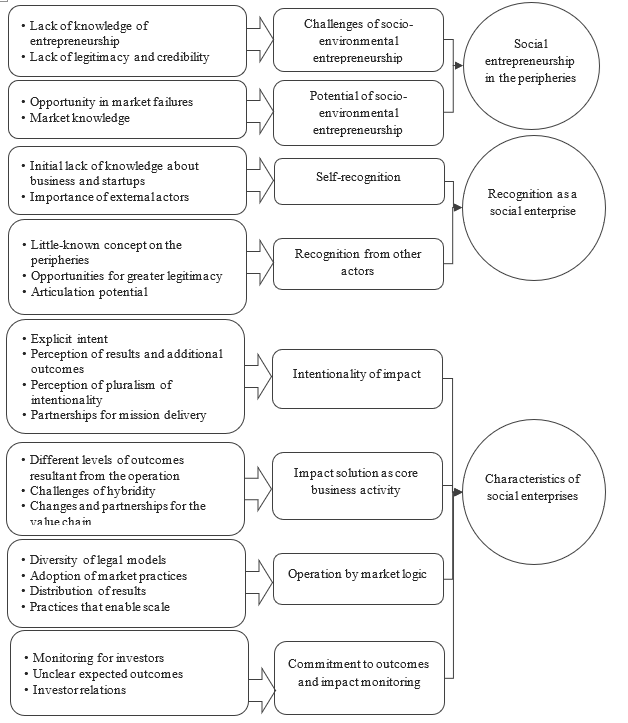
In the case of Jaubra, we interviewed one of its founders, and in the case of Enjoy, we interviewed the founder. With the permission of the participants, we recorded and transcribed the interviews. In the analysis of each case and between cases, the entire content of the interviews, together with the secondary data, was divided into topics according to the theoretical framework into 101 recording units, as proposed by Bardin (2007) and subsequently grouped in the tree coding according to the model by Gioia, Korley and Hamilton (2012). After fine-tuning, we ended up with 52 first-order categories that we consolidated into 23 categories in the first order of notions. We performed the next grouping in 8 second-order groups of notions and in 3 aggregated dimensions, which are presented in Figure 1.
Figure 1
Data Coding Tree
3.2 Presenting cases
Jaubra is a company that operated until 2021 in the mobility industry, working with passenger transportation through a digital urban mobility platform. Created in 2017 by an app driver (Mr. Alvimar) and his daughter Aline, the company was created as a cooperative called Ubra, an acronym for União da Brasilândia [Brasilândia Union, in our translation], but it established itself as a business that would bring together drivers from the region to provide exclusive service to the region's residents. Jaubra initially noticed that large app transportation companies vetoed peripheral areas in the city because they believed they were risky neighborhoods in São Paulo. The initial operation was possible due to an initial investment taken from Aline's severance indemnity fund, who worked as a bank employee and, after participating in accelerators and being selected, they received a contribution of US$ 6,000 from Ford Fund Lab and Artemisia.
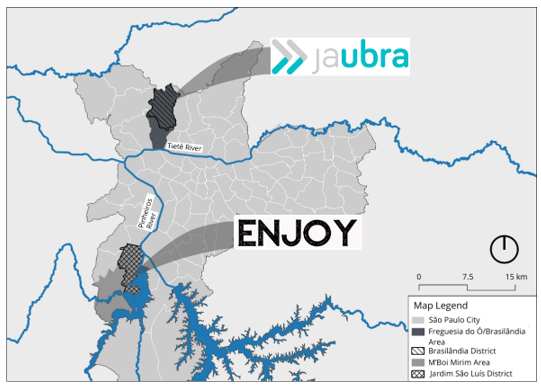
Enjoy Alimentação Orgânica began in 2017 as a platform that delivers organic food from local producers in Parelheiros to the outskirts of the South Zone of São Paulo. From this experience, Quebrada Orgânica was also created, another organization of the same partners. While Quebrada Orgânica works with environmental and urban agriculture practices, Enjoy Alimentação Orgânica distributes organic food in the outskirts and in the city of São Paulo. Figure 2 shows the location of cases in the city of São Paulo.
Figure 2
Map with the location of enterprises.
4 Analysis of results
The following analysis will be presented based on the 3 aggregated dimensions. We highlight that, throughout the process, we carried out an analysis of each case and a comparison between cases, as we will present below.
4.1 Entrepreneurship in the peripheries
We noticed that residents of the studied areas, whether they are entrepreneurs or customers, have little formal knowledge about what it means to be an entrepreneur. Even more so when it comes to socio-environmental entrepreneurship or social enterprises, the notions behind which are much more familiar to residents outside the peripheries. The entrepreneurs in the two cases studied admitted that they did not see themselves as a social enterprise at the beginning of Enjoy and Jaubra's activities. They also highlighted the difficulty of gaining recognition from the population of Brasilândia and the extreme south of São Paulo as social enterprises. It is not surprising that the demands from investors and the work from business accelerators — actors who are generally from outside the peripheries — often bring the issue closer to favelas and urban outskirts for the first time. In addition to the lack of entrepreneurial training, peripheral residents’ lack of recognition of the social enterprise’s importance stands out. In situations of job scarcity and great difficulties in obtaining income, encouraging people to shape their businesses or consume based on socio-environmental outcomes seems like an unfortunate task.
As we mentioned before, some readings about the urban peripheries interpret these areas as loci of power instead of them as places of scarcity (Barki et al. 2020a; 2023; Lyra, 2018; Meirelles & Athayde, 2014). This point of view is in line with a fact reported in the interviews: peripheral residents realize market failures in these territories better than people from rich neighborhoods, such as the lack of app-based transportation in Brasilândia, which generates pent-up demand for actions like Jaubra, or like the unexplored organic food market in the extreme south of São Paulo, which creates opportunities for Enjoy/Quebrada Orgânica. Of course, there are reasons for these failures; however, the knowledge of local people can be an asset that helps expand markets even in adverse situations.
4.2 Recognition as a social enterprise
The interviewed entrepreneurs mentioned their participation in processes led by central and higher-income territories or that follow their logic, such as fundraising and acceleration. During the construction of connections, residents of peripheries, understood mainly as being beneficiaries of this input, also contribute to the establishment of these ecosystems. Exchanges between stakeholders from non-outskirt neighborhoods and the peripheries enrich the local’s entrepreneurial ecosystem, as it brings to these areas a new way of seeing themselves. The idea that they are a potential market, combined with the possibility of generating local socio-environmental outcomes, is often unconsciously present in residents of low-income areas and can be brought to light by ecosystem stakeholders such as business accelerators, investors, and consumers in higher-income neighborhoods. Furthermore, the formation of networks within popular areas and between these areas and other neighborhoods with higher income can amplify the generation of financial results and socio-environmental outcomes for various stakeholders. This was pointed out by the Enjoy entrepreneur when mentioning the alliance between Enjoy (a business of Parelheiros), which finds a market in “upscale” neighborhoods, and Quebrada Orgânica, an initiative aimed at residents of the far end of south São Paulo. This perspective about strengthening ecosystems and building bridges between high-income areas and the outskirt neighborhoods is in line with what was showcased by Barki et al. (2020a).
4.3 Social enterprises’ characteristics
Next, we will discuss the social enterprises’ characteristics based on their applications in the selected cases.
4.3.1 Intended impact
Both organizations make their intent explicit in their missions or purposes. It was interesting to note, in fact, that in the case of Jaubra is more than one way to show its intent, as the company details its purpose, its manifesto, and its motivation. In the case of Enjoy, the intent is formalized in a mission statement, although it is not shared with its stakeholders. Additionally, the Enjoy entrepreneur highlighted the importance of having explicit and shared intent among the team, as this starts to guide decision-making within the organization.
Regarding the perception of additional outcomes, businesses identify other benefits provided to their audiences, which can serve as motivators and drivers for the organization in addition to the search for profit, corroborating Yunus (2008), Yunus et al (2010) and Gonçalves et al (2016). In the case of Enjoy, additional outcomes mentioned, in addition to the consumption of a healthier product, were a change in consumption behavior and a reduction of waste due to the possibility of purchasing only the quantity that will be consumed. Furthermore, it is worth highlighting the reduction of the carbon footprint and the generation of income for farmers and the community as a whole. In the case of Jaubra, the following additional outcomes were mentioned: (1) improved access to health services due to the greater availability of transportation for medical follow-ups; (2) generated income for drivers; and (3) the circulation of wealth within the neighborhood itself, with the establishment of partnerships with local businesses.
The multiple additional outcomes mentioned also reinforce the plurality of intent covering different areas of impact and stakeholders (Wilson & Post, 2013). In the case of Enjoy, there is a perception of environmental results in addition to social ones, especially related to the Quebrada Orgânica performance, and both Enjoy and Jaubra highlight their impact on consumers and suppliers, these being, in the case of Jaubra, the drivers. However, this plurality is not perceived in the explicit intent.
Additionally, both businesses establish partnerships to deliver their missions, corroborating Goyal et al (2014). In the case of Enjoy, it was necessary to partner with Quebrada Orgânica to serve a public that would not be able to purchase the products and with producers in the Parelheiros region to guarantee the supply of organic products. In the case of Jaubra, in addition to the partnership with drivers, partnerships were established to reduce costs in the technology and marketing area.
4.3.2 Impact solution as the core business activity
The overlap between the business model and the social and/or environmental outcomes can take on different levels (Alter, 2007; Comini, 2016), and this is what the cases indicated. In the case of Enjoy, there is a business operation model in which the intended outcome is achieved through the sales of organic food. However, for the product to be accessible to the low-income population, the company adopts different pricing strategies and additional activities to promote organic production through Quebrada Orgânica. This work by Quebrada Orgânica began with a focus on the intended social outcome since not all consumers were able to buy Enjoy products. Due to the decrease in Enjoy's business during the pandemic, it was possible to realize that the resources fundraised by Quebrada Orgânica maintained the operations of the ventures, somewhat opposite to the scenario showed by Alter (2007), in which the business resource would enable social outcomes. As for Jaubra, there is a great overlap between operation and the social and/or environmental outcomes since both are provided to drivers and residents of Brasilândia through the services provided brokered by Jaubra. However, this perception of the outcomes generated for these different audiences was built over time and informally through contact with drivers and users.
This overlap between social and/or environmental outcomes and financial results can bring specific challenges to the management of Enjoy and Jaubra (Battilana & Dorado, 2010; Battilana, 2019; Comini, 2016; Santos et al., 2015). In the case of Enjoy, it was possible to identify a challenge related to pricing, both for organic products, sold at a lower price in the peripheries to allow greater access and social and/or environmental outcomes, and for compost bins, made possible through donations. In the case of Jaubra, it was evident that looking at the outcomes is important to direct the company's operations, but that it needs to sustain itself financially and this is a challenge for the viability of the business.
When analyzing the necessary adaptations in the business model and value chain of Enjoy and Jaubra, we were able to understand that both organizations needed to promote changes with their suppliers and service providers, as well as in the service to their customers (Wilson & Post, 2013). In the case of Enjoy, a different negotiation with producers is necessary to fulfill small and custom-made orders that the company makes, which may even require arrangements in the logistics, while in the case of Jaubra, contact with drivers at the beginning it was done outside of a unified platform, which required negotiating values and direction of runs by the Jaubra team itself. Furthermore, it is interesting to note that both the adaptations in the business model and the value chain were due to characteristics of the location, such as the adoption of WhatsApp as a communication tool with customers so that they could purchase the companies' products and services. Finally, in the case of Jaubra it was still possible to identify that other forms of payment were implemented due to the local reality, such as, for example, paying in cash or even fuel directly to drivers.
4.3.3 Operating with market logic
Operating with market logic may require different legal models for enterprises (Alter, 2007; Comini, 2016; Yunus et al., 2010), and this was also identified in the analysis of the cases. In the case of Enjoy, the organization was formalized as a MEI (individual micro business), but the demand from potential funders in Quebrada Orgânica projects encouraged this other venture to be formalized as a non-profit association. Furthermore, the entrepreneur highlights that they are constantly adapting to the legal model. Jaubra was born with the idea of being a cooperative, but formalization took place as a company. Therefore, both Enjoy and Jaubra are formalized as companies, but it is interesting to note that different business moments and different stakeholders can influence the choice of the legal model to be adopted.
Regarding the market practices adopted by the cases, we can point out the financial management, marketing and sales, formalization, and entrepreneurship practices in general, such as, for example, the development of business models and pitch presentations, confirming the perspective of Yunus (2008) and Yunus et al. (2010) that these are businesses like any other. Both organizations also have the prospect of generating revenue through the business model and distributing financial results to partners. Finally, it is important to highlight that Jaubra had the technology company that developed the application as a partner and with the prospect of receiving dividends. These findings do not necessarily confirm the view of Santos et al. (2015), Wilson and Post (2013), and Yunus et al (2010) that social enterprises can be efficient and reinvest their results in the growth of the business itself, but expand the discussion on the distribution of dividends to shareholders as highlighted by Comini (2016), and Defourny and Nyssens (2017). Finally, we identified in the case of Jaubra that the adoption of market practices caused conflicts with the pace of the enterprise, but also allowed the business to scale up at that time, in contrast to what was shown by Halme et al (2012).
4.3.4 Commitment to outcomes and impact monitoring
Regarding the commitment to outcomes and impact monitoring, in both cases, we were able to notice that this is still an incipient topic and encouraged by investors. Both Enjoy and Jaubra believed they could improve the monitoring of indicators, which was done at the request of potential investors in pitches in the case of Jaubra or for accountability in the case of philanthropic resources contributed to Quebrada Orgânica. This scenario confirms that monitoring social enterprises’ outcomes and impact is often motivated by external stakeholders (Arena et al., 2015; Barraket & Yousefpour, 2013; Smith et al., 2013).
Likewise, we can state that there is little clarity as to the outcomes expected by the organization, a challenge highlighted by Arena et al. (2015), Bagnoli and Megali (2011), and Comini (2016). As a result, it was not possible to identify lessons learned from monitoring, and only a focus on better relationships with investors, which does not explore the points presented by Barraket and Yousefpour (2013) and Ormiston (2019).
5 Discussion
Even though there is an unformalized outcome intention, in peripheries social enterprises, stakeholders such as business accelerators, academia, and investors are relevant to demonstrate to these entrepreneurs that their businesses provide a socio-environmental outcome, favoring access to networks, investments, and opportunities aimed at this business profile. Additionally, in peripheral social enterprises, it will be important to understand how business models and value chains should be adapted while respecting local culture. In this context, local entrepreneurs can have a wider knowledge of the market and greater legitimacy for these adaptations to be made in business models and value chains, avoiding ready-made solutions that understand that their socio-environmental outcome resides only in serving people from the peripheries as customers. It is also important to take into account that, in the peripheral neighborhoods, the narrative that highlights social and/or environmental outcomes may be limited by the need to obtain financial returns for business survival and income generation for entrepreneurs.
External stakeholders can also contribute to improving management practices and increasing the legitimacy of social enterprises, helping the low-income areas in which the businesses operate to realize their importance (Barki et al., 2020a; Bazanini et al., 2020). After all, high-income and central neighborhoods have nurtured an entrepreneurial culture for longer. As a result, their entrepreneurs generally have more technical knowledge and may have more access to resources, even though the business models of rich neighborhoods are limited peripheral territories.
Finally, as the local community is one of the stakeholders that may demand monitoring of social and/or environmental outcomes, and is, at the same time, a stakeholder with whom entrepreneurs can and should build a relationship of legitimacy, one of the challenges perceived in peripheral social enterprises is the lack of resources for constant monitoring of their outcomes, which means that this report is only aimed at investors and in specific opportunities. Measuring outcomes, therefore, seems to be a requirement made by those who support the entrepreneurial culture of high-income neighborhoods. Furthermore, entrepreneurs must reflect on the positive and negative impacts of their actions. Jaubra, for example, by hypothetically reproducing a model of partnerships with drivers similar to that of Uber, can generate precarious work for these employees, as reported by Antunes (2018) in his analysis of the new setups for the service proletariat. Furthermore, by encouraging individual motorized transport, it can be understood that Jaubra discourages the use of public and less polluting transportation in São Paulo. Therefore, the challenge that arises is to develop ways of monitoring results and impact at a lower cost, as well as ways of communicating these results and outcomes to different stakeholders of social enterprises in peripheries.
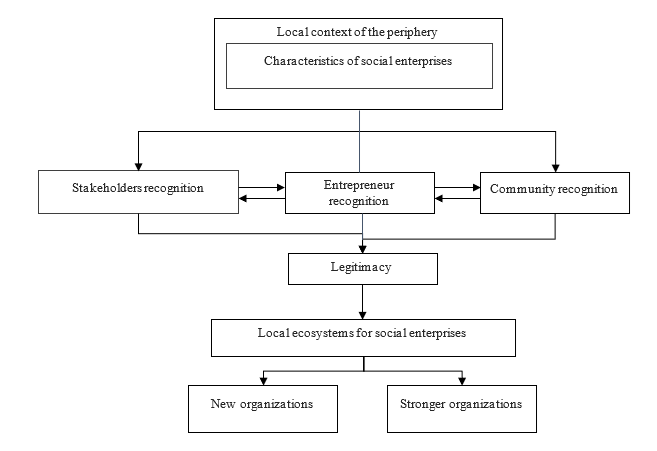
Understanding the characteristics of a social enterprise can provide entrepreneurs in low-income areas with greater legitimacy among different stakeholders. We note, however, that, in order to apply the criteria proposed by stakeholders mostly from outside the urban peripheries, adaptations are necessary to the context of entrepreneurship in these areas, so that the diversity and heterogeneity of their residents are respected, as explained by Barki et al. (2023). By the way, it is important to highlight the role of external stakeholders, who do not inhabit the symbolic low-income areas of the city (as defined by Mautner, 1999), in the dissemination of knowledge (Barki et al., 2020a). With their actions, entrepreneurs can recognize themselves as managers of social enterprises and the community can perceive these ventures as relevant to local development, legitimizing their actions. Finally, we believe that when external stakeholders, peripheral entrepreneurs, and the local community begin to recognize these organizations as solutions with social and/or environmental outcomes, these social enterprises can enjoy greater legitimacy. There are, of course, stakeholders who point out the individualism embedded in entrepreneurship and the process of capitalist accumulation (D'Andrea, 2020; Antunes, 2018; Maricato, 2020), but there are those who welcome the strengthening of local ecosystems for social entrepreneurship in favelas, which would allow local workers to develop the powers of precarious settlements and peripheries (Barki et al., 2023; Barki et al., 2020a; Lyra, 2018; Meirelles & Athayde, 2014), even strengthening territorial identity through entrepreneurship (Neves & Davel, 2021).
Figure 3 summarizes the main findings of this research for the development of the field of social entrepreneurship in peripheries. We acknowledge the injection into these areas of an entrepreneurial culture from the outside, which can be seen as a colonizing practice ― a valid discussion, and one that deserves to be addressed in depth in future work. However, recognizing the habits that many residents of favelas and peripheries have already been practicing regardless of the nomenclature can contribute to the generation of local income. Finally, we understand that social entrepreneurship can be an important tool in favelas and peripheries, as long as it is practiced critically by local residents, highlighting awareness of colonial actions, negative impacts on the quality of work, preservation of the environment, among other issues.
Figure 3
Summary of research findings
6 Final considerations
This research allowed us to understand the relevance of the local context in peripheries for promoting social entrepreneurship in these regions. As an academic contribution, we hope to have explored the notions of social enterprises in the literature, highlighting the lack of consensus on this topic. Furthermore, the application of the literature in practical cases can contribute to the evolution of future models applicable to specific realities. We also sought to understand the adoption of the concept in the urban peripheries and its impact in such territories. Therefore, this work also reinforces the need for research with specific perspectives on solutions from and for the peripheries (Barki et al., 2020a; Barki et al., 2023). As a managerial contribution, this work puts forth reflections on the recognition of peripheral entrepreneurs as social entrepreneurs. Additionally, based on this recognition, it is possible to enhance the legitimacy of local businesses and entrepreneurs, favoring the strengthening of businesses. As a social contribution, the research highlights the role of external stakeholders in promoting the field of social enterprises in low-income areas (Barki et al., 2020a), thus stimulating intersectoral partnerships, including public authorities, so that innovation ecosystems with social benefits are developed in Brazilian urban peripheries, as long as they respect the residents' choice to join or not and in what way. On the other hand, a critical view was also taken regarding the potential negative impacts of these businesses on territories.
Finally, as limitations of the study, we point out that the method does not allow generalization of the results and the fact that the cases studied are exclusively from the city of São Paulo. Therefore, it is recommended that future studies replicate the research in other peripheral areas of Brazil, expanding the number of cases and comparing the results from different local contexts. Finally, it is possible to advance the theory on the topic based on descriptive studies with a larger number of social enterprises in peripheries to assess the application of characteristics or delve deeper into specific characteristics.
References
Alter, K. (2007) Social Enterprise Typology. Virtue Ventures LLC, 1–31. http://rinovations.edublogs.org/files/2008/07/setypology.pdf.
Antunes, R. (2018). O privilégio da servidão: O novo proletariado de serviços na era digital. São Paulo: Boitempo Editorial, 2018.
Arena, M.; Azzone, G. & Bengo, I. (2015). Performance Measurement for Social Enterprises. Voluntas, 26(2), 649–672;
Austin, J.; Stevenson, H. & Wei-Skillern, J. (2006) Social and Commercial Entrepreneurship: Same, Different, or Both? Entrepreneurship Theory and Practice, 30(1), 1–22, Jan.
Bagnoli, L. & Megali, C. (2011). Measuring performance in social enterprises. Nonprofit and Voluntary Sector Quarterly, 40(1), 149–165.
Barki, E. (2015) Negócios de impacto: tendência ou modismo? GV-Executivo, 14(1), 14.
Barki, E.; de Campos, J. G. F.; Lenz, A. K.; Kimmitt, J.; Stephan, U.; Naigeborin, V. (2020a). Support for social entrepreneurs from disadvantaged areas navigating crisis: Insights from Brazil. Journal of Business Venturing Insights, 14, 1-9.
Barki, E.; Rodrigues, J. & Comini, G. M. (2020b). Negócios de Impacto: Um Conceito em Construção. Revista de Empreendedorismo e Gestão de Pequenas Empresas, 9(4), 477.
Barki, E., Salusse, M. A. Y., de Campos, J. G., Rocha, T. N., & Stephan, U. (2023). In Search of Inclusive Social Entrepreneurship. Stanford Social Innovation Review. https://ssir.org/articles/entry/in_search_of_inclusive_social_entrepreneurship.
Barraket, J. & Yousefpour, N. (2013) Evaluation and Social Impact Measurement Amongst Small to Medium Social Enterprises: Process, Purpose and Value. Australian Journal of Public Administration, 72(4), 447–458.
Battilana, J. & Dorado, S. (2010). Building sustainable hybrid organizations: The case of commercial microfinance organizations. Academy of Management Journal, 53(6), 1419–1440.
Bazanini, R., Da Silva, J. R., & Biffi, M. A. (2020). Empreendedorismo Social em Redes Interorganizacionais: o Fluxo Mimétrico como Absorção Adaptativa na Formação de Competências para o Empoderamento Social. Gestão & Regionalidade, 36(109).
Bocken, N. M. P.; Fil, A. & Prabhu, J. (2016). Scaling up social businesses in developing markets. Journal of Cleaner Production, 139, 295–308.
Comini, G. M. (2016). Negócios sociais e inovação social: um retrato de experiências brasileiras (Tese de Livre-Docência em Administração).
Comini, G. M.; Barki, E. & Aguiar, L. (2012). A three-pronged approach to social business: a Brazilian multi-case analysis. Revista de Administração (São Paulo), 47 (3), 385-397.
D’Andrea, T. (2020). Contribuições para a definição dos conceitos periferia e sujeitas e sujeitos periféricos. Novos estudos CEBRAP. São Paulo, 39(1), 19-36, jan-abr.
Defourny, J. & Nyssens, M. (2017). Fundamentals for an International Typology of Social Enterprise Models. Voluntas, 28 (6), 2469–2497.
Eisenhardt, K. M. (1989). Building Theories From Case Study Research. Academy of Management Review. v. 14, n.4, pp. 532- 550, 1989.
Eisenhardt, K. M. (2021). What is the Eisenhardt Method, really? Strategic Organization, 19(1), 147-160.
Fischer, R. M. (2002). Desafio da colaboração: práticas de responsabilidade social entre empresa e terceiro setor. São Paulo: Editora Gente.
Fischer, R. M. (2014). Negocios Sociais. In Dicionário para a Formação em Gestão Social (pp. 125–127).
Goia, D. A.; Korley, K. G. & Hamilton, A. L. (2012). Seeking Qualitative Rigor in Inductive Research: Notes on the Gioia Methodology. Organizational Research Methods, 16(1), 15-31.
Godoy, A. S. (1995). Pesquisa Qualitativa – tipos fundamentais. Revista de Administração de Empresas, 35(3), mai/jun, 20-29.
Gonçalves, C. P.; Carrara, K. & Schmittel, R. M. (2016). The Phenomenon of Social Enterprises: Are We Keeping Watch on This Cultural Practice? Voluntas, 27(4), 1585–1610.
Goyal, S.; Bruno, S. & Kapoor, A. (2014). Understanding the Key Characteristics of an Embedded Business Model for the Base of the Pyramid. Markets, Economics and Sociology, 7(4), 26-40.
Halme, M.; Lideman, S. & Linna, P. (2012). Innovation for Inclusive Business: Intrapreneurial Bricolage in Multinational Corporations. Journal of Management Studies, 49(4), 743–784.
ICE & Pipe Social (2019). O que são negócios de impacto: características que definem empreendimentos como negócios de impacto. Instituto de Cidadania Empresarial - ICE, 56. https://aliancapeloimpacto.org.br/wp-content/uploads/2020/03/ice-estudo-negocios-de-impacto-2019-web.pdf.
Kowarick, L. (1980). A espoliação urbana. Rio de Janeiro: Paz e Terra.
Lyra, E. (2018) Da favela para o mundo: Não importa de onde você vem, mas para onde você vai. São Paulo: Buzz Editora.
Maricato, E. (2015). Para entender a crise urbana. São Paulo: Editora Expressão Popular, 2015.
Maricato, E. (2020). “O Coronavírus e um plano de emergência para as cidades. In Borges, A. & Marques, L. (orgs.). Coronavírus e as cidades no Brasil: reflexões durante a pandemia. Rio de Janeiro: Outras Letras.
Meirelles, R. & Athayde, C. (2014). Um país chamado favela: A maior pesquisa já feita sobre a favela brasileira. São Paulo: Editora Gente.
Martin, R. & Osberg, S. (2007). Social Entrepreneurship: The Case for Definition. Stanford Social Innovation Review, 29-39, 2007.
Martins, G. A. & Teóphilo, C. R. (2007). Metodologia da Investigação Científica para Ciências Sociais Aplicadas – São Paulo: Atlas.
Mautner, Y. (1999). “A periferia como fronteira de expansão do capital”. In: Deák, C. & Schiffer, S. R. O processo de urbanização no Brasil. São Paulo: Edusp.
Neves, J. N. dos R., & Davel, E. P. B. (2021). A Territorialidade do Empreendedorismo: Perspectivas e Desafios para o Empreendedorismo Cultural. Gestão & Regionalidade, 37(112).
Oliveira, E. M. (2004). Empreendedorismo social no Brasil: atual configuração, perspectivas e desafios – notas introdutórias. Rev. FAE, Curitiba, 7(2), 9-18, jul./dez.
Ormistron, J. (2019). Blending practice worlds: Impact assessment as a transdisciplinary practice. Business Ethics, 28(4), 423–440.
Prahalad, C. K. & Hart, S. L. (2002). “The Fortune at the Bottom of the Pyramid.” Strategy + Business, 1 (26).
Santos, F.; Pache, A. C. & Birkholz, C. (2015). Making hybrids work: Aligning business models and organizational design for social enterprises. California Management Review, 57(3), 36–58.
Singer, P. (2002). Introdução à economia solidária. São Paulo: Fundação Perseu Abramo.
Smith, W. K.; Gonin, M. & Besharov, M. L. (2013). Managing Social-Business Tensions: A Review and Research Agenda for Social Enterprise. Business Ethics Quarterly, 23(3), 407–442.
Villaça, F. (2001). Espaço intra-urbano no Brasil. São Paulo, Studio Nobel.
Wilson, F. & Post, J. E. (2013). Business models for people, planet (& profits): Exploring the phenomena of social business, a market-based approach to social value creation. Small Business Economics, 40(3), 715–737.
Yunus, M. (2008). Creating a world without poverty: social business and the future of capitalism. Global Urban Development, 4(2), Nov.
Yunus, M.; Moingeon, B. & Lehmann-Ortega, L. (2010). Building social business models: Lessons from the grameen experience. Long Range Planning, 43(2–3), 308–325.
------
i Doutorando em Administração pela FEA-USP (São Paulo / SP); mestre em Administração pela FEA-USP (São Paulo / SP); especialista em Administração Estratégia pela FIA (São Paulo / SP); graduado em Comunicação Social com habilitação em publicidade e propaganda pela ESPM (São Paulo / SP).
ii Doutorando em Planejamento Urbano e Regional pela FAU-USP (São Paulo / SP); mestre em Planejamento Urbano pela Columbia University – Graduate School of Architecture, Planning and Preservation (New York / NY); graduado em Arquitetura e Urbanismo pela FAU-USP (São Paulo / SP).
iii Doutorando em Economia das Organizações pela FEA-USP (São Pulo/SP); mestre em ciências pelo departamento de Administração da FEA-USP (São Paulo/SP); graduado em Ciências Econômicas pela Universidade Presbiteriana Mackenzie (São Paulo/SP).