Received: 04/09/2024
Accepted: 30/09/2024
Green roofs and urban sustainability: a study on the
eldorado shopping project in São Paulo, Brazil
Telhados
verdes e sustentabilidade urbana: um estudo
sobre o projeto
do Shopping Eldorado em São Paulo, SP
Mariana Bortolato Martelli1i*, ORCID: https://orcid.org/0009-0003-9327-1386; Diego
de Melo Conti²ii, ORCID: https://orcid.org/0000-0003-1889-0462;
Luiza Vigne Bennedetti³iii, ORCID: https://orcid.org/0000-0001-8840-6766 ; Maurício
Lamano Ferreira⁴, ORCID: https://orcid.org/0000-0002-7647-3635;
1. Fundação Instituto de Administração, São Paulo, SP, Brasil. E-mail :
marianabivmartelli@gmail.com
2. Pontifícia Universidade Católica
de Campinas, Programa
de Pós-graduação em Sustentabilidade, Escola de Economia
e Negócios, Campinas, SP, Brasil. E-mail: diegoconti.prof@gmail.com
3.
Universidade de São Paulo,
Programa de Pós-Graduação em Ciência Ambiental, Instituto de Energia
e Ambiente, São Paulo, São Paulo, Brasil.
E-mail: lvbennedetti@usp.br
4. Universidade de São Paulo,
Departamento de Ciências
Básicas e Ambientais, Escola de Engenharia de Lorena, Lorena,
São Paulo, Brasil.
E-mail: lamano@usp.br
Abstract
Urbanization in cities has been characterized by an
accelerated process, leading to a series of challenges in making cities more
sustainable, efficient, and livable for their citizens. In response, the concept of sustainability has been adopted
to mitigate negative
actions and adapt urban structures. This study
investigates the benefits of green
roofs as a sustainable solution, focusing on the design of Shopping Eldorado in
São Paulo, SP. The methodology included a literature review and documentary
research, with a guided visit to the shopping center for analysis of the green roof and data collection on maintenance and benefits. The results highlight green roofs as efficient tools
for stormwater runoff management, energy consumption reduction, heat island
mitigation, and improved waste management. The conclusion emphasizes the
feasibility of green roofs in commercial centers, pointing to significant
economic, social and environmental benefits.
Keywords: urban sustainability; sustainable city; nature-based solutions; green roof.
Resumo
A urbanização das cidades tem se
caracterizado por um processo
acelerado e tem gerado uma série de desafios para tornar as
cidades mais sustentáveis, eficientes e habitáveis para seus cidadãos. Em
resposta, o conceito de sustentabilidade vem sendo adotado para mitigar ações
negativas e adaptar as estruturas urbanas. Este estudo investiga os benefícios
dos telhados verdes como solução
sustentável, focando no projeto do Shopping Eldorado
em São Paulo, SP. A metodologia incluiu revisão bibliográfica e pesquisa documental, com uma
visita guiada ao shopping para
análise do telhado verde e coleta de dados sobre manutenção e benefícios. Os
resultados destacam os telhados
verdes como ferramentas eficientes para escoamento de água
pluvial, redução de consumo de energia, mitigação de ilhas de calor e melhor
manejo de resíduos. A conclusão ressalta a viabilidade de telhados verdes em
centros comerciais, apontando para ganhos econômicos, sociais e ambientais
significativos.
Palavras-chave: sustentabilidade urbana; cidade sustentável; soluções
baseadas na natureza; telhado verde.
Citation: Martelli, M. B., Conti, D. M., Bennedetti, L. V., & Ferreira, M.
L. (2025). Telhados Verdes e Sustentabilidade Urbana: Um Estudo sobre
o Projeto do Shopping Eldorado
em São Paulo, SP. Gestão & Regionalidade, v. 41 e20259540.
https//doi.org/10.13037/gr.vol41.e20259450
1 Introduction
In the last centuries, human action on Earth has
drastically altered the planet's natural processes and flows. Negative
activities such as the destruction of forests and vegetation to make way for cities,
pollution of rivers and oceans,
alteration in nitrogen
levels due to intensive
land use, and the increase
in pollution and accumulation of greenhouse gases in the atmosphere
have led scholars to call the new geological epoch
as the Anthropocene (Barthel, Isendahl, Vis, Drescher, Evans & Timmeren,
2019). By focusing
on the most recent decades,
one observes an exacerbating factor of society's
negative actions with significant impacts on climate change: urbanization. This
phenomenon shows no signs of abating; on the contrary, it is estimated to
continue growing due to projections of urban growth. It is estimated that 68%
of the global population will live in cities by 2050,
indicating an increase
of 2.2 billion people in this type of
urban structure (UN, 2015).
In response to the adverse situations caused by urban
centers, the concept of sustainability is employed to mitigate negative actions
and adapt existing structures to better serve society with the available
resources (Thornbush, Golubchikov & Bouzarovski, 2013). Although
sustainability is often associated with environmental aspects, regarding
cities, it is necessary to also encompass economic and social issues and ensure
that these three spheres work together for a
sustainable city (Kadir & Jamaludin,
2013). To restraint the consequences of high urban expansion, policies
and strategies for sustainable development have been created (Egger, 2006), aiming to offer a
better quality of life for citizens and social and economic equity, conserve
energy, better utilize
natural resources, reduce
water and air pollution, manage food waste, and promote smart and
healthy growth in cities (Sodiq et al., 2019).
Still in response
to urban population growth and its negative consequences, sustainable cities seek
different tools to assist in managing and adapting to the climate crisis (Hong, Kim, Koo & Kwak,
2012). The pursuit of solutions
with relatively low costs compared
to extremely expensive systems
and technologies, capable
of utilizing and optimizing existing
infrastructure, has led cities to invest in living organisms such as
soils, sediments, and organic matter with multi-functional and adaptable capabilities, leading to the use of Nature-based Solutions (NbS) (Hobbie & Grimm, 2020). Through the provision of
ecosystem services (ES), NbS, such as green roofs, have been incorporated into
both new and existing buildings (Calheiros & Stefanakis, 2021), proving to be an efficient tool in terms of stormwater runoff, reduced energy consumption, urban heat island
effect mitigation, increased biodiversity, and improvement in social well-being
(Editors Rosenzweig, Gaffin & Parshall, 2006).
This strategy of innovating in sustainable environment
planning improves urban sustainability and brings benefits at different scales,
with scientific literature reporting these benefits for decades (Saadatian et
al., 2013; Pineda-Martos & Calheiros, 2021). The multiple gains can be
categorized into energy-related advantages (e.g., cooling), improvement of air
quality (e.g., CO2 sequestration and particulate matter retention), water
management (controlling surface runoff), and aesthetic gains, which can yield
psychological benefits (Mihalakakou et al., 2023).
Although there is considerable discussion about green
roofs and their ecosystemic benefits, less attention is given to their
feasibility on roofs of commercial centers or non-residential buildings, such
as shopping malls. These locations are strategically favorable for such practices because, in addition to having space, the production of organic
waste from food courts is high, which can be
decomposed to become compost for plants, thereby increasing productivity.
With the aim of demonstrating the benefits of green roofs
in fostering sustainable and smart cities, this study aimed to investigate the Green Roof project at Shopping Eldorado
in the city of São
Paulo (SP) as one example of tools
for building sustainable cities. Thus, the results of this study could be
extrapolated to other contexts, types of constructions, and commercial sectors,
since the proposal is to combine space availability, opportunity, and sustainable action in the transformation and
adaptation of cities.
2
Methodology
The present work is based on
a literature review, with the
selection of articles obtained through the CAPES Journal Portal from various databases, ensuring the breadth
and quality of the sources consulted. The analysis, of an explanatory and
descriptive nature, aims to present arguments, foundations, and information on
the implementation of green roofs as a tool for promoting the development of
sustainable cities. Essential issues regarding the concepts of green roofs and
urban sustainability were addressed, as well as the interconnection between
these topics and the needs and benefits that each aspect can bring to cities
and citizens.
In addition to the literature review, a documentary-based
research was conducted at Shopping Eldorado in São Paulo to examine a green
roof and gather information about the established maintenance process, as well
as the benefits and challenges for implementing the structure. The research was carried out through a guided tour provided by the establishment for individuals interested in learning about the project, which
allowed for photographic documentation and access to informational materials.
The visit took place in November 2022, and in addition to
specifically going to the rooftop of the building where the green roof is
located, the guide also took the group to other areas of the shopping mall to
demonstrate not only the process involved in maintaining the green structure
but also to explain all the sustainability initiatives of the shopping mall.
3
Results
3.1 Green Roof
Green roofs are urban structures (residential or others)
that add ecological value to the tops of buildings. Roofs with different types of plants can serve for human
food, promotion of ES,
ornamental values, or even cultural (religious) purposes. However, there is
currently a discussion on the importance of promoting this strategy to improve
urban sustainability, especially in the context of adapting urban spaces to
climate change (Li & Babcock, 2014).
The sixth report
of the Intergovernmental Panel on Climate Change (IPCC), a document
created by the UN on climate change, highlighted cities as one of the main
areas to address climate change,
since approximately 56% of the world's population lives in urban centers with
the prospect of this number
continuing to grow in the next decades
(IPCC, 2022). The need for cities to take action for climate
change increasingly leads cities to adopt the Sustainable Development Goals
(SDGs) presented by the UN, focusing on SDG 11 concerning cities, aiming to
reduce negative environmental impact per capita, develop projects, and
implement initiatives that lead to a decrease in greenhouse gas emissions,
improve air and water quality, and manage municipal waste, among others.
Considered fundamental actors in climate mitigation and adaptation efforts,
urban structures must include topics such as promotion and integration of green infrastructure, preventive action to reduce social
vulnerability, evolution in
climate change governance with greater participation of
civil society, and strategic urban planning (Tischler & Haltermann, 2019).
In this scenario where urban centers are predominantly
grey due to numerous constructions, which show no signs
of slowing down,
professionals from different sectors signal NbS,
which are considered living responses where processes and structures are
designed to address various environmental challenges while offering economic,
social, and ecological benefits (Brasil et al., 2021). NbS are grounded in the
act of learning from, being inspired by, and
emulating nature, with a crucial
understanding of the environment and natural processes
to harness the strength of ecosystems as infrastructure to provide
services that benefit the city as a whole (structure and actors) (Stefanakis,
Calheiros & Nikolaou, 2021). Pearlmutter et al. (2020) add that to combat the effects of climate and grey infrastructure, the integration of NbS and green
infrastructure is essential, a strategically planned network for delivering
ecosystem services, to increase the presence of nature in cities through the
formulation of innovative strategies.
Among the types of NbS are green roofs, parks, urban
forests and open spaces, community gardens, stormwater ponds, bioretention
basins, riparian zones, and structures for habitat restoration and protection
(Hobbie & Grimm, 2020). However, given the limited availability of space, there is a concern to innovate and optimize open areas. In response to this
situation, there is a movement towards the use of rooftops and roofs of
low-rise buildings for the implementation of green roofs, which can result in
savings, aid in climate mitigation, improvement in people's quality of life,
and contribution to social actions (Wright, Lytle, Santillo, Marcos & Mai,
2021). NbS, when integrated into buildings, can be presented
in three spheres: Green building spaces,
Green building materials, and Green building
systems, with the latter encompassing green roofs as it is classified as a system
that aims to include vegetation in its environments, so that
plant strips and living walls are also included in this classification
(Pearlmutter et al., 2020).
Green roofs, also referred to as eco-roofs, living roofs, natural
roofs, suspended gardens, among others (Rogers, 2013), despite gaining prominence in recent decades, have one of their earliest appearances dating back to 2500 BC in Mesopotamia, evidenced by records of buildings
with stepped shapes where it was possible
to install different
vegetation at various
levels, while in Brazil,
the first building
with vegetative cover appeared in the 1930s in Rio de Janeiro,
at the then Ministry
of Education and Health (Filho, Reis-Alves, Schueler & Rola, 2015). Unlike the early appearances when climate crisis or urban center
densification were not yet topics of discussion, roofs are now seen as
structures capable of generating direct and indirect benefits for improving
the quality of life in cities and contributing to carbon sequestration, reduction of heat
islands and energy consumption, stormwater runoff,
rainwater harvesting, and restoration
of degraded ecosystems (Sousa, Sousa, Magalhães Junior, Nunes, Faria &
Faria, 2021).
In addition to the different nomenclatures, the
structures in question can also be classified
as extensive, semi-intensive, and intensive depending on the vegetal
composition and maintenance
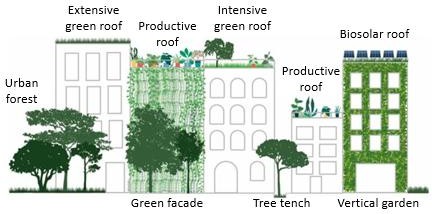
specifications (Alves, Bezerra, Silva Filho & Souza, 2021). For a better
understanding of the existing varieties, Calheiros and Stefanakis (2021)
created Figure 1.
Figure 1
Presence of nature-based solutions in constructions.
Source: Adapted
from Calheiros and Stefanakis (2021).
According to the authors, intensive green roofs feature a
wide variety of plant species, ranging from small to larger plants such as grass, shrubs,
and trees, which require
maintenance similar to that of a garden concerning fertilization, irrigation, and accommodation. Due to their sturdier specimens, they require a
greater quantity and depth of substrate, typically exceeding 15 cm (Alves,
Bezerra, Silva Filho & Souza, 2021). Extensive green roofs consist of
smaller, lightweight, yet resilient plants capable of withstanding low water
availability, harsh winters, and wind (Sousa, Sousa, Magalhães Junior, Nunes,
Faria & Faria, 2021). Due to their characteristics, they require
less maintenance as well as substrate, which varies between 5 and 15
cm; however, due to their smaller size, they support
less rainfall load (Alves, Bezerra,
Silva Filho & Souza, 2021). Although not represented in Figure 1,
semi-intensive roofs are characterized by medium-sized plants that alternate
between extensive and intensive systems (Sousa, Sousa, Magalhães Junior,
Nunes, Faria & Faria, 2021) and are typically composed
of a substrate layer that usually
ranges from 12 to 25 cm (Calheiros & Stefanakis, 2021). According
to Alves, Bezerra, Silva Filho
& Souza (2021),
implementation and maintenance costs can make green roofs less attractive, especially in drier regions where greater irrigation is required. In this
scenario, consideration of species capable of surviving with less water over a
longer period is necessary.
The composition and quantity of each element may vary
among different structures; however, generally, green
roofs are comprised
of vegetation, substrate, filtering layer, drainage layer, protective layer, root
barrier, insulation layer, waterproofing membrane, and conventional roof
platform (Morais et al., 2021).
3.1.2 Economic,
social, and environmental benefits of green roofs
The various benefits that green roofs can bring in terms
of economic, social, and environmental aspects have led several countries to
join this movement of change in urban centers and install this type of structure (Shafique, Kim &
Rafiq, 2018). In addition to helping reduce
energy consumption, heat island effect,
carbon sequestration, and improving air quality
(Seyedabadi, Eicker &
Karimi, 2021), the use of idle spaces
on buildings can lead to a
transformation in the visual identity of cities, as the
impermeable surface area of buildings in most cities ranges from 40 to 50%
(Calheiros & Stefanakis, 2021).
Making buildings greener also contributes to offsetting
the damage they bring, as according to the UN, based on reports from the
International Energy Agency, it is estimated that building operation and
construction sector together account for 38% of global carbon dioxide (CO2)
energy emissions (UNEP, 2020). Although there are cities that are signatories
to the World Green Building
Council's Net Zero Carbon Buildings
Commitment, only 29 cities
have committed to the cause, including two from South America, Medellín and
Santiago de Cali in Colombia (WGBC, 2016). For this scenario, green roofs can
be a solution in terms of carbon footprint and lower energy consumption.
Buildings with the potential for implementing a green roof can benefit from a series of sustainability-oriented
advantages, generating economic, social, and environmental gains for cities. Starting
with the economic
perspective, which can be perceived
through the performance of roofs directly on the buildings
they are on, there are studies demonstrating that the vegetation and soil of green roofs cool the roof surface and the surrounding air, acting as thermal insulation and reducing heat transfer
to the interior space (Sproul,
Wan, Mandel &
Rosenfeld, 2014). Since the temperature inside buildings undergoes smaller changes,
the demand for air conditioning or heating is lower, resulting in lower electricity consumption and therefore less expenditure.
By contributing to the sequestration
of CO2 and consequent improvement in air quality, although not as evident, green roofs can generate a social cost of carbon
(Teotónio, Silva &
Cruz, 2018). This expense
identifies the economic
cost of an additional ton of CO2 emitted into the
atmosphere on social welfare activities, meaning it is the value
of the damages caused at a given moment, which is important
information for the formulation of public policies
(CEPAL, 2019).
While some benefits can be easily monetized, there are others considered intangible as there is no clear and easy
way to quantify and assign financial value to them, such as well-being, noise reduction, ecological preservation, property value appreciation, and improvement
in the visual design of the city (Shafique, Kim & Rafiq, 2018). The
perception and quantification of benefits, according to Teotónio, Silva &
Cruz (2021), can also be affected in
terms of the scale of analysis, as depending on the type, it may only be perceived
at a broader level (city) and not at a smaller
level (building). The authors give an example
of the insignificant contribution that a 200 m2 green roof area can
have on improving the air quality of a city.
As an example
of carbon sequestration monetization, Hong, Kim,
Koo & Kwak (2012) established and analyzed
different scenarios and compositions of green roofs in schools,
which demonstrated at various
levels that the amount of CO2 absorption could result in carbon credits and thus monetary value.
Of the three spheres governing sustainability, the
environmental sphere is probably where the benefits are most easily perceived,
which can vary widely, such as managing stormwater runoff, improving air and
water quality, reducing building energy consumption, reducing noise pollution,
extending the life of roofs, mitigating heat island effects, and increasing green spaces in urban centers
(Vijayaraghavan, 2016). Given the breadth
of the topic and in order to elaborate
in more detail on how cities and citizens can benefit environmentally, this work will address
three issues: energy usage, stormwater runoff, and heat island effects.
By adding thermal resistance to buildings and reducing
heat exchange between the structure and the indoor environment, green roofs are
capable of cooling facilities during periods of warmer weather and consequently
reducing energy consumption for cooling (Shafique, Kim & Rafiq, 2018). This
phenomenon can be observed in both new and older buildings; however,
it is in the latter type where there is generally a greater reduction
in energy usage, as they tend to have a thinner
layer of thermal
insulation, resulting in greater heat transfer
(Cascone,
Catania, Gagliano & Sciuto, 2018). In order to demonstrate the energy efficiency of green roofs compared
to buildings without
this structure, Liu and Baskaran
(2003) conducted a study
in Canada comparing
the two constructions. Due to the strong influence of solar radiation on the heat flux of concrete,
the green roof showed excellent performance during spring and summer, as it was
able to improve thermal performance by providing shading, insulation,
evapotranspiration, and thermal mass.
During periods of heavy rainfall, trees and plants are
important allies for cities in reducing the risk of flooding. While the water
that falls on trees is quickly evaporated and returns to the atmosphere, the
soil has the function of absorbing it and gradually releasing it into streams
or providing a pathway for it to reach the groundwater table (Editors, Rosenzweig, Gaffin & Parshall, 2006).
In densely populated areas such as urban centers, where rainwater finds few absorption areas as it falls directly
onto pavements, green roofs also function as a sort of
purifier by absorbing
heavy metals such as copper, zinc, cadmium, and lead (Shafique, Kim & Rafiq, 2018).
Between 2006 and 2010, Zhang, Miao, Wang & Liu (2015) analyzed
the absorption and quality of rainwater from two areas
in Chongqing, China, one with a green roof and the other without vegetative cover installed adjacent
to a school. The traditional roof showed an average
of 0.42 mm of water retention, while the green roof absorbed an average of 11.61 m during the same period. Regarding the pH
of the water, the average
value obtained on the green roof was 6.84, which falls
within the standard range (6.0 -
9.0), whereas the other
roof exhibited a more acidic pH of 5.61. Considering that
Chongqing is a region typical
of acid rain (pH <
5), which brings damage to soils and physical structures, the study showed that
green roofs can help reduce the acidity of rainwater.
When considering the three fundamental elements of
sustainability—economic, environmental, and social—the latter is arguably the
most challenging sphere to link to the benefits of green roofs. This
inconvenience arises from the fact that social aspects are closely tied to visual and aesthetic considerations, as well as well-being, which are intangible and non-quantifiable
(Shafique, Kim & Rafiq, 2018). However, the social aspects and quality of
life benefits for citizens can be explained
through the value of
ES, which were precisely
created to demonstrate the benefits of ecosystems to society (Kotzen,
2018). The concept
of ES, although still not widely discussed, has been increasingly used
in the strategic realm of public policy creation, considering the relationship of the
topic with city sustainability,
natural resource use, climate change mitigation, ecosystem
restoration, citizen well-being, and city aesthetics (Hauck, Görg, Varjopuro, Ratamaki & Jax, 2013).
ES, to better categorize the various benefits they are
associated with, are divided by some authors into four categories: a)
regulation services: these concern natural resources (air, water, soil
quality), stormwater management, waste disposal, and disease regulation. b)
provisioning services: encompass consumer goods (food and medicine), biomass
production, and raw materials for energy resources. c) support services: are
related to elements that contribute to the conservation of biological factors
such as species habitat, maintenance of genetic diversity, soil formation, and
nutrient and water cycling. d) cultural services: include ethical values,
aesthetic appreciation and inspiration, recreation, well-being, mental and
physical health, education, and knowledge. (Kotzen, 2018; Spangenberg, Gorg,
Truong, Tekken, Bustamante & Settele, 2014; Kabisch, 2015).
When addressing the aesthetic and quality of life aspects
that green roofs bring to society, it is noted that they fall under cultural
services, as they are linked to non-material benefits (Kotzen, 2018). Even though there are decision-makers who argue that green spaces
are
superfluous items and should not be a priority within policies, studies
indicate a direct relationship between green areas and the mental and physical
health of individuals (Kondo, Fluehr, McKeon & Branas, 2018). Furthermore, Bratman
et al. (2015) point out several benefits that green areas bring to human
well-being, as areas with plants and vegetation can mitigate and improve mental
illnesses, stress, and even cognitive functions in people of various age
groups, prompting some cities to include
this issue in public agenda discussions and to rethink the structures and design of
urban centers.
Additionally, green roofs can bring social value by being
used for food production, albeit on a smaller scale compared to traditional
methods of production in large areas and directly in the soil (Shafique, Kim
& Rafiq, 2018). The use of buildings for this purpose not only allows
for a reduction in the distance between
producer and consumer, leading to less food
loss, but also results in educational and cultural enrichment regarding citizens' engagement with a system not commonly found in urban centers. Often,
because it is located in more remote municipalities, this leads to a lack of contact
and knowledge among
people about how the food they consume is produced (Walters
& Midden, 2018).
As green roofs are not only linked to ecological aspects but also present interconnected benefits with widely spread
sustainability concepts, encompassing economic, social, and environmental
dimensions, they emerge as allies for urban centers and citizens in fostering
businesses, mitigating the effects of climate change, and promoting a better
quality of life. However, for these structures to become even more prevalent in
cities in pursuit of a sustainable agenda capable of intelligently utilizing
all available resources, it is necessary for various actors in society to get
involved (Calheiros & Stefanakis, 2021).
3.2 Green Roof of
Eldorado Shopping Mall
The green roof of Shopping
Eldorado was created
in 2012 as a visionary solution for the proper disposal of the 164 tons of
organic waste generated monthly in the food court,
with the amount reaching
approximately 2,000 tons annually.
The waste treatment process begins in the food court
itself, more specifically in a sort of bay, where employees separate food and items left on trays into organic waste
(brown bag) and recyclable (green
bag).
After separation, the organic waste is taken to the
internal composting area, where it
is sorted (checking for any other waste besides organic) and then inserted into
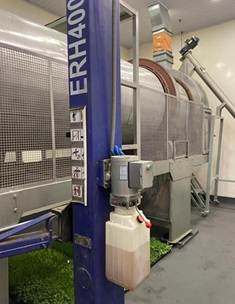
the composting machine (Figure 2),
which is an old machinery
purchased from a scrapyard. In the machinery, along with the waste, the
following are added: a) peat: responsible for accelerating the food
decomposition process; b) lime: aids in the drying of the food, through a chemical reaction
that occurs during the mixing of the elements; c) sawdust: reinforces
the food drying process and also reduces the strong odor of decomposing organic
matter.
Figure 2
Composting System at Eldorado Shopping
Mall.
Source: Authors' collection (2023).
From composting, the fertilizer to be used on the green
roof is obtained. Considering that the amount of fertilizer generated from
composting all organic material would be much higher than what the vegetation needs,
the shopping mall uses only 20% of the waste,
while the remainder is sent to
the company Biomix, which also uses them for
composting and later sells the
fertilizer.
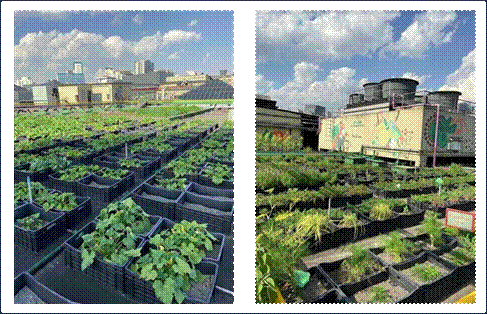
The green roof is primarily composed of vegetables and
greens, with some fruit trees and flowers as well (Figure 3). In the 6,000 m²
area, around 40,000 vegetables and greens are produced annually, comprising approximately 30 types such as lettuce,
arugula, zucchini, kale, parsley, herbs, among others. All
the food produced is distributed among the shopping mall employees, who rotate
to the roof when the crops are ready and participate in the harvesting process.
Figure 3
Green roof
- vegetables and greens - herbs and
flowers.
Source: Authors' collection (2023).
The reasons that led the shopping mall to implement the
green roof were basically twofold: sustainability and economic considerations.
In light of municipal law 13,478, from 2002, all Large Waste Generators (LWG),
meaning commercial establishments that generate more than 200 liters of waste
per day, must contract a responsible company to carry out the services of
collection, transportation, treatment, and final disposal of the generated
waste; the shopping mall is responsible for waste disposal, and until 2012, it
was entirely destined for landfills.
Following the implementation of the project, the waste began to be composted,
and the surplus was sent to a
third-party company responsible for collecting the material within the shopping
mall itself, leading the enterprise to reduce the amount of material sent to
landfills, from 86% (2013) of the total waste to 29% (2021). In terms of
benefits, the green roof also contributed to
reducing the temperature by
around 6°C in the inter-floor space of the building, resulting in lower energy
consumption.
In order to improve the sustainability actions of the
mall every year, the management aims to achieve zero landfill, which it intends
to accomplish by adapting to the market and introducing new and innovative
projects.
4
Analysis of the Results
According to the literature review
conducted, it is understood
that although green roofs are
recognized as a Nature-based Solution (NbS) that significantly contributes to
urban sustainability, especially in response to climate change
(Li & Babcock,
2014; IPCC, 2022),
the implementation of these structures faces challenges, including
initial and maintenance costs, particularly in drier regions (Alves, Bezerra,
Silva Filho & Souza, 2021). Furthermore, the composition and maintenance of green roofs vary depending
on the type, as they can be
extensive, semi-intensive, or intensive, each with different
substrate and care requirements (Calheiros & Stefanakis, 2021).
Shafique, Kim & Rafiq (2018), in their literature
review, also highlight the multiple benefits of green roofs, including their
impact on urban heat sensation, improvement of air quality, stormwater runoff
management, reduction of energy consumption, as well as cultural services
related to well-being and mental health. However, their work does not situate
green roofs within the context of Nature-based Solutions (NbS) and emphasizes a
greater need for detailed experimental investigation, specifically addressing
the impacts on hydrology and global warming mitigation.
Similarly, another literature review by Vijayaraghavan
(2016) identifies comparable benefits of
green roofs, but highlights the importance of integrating these structures with other management practices and optimizing components for
different climatic conditions. Additionally, the author emphasizes the lack of
analyses concerning the life cycle and
costs in each geographic location
to understand the real scenario
and enable better decision-making by consumers and policymakers.
In line with the findings from the present literature
review, the green roof project at Eldorado Shopping indicates a reduction in the building's internal temperature, leading
to lower energy consumption, and addresses efficient
waste management with a consequent reduction in landfill
disposal. Therefore, to further deepen the efficacy
and returns of the project, it would be highly valuable to conduct future
analyses encompassing additional parameters, including well-being and
aesthetics, as well as life cycle assessments and cost-benefit analyses.
5
Final
Considerations
Based on the literature review and field documentary
research, it was found that green roofs are a tool for promoting sustainable and smart cities,
especially in megacities. They offer benefits
such as reducing the urban heat island effect, improving air quality, managing
stormwater, and decreasing energy consumption—problems that are significantly
pronounced in large urban centers. However,
their implementation faces challenges such as high initial and maintenance costs, especially in dry regions,
and the need for adaptation according to the type of roof. Examples like the green roof
at Eldorado Shopping in the megacity of São Paulo highlight these benefits, demonstrating reduced internal temperatures and energy consumption, as well as efficient waste management.
Future studies should explore parameters such as well-being, aesthetics, life cycle
assessments, and cost-benefit analyses to gain a more comprehensive
understanding of the impacts and returns of this initiative.
Given the projection that the urbanization movement will
continue to grow in the coming decades, it is essential for cities to find
solutions to mitigate problems resulting from this unchecked growth and thus
contribute to the Agenda 2030, more specifically concerning this work, to SDG
11 related to sustainable cities and communities.
Within the movement
to ensure that cities are sustainable in various aspects,
green roofs emerge as an innovative solution as they bring adaptability with them. Knowing
that cities will continue to expand and that green
areas bring numerous benefits, finding unused spaces and transforming them into
environments capable of improving quality of life, helping to mitigate local
temperatures, assisting in reducing flooding, providing food, and saving
resources is innovative.
References
Alves, J. J. A., Bezerra, C. W. F., Silva Filho, R. V., & Souza, J. V. S.
(2021). Telhado verde e seu desempenho térmico em residências de regiões semiáridas. Revista em Agronegócios e Meio Ambiente, 14(4),
2176-9168. Retrieved from https://www.researchgate.net/publication/353715958_Telhado_verde_e_seu_desempenho_
termico_em_residencias_de_regioes_semiaridas.
Barthel, S., Isendahl, C., Vis, B. N., Drescher,
A., Evans, D. L., & Timmeren, A. V. (2019). Global urbanization and food production in direct competition for land: Leverage
places to mitigate impacts on
SDG2 and on the Earth System. The Anthropocene Review, 6(1-2), 71–97.
Retrieved from https://journals.sagepub.com/doi/full/10.1177/2053019619856672.
Brasil, J., Macedo, M., Lago, C., Oliveira, T.,
Júnior, M., Oliveira, T., & Mendiondo, E. (2021). Nature-Based Solutions and Real-Time Control:
Challenges and Opportunities. Water, 13(5), 651.
Retrieved from https://www.mdpi.com/2073-4441/13/5/651.
Bratman, G. N., Hamilton, J. P., Hahn, K. S.,
Daily, G. C., & Gross, J. J. (2015). Nature experience reduces
rumination and subgenual
prefrontal cortex activation. Proceedings of the National Academy of Sciences,
112(28), 8567-8572. Retrieved from https://www.ncbi.nlm.nih.gov/pmc/articles/PMC4507237/.
Calheiros, C., & Stefanakis, A. (2021). Green Roofs Towards
Circular and Resilient Cities.
Circular Economy
and Sustainability, 1, 395-411. Retrieved from https://www.ncbi.nlm.nih.gov/pmc/articles/PMC7997554/.
Cascone, S., Catania, F., Gagliano, A., & Sciuto, G. (2018).
A comprehensive study on green roof performance for retrofitting
existing buildings. Building and Environment, 136, 227-
239. Retrieved from https://www.sciencedirect.com/science/article/pii/S0360132318301872.
CEPAL (2019). El costo social del carbono: una visión agregada
desde América Latina.
Retrieved from https://repositorio.cepal.org/bitstream/handle/11362/44423/1/S1800462_es.pdf.
Editors, C.,Rosenzweig, S, Gaffin, S., & Parshall, L. (2006).
Green Roofs in the New York
Metropolitan Region. Columbia University Center for Climate Systems Research.
Retrieved
from https://www.researchgate.net/publication/267995436_Green_Roofs_in_the_New_York_M etropolitan_Region_Research_Report.
Egger, S. (2006). Determining a sustainable city model.
Environmental Modelling & Software, 21(9), 1235-1246.
Retrieved from https://www.sciencedirect.com/science/article/pii/S1364815205001313.
Filho, M. O. S., Reis-Alves, L. A., Schueler, A.
S., & Rola, S. M. (2015). Além de um Diálogo Reservado com as Estrelas: O Processo de Formação e Transformação do Terraço
Jardim ao Telhado Verde.
Revista de Ciência
e Tecnologia, 1(1). Retrieved
from https://revista.ufrr.br/rct/article/view/2540/1801.
Hauck, J., Görg, C., Varjopuro, R., Ratamaki O., & Jax, K.
(2013). Benefits and limitations of the ecosystem services concept in environmental policy and
decision making: Some stakeholder perspectives. Environmental Science &
Policy, 25, 13-21. Retrieved from https://www.researchgate.net/publication/232971454_Hauck_Jennifer_Christoph_Gorg_Ri
ku_Varjopuro_Outi_Ratamaki_and_Kurt_Jax_Benefits_and_limitations_of_the_ecosystem
_services_concept_in_environmental_policy_and_decision_making_some_stakeholder_pe
rspect.
Hobbie, S., & Grimm, N.
(2020). Nature-based approaches to managing climate change impacts in cities. Philosophical Transactions of the Royal Society
B: Biological Sciences, 375(1794). Retrieved from https://www.ncbi.nlm.nih.gov/pmc/articles/PMC7017761/.
Hong, T., Kim, H., Koo, C., & Kwak, T. (2012). Life-cycle cost and life-cycle carbon dioxide
analyses of the new/renewable energy systems and the energy-saving measures in
the elementary school facilities in South Korea. In Life-Cycle and
Sustainability of Civil Infrastructure Systems - Proceedings of the 3rd
International Symposium on Life-Cycle Civil Engineering, Vienna (p.
1167-1174). Retrieved from https://yonsei.elsevierpure.com/en/publications/life-cycle-cost-and-life-cycle-carbon-dioxide-analyses-of-the-new.
IPCC
(2022). IPCC Sixth Assessment Report: Mitigation of Climate Change. Retrieved from https://www.ipcc.ch/report/ar6/wg3/downloads/report/IPCC_AR6_WGIII_FullReport.pdf.
Kabisch, N. (2015).
Ecosystem service implementation and governance challenges in urban green space
planning -The case of Berlin, Germany. Land Use Policy, 42, 557-567.
Retrieved from https://www.sciencedirect.com/science/article/pii/S0264837714002002.
Kadir, S. A., & Jamaludin, M. (2013).
Universal Design as a Significant Component for Sustainable Life and Social
Development. Procedia - Social and Behavioral Sciences, 85, 179-190.
Retrieved from https://www.researchgate.net/publication/273853138_Universal_Design_as_a_Significant_
Component_for_Sustainable_Life_and_Social_Development.
Kondo, M. C., Fluehr, J. M., McKeon,
T., & Branas, C. C. (2018). Urban Green Space and Its Impact on Human Health. International
Journal of Environmental Research and Public Health, 15(3), 445. Retrieved
from https://pubmed.ncbi.nlm.nih.gov/29510520/.
Kotzen, B. (2018). Green Roofs
Social and Aesthetic Aspects. In G. Perez, & K. Perini, Nature Based
Strategies for Urban and Building Sustainability. Butterworth-Heinemann,
273-281. Retrieved from https://www.researchgate.net/publication/323621036_Green_Roofs_Social_and_Aesthetic
_Aspects.
Li, Y., &
Babcock, R. W. (2014). Green
roofs against pollution and climate change. A review.
Agronomy for Sustainable Development, 34, 695-705. Retrieved from https://link.springer.com/article/10.1007/s13593-014-0230-9.
Liu, K., & Baskaran, B. (2003). Thermal performance of green roofs
through field evaluation.
In: Proceedings of 1st North American Green Roof Conference: Greening Rooftops for Sustainable Communities, Chicago,
Illinois. Retrieved from https://www.osti.gov/etdeweb/biblio/20398190.
Mihalakakou, G., Souliotis, M., Papadaki, M.,
Menounou, P., Dimopoulos, P., Kolokotsa, D., Paravantis, J. A., Tsangrassoulis, A., Panaras, G., Giannakopoulos, E., & Papaefthimiou, S. (2023). Green roofs as a nature-based solution for improving urban sustainability: Progress and perspectives. Renewable and
Sustainable Energy Reviews, 180, 113306. Retrieved from https://www.sciencedirect.com/science/article/pii/S1364032123001624.
Morais, B., Quintero, J. M., Macedo, D. R., &
Nero, M. A. (2021). Os telhados verdes nas políticas ambientais e como medida
mitigadora das inundações urbanas: uma revisão sistemática. Labor &
Engenho, 15(00), 1-12. Retrieved from https://www.researchgate.net/publication/357149198_Os_telhados_verdes_nas_politicas_a
mbientais_e_como_medida_mitigadora_das_inundacoes_urbanas_uma_revisao_sistematic a.
Pineda-Martos, R., & Calheiros, C. S. (2021).
Nature-Based Solutions in Cities - Contribution
of the Portuguese National Association of Green Roofs to Urban Circularity. Circular
Economy and Sustainability, 1(3), 1-17. Retrieved from https://www.researchgate.net/publication/352018101_Nature-Based_Solutions_in_Cities-Contribution_of_the_Portuguese_National_Association_of_Green_Roofs_to_Urban_Circu larity.
Pearlmutter, D., Theochari, D., Nehls, T., Pinho, P., Piro,
P., Korolova, A., Papaefthimiou, S., Mateo, M. C. G., Calheiros, C., Zluwa, I., Pitha, U.,
Schosseler, P., Florentin, Y., Ouannou, S., Gal, E., Aicher, A., Arnold, K.,
Igondová, E., & Pucher, B. (2020).
Enhancing
the circular economy with nature-based solutions in the built urban
environment: Green building
materials, systems and sites. Blue-Green Systems, 2(1), 46–
72. Retrieved from https://cris.bgu.ac.il/en/publications/enhancing-the-circular-economy-with-nature-based-solutions-in-the.
Rogers, J. (2023).
Green, brown or grey:
green roofs as ‘sustainable’
infrastructure.
Sustainable
Development and Planning, 173. Retrieved from https://www.researchgate.net/publication/271439732_Green_brown_or_grey_Green_roofs
_as_'sustainable'_infrastructure.
Seyedabadi, M.,
Eicker, U., & Karimi,
S. (2021). Plant selection for green roofs and their impact on carbon sequestration and
the building carbon footprint. Environmental Challenges, 4. Retrieved
from https://www.sciencedirect.com/science/article/pii/S2667010021000986.
Saadatian, O., Sopian, K., Salleh, E., Lim, C.
H., Riffat, S., Saadatian, E., Toudeshki, A., & Sulaiman, M. Y. (2013). A review of
energy aspects of green roofs. Renewable and sustainable energy reviews, 23,
155-168. Retrieved from https://www.sciencedirect.com/science/article/pii/S136403211300124X.
Shafique, M., Kim,
R., & Rafiq, M. (2018). Green roof benefits, opportunities and challenges
- a review. Renewable and Sustainable Energy
Reviews, 90, 757-773. Retrieved from https://www.sciencedirect.com/science/article/pii/S136403211830217X.
Sodiq, A, Baloch, A. A. B., Khan, S. A., Sezer,
N, Mahmoud, S., Jama, M., & Abdelaal, A. (2019). Towards modern sustainable cities: Review of sustainability principles and trends. Journal
of Cleaner Production, 227, 972-1001. Retrieved from https://www.sciencedirect.com/science/article/pii/S0959652619311837.
Sousa, I. V. D., Sousa, H. V. D., Magalhães
Junior, A. M., Nunes, P. H., Faria, I. L. C., & Faria, A. J.
C. (2021). Os Benefícios do Telhado Verde
e a sua Utilização pela Construção
Civil. Revista de Engenharia e Tecnologia, 13(2), 170-181. Retrieved
from https://revistas.uepg.br/index.php/ret/article/view/17679.
Spangenberg, J. H., Gorg, C.,
Truong, D. A., Tekken, V., Bustamante, V., & Settele, J. (2014). Provision
of ecosystem services is determined by human agency, not ecosystem functions.
Four case studies. International Journal of Biodiversity Science, Ecosystem
Services & Management, 10(1), 40-53. Retrieved from https://www.researchgate.net/publication/263123369_Provision_of_ecosystem_services_is
_determined_by_human_agency_not_ecosystem_functions_Four_case_studies.0.
Sproul, J., Wan, M. P., Mandel, B. H., &
Rosenfeld, A. H. (2014). Economic Comparison of White, Green, and Black Flat Roofs in the United
States. Energy and Buildings, 71, 20-27.
Retrieved from https://www.researchgate.net/publication/260015473_Economic_comparison_of_white_gr
een_and_black_flat_roofs_in_the_United_States.
Stefanakis, A., Calheiros, C., & Nikolaou, I. (2021).
Nature-Based Solutions as a Tool in the New Circular Economic Model for
Climate Change Adaptation. Circular Economy and Sustainability, 1,
303-318. Retrieved from https://www.researchgate.net/publication/350715205_Nature-Based_Solutions_as_a_Tool_in_the_New_Circular_Economic_Model_for_Climate_Chan
ge_Adaptation.
Tassi, R., Tassinari, L. C. S.,
Allasia, D. G., Persch, C. G. (2014). Telhado verde: uma alternativa sustentável para a gestão
das águas pluviais. Ambiente Construído, 14(1), 139-
154. Retrieved from https://www.researchgate.net/publication/273236551_Telhado_verde_uma_alternativa_sus
tentavel_para_a_gestao_das_aguas_pluviais.
Teotónio, I., Silva, C. M., & Cruz, C. O. (2021). Economics of green roofs and green walls:
A literature review. Sustainable Cities and Society, 69, 102781.
Retrieved from
https://www.researchgate.net/publication/349486880_Economics_of_Green_Roofs_and_G reen_Walls_A_Literature_Review.
Teotónio, I., Silva, C. M., & Cruz, C. O.
(2018). Eco-solutions for urban environments regeneration: The economic value
of green roofs. Journal of Cleaner Production, 199, 121-135. Retrieved
from https://www.sciencedirect.com/science/article/pii/S0959652618320572.
Thornbush, M., Golubchikov, O., &
Bouzarovski, S. (2013) Sustainable cities targeted by combined mitigation–adaptation efforts
for future-proofing. Sustainable Cities and Society, 9, 1-9. Retrieved from https://www.sciencedirect.com/science/article/pii/S2210670713000048.
Tischler, J., & Haltermann, I. (2019).
Introduction: Environmental Change and African Societies. In J. Tischler & I. Haltermann (eds.), Environmental
Change and African Societies (pp. 1–20). Leiden: Brill (Climate and
Culture). Retrieved from https://library.oapen.org/bitstream/handle/20.500.12657/53804/9789004410848.pdf?seque
nce=1.
UNEP (2020).
Global Status Report
for Buildings and Construction.
Retrieved from https://wedocs.unep.org/bitstream/handle/20.500.11822/34572/GSR_ES.pdf.
Vijayaraghavan, K. (2016). Green roofs: A
critical review on the role of components, benefits, limitations and trends.
Renewable and Sustainable Energy Reviews, 57,
740-752. Retrieved from https://www.sciencedirect.com/science/article/pii/S1364032115015026.
Walters, S. A., & Midden,
K. S. (2018). Sustainability of Urban Agriculture: Vegetable Production on Green Roofs. Agriculture, 8(11),
168. Retrieved from https://www.mdpi.com/2077-0472/8/11/168.
WGBC (2016). Signatários do Compromisso de Construções de Carbono Zero. Retrieved from https://worldgbc.org/thecommitment/.
Wright, J., Lytle, J., Santillo, D., Marcos, L., & Mai, K.
V.. (2021). Addressing the Water–Energy–Food
Nexus through Enhanced Green Roof Performance. Sustainability, 13(4), 1972. Retrieved from https://www.mdpi.com/2071-1050/13/4/1972.
Zhang, Q., Miao, L., Wang, X., & Liu, D.
(2015). The capacity of greening roof to reduce stormwater runoff
and pollution. Landscape and Urban Planning,
144, 142-150. Retrieved from
https://www.researchgate.net/publication/284009922_The_capacity_of_greening_roof_to_
reduce_stormwater_runoff_and_pollution.
i Especialista em Gestão
Estratégica da Sustentabilidade, Fundação Instituto de Administração, São Paulo, SP, Brasil.
ii Doutorado em Administração, Pontifícia Universidade Católica de São Paulo,
São Paulo, SP, Brasil.
iii Mestre em Ciências Médicas,
Universidade Federal do Rio Grande
do Sul, Porto Alegre, RS, Brasil.
iv Doutorado em Ciências, Universidade de São Paulo, São Paulo, SP, Brasil.