The requirements from the brazilian securities and exchange commission (CVM) in re-doing accounting
statements from 2009 to 2021
As exigências da comissão de valores mobiliários (CVM) no refazimento de
demonstrações contábeis em relação ao período de 2009 a 2021
Bruna Cândido Teles1i, ORCID: https://orcid.org/0009-0001-4193-3689; Marília de Jesus Bomfim2ii, ORCID: https://orcid.org/0000-0002-4878-4241; Sheron Pereira da Silva Torres3iii, ORCID: https://orcid.org/0009-0005-0103-440X; Fernando de Almeida Santos4iv, ORCID: https://orcid.org/0000- 0002-1716-2802.
1 Faculdade de Tecnologia Prefeito Hirant Sanazar (Fatec Osasco), Osasco - SP, Brasil. E-mail: brunacandidoteles@gmail.com 2 Faculdade de Tecnologia Prefeito Hirant Sanazar (Fatec Osasco), Osasco - SP, Brasil. E-mail: marilia.bomfim10@gmail.com. 3. Faculdade de Tecnologia Prefeito Hirant Sanazar (Fatec Osasco), Osasco - SP, Brasil. E-mail: sheron.torres.10@gmail.com
4 Faculdade de Tecnologia Prefeito Hirant Sanazar (Fatec Osasco)/Pontifícia Universidade Católica de São Paulo - PUC/SP – Brasil. FEA- Contábeis, São Paulo, Brasil. E-mail: fernando@fernandoasantos.com.br
Abstract In Brazil, The Securities and Exchange Commission (CVM) has the mission of developing, regulating and monitoring the Securities Market. If the requirements of these agencies are not met, it requests that the financial statements be re-issued. In order to identify the main reasons for the re-issue of financial statements required by the CVM, this study aims to understand the reasons that led to the determination of the republication of financial statements of 25 companies that were inspected. The research found that there are 49 standards that require organizations to re-issue their quarterly and annual financial statements. The following pronouncements stood out as the most cited, CPC 23 and 39, and CVM Instruction 247/96, demonstrating the need for greater attention and study when preparing the statements. The research can be used by companies and their auditors to improve their processes, in addition to conducting training and policies that seek to improve the practices required by the standards.
Keywords: financial statements, accounting standards, redoing
Resumo A Comissão de Valores Mobiliários tem a missão de desenvolver, regular e fiscalizar o Mercado de Valores Mobiliários. Caso as exigências desses órgãos forem cumpridas, solicita- se o refazimento das demonstrações financeiras. Com o propósito de identificar as principais causas do refazimento das demonstrações financeiras exigidas pela CVM, este estudo buscou entender os motivos que conduziram à determinação das republicações de demonstrações de 25 empresas fiscalizadas. A pesquisa observou que há 49 normas determinantes para que as organizações refizessem as demonstrações contábeis trimestrais e anuais. Destacou-se os seguintes pronunciamentos: CPC 23 e 39, e a Instrução CVM 247/96, como mais citados, demonstrando necessidade de maior atenção e estudo para elaboração das demonstrações. A pesquisa pode ser utilizada pelas empresas e por suas auditorias, a fim de aperfeiçoarem seus processos, além de realizarem treinamentos e políticas que busquem melhorar as práticas exigidas pelas normas mencionadas.
Palavras-chave: demonstrações financeiras, normas contábeis, refazimento.
Citação: Teles, B. C., Bomfim, M. J., Torres, S. P. S., &, Santos, F. A. (2025). The requirements from the brazilian securities and exchange commission (CVM) in re-doing accounting statements from 2009 to 2021. Gestão & Regionalidade, v. 41, e20259550. https//doi.org/10.13037/gr.vol41.e20259550
1 Introduction
The Ministry of Economy (2023), in accordance with Law No. 6,385 of December 1976, establishes a link with the Securities and Exchange Commission (CVM), configuring itself as an entity representing the capital market and maintaining a strictly independent administrative relationship in this area. The mission granted to the CVM is to develop, regulate and supervise the Securities Market, as an instrument for obtaining resources for companies, ensuring the interest of investors and the dissemination of information about issuers and their securities.
In this scenario, the Ministry of Finance (2023) emphasizes the importance of professionals to ensure the credibility of financial statements, an activity carried out by independent auditors in order to contribute to the maintenance of the securities market and correlate the transparency of accounting information between publicly traded companies and investors.
The Financial Intelligence Portal (2022) describes the Bovespa Index (Ibovespa), also known as IBOV, as a performance indicator of the Stock Exchange (B3), whose objective is to monitor market behavior.
Rocha (2023) highlights that Ibovespa is the main index and thermometer of the economy in the country, as it tracks, in real time, the shares of the most relevant companies in the Brazilian capital market, since its creation in 1968.
Exame (2023) describes IBOV as an important tool for monitoring the historical performance of the stock market, also used to calculate the risk and cost of companies equity capital, in order to reflect investors feelings and increase visibility of the organizations that make up the portfolio. Based on information disclosed in the B3 Market Data spreadsheet (Brasil, Bolsa, Balcão, 2023), in 2022, the Exchange recorded R$7.46 trillion in trades with an average value of R$3, 97 million made per day.
According to Redação XP Educação (2022), the composition of the Ibovespa portfolio is updated every four months. This has criteria for rebalancing, liquidity and financial volume. However, shares and units must represent 85% negotiability in the reference period and cannot be priced below R$1.00 nor be in judicial recovery (B3 Bora Investir, 2022).
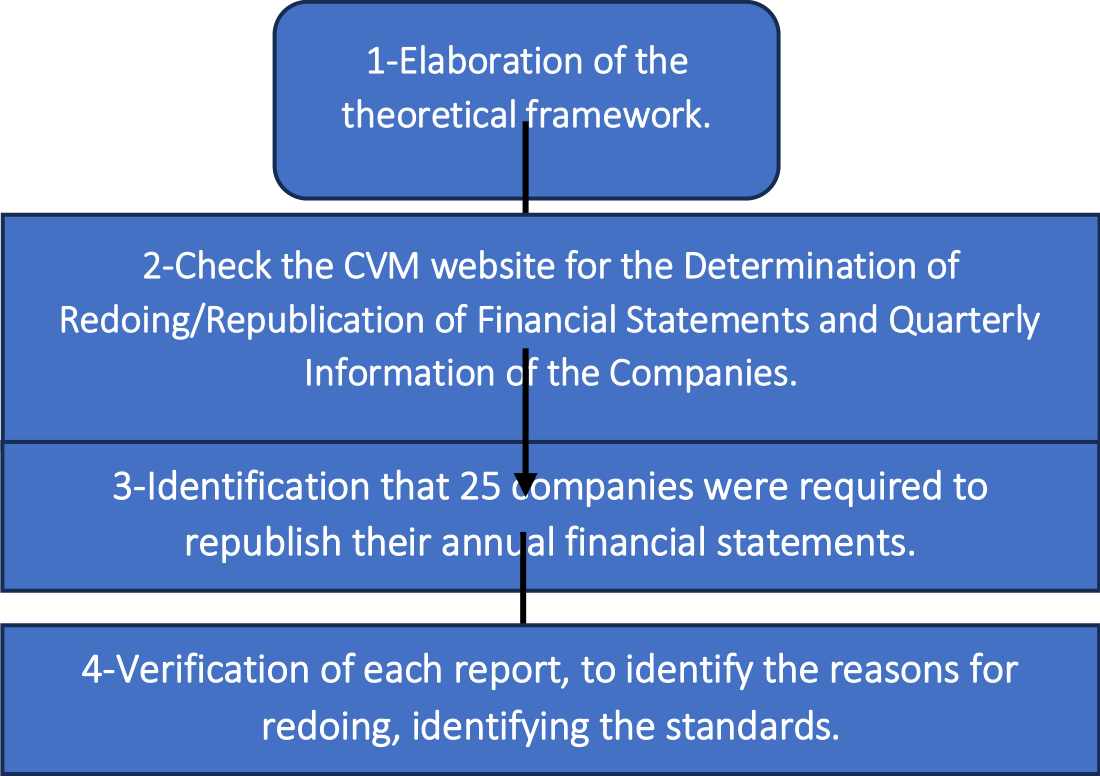
This study intends to address as a topic, the CVM's requirements in redoing financial statements for the period from 2009 to 2021, seeking to understand the main reasons that led the CVM to determine the republication of annual and quarterly statements of 25 companies inspected in this period. .
It is seen as a problem to be discussed in this study: what were the main reasons why the CVM requested the republication of financial statements in the period from 2009 to 2021? In this sense, the objective of this article is to identify the reasons why the CVM requested the republication of financial statements for the period from 2009 to 2021.
Therefore, this research allows companies and their audits to identify failures of professionals who prepare financial statements, which were not noticed by internal and external auditors. With this survey, it is possible for companies to improve their processes, in addition to carrying out training and policies that seek to streamline the practices required by the aforementioned standards. It helps educational institutions dedicated to undergraduate courses in Accounting Sciences to provide more evidence to the standards that are frequently violated when publishing financial statements.
2. Theoretical Framework
2.1 The Brazilian Business Market and the role of the CVM
Lopes et al. (2007) highlight that the capital market performs distinctive functions in terms of economic development, configuring itself as an immense source of permanent resources for the economy, as it is the connection between: agents with the capacity to save and those who need to borrow resources. However, for operations to be carried out in a safe and functional manner, the existence of a governmental body with the purpose of regulating and supervising the Stock Exchange becomes essential.
According to Carvalho (2014, in Sachett & Begnis, 2019), historically, the Central Bank of Brazil (BACEN) was the body responsible for regulating and supervising the capital market, but it was burdened with the segregation of functions due to the reform of the System. Financial, consequently, restrained its attention to the Stock Exchange and negotiations. Thus, in 1976, the Corporate Law was reformulated by Law No. 6,404, parallel to the creation of the CVM by Law No. 6,385/76. The ME clarifies that the CVM:
Its objective is to discipline, monitor and develop the securities market in Brazil. Its functions are related to companies, investment funds, public offerings, financial intermediaries, investors, external supervision, accounting and auditing standards, legal matters, market development, internationalization, information technology and administration. It is an autonomous entity, under a special regime, linked to the Ministry of Economy. It has its own legal personality and assets, endowed with independent administrative authority, absence of hierarchical subordination, fixed mandate and stability of its directors, and financial and budgetary autonomy.
According to Freire (2022), the CVM, despite being the main regulator of the Brazilian securities market segment, still lacks financial, technical and human resources to regulate the market in the best way, therefore, it uses other agents such as auxiliary bodies. This form of market self-regulation is based on Article 17 § 1, of Law No. 6,385 of 1976, as described in the articles:
Art. 17. Stock Exchanges, Commodities and Futures Exchanges, organized over-the-counter market entities and securities operations clearing and settlement entities will have administrative, financial and patrimonial autonomy, operating under the supervision of the Securities and Exchange Commission.
§ 1 Stock Exchanges, Commodities and Futures Exchanges, organized over-the-counter market entities and entities for the clearing and settlement of transactions with securities are responsible, as auxiliary bodies of the Securities and Exchange Commission, to supervise their respective members and operations with securities carried out therein.
Established by the CVM, in accordance with Article 1 of Law No. 6,385/76, the following are mandatory:
Art. 1 The following activities will be disciplined and supervised in accordance with this Law: I - The issuance and distribution of securities on the market; II - Negotiation and intermediation in the securities market; III - Negotiation and intermediation in the derivatives market; IV - The organization, functioning and operations of Stock Exchanges; V - The organization, functioning and operations of Commodities and Futures Exchanges; VI - Portfolio management and custody of securities; VII - Auditing of publicly-held companies; VIII - Securities consultant and analyst services.
In accordance with Article 8 of Law No. 6,385/76, which describes its competencies:
Art. 8 The Securities and Exchange Commission is responsible for: I - Regulate, in compliance with the policy defined by the National Monetary Council, the matters expressly provided for in this Law and in the law on joint stock companies; II - Manage the records established by this Law; III - permanently monitor the activities and services of the securities market, referred to in Article 1, as well as the dissemination of information relating to the market, the people who participate in it, and the values traded therein; IV - Propose to the National Monetary Council the eventual establishment of maximum price limits, commissions, fees and any other benefits charged by market intermediaries; V - Supervise and inspect publicly-held companies, giving priority to those that do not present a profit on the balance sheet or those that fail to pay the minimum mandatory dividend.
Correlated with Item III, of the aforementioned Article, the CVM is responsible for inspecting the financial statements and designating publicly traded and foreign companies to determine the redo and/or republication of financial statements and mandatory quarterly information.
When investigating the relevance and connection between the institutional environment and the economic system, Sachett and Begnis (2019), observed that the Brazilian capital market has a history of instability that shapes the development of the business market, being a system in constant transformation due to obstacles of institutions and which is subject to the interests of groups.
According to B3's 2022 Annual Report (2023), 475 corporations have high governance standards and are listed on the Stock Exchange. In this way, the CVM contributes to the role of ensuring that companies comply with accounting standards and are transparent to the market and potential investors.
In this sense, “Entrepreneurship” is associated with transformation movements with a significant impact on everyday life, as stated by Lima (2023), therefore when opening a new business, whether due to opportunity or necessity, it is essential to solve problems and carry out processes correctly using critical thinking. , in order to establish itself in the market, since the country is among the most bureaucratic, considering: the time it takes to open companies, the list of taxes that can lead to legal issues and the lack of human resources.
2.2 Relevance of financial statements
According to CVM Resolution No. 106 (2022), financial or accounting statements have the purpose of covering the informational needs of external users, that is, banks, suppliers, investors, individuals, government and among others, regarding the position patrimonial and financial, performance and cash flow, in order to be useful in making economic decisions, in addition to presenting the results of management's actions, given the resources that are under its responsibility.
According to the technical pronouncement of the Accounting Pronouncements Committee (CPC) 00 (R2) (2019c), financial reports do not provide all information, but only provide that information that helps users predict future cash flows, so they need obtain from other sources and analyze the scenarios in which companies find themselves, for example, general economic expectations and political events.
The analysis of financial statements is like a management support mechanism that is based on financial balance, profitability, growth, risk and value, therefore, it is necessary to adequately and reliably demonstrate assets, liabilities, net worth, income and expenses, changes
in equity with possible payments and the entity's cash flow in consensus with Brazilian accounting practices and international accounting standards validated by regulatory bodies (Sabino, 2022).
Regarding the relevance of financial reports, Guimarães & Rover (2022) understand that this can be discussed based on the relationship between the principles of “comparability” and “uniformity” in the company evaluation process. The terms are easily confused, however “uniformity” is a means to achieve “comparability” which, in turn, has a qualitative characteristic, because when operations are recorded in a continuous and consistent way they allow comparison between different entities (even if located in different jurisdictions) and/or between the same entity in different periods.
Based on Laws nº 6,404/76 and 4,595/64 and by Communiqué nº 14,259/2006, issued by the Central Bank, which reinforces the importance of quality, transparency, simplification and comparability of documents, Brazilian institutions listed on the stock exchange must present reports standardized following the BACEN Generally Accepted Accounting Principles (GAAP) and International Financial Reporting Standards (IFRS) models, adopted as a result of changes in the economic scenario and which are based, respectively, on rules and principles, as emphasized by Marques et. al. (2021).
Alves Júnior and Galdi (2020) show, according to Table 1, the mandatory and voluntary composition that companies internal and external agents must pay attention to in order to disclose information according to the required periodicity.
Table 1
Quarterly information (ITRs) vs. standardized financial statements (DFPs)
| Information disclosed | ITRs | DFPs |
| Balance sheet | Yes | Yes |
| Income statement | Yes | Yes |
| Statement of comprehensive income | Yes | Yes |
| Statement of changes in equity | Yes | Yes |
| Cash flow statement | Yes | Yes |
| Demonstration of added value | Yes | Yes |
| Independent auditors report with the MAMs* | No | Yes |
* MAMs = main audit matters
Source: Alves Júnior & Galdi (2020).
* MAMs = main audit matters
A fundamental characteristic for the publication of financial statements is “comparability”, as it allows greater transparency and security for investors. Proper preparation of standards and appropriate publication assist in this annual comparability of performance, as well as measuring the performance of competitors or companies in other sectors.
The comparability of financial information is one of the qualitative characteristics provided for in international standards, but studies have shown that this characteristic may be absent even between entities in the same segment or with the same type of asset, depending on the accounting choices allowed by accounting standards. accounting (Oliveira, Nakao & Rech, 2023).
Complementing the authors observations, by not following the standards, comparability and transparency are even more compromised or hindered.
Silva et. al. (2024) carried out a study with the objective of identifying the companies listed on B3 that republished their standardized financial statements in the year 2022, referring
to the year ending in 2021, and what are the biases relevant to the respective republications. 400 companies listed on B3 were analyzed. Of these, 53 companies in the financial and over- the-counter segments were excluded, leaving 347 companies; only 70 were considered for republishing their statements. The results demonstrate changes made to reports, opinions and explanatory notes, which were categorized as “changes in reports”. As for accounting changes, the result reveals changes in the insertion, deletion and replacement of information in it’s financial statements, including those in the category of other changes, justified by grammatical, spelling correction, adjustment and formatting of the document presentation.
2.3 The role of the Accountant and Auditor
In Brazil, on September 22, 1945, Decree-Law No. 7,988 sanctioned by the President of the Republic Getúlio Vargas came into force, which provides for higher education in Economic Sciences and Accounting and Actuarial Sciences, thus establishing graduation in the territory national. This fact contributed to historically marking “Accountant’s Day” (FEAAC, 2020).
A degree in Accounting Sciences provides professionals with several opportunities, Accounting is one of them (Anthony, 2019). In this area it is possible to work in accounting for a company, government agency and public or private institutions. The Brazilian Micro and Small Business Support Service (Sebrae) (2022) gives credibility to the importance of this qualification, as it empowers the student body to ensure the financial health of legal entities and individuals and, if they are accredited by the Regional Accounting Council (CRC), your options expand, with possible work in business management, audits, expertise, controllership and in any financial bodies. The role of the accountant has become indispensable to keep the company in compliance with the law, giving him the responsibilities of assisting in the opening of companies, accounting bookkeeping, ancillary obligations, labor consultancy, negative certificates and company closure.
Historically, the origin of Auditing came from the growth of large businesses in England and the need to ensure accounting records and results presented in the financial statements. From that moment on, in proportion to economic expansion and company progress, the auditing area developed (CRC-CE). The role of the auditor:
It aims to verify compliance with internal controls, procedures and rules established by the company, and whether documents, records and papers comply with established standards. The audit work that is carried out during the review and development will be formally reported, which must include the results of the application test, comments and suggestions to the auditor, with these facts being passed on to the responsible entity so that it can take the necessary measures and make changes (Coelho, 2023).
Auditing is classified in two ways: internal and external (independent), although similar, they have some different characteristics (Oda, 2021).
In an institution, in the internal audit area, there are employees focused on investigating internal standards: ensuring compliance with standards as planned, identifying opportunities for improvements in relation to applied internal standards, observing the essentiality of creating new internal standards, carrying out the audit based on accounting reports in operational departments and the largest volume of testing, that is, dedicating the greatest amount of time in the company to develop authoring activities (Sammour & Cintra, 2019).
Law No. 11,638/07 declares that large companies that had, in the previous fiscal year, total assets exceeding R$240 million or annual gross revenue exceeding R$300 million, are
obliged to provide their financial statements and these statements must be inspected by an independent auditor registered by the CVM.
It corresponds to the function of external auditing: analyzing the adequacy and veracity of a company's accounts, examining and certifying the integrity of the information; however, for this process to be carried out, technical methods are necessary, based on which the financial statements will be examined with the purpose of determining, recorded in an opinion, whether they are in compliance with Accounting Principles and Brazilian Accounting Standards (NCB). In this process, the company must not have links with experts, so that there is no interference with the results obtained (Reis, 2018).
Sousa Júnior & Cruz (2018) state that the purpose of the Audit is to systematically examine a company's books, accounts, receipts and other financial records. The objective, according to the authors, is to determine the integrity of the accounting internal control system for financial statements. It consists of a branch of Accounting and an important instrument in preventing and combating errors and fraud in organizations, with the function of reducing and even resolving the practice of these crimes.
Parreira, Nascimento & Murcia, (2020) highlight that companies listed on B3 are required, by law, to undergo regular audits and to publish their financial reports and complementary information. Therefore, audited financial statements constitute an important resource for good governance and transparency practices in modern business corporations. The authors also remember that, in order to reduce information asymmetry and improve these practices, the CVM established the need for audit rotation.
Brandão et. al. (2018), consider that the implementation of the rotation of independent auditors is intended to preserve the independence of the external auditor, as well as to reduce fraud and accounting errors in financial statements.
Ishigami, Portulhak, & Azevedo (2023) carried out research in order to identify the most recurring inconsistencies highlighted by independent audits of the financial statements of Brazilian Third Sector Organizations (OTS). During the investigation, 73 audit reports relating to the OTS Financial Statements were examined, of which 15 contained reservations. The most recurrent inconsistencies focused on aspects of reconciliation of accounting accounts, nonconformities in fixed assets, provisions made in error and errors in the presentation of financial statements.
Simões et. al. (2021) carried out research on the possible benefits of using Blockchain technology as an instrument for accounting auditing. According to the authors, literature findings show that, despite the complexities, Blockchain technology offers an opportunity to improve financial reporting and auditing processes.
In short, according to Sofia (2022), Accounting is based on order, while auditing is based on analysis.
3. Methodology
Figure 1 – Steps for preparing the research
Source: Prepared by the authors.
The initial period of this study is linked to Law No. 11,638/07, which provides for the harmonization of accounting standards in force since 2008 in Brazil, complemented by Law No. 11,941 enacted in 2009.
The 25 companies that, as determined by the CVM, were required to republish their annual and quarterly financial statements for the period from 2009 to 2021 were identified; with the exception of the years 2015 and 2019, which were disregarded because there were no requests in the database. In 2012 there was only one letter with two companies, which for this research was only counted as one company. In 2016, one of the letters refers to a resource, also considered in the study, totaling 26 letters analyzed. In the data collection, there was a divergence in the year of publication of Standard nº 247/96, however, for this study, the year in which the guideline came into force is accepted.
Therefore, the research covered all companies that appeared on the list of companies that obtained a determination to redo and/or republish financial statements and mandatory quarterly information from the CVM (2023). Before and after the period, until 2023, there are no companies that were required to republish their annual financial statements.
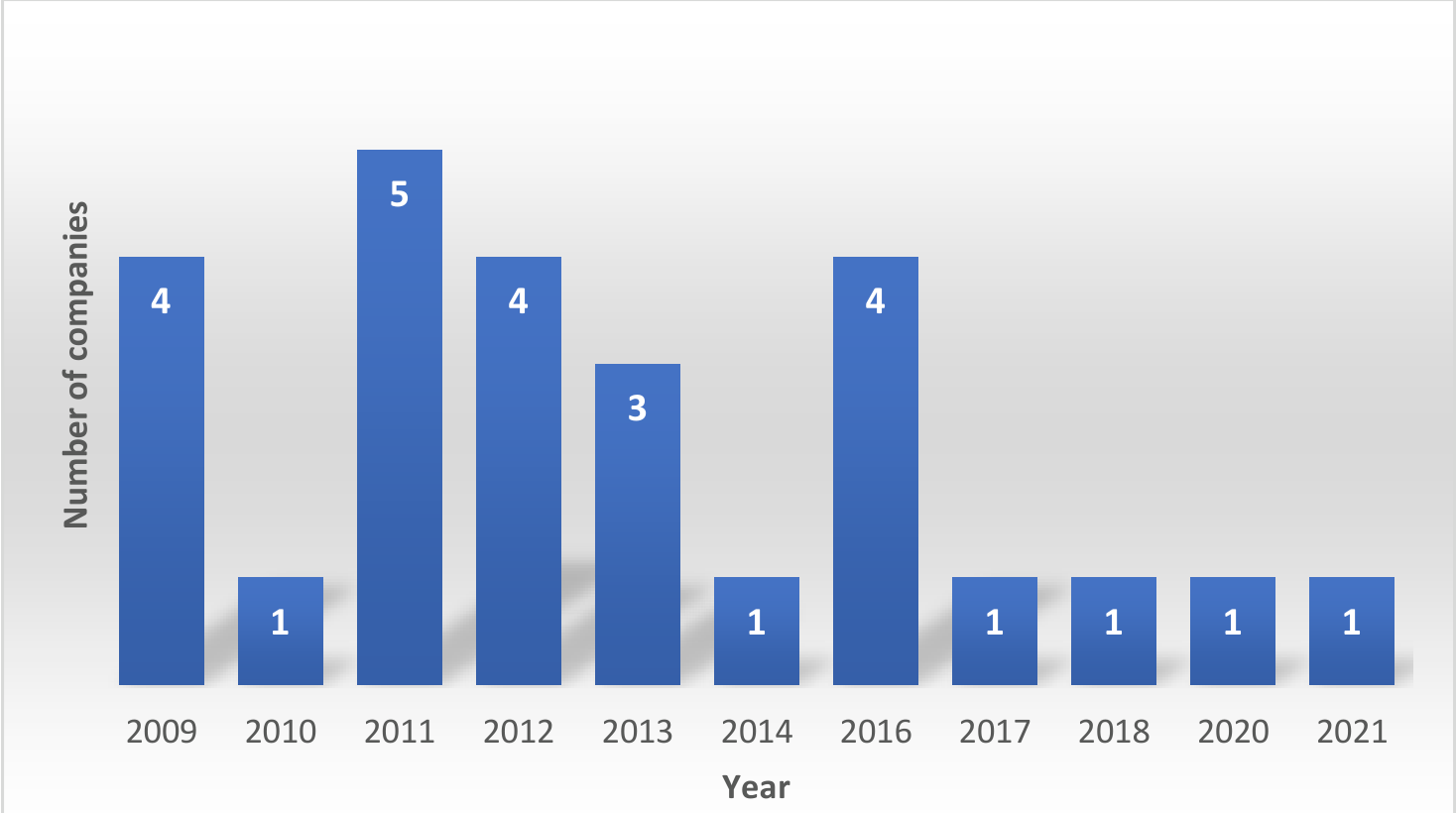
Table 2 and Figure 2 present the annual number of companies that obtained the aforementioned determination:
Table 2
Determination of Redo - Republication of Financial Statements and Quarterly Information in the years 2009 to 2021
| Year | Number of companies |
| 2009 | 4 |
| 2010 | 1 |
| 2011 | 5 |
| 2012 | 4 |
| 2013 | 3 |
| 2014 | 1 |
| 2016 | 4 |
| 2017 | 1 |
| 2018 | 1 |
| 2020 | 1 |
| 2021 | 1 |
Source: Prepared by the authors. Dados: CVM, 2023.
Figure 2: Determination of Redo - Republication of DFs and ITRs in the years 2009 to 2021
Source: Prepared by the authors. Dados: CVM, 2023.
Therefore, it is considered that, in each period, the number of letters illustrated in Table 2 were issued. From the letters made available, all the aforementioned standards and codes were gathered, including the CVM Deliberations and Instructions, the Pronouncements (CPC), Interpretations (ICPC) and Guidelines from the Accounting Pronouncements Committee (OCPC) and Pronouncements from the Brazilian Independent Audit Institute (Ibracon) and identified the main reasons for the redo request.
The analysis was preceded by the exclusion of CVM Instructions nº 452/07 (revoked) and nº 608/19 (revoked) and CVM deliberations nº 463/03 (revoked) and nº 481/05 (revoked), as they refer to the application fine for non-compliance with requirements and the possibility of filing an appeal with the Superintendency of Business Relations (SEP). From this, the organization of the data and the demonstration in Tables and Figures were carried out in order to contribute to the best presentation of the results.
This study is based on qualitative content analysis, based on Bardin's methodology (1977), whose process is defined through the stages: pre-analysis, exploration of the material, treatment of results and interpretation.
4. Results and discussions
The CVM, as a regulatory body, may require the redoing and republication of reports presented by companies when they are not approved by the General Assembly or at any time they wish to make corrections or additions.
Albuquerque and Garcia (2019) carried out research on the topic, as they analyzed the remake and republication letters issued by the CVM and the results indicated that the cyclical consumption sectors, followed by non-cyclical consumption and industrial goods had a higher incidence of remake and resubmission. Therefore, the data collection carried out in the letters made available by the CVM revealed the mention, mainly, of CPCs, as shown in Table 3. The second largest mention in the letters is of CVM Deliberations, whose content deals with both the approval of the CPCs themselves and the summary of the board's decision on matters within its competence.
It is observed that 51% of the requirements to redo were due to CPCs, 29% were due to non-compliance with CVM deliberations and 10% due to CVM Instructions.
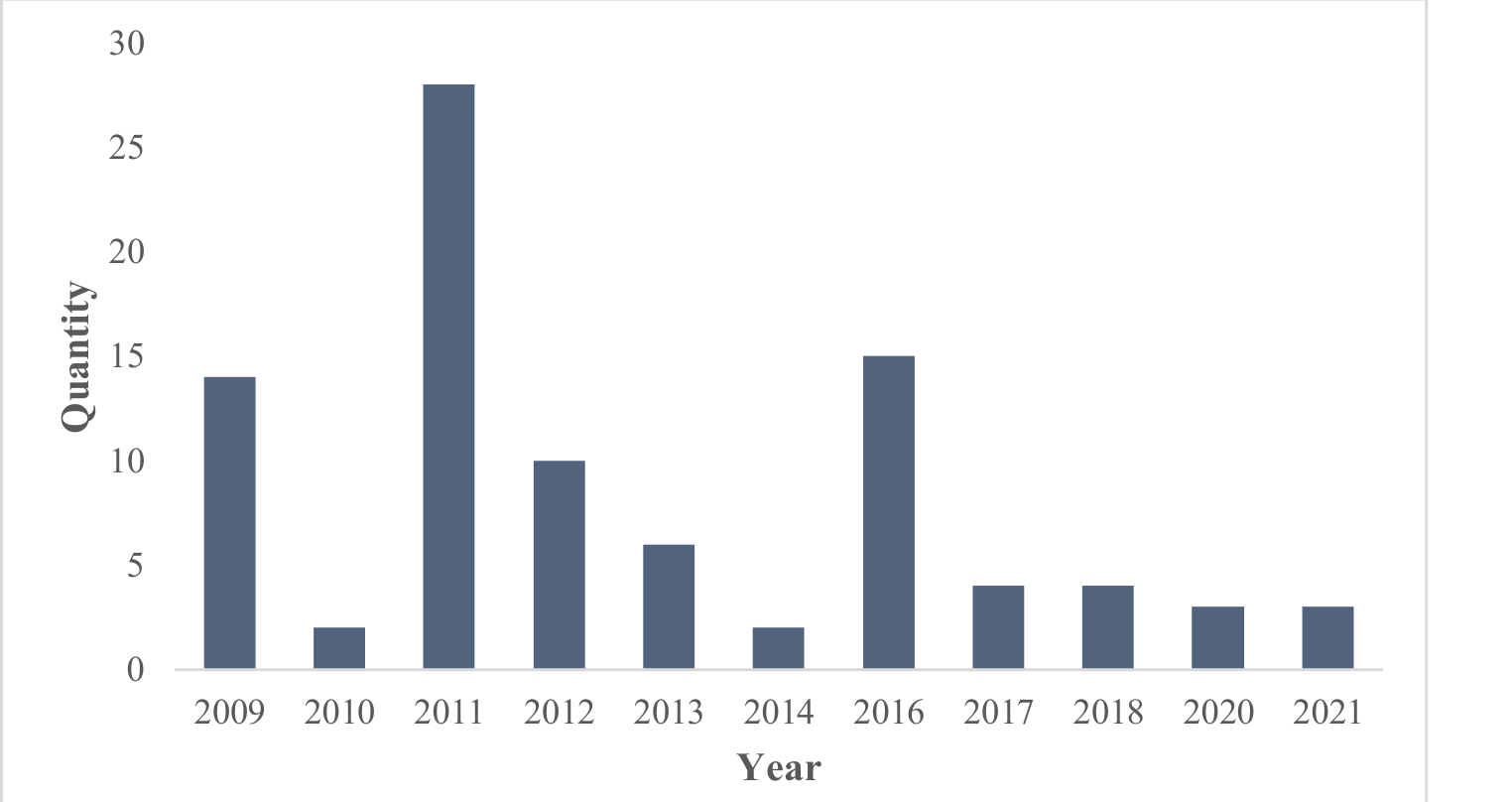
Table 4 and Figure 3 list the 91 notes, made during the period of this study, to be corrected or added. According to the CVM, the year 2011 (31%) has the highest number of divergences in relation to the standards of accounting standards, despite the significant number, these 28 irregularities may or may not be repeated in this year's letters and from different companies . The years 2009 and 2012 had 14 (15%) and 10 (11%) notes, respectively. The years 2010 and 2014 presented the lowest number of deviations, both with 2, but they were also the years with the least publication of letters, as shown in Table 2.
Table 3
Type of standards mentioned in the letters
| Standards | Amount | % |
| CPC | 25 | 51% |
| Deliberation CVM | 14 | 29% |
| Instruction CVM | 5 | 10% |
| Interpretation CPC | 3 | 6% |
| Orientation CPC | 1 | 2% |
| IBRACON | 1 | 2% |
| Total | 49 | 100% |
Source: Prepared by the authors. Data: CVM, 2023
Table 4
Number of standards appointed per year
| Year | Quantity | % |
| 2009 | 14 | 15% |
| 2010 | 2 | 2% |
| 2011 | 28 | 31% |
| 2012 | 10 | 11% |
| 2013 | 6 | 7% |
| 2014 | 2 | 2% |
| 2016 | 15 | 16% |
| 2017 | 4 | 4% |
| 2018 | 4 | 4% |
| 2020 | 3 | 3% |
| 2021 | 3 | 3% |
| Total | 91 | 100% |
Source: Prepared by the authors. Dados: CVM, 2023.
Figure 3: Number of standards indicated per year
Source: Prepared by the authors. Data: CVM, 2023.
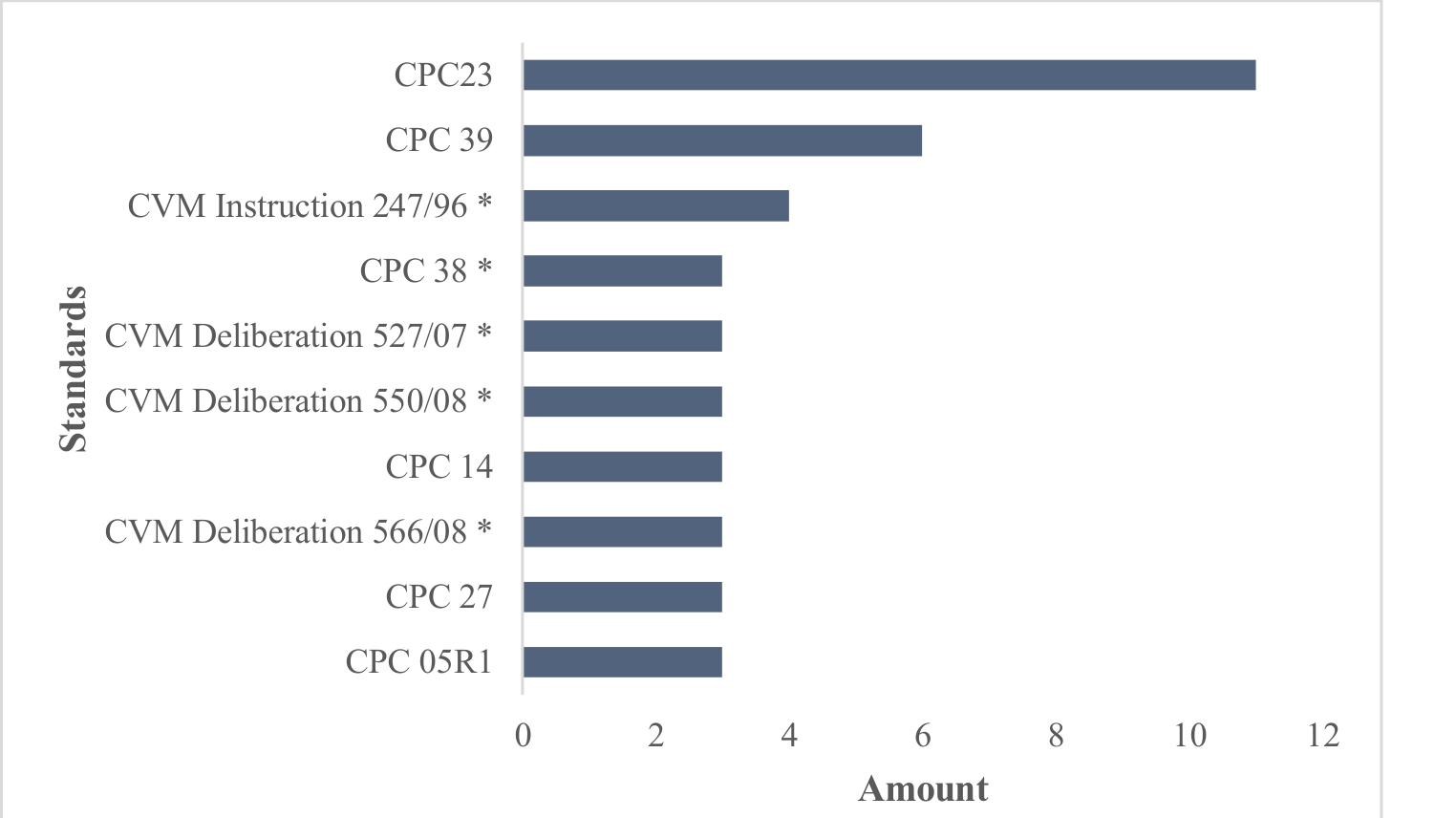
According to Table 5 and Figure 4, among the 10 most cited standards in the study period, CPC 23 stands out, with 11 (12%) citations and CPC 39, with 6 (6.5%), titled, respectively, such as “Accounting policies, estimate changes and error rectification” and “Financial instruments: presentation” and CVM Instruction 247/96.
Table 5
The 10 most cited standards in the period studied
| Standards | Amount |
| CPC 23 | 11 |
| CPC 39 | 6 |
| CVM Instruction 247/96 * | 4 |
| CPC 05R1 | 3 |
| CPC 27 | 3 |
| CVM Deliberation 566/08 * | 3 |
| CPC 14 * | 3 |
| CVM Deliberation 550/08 * | 3 |
| CVM Deliberation 527/07 * | 3 |
| CPC 38 * | 3 |
* Revoked standard.
Source: Prepared by the authors. Data: CVM, 2023.
Figure 4: The 10 most cited standards in the period studied
Source: Prepared by the authors. Data: CVM, 2023.
When analyzing, individually, the CPCs most cited in Tables 6 and 7, it is clear that CPC 23 is mentioned in 11 companies. This statement details how rectifications and disclosures of errors from previous periods should occur in items 42 and 49 contained in the official notes. Regarding CPC 39, mentioned in 6 companies, it is understood that, among the infractions, there is a repetition of items 11, 16 and 17 which discuss the classification of financial and
equity instruments, financial assets, financial liabilities, fair value and instrument with a put
Table 6
Occurrence of CPC 23 per year
| Year | Amount |
| 2012 | 1 |
| 2013 | 2 |
| 2014 | 1 |
| 2016 | 3 |
| 2017 | 1 |
| 2018 | 1 |
| 2020 | 1 |
| 2021 | 1 |
| Grand total | 11 |
Source: Prepared by the authors. Data: CVM, 2023.
Table 7
Occurrence of CPC 39 per year
| Year | Amount |
| 2011 | 1 |
| 2012 | 2 |
| 2013 | 2 |
| 2021 | 1 |
| Grand total | 6 |
Source: Prepared by the authors. Data: CVM, 2023.
Source: Prepared by the authors. Data: CVM, 2023.
CVM Instruction 247/96, expressed in Table 8, breaks down its guidelines into articles that are not repeated when mentioned in the letters of 4 companies; however, it generally addresses issues related to the preparation and disclosure of consolidated financial statements and the evaluation of investments in associated and controlled companies, so that Fundamental
Table 8
Occurrence of CVM instr. 247/96
| Year | Amount |
| 2009 | 1 |
| 2010 | 1 |
| 2011 | 2 |
| Grand total | 4 |
Source: Prepared by the authors. Data: CVM, 2023.
It is concluded, therefore, that the redactions of the financial statements were required because they did not follow the regulations and requirements of regulatory bodies and were in disagreement with the Conceptual Framework for Financial Reporting.
Final Considerations
As you can see, among the 10 most cited standards during the study period, CPC 23 and 39 stands out, entitled, respectively, as “Accounting policies, changes in estimates and error rectification” and “Financial instruments: presentation” and CVM Instruction 247/96. The first aims to define the criteria for the selection and change of accounting policies and error rectification, in addition to improving the relevance and reliability of the statements, in order to allow comparability. The second determines the assumptions for presenting financial instruments as liabilities or equity and for offsetting financial assets and financial liabilities. The third most mentioned standard coordinates the analysis of investments in associated and controlled companies and the procedures for preparing and disclosing consolidated financial statements.
Therefore, the main reasons for redoing financial statements by companies refer to the rectification of previous errors to increase the reliability of information to the capital market and allow comparability in different periods of the same organization and between other companies, classification of financial instruments up to the its presentation and measurement of investments by associated and controlled companies.
When considering the number of existing corporations with high governance standards and which are listed on the Stock Exchange, it is understood that the number of redo requests by the CVM is not a significant number, as only 25 companies were determined to resubmit its financial statements with the necessary corrections and additions for the period from 2009 to 2021, in addition to showing that the errors of the same company are not repeated over the years, showing the effectiveness of the regulatory body.
It is necessary for the professional accountant and auditor to have knowledge of the nomenclatures so that data can be classified and presented appropriately in the financial statements, thus avoiding new notifications and rework. If necessary, this professional must use his technical competence to file an appeal if there were no errors identified, as long as they are based on accounting standards.
It can be seen that the results of the collections carried out indicate that the topic addressed is of significant complexity, as it demonstrated the need for greater attention and study of these standards to prepare the statements.
The research was limited to observing the aforementioned standards and offers, as a suggestion for future research, the identification of possible solutions to avoid redoing, with a special analysis of the origin of this problem: need for training or other causes.
References Albuquerque. D. F. & Garcia, I. D. (2019). Análise dos ofícios de refazimento e republicação
emitidos pela CVM. Revista Cosmos Acadêmico (ISSN 2595-0304), vol. 4, nº 2 – Agosto a Dezembro. https://multivix.edu.br/wp-content/uploads/2021/06/revista- cosmos-academico-v04-n02-artigo02.pdf Alves Júnior, E. D., & Galdi, F. C. (2020). Relevância informacional dos principais assuntos
de auditoria. Revista Contabilidade & Finanças, 31 (82), 67-83. https://doi.org/10.1590/1808-057x201908910 Anthony, I. (2019). O que é preciso para se tornar um contador? Portal Educa + Brasil.
https://www.educamaisbrasil.com.br/cursos-e-faculdades/ciencias-contabeis/ noticias/o-que-e-preciso-para-se-tornar-um-contador.
B3 Bora Investir. (2022). Ibovespa B3: como é calculado e o que significa o principal indicador
do mercado. Portal B3 Bora Investir. https://borainvestir.b3.com.br/noticias /ibovespa-b3-como-e-calculado-e-o-que-significa-o-principal-indicador-do-mercado/ B3 - Brasil, Bolsa, Balcão. (2023). B3 divulga Relatório Anual 2022. https://www.b3.com.br/pt_br/noticias/b3-divulga-relatorio-anual-2022.htm Bardin, L. (1977). Análise de conteúdo (Reto, A.L., Pinheiro, A, Trad.) . Edições 70, 9-225.
https://edisciplinas.usp.br/pluginfile.php/7684991/mod_resource/content/1/BARDlN_ _L._1977._Analise_de_conteudo._Lisboa__edicoes__70__225.20191102-5693- 11evk0e-with-cover-page-v2.pdf Brandão, M. R. S., Resende, L. L., & Machado, L. K. C. (2018). O rodízio de auditores
independentes e o gerenciamento de resultados em instituições bancárias: uma análise Econométrica de 1997 a 2013. Revista Brasileira de Contabilidade, 12-23. Coelho, R. P. (2023). Auditoria conceito e objetivo. Linkedin. https://pt.linkedin.com/pulse/auditoria-interna-e-externa-rafael-paulo-coelho Comitê de Pronunciamento Contábeis (CPC). (2009a). Pronunciamento técnico CPC 23..
Políticas contábeis, mudança de estimativa e retificação de erro. Comitê de pronunciamentos contábeis. https://www.cpc.org.br/CPC/Documentos- Emitidos/Pronunciamentos/Pronunciamento?Id=54 Comitê de Pronunciamento Contábeis (CPC) . (2009b). Pronunciamento técnico CPC 39 –
Instrumentos Financeiros: Apresentação. Comitê de Pronunciamentos Contábeis. https://www.cpc.org.br/CPC/Documentos- Emitidos/Pronunciamentos/Pronunciamento?Id=70 Comitê de Pronunciamento Contábeis (CPC). (2019c). CPC 00 (R2)- - Estrutura Conceitual
Para Relatório Financeiro. Comitê de pronunciamentos contábeis. https://www.cpc.org.br/CPC/Documentos- Emitidos/Pronunciamentos/Pronunciamento?Id=80 Comitê Regional do Conselho de Contabilidade deo Ceará (CRC-CE). (n.d.). Auditoria
Contábil. Portal do Conselho Regional de Contabilidade do Ceará. https://www.crc- ce.org.br/fiscalizacao/informacoes-importantes/ auditoria-contabil/ Comissão de Valores Mobiliários (CVM) (n.d.). O que é a CVM? Portal gov.br.
https://www.gov.br/cvm/pt-br/acesso-a-informacao-cvm/servidores/estagio/2-materia- cvm-e-o-mercado-de-capitais Comissão de Valores Mobiliários (CVM). (2023). Determinação de Refazimento/Republicação
de Demonstrações Financeiras e Informações Trimestrais das Companhias. Portal gov.br https://conteudo.cvm.gov.br/menu/regulados/companhias/consultas/refazimento/index. html Exame. (2022). O que é Ibovespa? Conheça o índice da B3. Exame. https://exame.com/invest/guia/o-que-e-ibovespa-2/ FEAAC - Faculdade de Economia, Administração, Atuária e Contabilidade. (2020). 22 de
setembro – Dia do Contador. Portal da UFC. https://feaac.ufc.br/pt/22-de-setembro- dia-do-contador-2/ Freire, L. A. (2022). O Modelo Brasileiro de Autorregulação do Mercado de Valores
Mobiliários. Revista da Procuradoria-Geral do Banco Central, 15(2), 157-174. https://doi.org/10.58766/rpgbcb.v15i2.1135
Guimarães, E. F., & Rover, S. (2022, 5 de Maio). Uniformidade e comparabilidade: uma análise
da relevância para o mercado de capitais brasileiro. Revista Contabilidade & Finanças, 3 (89), 265-280. https://doi.org/10.1590/1808-057x202112890 Instrução CVM nº 247, de 27 de março de 1996 (1996). Dispõe sobre a avaliação de
investimentos em sociedades coligadas e controladas e sobre os procedimentos para elaboração e divulgação das demonstrações contábeis consolidadas, para o pleno atendimento aos Princípios Fundamentais de Contabilidade, altera e consolida as Instruções CVM nº 01, de 27 de abril de 1978, nº 15, de 03 de novembro de 1980, nº 30, de 17 de janeiro de 1984, e o artigo 2º da Instrução CVM nº 170, de 03 de janeiro de 1992, e dá outras providências. https://conteudo.cvm.gov.br/export/sites/cvm/legislacao/instrucoes/anexos/200/inst247 consolid.pdf Inteligência Financeira. (2022). Você sabe o que é o Ibovespa e sua importância no mercado de
capitais? Portal G1. https://g1.globo.com/economia/especial-publicitario/inteligencia- financeira/noticia/2022/06/23/voce-sabe-o-que-e-o-ibovespa-e-sua-importancia-no- mercado-de-capitais.ghtml Ishigami, R. T., Portulhak, H., & Azevedo, S. U. de. (2023). Inconsistências mais recorrentes
apontadas por auditorias independentes às demonstrações financeiras de organizações brasileiras do terceiro setor do ano de 2018. Revista Científica Hermes, 34(1), 190–213. https://doi.org/10.21710/rch.v34i1.682 Lei nº 6.385, de 7 de dezembro de 1976. (1976). Dispõe sobre o mercado de valores mobiliários
e cria a Comissão de Valores Mobiliários. https://www.planalto.gov.br/ccivil_03/leis/L6385compilada.htm Lei nº 7.988, de 22 de setembro de 1945. (1945). Dispõe sôbre o ensino superior de ciências
econômicas e de ciências contábeis e atuariais. http://www.planalto.gov.br/ccivil_03/decreto-lei/1937-1946/Del7988.htm Lei nº 11.638, de 28 de dezembro de 2007. (2007). Altera e revoga dispositivos da Lei nº 6.404,
de 15 de dezembro de 1976, e da Lei no 6.385, de 7 de dezembro de 1976, e estende às sociedades de grande porte disposições relativas à elaboração e divulgação de demonstrações financeiras. https://www.planalto.gov.br/ccivil_03/_ato2007- 2010/2007/lei/l11638.htm Lei nº 11.941, de 27 de maio de 2009. (2009). Altera a legislação tributária federal relativa ao
parcelamento ordinário de débitos tributários; concede remissão nos casos em que especifica; institui regime tributário de transição. https://www.planalto.gov.br/ccivil_03/_ato2007-2010/2009/lei/l11941.htm Lima, B. B. de. (2023, 9 de Fevereiro). Empreendedorismo no Brasil: entenda o cenário atual!
Comunidade SEBRAE. https://sebraepr.com.br/comunidade/artigo/empreendedorismo-no-brasil Lopes, C. F. L. R., Antunes, L. P., & Cardoso, M. A. S. (2007). Financiamento de longo prazo:
mercado de debêntures e programa de emissão da BNDESPAR. Revista do BNDES, 14 (27), 43-70. http://web.bndes.gov.br/bib/jspui/handle/1408/13438 Marques, M. T., Dalmacio, F. Z., & Rezende, A. J. (2021). IFRS X Bacen Gaap: Value
Relevance das Informações Contábeis das Instituições Financeiras do Brasil. Brazilian Business Review, (19), 1-18. https://doi.org/10.15728/bbr.2022.19.1.1 Ministério da Fazenda. (2023). Sobre a CVM. Portal gov.br. e https://www.gov.br/cvm/pt-
br/acesso-a-informacao-cvm/institucional/sobre-a-cvm Oda, G. (2021). Auditoria interna e externa: o que é cada uma? Quais as diferenças? Afixcode.
https://www.afixcode.com.br/blog/auditoria-interna-extern
Oliveira, D. de L., Hiroshi Nakao, S., & José Rech , I. (2023). Comparabilidade das informações
em IFRS: : uma análise cross-country de ativos florestais. Contabilidade Vista & Revista, 34(1), 123–160. https://doi.org/10.22561/cvr.v34i1.7563 Parreira, M. T. S., Nascimento, E. M., Puppin, L., & Murcia, F. D. R. (2020). Rodízio de
auditoria independente e gerenciamento de resultados: uma investigação entre empresas de capital aberto no Brasil. Enfoque: Reflexão Contábil, 40(1), 67-86. https://doi.org/10.4025/enfoque.v40i1.44318 Redação XP Educação. (2022). Ibovespa: o que é e como é composto o mais importante índice
da bolsa? XP Educação. https://blog.xpeducacao.com.br/ibovespa-o-que-e/ Reis, T. (2018). Auditoria externa: a análise independente das contas de uma empresa. SUNO
ARTIGOS. https://www.suno.com.br/artigos/auditoria-externa/ Resolução CVM nº 106, de 20 de maio de 2022. (2022). Aprova a Consolidação do
Pronunciamento Técnico CPC 26(R1) do Comitê de Pronunciamentos Contábeis – CPC, que trata da Apresentação das Demonstrações Contábeis. https://conteudo.cvm.gov.br/export/sites/cvm/legislacao/resolucoes/anexos/100/resol1 06.pdf Rocha, B. (2023). O que é o Ibovespa? Estadão E-Investidor - As principais notícias do
mercado financeiro. https://einvestidor.estadao.com.br/mercado/o-que-e-ibovespa/ Sabino, N. (2022). A Importância das Demonstrações Financeiras. Linkedin. https://www.linkedin.com/pulse/import%C3%A2ncia-das- demonstra%C3%A7%C3%B5es-financeiras-ndjizas- sabino/?utm_source=share&utm_medium=member_android&utm_campaign=share_v ia Sachett, A. I., & Begnis, H. S. M. (2019). Regulação do Mercado de Capitais e
Desenvolvimento Empresarial no Brasil. Desenvolvimento em Questão, 17 (47), 81- 101. https://doi.org/10.21527/2237-6453.2019.47.81-101 Sammour, J. R., & Cintra, D. G. B. (2019). Auditoria externa x interna: Funções e Diferenças.
Revista De Estudos Interdisciplinares do Vale do Araguaia - REIVA, 2(2), 1-14. http://reiva.unifaj.edu.br/reiva/article/view/85 Sebrae. (2022). Conheça mais sobre o papel do contador. Portal Sebrae. https://sebrae.com.br/sites/PortalSebrae/ufs/ms/sebraeaz/conheca-mais-sobre-o-papel- do-contador,e37028bd1363e710VgnVCM100000d701210aRCRD Silva, O. L. S., Cescon, J. A., Lima, N. C., & Lopes, J. C. de S. (2024). Republicação das
Demonstrações Financeiras das Empresas Listadas na B3. Revista Multifaces, vol. 6, n. 1, p. 76-86. https://doi.org/10.29327/2169333.6.1-10 Simões, M. P. A., Cavalcanti, J.A.A., Melo, J. M.M., & Reis, C. Q.(2021). Benefícios do uso
da tecnologia Blockchain como instrumento para a auditoria contábil. Revista Ambiente Contábil - Universidade Federal Do Rio Grande Do Norte - ISSN 2176-9036, 13(1), 39 -53. https://doi.org/10.21680/2176-9036.2021v13n1ID19535 Sofia, A. (2022). Qual a diferença entre contabilidade e auditoria. Wondershare.
https://pdf.wondershare.com.br/accounting/auditing- accounting.html#:~:text=A%20contabilidade%20baseia%2Dse%20na,acordo%20com %20uma%20ordem%20particular Sousa Júnior, A. B., & Cruz, C.F. (2018). Atividade de auditoria contábil: um enfoque teórico
de sua aplicação em empresas. Entrepreneurship. v. 2, n. 2. https://doi.org/10.6008/CBPC2595-4318.2018.002.0001
i Graduada em Tecnologia de Gestão Financeira pela Faculdade de Tecnologia Prefeito Hirant Sanazar (Fatec Osasco), São Paulo, Brasil.
ii Graduada em Tecnologia de Gestão Financeira pela Faculdade de Tecnologia Prefeito Hirant Sanazar (Fatec Osasco), São Paulo, Brasil.
iii Graduada em Tecnologia de Gestão Financeira na Faculdade de Tecnologia Prefeito Hirant Sanazar (Fatec Osasco), São Paulo, Brasil
iv Pós-doutorado em Ciências Contábeis e Doutor em Ciências Sociais pela Pontifícia Universidade Católica de São Paulo (PUC/SP).