
The New Careers in Public Companies in the
Context of Technological Advancement
As Novas Carreiras em Empresas Públicas
num Contexto de Avanços Tecnológicos
Elza Fátima Rosa Veloso1*, Orcid: https://orcid.org/0000-0002-9494-2108; Daielly Melina Nassif Mantovani2, Orcid: https://orcid.org/0000-0001-6320-3268; Tiago Luciano Alves3, Orcid: https://orcid.org/0000-0001-6208-5706; Leonardo Nelmi Trevisan4, Orcid: https://orcid.org/0000-0002-0914-3679.
1. Faculdade FIA de Administração e Negócios, São Paulo, SP, Brasil
2. Pontifícia Universidade Católica de São Paulo, São Paulo, SP, Brasil
3. Faculdades Metropolitanas Unidas, São Paulo, SP, Brasil
4. Pontifícia Universidade Católica de São Paulo, São Paulo, SP, Brasil
*Autor correspondente: elzav@fia.com.br; Av. Dra. Ruth Cardoso, 7221 - Pinheiros, São Paulo - SP, Brasil, 05425-902.
Abstract
The study aimed to test the application of non-traditional career theories in a context of apparent job stability, but one that involves high technological advances that causes continuous downsizing. The methodological choice was a quantitative investigation, with an exploratory character and a descriptive approach, applied as a survey to 6,405 employees. The results revealed that respondents manage their careers accordingly to the boundaryless career and protean career concepts, which present patterns of flexibility and independence from the organization. They virtually disregard the threat that the technological advances will have upon their work, resulting in the replacement of their work by machines. The study shows that non-traditional theories are also applicable to this type of context.
Keywords: career in public companies; technological advances; new careers; boundaryless career; protean career.
Resumo
O estudo visou testar a aplicação de teorias de carreira não-tradicionais em um contexto de estabilidade aparente no emprego, mas com altos avanços tecnológicos e reduções constantes de pessoal. A escolha metodológica foi uma investigação quantitativa, com caráter exploratório e abordagem descritiva, aplicada como pesquisa a 6.405 funcionários. Os resultados revelaram que os respondentes gerenciam suas carreiras de acordo com os conceitos de carreira sem fronteiras e carreira proteana, que apresentam padrões de flexibilidade e independência da organização. Eles praticamente ignoram a ameaça que os avanços tecnológicos terão sobre seu trabalho, resultando na substituição de seu trabalho por máquinas. O estudo mostra que teorias não-tradicionais também são aplicáveis a esse tipo de contexto.
Palavras-chave: carreira em empresas públicas; avanços tecnológicos; novas carreiras; carreira sem fronteiras; carreira proteana.
Citação: Veloso, E. F. R., et al. (2024). The New Careers in Public Companies in the Context of Technological Advancement. Gestão & Regionalidade, v. 41, e20258951. https//doi.org/10.13037/gr.vol41.e20258951
1 Introduction
Nowadays, online businesses threaten the survival of traditional jobs and spare virtually no sector of the global economic activity. Therefore, there is no longer any doubt about the possibility of replacing people with technology (Trevisan, Veloso, Silva, & Dutra, 2016). At the same time, Barley, Bechky and Milliken (2017) emphasized the concerns of technologists and economists who raised questions about the effects of artificial intelligence on the nature of work and the availability and opportunities for employment.
On the other hand, around the world, the public sector is stigmatized for its alleged inefficiency, and this translates into the view that employees in these companies do not proactively manage their careers. An example of this worldwide stigma can be noted in the observation of Giannechini and Bagdadli (2023), that, in Italy, the large public sector is characterized by poor efficiency, bureaucracy, non-meritocratic policies, and a high rate of absenteeism. Despite this view, technology is also relentless with careers in the public sector.
Both in the public and private sectors, it is essential that people assume the self-management of their career, which involves the search for qualification, maintaining employability and also seeking satisfaction and professional fulfillment (Anderson, Veloso, Trevisan & Stefani, 2021). By the predictions of career changes associated with the rise of new digital waves of technology and gradual replacement of human labor by technological resources (Trevisan et al., 2016), it is possible to suppose that even people who work in companies that are socially regarded as providing stable jobs are concerned about the future of their careers. An example of this is companies that are Mixed Economy Societies, which in Brazil are part of the indirect public administration.
In the current scenario, there is a government concern regarding the use of information and communication technologies for accessing public services, reflected in recent studies that address the access to "e-Government" services (Araujo, Reinhard, & Cunha, 2018; Przeybilovicz, Cunha, & Meirelles, 2018). In the case of the public company under analysis in this study, it is a Brazilian Mixed Economy Society with local and international operations, belonging to the banking sector, with large participation in the financial market and high application of technology, typical of this sector. In this article, employees of this institution were addressed by means of a quantitative survey. The aim of the study was testing the application of non-traditional career theories in a context of apparent job stability, but one that involves high technological advance that causes continuous downsizing.
According to Veloso and Dutra (2011), Mixed Economy Societies retain characteristics of stability of the functional staff and resignations are usually motivated by gross misconduct or due to the will of the resigners, favoring the planning of professional life linked to the organization. Stillman (2017) stated that, both in developed and developing countries, public service professionals are highly contributive, but there are important gaps in their training. These gaps occur, according to this author, mainly due to their perspective about the future, even in the current era, when the arrival of big data, which demands the gathering, understanding, and analyzing a large amount of data, presents an enormous influence about the decisions.
Regarding the career, Klein and Mascarenhas (2016) explained that the probability of satisfaction with the public career depends on extrinsic factors, linked to salary, but mainly on intrinsic factors, related to the nature of the job, such as the relevance of the activities performed and their compatibility with the job description. Another factor that affects the career of civil servants refers to the reputation of these companies, since the general population usually knows them. According to Overman, Busuioc and Wood (2020), reputation is very important for the study of public companies and refers to the external image of the organization.
The association of professional satisfaction with the job post, also described by Klein and Mascarenhas (2016), refers to a time when the career was strongly associated and, in most cases, dependent on working in organizations. However, career theory shows that such association has lost strength in the face of the new careers.
2 Theoretical Framework
Career study is not simple at all. While it affects everyone in the world of work and are made up of identifiable and interconnected parts, these parts are not easily understood (Mayrhofer, Briscoe,, Dickmann, Hall & Parry, 2023). That is why career studies must be surrounded by theoretical precautions. That way, in this session, theories, and thoughts useful for the research work and the study hypotheses are presented.
2.1 The New Careers
In their proposal for new careers, Arthur, Inkson and Pringle (1999) addressed the evolution of traditional to non-traditional theories. These authors explained that traditional theories recognize the connection between career and personal fulfillment, encompassing the Vocational Counseling Approach and that of Human Resources, in addition to Development Theories. The major criticism of this traditional view is that subjective meanings of career and the effect of experienced episodes, or even the environment in which the career takes place, are disregarded. These theories are adherent to the organizational or traditional career, the one designed to consider a single employment scenario (Hall, 1996; Veloso, 2012; Veloso, Trevisan, Silva, & Dutra, 2018). Oliveira and Gomes (2014) stated that traditional career is still found in Brazilian companies, in contrast to modern career concepts, prevailing in contests, recruitment, and internal competition as a way to promote the professional, linking the measure of success to the vertical form of progression and climbing of the hierarchical pyramid.
In contrast to traditional theories, Arthur et al. (1999) acknowledged non-traditional theories as an evolution. According to Veloso, Trevisan, Silva and Dutra (2018), non-traditional theories encompass the Chicago School, which shifts the focus from association with the career to bureaucratic structures; Psychology, which perceives people as sculptors of their own careers; and the Social Sciences, which reveal the importance of career self-management. According to these authors, the boundaryless career and the protean career are ways of considering non-traditional theories in the study of careers and, together, constitute the so-called the "new career".
2.2 The Protean Career and the Boundaryless Career
The Protean career is characterized by being self-directed by the professional, and metaphorically correlated to the myth of Proteus - Greek divinity/sea god whose main attribute is physical self-transformation in the face of adverse situations and contexts (Martins, 2011). The allusion to the mythical character is used to refer to a career style in which subjective success might be achieved through self-directed vocational behavior targeting individual values (Hall, 1996; Hall, Yip, & Doiron, 2018).
The protean career is characterized by two variables, according to Hall (2002), named as career Self-Direction and Values Orientation career. Career self-direction manifests itself as the professional takes control of his/her career and creates his/her own opportunities for development. The values orientation career happens when the professional privileges his own values by establishing priorities and objectives, as well as when he defines the concept of success from his own criteria and values, leading to a state of psychological satisfaction (Hall, 2002)
A boundaryless career is characterized by the movement of professionals who see and launch themselves beyond the boundaries of organizations, whose professional trajectories are focused on the search and learning opportunity and/or the formation of networks (Arthur, 2014). The adoption of a boundaryless career by a professional implies, therefore, the willingness for the continuous development of knowledge, skills and competencies adequate to the main market demands, as well as physical and psychological mobility that allows him/her to maintain inter-relations with several organizations (Veloso & Dutra, 2011; Veloso, 2012). Regarding employees of public companies, Schwars, Eva and Newman (2020) stated that managers should encourage them to initiate and maintain contacts with their organizations so that they are able to access relevant information, technical knowledge, and resources that may not be available internally.
In general, the boundaryless career model takes a new look at the professional path and, according to Arthur and Rousseau (1996), moves across the frontiers of different employers. This type of career is able to be traded outside the present employer and is supported by relationship networks. In this model, the hierarchical discourse and the principles of progress are broken. Moreover, the person is prone to reject professional opportunities for personal or family reasons. From the perspective of boundaryless career, according to Arthur and Rousseau (1996) and Arthur (2014), the individual is responsible for his career and must constantly seek to cultivate networks of relationships, developing himself and accessing the knowledge of other people.
2.3 The New Organizational Career and the Dimension of New Careers
Since the 1990s, more individual-oriented types of careers have become predominant. Today, the prevailing view is that the individual should "own" his/her career. This concept, of career ownership, leads to the belief that the worker should own his own career instead of allowing an organization to do so (Arthur, Khapova, & Richardson 2017a; Arthur, 2018). However, even with this scenario of career individualization, Clarke (2013) claimed that organizational careers have not lost their place in society and proposed the "new organizational career" model, which combines characteristics of the traditional organizational career, careers without frontiers, and the protean career. This author presented the results of several surveys, conducted in several countries, which provided evidence that "the organizational career is alive and well" (Clarke, 2013, p. 688).
In the proposal of Clarke (2013), organizational careers may be flexible, challenging, and provide mobility; they may provide opportunities for the employee development; they may be managed in a shared way between employee and employer; they may promote balanced relationships in which the investment is mutual between company and employee. On the other hand, according to the author, this type of career may restrict the decisions of the workers, especially regarding Physical Mobility, making it difficult to seek career changes. Based on this reasoning, considering that the people who work in the public company investigated in this article enjoy a certain amount of job stability, but, on the other hand, receive stimuli consistent with the new organizational career, the first hypothesis of the study was elaborated:
H1 – Public company employees have a career perception compatible with the new careers.
In addition to the concern expressed by Clarke (2013) about the organizational career and its association with the characteristics of the new careers, researchers have highlighted the need for new studies on careers without frontiers and protean careers, such as for example Tams and Arthur (2010). These concerns are consistent with the need for consolidation of career theories and have been latent since the year 2000. The results of this concern were the inclusion, in careers without frontiers, of reflections that consider Physical Mobility and Psychological Mobility (Sullivan & Arthur, 2006); and the inclusion, in the protean career, of the dimensions of Self-Direction and Values Orientation (Briscoe & Hall, 2006). Table 1, adapted from Cordeiro and Albuquerque (2013), shows the characteristics of such dimensions.
Table 1
Dimensions of the boundaryless career and of protean career models
|
Dimensions of New Careers |
|
|
Boundaryless Career |
Protean Career |
|
Psychological Mobility: general attitude of the individual to work across organizational boundaries, showing interest in interacting with people from outside the organization, having new experiences, and constant learning. |
Self-Direction: individual-driven career management, which creates its own opportunities for development and for expanding its ability to adapt to the performance demands. |
|
Physical Mobility: preference for organizational mobility, i.e. the level of interest in moving between different employers. |
Personal Values Orientation: prioritize the individual personal values when determining goals and objectives and making career decisions. |
Source: Adapted from Cordeiro and Albuquerque (2013, pp. 5-6), based on Briscoe, Hall and DeMuth (2006)
In the study about new careers, besides the dimensions presented in table 1, which indicate personal tendencies in career choice, it is possible to assume that other variables influence professional decisions. In this sense, Lyons, Schweitzer and Ng (2015), when analyzing people of different ages, from different generations, despite explaining that career patterns have not changed in a very significant way between the generations, stated that they realized that young people are more flexible. Based on this perception that profile variables may influence the view about the career, the following hypotheses were elaborated:
H2 - The longer the working time in the public organization, the lower the Self-Direction.
H3 - The older the employee, the lower the Self-Direction.
H4 - The longer the working time in the public organization, the lower the Values Orientation in the career.
H5 - The older the employee, the lower the Values Orientation career.
H6 - Professionals who work in management positions in public companies present higher Psychological Mobility.
H7 - Professionals who work in management positions in public companies present lower Physical Mobility.
In addition to the issues associated with personal and hierarchical characteristics addressed in hypotheses 2 to 7, it is necessary to consider the context in which careers are currently inserted. Accordingly, as Barley et al. (2017) reminded us, recent technological advances that provide drastic changes in the nature of work and, consequently, careers, cannot be disregarded.
2.4 Technology and Career
In addition to being challenging for workers, technological advances are also mandatory for companies. Gómes and Martínez (2023) mention that an important factor of attraction and retention of people related to aspects of the business is precisely the technology. But technological challenges are not a new phenomenon. Ten years earlier, Ramarajan and Heid (2013) explained that three changes in the social organization of labor are taking place and reshaping the boundaries between labor and non-work identities: the decline in labor security; the diversity of the workforce; and the dissemination of communication technology. This loss of frontiers, in the case of technology, occurs because technology brings social interactions and experiences that are normally associated with work, but which happen in spaces associated with non-work. Thus, Arthur, Khapova and Richardson (2017b) stated that the technological innovations that took place in the 20th century became more evident in the first decade of the 21st century, making interdependent the virtual and the physical worlds, which previously were independent.
In addition to the notable transformations in the nature of work mentioned by Barley et al. (2017), it is essential to reflect on the impact of technology on employment levels and the survival of jobs, activities, positions, and careers. This issue was analyzed by Trevisan (2014, p. 94), pointing out that futurism is no longer a remote point in time, since it is "here and now". According to this author, automation replaces man at work in companies, in commerce and in the provision of services all over the world, in not only activities with a high degree of danger and precision, but in basic and simple tasks. In relation to the Brazilian context, Trevisan, Veloso, Silva and Dutra (2016) supposed that online businesses threaten to replace traditional jobs in the most varied sectors of the economic activity, causing the effective replacement of traditional performance by technology.
Studies developed by American researchers such as Autor and Price (2013) and Frey and Osborne (2013), according to Trevisan (2014) and Veloso et al. (2018), revealed that other activities with a high level of complexity could also be incorporated into the list of solutions offered by the technology. These authors stressed, in the context of 2014, that the "machine" might replace man in activities and functions that require logical reasoning, choices, and strategies as a sign of evolution. An example of this contemporary trend is "Google Translator, whose translations have reached an 'almost human’ standard" (Trevisan, 2014, p. 97).
Autor and Price (2013) conducted an investigation that considered as commonplace the possibility of job losses due to automation and concluded that non-routine tasks would be more protected. In parallel, Frey and Osborne (2013) sought to explain the replacement of tasks usually performed by people by machines and calculated that this phenomenon might happen in up to a decade in 47% of human occupations, driven by technical standardization. These authors consider that even "non-routine" jobs might be replaced due to advances in robotics.
The researches of Autor and Price (2013) and Frey and Osborne (2013) were considered in the studies of Veloso et al. (2018) and Trevisan et al. (2016). In their results, these authors found that, despite all signs, young Brazilian professionals are not concerned about their careers when it comes to incorporate new technologies.
Regarding the current scenario, Lyons et al. (2015) stated that workers are required to change jobs more often because technology, globalization, and economic change make jobs obsolete faster than in the past. While jobs in public enterprises are more stable than in the private sector, it is important to pay attention to the warning of these authors that, many times, jobs change around the individuals, requiring them to move and adapt, even when they remain within the same organization. Based on this argument the last hypothesis of this study was extracted:
H8 - Awareness of the advancement of new technologies in job replacement positively influences attitudes of public company employees towards new careers.
3 Materials and Methods
The methodological choice was a quantitative investigation, with an exploratory character and a descriptive approach, applied in as a Survey (questionnaire), made available on the private electronic platform "Surveygizmo". The statements were answered according to the Likert'5-point psychometric scale.
The survey was carried out with the authorization of the public financial institution under study. It allowed the sending of an invitation letter and the respective questionnaire to the 74,170 employees of the organization, who developed their professional activities in a conglomerate, at the time formed by 5,554 retail agencies, government, and regional/state superintendencies, located in national territory. The return of the questionnaires resulted in a sample with 6,405 valid cases (8.63% of the total number of employees invited).
The proposed questionnaire, related to new careers, was adapted and validated in Brazil by Cordeiro (2012), based on the original model proposed by Briscoe et al. (2006). A cover sheet formed by questions important to characterize the socio-demographic profile of the respondents (personal, academic, and professional aspects) preceded this instrument. In the sequence, 27 questions were presented to the subjects subdivided in four dimensions: 1st dimension - Self-Direction; 2nd dimension – Values Orientation; 3rd dimension - Psychological Mobility, and 4th dimension - Physical Mobility.
Due to the relevance of the technology issue, questions related to the use, application, and experience of collaborators with the most recent technologies and the changes and demands that resulted from them have been added to the four primary dimensions of Briscoe et al. (2006). The questions were based on Trevisan (2014), and are published in Trevisan et al. (2016), yielding the 4th Dimension of the study: Technology.
The institution under study has an effective staff of more than 100 thousand employees, with a national client portfolio of more than 20 million customers and has the largest network of ATMs in the world. It is a Mixed Economy Society, being part of the National Financial System (NFS), acting in the areas of financial intermediation and special policy advisor, acting as a multiple bank.
Regarding the career of the employees, civil service admission test is mandatory to fill the positions. The progression and mobility of positions are managed by a specific system, which accumulates information about employees. To apply for any opportunity within the company, the employee must enroll in this system and be ranked among the top 20. This classification results from weighing items such as: company time, current position, academic background, on-site or online courses provided by the corporate university, internal certifications, legal certifications, and performance evaluation score, among others.
For a better understanding of the research stages, in Figure 1, we present the methodological flow of the study.
Figure 1
Research method flowchart
Source: The authors
4 Results
After completing the electronic application process of the survey, the data were tabulated with the aid of Excel software and received statistical treatment through SPSS software version 22.0.
4.1 Respondents Profile
Regarding the regional aspect, among the 6,405 respondents, there was a massive participation of the Southeastern and Southern regions of Brazil, corresponding to 66.6% of the valid cases. The Southeast Region, which has 33,729 collaborators, had 2,584 participants (40.3%) and the South Region, with 13,886 collaborators, had a participation of 1,423 subjects (22.3%). These data represent a total of 47,615 collaborators, among whom 2,007 voluntarily participated in the survey. The Northeast Region, despite also showing a significant number of employees (15,431), had only 1,091 respondents (17.0%) followed by the discrete and/or moderate participation of the other regions of the country. These data might suggest a higher interest in the research developed by employees professionally located in the large urban centers and main capitals of the country and in the Southeast Region, which is a highly developed region economically.
The analysis of the profile of the surveyed population indicates, with respect to gender, that there is a prevalence of male respondents (3,868 participants - 60.4%). The female respondents correspond to 2,537 participants (39.6%). The predominant age groups were from 31 to 35 years (1559 participants - 24.3%) and from 41 to 45 years (1,377 participants - 21.5%), which together represent 45.8% of the surveyed sample. The lowest incidence is of employees aged 56 years or more (3.0%). Regarding ethnicity, the great majority of the participants were white (4,537 participants - 70.8%) and a minority declared themselves as indigenous (12 participants - 0.2%).
In summary, under the aspects of gender, ethnicity, and age group, the numbers obtained highlight the predominance of a young, male, and white population among the employees of the institution interested in answering the questionnaire.
Regarding the level of education, 2,579 participants (40.3%) have a complete specialization course and 1,962 have a complete graduation (30.6%).
With regard to company time, position held, and time in the position, the following information was obtained:
1. Time in the company - 27.2% of the subjects (1,743) have been in the company for 0 to 5 years; 32.3% of the participants (2,069) have been in the company for 6 to 10 years, and 21.5% (1,374) of the employees have been in the company for 11 to 15 years. These data suggest low staff turnover, probably because it is a mixed economy company (public/private), with a process of admission and professional promotion via civil service test.
2. Position held - 2,600 participants (40.6%) hold the position of manager; 1,574 participants (24.6%) are clerks, and 1,433 of the participants (22.4%) are assistants. It might be observed, in this category, that only three positions represent 87.6% of the positions occupied by the participants.
3. Time in the position - regarding this category, two groups are highlighted that comprise most of the investigated population: from 0 to 5 years (4,238 participants - 66.2%) and from 6 to 10 years (1,611 participants - 25.2%).
4. Still as part of the profile, the researched subjects were asked if they act professionally in their state of origin or in another region. The data tabulation allowed us to observe that 26.4% of the participants act in a state other than their state of origin. This result might be explained by the fact that, in the analyzed company, physical career changes occur at the initiative of the employee:
4.2 Analysis of Research Dimensions and Study Hypotheses
Initially, the variables were grouped according to the theoretical dimensions, based on the arithmetic mean in order to create a factor score. The factors were then analyzed according to their reliability, normality, and were submitted to significance tests for the testing the research hypotheses.
The values obtained for the Cronbach's Alpha statistic indicate satisfactory reliability of the study dimensions (Alpha > 0.7), with Self-Direction: 0.813; Values Orientation: 0.774; Psychological Mobility: 0.827; Physical Mobility: 0.853; and Technology: 0.758. The K-S test indicated the non-normality of the scores and so non-parametric tests were chosen (Mann-Whitney and Kruskall-Wallis) to evaluate the research hypotheses. The descriptive statistics are presented in Table 2:
Table 2
Descriptive statistics of the study constructs
|
Description of the Study Constructs |
Minimum |
Maximum |
Mean |
Standard Deviation |
CV |
Skewness |
Kurtosis |
K-S (sig) |
|
Self-Direction |
1.00 |
5.00 |
3.641 |
.627 |
17% |
-.238 |
.148 |
5.55 (0.000*) |
|
Values Orientation |
1.00 |
5.00 |
3.391 |
.721 |
21% |
-.253 |
.171 |
4.92 (0.000*) |
|
Psychological Mobility |
2.50 |
6.10 |
4.736 |
.528 |
11% |
-.076 |
.230 |
4.46 (0.000*) |
|
Physical Mobility |
1.00 |
5.00 |
3.074 |
.967 |
31% |
.004 |
-.440 |
6.69 (0.000*) |
|
Technology |
1.00 |
5.00 |
2.487 |
.762 |
31% |
.351 |
.058 |
6.57 (0.000*) |
Note: cv = (mean/standard deviation)*100, values of cv<30% show homogeneity/ *p<0.01
Source: The authors
The descriptive statistics showed a higher average score for Psychological Mobility, a feature typical of a boundaryless career. This dimension is also the one with the lowest coefficient of variation, revealing cohesion among the respondents, that is, the perception of the employees is quite similar about this dimension.
Next, comes the Self-Direction, Values Orientation, and Physical Mobility dimensions, with intermediate scores, tending to be favorable. Thus, hypothesis H1 (employees of the organization with characteristics of a public company have a career perception compatible with new careers) could be proved, i.e., although it is a company with characteristics of a public company, employees have attitudes favorable to new careers, especially about Psychological Mobility.
Due to the non-normality of the data, the non-parametric tests of Kruskall Wallis was applied for "independent k-samples", Mann-Whitney for two independent samples, and Spearman's Correlation, according to Table 3.
Table 3
Correlations between the study constructs
|
Study Constructs |
Self-Direct. |
Values Orient.. |
Mobil. Psychol.. |
Mob. Physical |
Technol. |
||
|
Spearman's rho |
Self-Direction |
Correlation Coefficient |
1.000 |
|
|
|
|
|
Sig. (2-tailed) |
. |
|
|
|
|
||
|
Values Orientation |
Correlation Coefficient |
.254 |
1.000 |
|
|
|
|
|
Sig. (2-tailed) |
.000** |
. |
|
|
|
||
|
Psychological Mobility |
Correlation Coefficient |
.116 |
.077 |
1.000 |
|
|
|
|
Sig. (2-tailed) |
.000** |
.000** |
. |
|
|
||
|
Physical Mobility |
Correlation Coefficient |
.057 |
-.011 |
-.363 |
1.000 |
|
|
|
Sig. (2-tailed) |
.000** |
.369 (NS) |
.000** |
. |
|
||
|
Technology |
Correlation Coefficient |
-.153 |
.026 |
-.167 |
.134 |
1.000 |
|
|
Sig. (2-tailed) |
.000** |
.037* |
.000** |
.000** |
. |
||
Note: *P<0.05; **p<0.01; NS (not significant).
Source: The authors
The Kruskall-Wallis Significance Tests indicated significant difference between time in the company and the self-direction dimension (Chi-square=53.96, p<0.01), and the Scheffe post hoc test identified significant difference between employees with up to 5 years of company and employees with 6 to 15 years in the company (p<0.01). This indicates that people starting their careers in this organization are more self-directed than those with up to 15 years in the company. For the other periods (16 years or more) no significant difference was observed. Thus, the H2 hypothesis (the longer the working time in the organization with the characteristics of a public company, the lower the self-direction) was partially proved.
Regarding age, the Kruskall Wallis test identified significant difference (Chi-square = 18.46; p<0.05) only between the age group of 18 to 25 years old and the group of 36 to 40 years old, with the younger group being more self-directed than those in the group of 36 to 40 years old (p<0.05). Thus, hypothesis H3 (the older the professional, the lower the Self-Direction) was partially proved.
In the analysis, the dimension of Values Orientation, a significant difference was observed for people with different time in the company (Chi-square=23.61; p<0.01). However the post hoc test identifies significant difference only between people with 6 to 10 years of company and people with 11 to 20 years of company, the latter having a higher Values Orientation than those with 6 to 10 years of company time (p<0.1). Thus, the H4 hypothesis (the longer the working time in the organization with the characteristics of a public company, the lower the Values Orientation) was not proved.
There is a significant difference in the dimension Values Orientation for different age groups (chi-square=23.57, p<0.01). The post hoc test showed significant difference between people with 36 to 40 years and 41 to 50 years, the former presenting more Values Orientation than the employees with 41 to 50 years (p<0.05). Thus, hypothesis H5 (the older the professional, the lower the Values Orientation) was partially proven.
The variable "position" was recoded so that only two categories were derived: (1) management positions including president/vice-president, director, executive manager, superintendent, and manager; and (2) other positions including advisor/analyst, supervisor, assistant, cashier, and clerk. The Mann-Whitney test identified no significant difference in Psychological Mobility between people in management or other positions (Z=-.0692; p>0.1). Thus, the H6 hypothesis (professionals who work in management positions have higher Psychological Mobility) was not proved. This result is consistent with the descriptive statistics of the study, which indicated high score and low variability in the sample, showing that professionals in this organization have a similar opinion, regardless of their position.
When assessing the dimension of Physical Mobility, in the Mann-Whitney Test, a significant difference was observed between individuals in management positions and in other positions (Z=-7.01; p<0.01), with management professionals presenting a higher score than professionals in other positions. It should be noted that in the scale employed high scores indicated desire to remain in the organization. Thus, Hypothesis H7 (professionals working in management positions have less Physical Mobility) was proved.
In the descriptive statistics, the Technology dimension presented the lowest average score, i.e. respondents do not consider themselves pressured or threatened by new technologies in the banking sector. This dimension, according to table 3, was correlated with the dimensions related to new careers and weak correlations between them were observed. Therefore, the H8 hypothesis (the awareness about the advancement of new technologies replacing jobs affects positively the attitudes towards new careers) was not proved.
In general, the dimensions show homogeneity, which suggests close perception and little variability among the components of the sample. Because of this limitation, we proceeded to a cluster analysis, described below.
4.3 Cluster Analysis
Clusters Analysis is a statistical technique of interdependence, whose objective is to group cases from a database according to their similarity in variables of interest to the study. The similarity between cases is obtained through a measure of distance, so that cases closer to each other are considered similar and then grouped. This analysis produced clusters that were internally homogeneous and heterogeneous. Initially, the Cluster Analysis was applied to the career dimensions (Self-Direction, Values Orientation, Physical Mobility, Psychological Mobility, and Technology) by the hierarchical method with quadratic Euclidean distance, Ward's algorithm, and variables standardized by the Z-score, obtaining a solution with three clusters. This solution was then confirmed by the nonhierarchical method. The ANOVA made by the K-means method indicated that the five constructs used for clustering were significant (p<0.01), with Physical Mobility and Technology being the variables that most influence the differentiation of the groups. The descriptive statistics for each group are presented in Table 4. The values of the coefficient of variation revealed that the clusters are internally homogeneous.
Table 4
Descriptive statistics of the groups
|
Cluster |
Self-direc. |
Val. Orient. |
Phys.Mob. |
Technol. |
Psych. Mob. |
|
|
1 |
Mean |
3.84 |
3.74 |
2.32 |
2.24 |
3.97 |
|
Standard deviation |
0.62 |
0.61 |
0.74 |
0.63 |
0.47 |
|
|
Minimum |
1.50 |
1.67 |
1.00 |
1.00 |
2.50 |
|
|
Maximum |
5.00 |
5.00 |
5.00 |
5.00 |
5.00 |
|
|
CV* |
16% |
16% |
32% |
28% |
12% |
|
|
2 |
Mean |
3.50 |
3.50 |
3.54 |
3.19 |
3.16 |
|
Standard deviation |
0.60 |
0.64 |
0.81 |
0.59 |
0.51 |
|
|
Minimum |
1.00 |
1.00 |
1.00 |
1.67 |
1.00 |
|
|
Maximum |
5.00 |
5.00 |
5.00 |
5.00 |
4.60 |
|
|
CV* |
17% |
18% |
23% |
18% |
16% |
|
|
3 |
Mean |
3.58 |
2.92 |
3.38 |
2.03 |
3.40 |
|
Standard deviation |
0.61 |
0.66 |
0.84 |
0.49 |
0.47 |
|
|
Minimum |
1.00 |
1.00 |
1.00 |
1.00 |
1.50 |
|
|
Maximum |
5.00 |
5.00 |
5.00 |
3.67 |
4.80 |
|
|
CV* |
17% |
23% |
25% |
24% |
14% |
|
Note: *The coefficient of variation evaluates the homogeneity of the group and is obtained by the expression cv= (standard deviation/mean)*100.
Source: The authors
Cluster 1 concentrated 34% of the cases and obtained the highest averages for Self-Direction, Values Orientation, and Psychological Mobility dimensions. On the other hand, it presents the lowest average for Physical Mobility and the second lowest average for Technology. Cluster 2 concentrates 33% of the cases and obtained the highest average scores for Physical Mobility and Technology dimensions and the lowest for Self-Direction and Psychological Mobility. Finally, cluster 3 (33% of the cases) presents the lowest scores in Value Orientation and Technology. Considering that the scale used varies from 1 to 5, with scores closer to 1 indicating an unfavorable attitude about that dimension and values closer to 5 indicating a favorable attitude, the following classification was used for analysis purposes: score ≤2,5 unfavorable; 2,5<score ≤ 3,5 indefinite; and score>3,5 favorable. The classification of the groups is made according to this criterion in Figure 2.
Figure 2
Group classification
|
Group |
1 |
2 |
3 |
|
Self-Direction |
|
|
|
|
Values Orientation |
|
|
|
|
Physical Mobility |
|
|
|
|
Technology |
|
|
|
|
Psychological Mobility |
|
|
|
Note: the vertical pattern indicates unfavorable attitude, horizontal pattern indefinite attitude, and white color indicates favorable atitude.
Note: The authors
Figure 2 shows that cluster 1 presents favorable attitudes about the dimensions Self-Direction, Values Orientation, and Psychological Mobility, and unfavorable attitudes about Physical Mobility and Technology. The analysis of this result shows that a group of people in the organization under study manages their careers in a protean and borderless manner. However, this management focus only inside the bank, since Physical Mobility is low and so is the concern with Technology. This group does not believe that their jobs might be replaced by machines and does not clearly perceive the possibility of changes that would result in new work possibilities outside the bank. Among these people, the view recorded by Clarke (2013) prevailed: despite the various possibilities that an organizational career provides, which may be flexible, there is a risk in this type of career of restricting the decision of the workers to change, especially with regard to Physical Mobility.
Group 2 presented an undefined attitude in all dimensions, except in Physical Mobility, and was the group with the best perception about Technology aspects. In this group, a certain indifference towards new careers was observed, but it is a more sensitive group than the others are about Technology. Despite this apparent indifference, these workers monitor the labor market in a manner consistent with careers without borders (Arthur & Rousseau, 1996; Arthur, 2014), since they are more aware that their work might be replaced by machines (Trevisan, 2014). Since they have the most positive attitude towards Physical Mobility, they have an "open mind" to other job opportunities.
Group 3 presents an indefinite attitude in all dimensions, with the exception of Self-Direction, in which their attitude is favorable, and Technology, in which their attitude is unfavorable. Although they are self-directed in a manner consistent with the protean career (Hall, 2002; Hall et al., 2018), in general, the individuals in this group have a neutral vision about new careers. At the same time, they do not believe that their jobs might be replaced by technology, in a manner consistent with the results found by Trevisan et al. (2016) and Veloso et al. (2018).
Based on the analyses presented in this session, the results of the study are discussed below, where final considerations are also presented.
5 Discussion and Final Considerations
The evidence of hypothesis H1 shows that the employees of the organization manage their careers in a way consistent with the new careers. The emphasis on the Psychological Mobility aspect shows that these people are interested in interacting with professionals from outside the organization, in having new experiences, and in constantly learning. At the same time, although they work professionally in a company that still allows the construction of a traditional career, they have a look "beyond organizational frontiers". As a theoretical implication, this result is in line with the work of Clarke (2013) regarding the new organizational career and is reflected in the first cluster, of people who present favorable attitudes to three of the four career aspects studied in the research. This fact may reflect the fact that most respondents work in the South and Southeast Regions of Brazil, which are regions where the career tends to be more competitive. As practical implications, it is important to consider that this result has the potential to show that changes in organizational careers to more flexible formats are not a privilege of the private sector and are also reflected in public sector careers. Another practical implication is that, for nationwide public companies, regional differences leading to differences in the perceptions of workers about careers should be analysed.
Regarding hypotheses H2 and H3, which consider profile variables, although not fully proven, there are indications that people at the beginning of their careers and younger people are more self-directed. These respondents have certainly been driven to manage their careers more autonomously, creating their own development opportunities, and seeking to adapt their performance, even working in a company that offers some stability. In the cluster analysis, the self-directed dimension proved unfavorable only in the perception of one of the groups. As a practical implication, these results indicate that most of the workers of the company assimilate this need for autonomy, which helps public managers to reflect and act on the distribution of tasks. There is also the possibility of finding reflections on the attractiveness of public service for young workers.
In the analysis of hypotheses H4 and H5, although a long time in the company time has not been proven a factor that results in less orientation towards career values, with the group between 36 and 40 years having this orientation more latent than those between 41 and 50 years do. This age difference may show the tendency for younger people to prioritize their personal values when making career decisions. On the other hand, the lack of total proof about these hypotheses, as a theoretical implication, goes against the observation of Lyons et al. (2015), because although young people are more mobile, career patterns have not changed significantly between generations.
Hypotheses H6 and H7 show that people in management positions do not present high Psychological Mobility. This result indicates that the interest in working across organizational boundaries is independent of the position the person holds. On the other hand, since managers present less Physical Mobility, they have little interest in moving between different employers, presenting a higher adherence to the company. In cluster analysis, the first group revealed a very unfavorable attitude towards Physical Mobility, although it was highly focused on new careers, confirming the results of hypothesis 1 of this study. The theoretical implication of this result is consistent with the work of Clarke (2013) that the organizational career might have the effect of reducing Physical Mobility, making it difficult to search for career changes.
Regarding technology, the analysis of hypothesis H8 and also the cluster analysis corroborate, as a theoretical implication, the results found by Trevisan et al. (2016) and Veloso (2018): almost a total disregard for the possibility of replacing work by machines in the organization. Thus, the warnings of Trevisan (2014), Autor and Price (2013), and Frey and Osborne (2013), among others, are still disregarded by this group, which, according to the analysis of this hypothesis, do not link the management of their careers to the perception of technological advances. There is also a practical implication in this result: that workers in public companies may be disregarding a reality and creating resistance which, besides leading to management inefficiency, has the potential to harm the career of these workers.
5.1 Guiding model for actions to career management in public companies
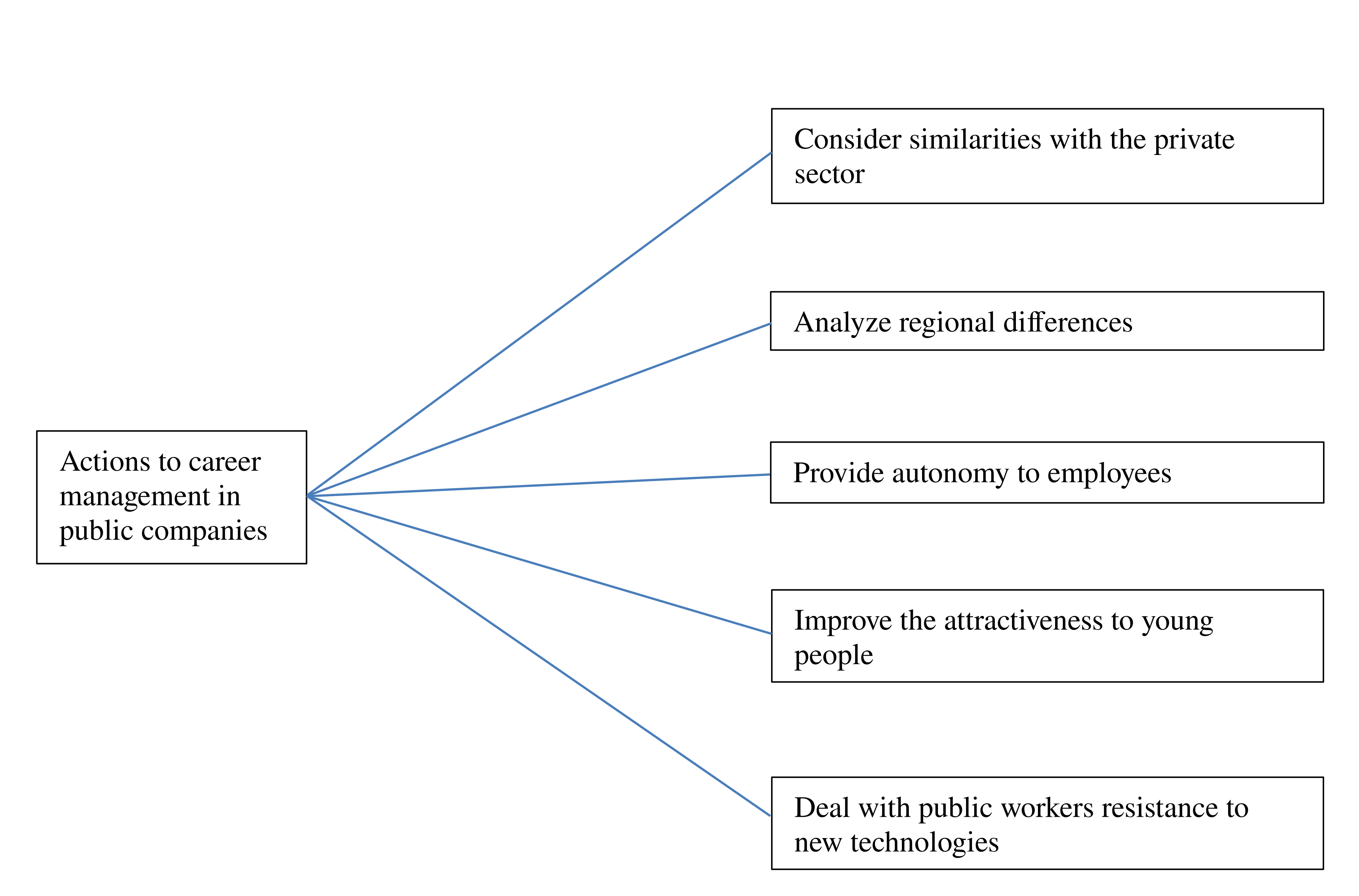
After the discussion of results, we summarize five factors from the study that can guide career management actions in public companies:
1. Managers should consider that the personal career management of public company employees might be similar to the private sector in terms of flexibility;
2. For public enterprises of national scope, it is important to analyze regional differences that lead to variations in the perception of career by workers;
3. In the distribution of tasks, managers of public enterprises should consider, within the limits of the public service, the possibility of providing autonomy to employees;
4. The attractiveness of public companies as employers of young people at the beginning of their careers should be increased in order to make room for new talent;
5. When applying new technologies, public enterprise managers should deal not only with the implementation of new processes, but also with the resistance of workers.
Figure 3 shows the proposed model for actions for career management in public companies, in contexts of technological advances.
Figure 3
Actions for career management in public companies
Note: The authors
Technological evolution has grown exponentially in the last five years, driving new disruptive business models in Brazilian organizations (Macedo, Veloso, Pinsky & Trevisan, 2023). Considering this scenario, this study intends to contribute to the management of public companies despite the fact that the studied organization presents hybrid characteristics, typical of a public company of indirect administration. For the Human Resources area, professionals who experience the dilemma between people retention and task automation may also benefit from these reflections. The limitation is the fact that the significance tests did not reveal marked differences in the attitudes regarding demographic data, therefore suggesting that the observed homogeneity might be due to other characteristics, such as the organizational culture or socialization and training actions, which opens an opportunity for future research to explore these and other issues.
Finally, to contribute to the development of a research agenda, we understand that it is essential to carry out qualitative research on careers in the public sector that allow exploring the reasons that move these workers towards new careers. It is also important to compare the effects of the implementation of new technologies on the career of workers in the public sector with those in the private sector.
References
Anderson, M. M. M, Veloso, E. F. R., Trevisan, L.N. & Stefani, S. R (2021). Career transition of middle-aged professionals. Revista de Administração da UFSM, v. 14, p. 63-78.
Araujo, M. H., Reinhard N., & Cunha, M. A. (2018). Eletronic government services in Brazil: na analysis based on measures of access and users’ internet skills. Revista de Administração Pública 52(4), 676–694.
Arthur. M. B., Inkson K., & Pringle, J. K. (1999). The New careers: Individual Action and Economic Change. London: Sage Publications.
Arthur, M. B., & Rousseau, D. M. (1996). Introduction: the boundaryless career as a new
employment principle. In M. B. Arthur, & D. M. Rousseau (Eds.), The Boundaryless Career: a New Employment Principle for a New Organizational Era. New York: Oxford University Press.
Arthur, M. B. (2014). The boundaryless career at 20: where do we stand, and where can we go?
Career Development International 19(6): 627–640.
Arthur, M. B., Khapova, S. N., & Richardson, J. (2017a). Taking Stock. In M. B. Arthur, S. N. Khapova, & J. Richardson (Eds.), An Intelligent career: taking ownership of your work and your life. New York: Oxford University Press.
Arthur, M. B., Khapova, S. N., & Richardson, J. (2017b). Embracing Technology. In M. B. Arthur, S. N. Khapova, & J. Richardson (Eds.), An Intelligent career: taking ownership of your work and your life. New York: Oxford University Press.
Arthur, M. B. (2018, August). A Brief History of Business School: Thinking about Careers and Why it
Matters. Forbes. https://www.forbes.com/sites/michaelbarthur/2018/08/ 04/a-brief-history-of-business-school-thinking-about-careers-and-why-that-matters-to-you/#36e9dc6d57c1
Autor, D. H., & Price, B. (2003). The Changing Task Composition of the US Labor Market: An Update of Autor, Levy, and Murnane. MIT Paper.
Barley, S. R., Bechky, B. A., & Milliken, F. J. (2017). The changing nature of work: careers, identities, and work lives in the 21st Century. Academy of Management Discoveries 3(2): 111–115.
Briscoe, J. P., Hall, D. T., & Demuth, R. F. L. (2006). Protean and boundaryless careers: An empirical exploration. Journal of Vocational Behavior 69(1): 30–47.
Capelli, P., & Keller, J. R. (2013). Classifying Work in the New Economy. Academy of Management Review 38(4): 575–596.
Clarke, M. (2013). The organizational career: not dead but in need of redefinition. The international Journal of Human Resource Management 24(4): 684–703.
Cordeiro, H. T. D. (2012). Perfis de carreira da geração Y (Master’s Thesis). Faculty of Economics, Business, and Accounting of the São Paulo University.
Cordeiro, H. T. D., & Albuquerque, L. G. (2013). Perfis de carreira da geração Y. Paper presented at the XXXVII EnANPAD, Rio de Janeiro.
Eufrásio, M. A. P. (2011). As transformações no mundo do trabalho frente à globalização. Revista Labor 5(1): 121–140.
Frey, C. B., & Osborne, M. A. (2013). The future of employment: how susceptible are jobs to computadorisation? Oxford University Engineering Sciences Department and the Oxford Martin Programme on the Impacts of Future Technology Paper.
Bagdadli, S. & Giannechini, M. (2023) Leonardo da Vinci’s spirit: a career story of an Italian creative entrepreneur. J. Briscoe, M. Dickmann., D. Hall, D. Mayrhofer & E. Parry Understanding Careers Around the Globe. 25-35. Edward Elgar Publishing, Inc. Cheltenham, UK • Northampton, MA.
Gómes, S. M. & Martínez, J. L. (2023) What attracts young people today? Insights from Mexico. J. Briscoe, M. Dickmann., D. Hall, D. Mayrhofer & E. Parry Understanding Careers Around the Globe. 25-35. Edward Elgar Publishing, Inc. Cheltenham, UK • Northampton, MA.
Hall, D. T. (1976). Career in organizations. Pacific Palisades: Goodyear.
Hall, D. T. (1996). Preface. In D. T. Hall & Associates (Eds.), The Career is Dead - Long Live the Career: a
relational approach to careers. San Francisco: Jossey-Bass Publishers.
Hall, D. T. (2002). Careers In and Out of Organizations. London: Sage Publications.
Hall, D. T., Yip, J., & Doiron, K. (2018). Protean career at work: self-direction and values orientation in psychological success. Annual Review of Organizational Psychology and Organizational Behavior 5(6): 1–6.
Klein, F. A., & Mascarenhas, A. O. (2016). Motivação, satisfação profissional e evasão no serviço público: o caso da carreira de especialistas em Políticas Públicas e Gestão Governamental. Revista de Administração Pública 50(1): 17–39.
Lyons, S. T., Schweitzer, L., & Ng, E. S. W. (2015). How have careers changed? An investigation of changing career patterns across four generations. Journal of Managerial Psychology 30(1): 8–21.
Macedo, R. R.; Veloso, E. F. R., Pinsky, V. & Trevisan, L. N. (2023) Career management in digital age: a study of leadership’s competencies and practices applied for IT professionals. Revista de Administração da UFSM, v. 16, p. e3-34.
Martins, H. T. (2011). Gestão de Carreiras na Era do Conhecimento: Abordagem Conceitual e Resultados de Pesquisa. Rio de Janeiro: Qualitymark.
Mayrhofer, W., Briscoe, J., Dickmann, M., Hall, D. T. & Parry, E. (2023) Careers: what they are and how to look at them. J. Briscoe, M. Dickmann., D. Hall, D. Mayrhofer & E. Parry Understanding Careers Around the Globe. 25-35. Edward Elgar Publishing, Inc. Cheltenham, UK • Northampton, MA.
Oliveira, M. Z., & Gomes, W. B. (2014). Estilos reflexivos e atitudes de carreira proteana e sem fronteiras nas organizações contemporâneas brasileiras. Revista Psicologia: Organizações e Trabalho 14(1): 105–118.
Overman, S., Busuioc, M., & Wood, M. (2020). A multidimensional reputation barometer for Public agencies: a validated instrument. Public Administration Review 80(3): 415–425.
Przeybilovicz, E., Cunha, M. A., & Meirelles, F. S. (2018). The use of information and comunication technology to characterize municipalities: who they are and what they beed to develop e-govermment and smart city initiatives. Revista de Administração Pública 52(4): 630–649.
Ramarajan, L., & Reid, E. (2013). Shattering the myth of separate worlds: negotiating nonwork identities at work. Academy of Management Review 38(4): 621–644.
Schwars, G., Eva, N., & Newman, A. (2020). Can public leadership increase public service motivation and job performance? Public Administration Review 9999(9999): 1–12.
Stillman, R. (2017). Public professionalism in an era of radical transformations: its meaning, challenges, and training. Revista de Administração Pública 51(6): 917–926.
Tams, S., & Arthur, M. B. (2010). New directions for boundaryless careers: agency and interdependence in a changing world. Journal of Organizational Behavior 31(5): 629–646.
Trevisan, L. N., Veloso, E. F. R., Silva, R. C., & Dutra, J. S. (2016). Âncoras de carreira e tecnologia na percepção sobre estresse no ambiente de trabalho. Organizações em Contexto 12(24): 66–89.
Trevisan, L. N. (2014). Realidade virtual versus mundo corporativo. Revista da ESPM 21(5): 94–101.
Veloso, E. F. R., & Dutra, J. S. (2011). Carreiras sem fronteiras na gestão pessoal da transição profissional: um estudo com ex-funcionários de uma empresa com características de empresa pública. Revista de Administração Contemporânea 15(5): 834–854.
Veloso, E. F. R. (2012). Carreiras sem fronteiras e transição profissional no Brasil: desafios e oportunidades para pessoas e organizações. São Paulo: Atlas.
Veloso, E. F. R., Trevisan, L. N., Silva, R. C., & Dutra, J. S. (2018). The use of traditional and non-traditional career theories to understand the young’s relationship with new technologies. Revista de Gestão 25(4): 340–357.