 Article Type:
Original article
Received: 30/01/2023
Accepted: 18/09/2023
Challenges and opportunities of 4.0 technologies in the construction sector: analyzing manager' perceptions in Pernambuco state
Desafios e oportunidades das tecnologias 4.0 no setor da construção: analisando a percepção dos gestores do estado de Pernambuco
Gabriela Eloanne Vidal Leite1i, ORCID: https://orcid.org/0000-0002-8856-5430; Marcele Elisa Fontana2ii*, ORCID: https://orcid.org/0000-0002-1436-8311.
1. Universidade Federal de Pernambuco, Programa de Pós-Graduação em Engenharia de Produção, Caruaru, PE, Brasil.
2. Universidade Federal de Pernambuco, Centro de Tecnologia e Geociências, Departamento de Engenharia Mecânica, Recife, PE, Brasil.
*Corresponding Author: marcele.elisa@ufpe.br; Av. da Arquitetura, s/nº, 2o Andar do Bloco Naval. Cidade Universitária, Recife, PE, Brasil, CEP 50740-550.
Abstract
The literature shows that 4.0 technologies have a significant impact on facing the housing deficit and sustainability. However, in the construction sector, there are social and technical implications that make this transformation difficult, especially for companies located in emerging countries. Thus, understanding managers' perceptions can help in formulating strategies and public policy. We study the challenges and opportunities of new technologies according to the managers’ perception of construction companies located in Pernambuco, Brazil. The results demonstrate that the lack of interest of managers, lack of capital, and lack of Knowledge are recognized barriers to implementing 4.0 technologies in the construction sector. Although managers know that 4.0 technologies can contribute to reducing costs and increasing productivity, quality, and competitiveness, most of them have difficulties relating the current organizational culture with the challenges of adopting new technologies.
Keywords: sustainability, innovation, construction 4.0, drivers, barriers, benefits.
Resumo
A literatura mostra que as tecnologias 4.0 têm um impacto significativo no enfrentamento do déficit habitacional e na sustentabilidade. No entanto, no setor da construção civil, existem implicações sociais e técnicas que dificultam essa transformação, principalmente para empresas localizadas em países emergentes. Assim, compreender as percepções dos gestores pode auxiliar na formulação de estratégias e políticas públicas. Estudamos os desafios e oportunidades das novas tecnologias segundo a percepção dos gestores de construtoras localizadas em Pernambuco, Brasil. Os resultados demonstram que a falta de interesse dos gestores, a falta de capital e a falta de conhecimento são barreiras reconhecidas para a implementação de tecnologias 4.0 no setor da construção. Embora os gestores saibam que as tecnologias 4.0 podem contribuir para a redução de custos, aumento da produtividade, qualidade e competitividade, a maioria deles tem dificuldade em relacionar a cultura organizacional atual com os desafios da adoção de novas tecnologias.
Palavras-chave: sustentabilidade, inovação, construção 4.0, motivadores, barreiras, benefícios.
Citation: Leite, G. E. V. & Fontana, M. E. (2025). Challenges and opportunities of 4.0 technologies in the construction sector: analyzing manager' perceptions in Pernambuco state. Gestão & Regionalidade, v.41, e20258957. https://doi.org/10.13037/gr.vol41.e20258957
Data Availability: All data is available upon reasonable request.
Author Contributions: Conceptualization - M.E.F. and G.E.V.L.; Methodology – G.E.V.L.; Validation and formal analysis – G.E.V.L and M.E.F..; Writing—original draft preparation – M.E.F. and G.E.V.L.; Writing—review and editing - M.E.F. and G.E.V.L.; Project administration – M.E.F.
Funding: This research was funded by Fundação Coordenação de Aperfeiçoamento de Pessoal de Nível Superior (CAPES) - grant number 001, Universidade Federal de Pernambuco (UFPE) - Edital pesquisador PROPG nº 06/2022, and Fundação de Amparo à Ciência e Tecnologia de Pernambuco – grant number PBPG-1394-3.08/19.
Acknowledgments: The authors would like to thank the Coordination for the Improvement of Higher Education Personnel (CAPES).
1 Introduction
Construction industry is strategically important, being a major contributor to job creation and economic development in many countries (Qian and Leng, 2021; Yevu et al., 2021). However, in Brazil, historically, construction is among the sectors that least invests in innovation, and is characterized by using very artisanal techniques and by wasting a high level of resources and time (Sherratt and Sherratt, 2020). The International Data Corporation (ID) consultancy surveyed 835 professionals from large construction companies located in Europe, Asia, and the Americas, including Brazil, and this study revealed that 58% of companies are still in the initial stage of the innovation journey, and only 13% have the potential to be considered mature in adopting new technologies (IDC, 2020).
According to the report of the World Economic Forum (WEF, 2016), worldwide more than 200,000 people migrate to urban areas every day. These people have needs to be met, with regard to housing, social infrastructure, transport, public services, health and education. In Brazil, although access to housing is a right provided for by Art. 6 of the Federal Constitution of Brazil, in 2019 the country had a housing deficit of 5.877.000 households (Fundação João Pinheiro – FJP, 2021). In addition to the financial difficulties of both the population and the government, the construction sector has been slow to respond to finding ways to achieve the productivity gains necessary to meet this demand. Mesa et al. (2016) stated that most construction projects do not meet the performance expectations of owners and that studies exploring project delivery and supply chain relationships and their potential performance in the project are still insufficient.
In this sense, Industry 4.0 (I4.0), or 4th industrial revolution, can revolutionize the construction sector and its supply chain (Dallasega et al., 2018). Innovations related to I4.0 have transformed the industrial sector drastically (Cabral da Silva and Magalhães Correia, 2022; De Muylder et al., 2021). Construction 4.0, as it has been called, is a construction method that makes it possible to advance the process, from design to construction, by applying intelligent manufacturing and automation techniques (Qi et al., 2020; Qi et al., 2021). Innovations in the construction sector are advancing faster and faster, aimed at solving problems in a simpler, more economical and sustainable way (Aghimien et al., 2021). The technological portfolio associated with I4.0 is vast and the combination of the latest technologies such as digitization, Building Information Modeling (BIM), Additive Manufacturing (AM), and the Internet of Things (IoT) is of great importance in terms of promoting changes in project management (Dallasega et al., 2018; Demirkesen and Tezel, 2021; Ern, et al., 2020; Hadzaman, et al., 2020; Nguyen et al., 2021; Saieg et al., 2018).
These new technologies offer new opportunities to support design and manufacturing, capable of making construction more efficient by reducing waste, reducing the use of materials and electricity consumption, increasing productivity, reducing errors, improving the quality and, consequently, the costs (Begić and Galić, 2021; Carneau et al., 2020; He et al., 2021; Mannino et al., 2021). In addition, advances in technology leverage the movement to change traditional construction sites to help in the sustainable development of cities and mitigate housing shortage problems. The transformation of the construction sector has social and technical implications (Balasubramanian et al., 2021). Adopting more advanced technologies brings challenges to organizations and a significant change in the way of working, which requires qualified labor and a change in mindset (Deng et al., 2021).
Therefore, this study analyzed the development of construction 4.0 in the countryside of Pernambuco, Brazil, to understand the challenges and opportunities generated by the adoption of 4.0 technologies in the construction sector. For this, several hypotheses were surveyed, considering the literature review, and tested through the empirical analysis of a sample of 26 managers of construction companies in the region of the state called Agreste.
Studies like this are important to support all parties involved in the learning process and in planning actions to mitigate the problem in question, providing scientific support for decision-making and transparency of information, in which society is the biggest beneficiary of the synergy created. In addition, there is a lack of studies aimed at using technologies from I4.0 on construction sites in emerging countries, such as Brazil (Leite and Fontana, 2021), and how using these technologies may assist in solving the housing deficit. This is still an embryonic idea in Brazil.
2 Material and methods
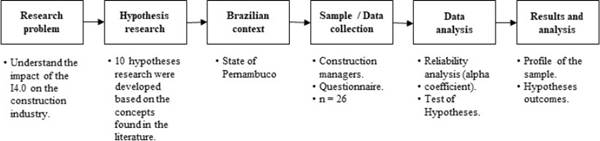
This research has a descriptive character and a mixed approach (quantitative/qualitative) was used. The schematic diagram (Figure 1) summarizes the steps followed to prepare the study.
Figure 1 - Research design
Source: adapted from Aragão and Fontana (2022).
2.1 Research problem
Revolutionary changes in society are today often linked to digital technologies and affect all areas of social life, not excluding the construction industry (El‑Sayegh et al., 2020; Kozlovska et al., 2021). In other words, construction projects are becoming more and more complex and require I4.0 to solve their new business model (Lenz et al., 2020; Opoku et al., 2021). Thus, I4.0 has been challenging construction sector, promoting a glimpse of the potential for digitizing construction with the availability of digital data and online digital access that automatically gathers and processes electronic data in the value chain (Demirkesen & Tezel, 2021; Hussein et al., 2021; Rivera et al., 2021).
These new alternatives on how best to tackle construction include research into form, function, structure, and materials, and have a great influence on drawing up the architectonic project as well as on its production process, thereby providing faster and smoother interactions between customers, developers, and workers (Kuipers et al. al., 2014). As a result, 4.0 technologies have great potential to significantly reduce general investments, time and resources (capital, materials and labor), and to decrease pollution and the use of energy (Oesterreich and Teuteberg, 2016), and decrease pollution and energy use, orienting the process towards a triple-bottom-line approach in sustainability perspectives (Balasubramanian, 2021).
However, the construction industry remains significantly underrepresented in I4.0, as the technical aspects of available technologies are still being examined in greater depth (Deng et al., 2021). Although the 4th Industrial Revolution is a strategic watershed, it is also a major disruptor, and to effectively enter an organization, a change in organizational management is necessary, a task for which the industry seems unprepared (Newman et al., 2021).
The construction model of the future will depend on a view directed at the “systems” of digital technologies that already exist, and those under development or that will still be developed, how their use can be combined in a holistic connected architecture (Turner et al., 2021). The challenges and opportunities linked to applying I4.0 in construction will indicate areas for further exploration in the next five to ten years (Perrier et al., 2020; Wang et al., 2020).
2.2 Hypothesis research
The recent literature show that the construction sector has not kept pace with the technological opportunities that may well contribute to improving production and increasing productivity, thus presenting several challenges when implementing I4.0 (Alaloul et al., 2020; Delgado et al., 2019; Kedir and Hall, 2021; Maskuriy et al., 2019). Comparing the advance between various sectors, the construction sector is resistant to incorporating new technologies in its basic processes (Abioye et al., 2021; Sepasgozar, 2021). In several developing countries, the construction industry continues to follow traditional practices of this labor-intensive industry (Xu and Moreu, 2021).
The complexity involved in construction is one of the reasons for the slow evolution of this industry. Although efficient communication between designers, builders, suppliers and customers is essential to ensure the success of the project and the satisfaction of all parties, the organizational structure of construction is quite complex, covering several stakeholders throughout the production chain (Xu and Moreu, 2021). Researchers point out that conventional design methods can segment the production process, and can prompt professionals from different areas to become isolated from each other and this can lead to a lack of coordination between teams (Nawi et al., 2014). Given this evidence, it can be inferred that:
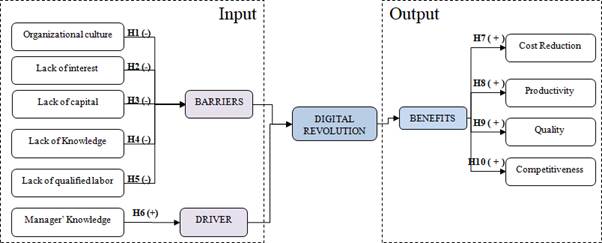
H1: Conventional organizational culture is a barrier to joining the digital revolution in construction sector.
Faced with a highly technological scenario and the changes that occur daily, management activities need to be focused on using digital technologies for the planning and execution process of the work and promoting teamwork skills (El‑Sayegh et al., 2020; Kozlovska et al., 2021). In addition to a reform of knowledge, this requires a reform of employee skills (Leite and Fontana, 2021). Today's professional needs skills to work in a team and master digital applications, using computers, cell phones, the internet, machines, and devices equipped with digital technology (Akanmu et al., 2021; da Silva and Gil, 2020). However, Newman et al. (2021) stated that, in construction, there is enormous difficulty in recruiting professionals with skills in digital technology, especially in emerging countries.
In addition, implementing 4.0 technologies has a higher cost when compared to traditional technologies, considering the initial investment required (Mesa-Fernández et al., 2020). However, in general, there is a lack of capital for investment (Leite and Fontana, 2021). The construction industry has one of the lowest capital investments as well as low capital intensity with the lowest research and development (R&D) intensity compared to other sectors despite being a major contributor to employment and the economy in many countries (Qian and Leng, 2021; Yevu et al., 2021). For the investment to be well applied, the construction must be a large company, with several construction projects simultaneously (Tay et al., 2017).
Finally, while the lack of knowledge about the power of innovation generates uncertainty for senior management, the main driving force behind the development of construction 4.0 is knowledge, especially from its managers (Nagy et al., 2021). "Knowledge has a significant influence on both of the actions an organization takes and the decisions it makes" (Alhammadi et al., 2022). Thus, the hypotheses are:
H2: The lack of interest from senior management or owners is a barrier to joining the digital revolution in construction sector.
H3: Lack of capital is a barrier to joining the digital revolution in construction sector. H4: The lack of knowledge of new technologies is a barrier to joining the digital revolution in construction sector.
H5: The lack of qualified labor is a barrier to joining the digital revolution in construction sector.
H6: The higher the manager's level of knowledge about I4.0 the closer the company is to the digital revolution.
The proper entry of new technologies into the construction sector is desirable. Leite and Fontana (2021) highlighted cost reduction, increased quality, and more agile and flexible production as the greatest benefits generated by 4.0 technologies in construction, and this is seen to have increased the competitive advantage of companies in the sector, which can be regarded as “superior performance” or “superior profitability” (Nguyen et al., 2021). As new technologies are incorporated, this increases the ability to customize and innovate, making the company more competitive. Internal routines become more effective, prototyping and the manufacture of parts and tools become faster and more economical, accelerating the development of new projects and making it possible to meet the most demanding requirements (Carneau et al., 2020; Nguyen-Van et al., 2021; Sallehuddin et al., 2021).
Furthermore, 4.0 technologies improve working conditions by automating some tasks, reducing the manual labor required and the exposure of workers to unhealthy situations (Biswas et al., 2017). According to Oesterreich and Teuteberg (2016), I4.0 can help construction companies to reduce complexity and uncertainty, to improve the exchange of information and communication between project stakeholders and, thus, to increase productivity and quality. Hence, construction 4.0 must take into account its project-oriented nature, hence influencing the “temporary” proximity of the actors in the production chain, raising product traceability as a priority for managers.
Nagy et al. (2021), in their study of challenges and solutions at the organizational level of construction 4.0, observed that organizations that seek to innovate in their processes and take technological risks to maximize the efficiency of their business increasingly become an attractive workplace for the new generations.
To sum up, four hypotheses regarding the main benefits generated by joining the digital construction revolution were drawn up, namely: ‘In the construction sector, I4.0 emerges as a natural way’ …
H7: to reduce costs.
H8: to increase productivity. H9: to improve quality.
H10: to increase competitiveness.
Figure 2 shows the conceptual model of influence relationships between the hypotheses and the 4.0 technologies in construction.
Figure 2 - Conceptual model
Source: The authors (2022).
2.3 Regional context
The civil construction sector has great importance in the Brazilian economy, especially due to the generation of jobs. The National Construction Index showed an accumulated 18.65% in 2021, representing an increase of 8.49 percentage points compared to 2020 (10.16%) (Instituto Brasileiro de Geografia e Estatística - IBGE, 2022). Despite this, in 2021 the participation of construction in the Gross Domestic Product (GDP) of Brazil was 2.6%, a very timid situation in comparison to other countries such as the United States and Europe countries, where the activity represents 7% to 8% of the GDP (Brazilian Chamber of the Construction Industry - CBIC, 2022).
Most Brazilian industry has a production system associated with the 2nd and 3rd Industrial Revolutions, which makes partial use of assembly and automation lines (Federação das Indústrias do Estado do Rio de Janeiro - FIRJAN, 2019). In the 2021 Global Innovation Index, which measures the performance of innovation-driven ecosystems in 132 economies and identifies the latest global trends in innovation, Brazil ranks 57th position of economies with the greatest innovation capacity and success (World Intellectual Property Organization - WIPO, 2021).
There are a small number of studies focused on the use of technologies from I4.0 on construction sites in Brazil – which is still at an embryonic level - as a solution to the housing deficit. But it should not be long before we see significant changes in this scenario. In particular, due to the philosophy of lean thinking, it is expected that a business management system will come into use that seeks to deliver more value to the customer, with less waste of resources or energy (Leite and Fontana, 2021).
Even with the face of the growth of investments in the sector, the scenario is still pessimistic, which indicates that construction entrepreneurs in Pernambuco are still not willing to invest in innovation as much as entrepreneurs in other sectors (Federação das Indústrias do Estado de Pernambuco - FIEPE, 2022).
2.4 Sample and data collection
The main object of the study was housing construction companies and building facilities. The choice of construction companies was made taking into account their performance in the Agreste region of Pernambuco, Brazil. The self-administered questionnaire was sent electronically to the managers of the construction companies selected for convenience. Only individuals in management positions could respond to the questionnaire. Therefore, of the 30 questionnaires sent, 26 were answered, which corresponds to a response rate of 86.66%.
The questionnaire consisted of 23 questions in total, divided into 2 sections: (1) general questions about the respondent; and (2) specific questions about the topic of study. The descriptive data extracted bring knowledge about the sample and partially represent the population.
2.5 Data analysis
In this study, the alpha coefficient (α), developed by Cronbach (1951) was used as an estimator of the internal consistency of the questionnaire (Leontitsis and Pagge, 2007). In the literature, some studies have specified ranges of acceptable alpha coefficient values. In general, an acceptable value of the alpha coefficient should be in the range of 0.7 to 0.9 (Aragon and Fontana, 2022; Cronbach, 1951). Our questionnaire presented an alpha of 0.874. i.e., it is acceptable. Table 1 related the questions of the questionnaire with the hypotheses tested.
Table 1 - Relationship between the questionnaire and the hypotheses tested
|
Dimension |
Question |
Hypothesis |
|
Barriers |
What is the level of relevance of the following barriers to the adoption of Industry 4.0 concepts by construction companies? |
|
|
(a) Organizational culture closed to changes (traditional) |
H1 |
|
|
(b) Lack of interest from senior management or owners |
H2 |
|
|
(c) Lack of capital for investment |
H3 |
|
|
(d) Lack of knowledge about Industry 4.0 |
H4 |
|
|
(e) Lack of qualified labor |
H5 |
|
|
Driver |
How do you rate your knowledge about the Fourth Industrial Revolution (Industry 4.0)? How close is the construction company where you work to the current digital revolution? |
H6 |
|
Benefits |
What is the level of agreement regarding the following benefits of Industry 4.0 for the construction company you work for? |
|
|
(a) Cost reduction |
H7 |
|
|
(b) Increase in productivity; |
H8 |
|
|
(c) Minimize the occurrence of errors (Quality); |
H9 |
|
|
(d) Find new market opportunities (Competitiveness). |
H10 |
Source: The authors (2022).
Due to the small sample size (n < 30), normality conditions were not reached. So, non-parametric Fisher's exact test was used to test hypothesis H6, while non-parametric Binomial test was used in the other hypotheses. Barriers and benefits were assessed using a 5-point Likert scale. Thus, the Binomial test requires that the evaluations be grouped into two: barriers – 1 (Very important and Important) and 0 (Moderately important, Little importance, and Not important,); Benefits - 1 (High and Good) and 0 (Medium, Low, None).
3 Results
3.1 Profile of the sample
All 26 construction companies operate in the Agreste region of Pernambuco, i.e., meeting the research requirements. Although the headquarters of these companies are mostly located in the Agreste region, 69.23% in Caruaru and 3.84% in Garanhuns, many of them are in other regions such as 3.84% in Arcoverde (hinterland region), 15.38% in Recife and 3.84% in Ipojuca (the coastal region), and 3.84% in another state, Belo Horizonte - MG.
Regarding the classification of companies by size, 38.5% are micro-small companies (up to 49 employees), 50% are medium-sized companies (50 to 99 employees), and 11.5% are large companies (100 or more employees). These data demonstrate the great importance that micro-small and medium-sized companies play in Brazil. Regarding the profile of the respondents, Table 2 summarizes the main information.
Table 2 - Profile of the sample
|
Variable Answers |
(%) |
|
Gender Male |
92.30 |
|
Female |
7.7 |
|
Middle/ Technical school |
3.8 |
|
Formal Education Holds graduate degree |
57.7 |
|
Specialization (lato sensu) |
34.6 |
|
Master’s (stricto sensu) |
3.8 |
|
1 to 2 years |
69.23 |
|
Length of employment in the 3 to 4 years |
7.69 |
|
construction company 5 to 6 years |
11.53 |
|
7 to 8 years |
7.69 |
|
9 to 11 years |
3.84 |
Source: The authors (2022).
Among all those who have a degree, 84% have degrees in civil engineering, 8% in production engineering, 4% in mechanical engineering, and 4% in real estate business management. This fact shows that the sample analyzed consists of respondents who have experience in the construction sector and who work in the Agreste region.
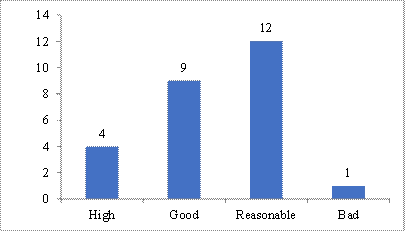
In the self-assessment of their level of knowledge about I4.0, 50% of respondents attributed good or high knowledge (Figure 3).
Figure 3 - Self-assessment of the level of knowledge in I4.0

Source: The authors (2022).
Regarding the industrial revolution context in which respondents believe the company is, 11.5% classified as the 1st Industrial Revolution, using totally manual production, 11.5% classified as the 2nd Industrial Revolution, where there is a division of labor and partial mechanization of activities, 53.8% classified as the 3rd Industrial Revolution, where they make partial use of technologies and semi-automated equipment; and 23.1% classified as the 4th Industrial Revolution, where they make use of management systems (ERP), laser level, infrared measuring tape, BIM software, 3D printers, etc.
3.2 Hypotheses outcomes
With a confidence level of 95% (significance level of 5%) and p-value of 0.5, the hypotheses defined in section 2 were tested using the SPSS software version 28.0.1.1, 14th edition, 2022. Table 3 shows that hypotheses H1, H5 and H6 were not confirmed.
Table 3 - Hypotheses
|
Hypothesis |
Variable |
p-value |
|
H1 |
Organizational culture |
0.327 |
|
H2 |
Lack of interest of managers |
0.031 |
|
H3 |
Lack of capital |
0.011 |
|
H4 |
Lack of Knowledge |
0.031 |
|
H5 |
Lack of qualified labor |
0.170 |
|
H6 |
Managers’ Knowledge |
0.264 |
|
H7 |
Cost Reduction |
0.001 |
|
H8 |
Productivity |
0.001 |
|
H9 |
Quality |
0.001 |
|
H10 |
Competitiveness |
0.011 |
Source: The authors (2022).
4 Discussion
Although the move to the 4.0 model requires a change in the organizational and cultural structure of the company, as pointed out in the literature (Nawi et al., 2014; Newman et al., 2021; Xu and Moreu, 2021), there is no evidence to say that conventional organizational culture is a barrier to the adoption of 4.0 technologies in Agreste region. In part, this is due to the modernization movement of the construction companies studied has not started, making it difficult for respondents to have a real perception of this barrier. On the other hand, there is evidence that some of the reasons why construction companies in the Agreste region of Pernambuco, Brazil, do not adhere to I4.0 are: lack of interest from senior management, lack of capital for investment, and lack of knowledge about new technologies, as pointed out by several authors (El‑Sayegh et al., 2020 Kozlovska et al., 2021; Nagy et al. 2021 Mesa-Fernández et al., 2020, Qian and Leng, 2021; Yevu et al., 2021).
There is also evidence that cost reduction, increased productivity, quality improvement, through fewer errors, and the opportunity to increase competitiveness are expected benefits on adopting technologies arising from I4.0, which is in agreement with statements made in the literature (Alaloul et al. 2020; Biswas et al., 2017; Carneau et al., 2020; Delgado et al. 2019; Nguyen-Van et al., 2021; Oesterreich and Teuteberg, 2016).
Although the literature points out that as the manager's knowledge of I4.0 increases the company moves closer to the digital revolution (El‑Sayegh et al., 2020; Kozlovska et al., 2021; Leite and Fontana, 2021; Nagy et al. 2021), the data from our research were not enough to prove this statement. This happened in part, as our sample is aware of the I4.0 technologies, but other factors, mainly economic, lead to the non-adoption of these changes. The same analogy is made for the qualification of the workforce, because, since the adoption of new technologies is not considered for economic reasons, the non-existence or lack of qualifications of the workforce cannot yet be considered a challenge.
However, respondents mentioned the importance of disseminating knowledge associated with I4.0 in construction companies, as well as in service providers, in order to contemplate the increase in the maturity of individuals not only in relation to the knowledge of technologies that enable I4.0, but also taking into account the potentialities in relation to the transformation process of each agent involved.
5 Conclusion
Given the above, it is noticeable how the advancement of technology in recent times has contributed to increased productivity in different markets and that managers are starting to become aware of the importance of investing in technologies to improve their processes. Evidence of this is their interest in knowing more about I4.0 and the benefits achieved by it within the sector.
In order to remain competitive, construction companies need to adopt new forms of management. For this, technologies that reach all groups of project management process are emerging, these being of great importance to help the execution of the tasks of the project life cycle, where the I4.0 contributes to the modernization of organizational, operational and control of processes applied in the production chain of construction.
5.1 Theoretical contributions
Technological advances in the construction sector help in the sustainable development of cities. Hence, innovating in this sector aims to increase the speed of production, to reduce costs, and promotes sustainability. Thus, the advancement of technology in the sector contributes to the management of work and increased productivity. With the use of I4.0 technologies, constructions are now carried out in an agile and economical way, essential criteria for social housing. Thus, since the adaptation of the sector to the 4th Industrial Revolution, in other countries, has been shown to lead to a considerable increase in the rate at which housing units can be built, if the construction sector in Brazil were to do likewise, this could have a significant impact on tackling the Brazilian housing deficit and would also contribute to sustainability and environmental preservation issues.
Therefore, it is important to emphasize the relevance of the I4.0 theme acting on construction in Pernambuco, in the face of a scenario of constant changes, whether in the social, productive, or academic scope. The 4.0 technologies have the ability to provide essential skills to the new professionals who are emerging and who aim to work in construction 4.0.
5.2 Managerial implications
The use of new technologies in construction is still embryonic in Brazil. Today, its application is oriented to the prototyping of architectural and structural models. Due to the high cost of implementation, companies need to be motivated to adhere to technological innovations through government initiatives, mandates or financing programs (Boton et al., 2021). Thus, as the strengthening of planning and management of cities is a priority area of the government of the state of Pernambuco. This study makes an important contribution to the diagnosis of companies that operate in the state in the construction sector. The results presented can support public policies to improve the urban management of municipalities in Pernambuco.
Therefore, changes will be necessary in the entire structure of organizations so that I4.0 can be really inserted in the Brazilian context, especially in construction. In addition, it will be a great challenge that can free up not only time, but also resources for research and technology acquisitions. However, it is important to understand that it is not a choice, but something that is already occurring as a global trend for development and it is a path of no return.
5.3 Limitations and future research
As for the limitations for carrying out the research, it is noteworthy that the sampling was not probabilistic, but for convenience, so the results of this study may differ from the population. However, the results raise significant evidence that justifies the concern with the topic addressed and, consequently, the present study. As a suggestion for future studies, an analysis of the need to change the profile of the professional who will work in civil construction in the coming years can be done, by the precepts of I4.0, thus causing a break in the training paradigms offered by universities today.
Referências
Abioye, S. O., Oyedele, L. O., Akanbi, L., Ajayi, A., Delgado, J. M. D., Bilal, M., Akinade,
O.O. & Ahmed, A. (2021). Artificial intelligence in the construction industry: A review of present status, opportunities and future challenges. Journal of Building Engineering, 44, 103299.
Aghimien, D., Aigbavboa, C., Aghimien, L., Thwala, W., & Ndlovu, L. (2021). 3D Printing for sustainable low-income housing in South Africa: A case for the urban poor. Journal of Green Building, 16(2), 129-141.
Akanmu, A. A., Anumba, C. J., & Ogunseiju, O. O. (2021). Towards next generation cyber-physical systems and digital twins for construction. The Journal of Information Technology in Construction (ITcon), 26, 505-525.
Alaloul, W. S., Liew, M. S., Zawawi, N. A. W. A., & Kennedy, I. B. (2020). Industrial Revolution 4.0 in the construction industry: Challenges and opportunities for stakeholders. Ain shams engineering journal, 11(1), 225-230.
Alhammadi, E. M. A., Kasim, R., & Lohana, S. (2022). Knowledge Management Factors Affecting Construction Project Performance Model. International Journal of Sustainable Construction Engineering and Technology, 13(1), 149-158.
Aragão, J. P. S., & Fontana, M. E. (2022). Guidelines for public sector managers on assessing the impact of outsourcing on business continuity strategies: a Brazilian case. Journal of Global Operations and Strategic Sourcing, (ahead-of-print). https://doi.org/10.1108/JGOSS-07-2021-0051
Balasubramanian, S., Shukla, V., Islam, N., & Manghat, S. (2021). Construction industry 4.0 and sustainability: an enabling framework. IEEE transactions on engineering management, 1-19.
Begić, H., & Galić, M. (2021). A Systematic Review of Construction 4.0 in the Context of the
BIM 4.0 Premise. Buildings, 11(8), 337.
Biswas, K., Rose, J., Eikevik, L., Guerguis, M., Enquist, P., Lee, B., Love, L., Green, J. & Jackson, R. (2017). Additive manufacturing integrated energy—enabling innovative solutions for buildings of the future. Journal of Solar Energy Engineering, 139(1), 015001.
Boton, C., Rivest, L., Ghnaya, O. & Chouchen M. (2021). What is at the root of construction 4.0: a systematic review of the recent research effort. Archives of Computational Methods in Engineering, 28, 2331–2350.
Câmara Brasileira da Indústria da Construção (CBIC). (2022). A atividade da construção civil é a âncora do desenvolvimento. Available in < https://cbic.org.br/a-atividade-da-construcao-civil-e-a-ancora-do-desenvolvimento/>
Cabral da Silva, W. B., & Magalhães Correia, A. M. (2022). Análise da inovação no segmento da indústria de cerâmica vermelha: Uma aplicação do radar da inovação. Gestão & Regionalidade, 38(115). https://doi.org/10.13037/gr.vol38n115.7568
Carneau, P., Mesnil, R., Roussel, N., & Baverel, O. (2020). Additive manufacturing of cantilever-from masonry to concrete 3D printing. Automation in Construction, 116, 103184.
Cronbach, L.J. (1951). Coefficient alpha and the internal structure of tests, Psychometrika, 16(3), 297-237.
da Silva, A., & Gil, M. M. (2020). Industrial processes optimization in digital marketplace context: A case study in ornamental stone sector. Results in Engineering, 7, 100152.
Dallasega, P., Rauch, E., & Linder, C. (2018). Industry 4.0 as an enabler of proximity for construction supply chains: A systematic literature review. Computers in industry, 99, 205-225.
De Muylder, C. F., Araújo, L. A., La Falce, J. L., & Mesquita, S. R. de L. (2021). Análise da percepção dos gestores e empregados acerca do comportameno inovador em uma indústria automobilística. Gestão & Regionalidade, 37(112). https://doi.org/10.13037/gr.vol37n112.5678
Delgado, J. M. D., Oyedele, L., Ajayi, A., Akanbi, L., Akinade, O., Bilal, M., & Owolabi, H. (2019). Robotics and automated systems in construction: Understanding industry-specific challenges for adoption. Journal of Building Engineering, 26, 100868.
Demirkesen, S., & Tezel, A. (2021). Investigating major challenges for industry 4.0 adoption among construction companies. Engineering, Construction and Architectural Management, 29(3), 1470-1503.
Deng, T., Zhang, K., & Shen, Z. J. M. (2021). A systematic review of a digital twin city: A new pattern of urban governance toward smart cities. Journal of Management Science and Engineering, 6(2), 125-134.
El-Sayegh, S., Romdhane, L., & Manjikian, S. (2020). A critical review of 3D printing in construction: Benefits, challenges, and risks. Archives of Civil and Mechanical Engineering, 20(2), 1-25.
Ern, P. A. S., Ooi, Y. Y., & Al-Ashmori, Y. Y. (2020). Comparative study on the perspective towards the benefits and hindrances of implementing building information modelling (Bim). International Journal of Sustainable Construction Engineering and
Technology, 11(1), 194-205.
Federação das Indústrias do Estado do Rio de Janeiro (FIRJAN). (2019). Indústria 4.0 no Brasil: Oportunidades, perspectivas e desafios. Firjan SENAI, Finep. Rio de Janeiro. Available in https://www.firjan.com.br/publicacoes/publicacoes-de-inovacao/industria-4-0-no-brasil-oportunidades-perspectivas-e-desafios.htm
Federação das Indústrias do Estado de Pernambuco (FIEPE). (2022). Sondagem Industrial da Construção. 04. Available in http://fiepe.org.br/sondagens-da-industria-e-da-construcao-apontam-recuo/
Fundação João Pinheiro (FJP). (2021). Déficit Habitacional no Brasil. Available in: < http://fjp.mg.gov.br/deficit-habitacional-no-brasil/>
Hadzaman, N. A. H., Takim, R., & Nawawi, A. H. (2020). Client governing success criteria in Building Information Modelling (BIM)-based projects. International Journal of Sustainable Construction Engineering and Technology, 11(1), 64-75.
He, R., Li, M., Gan, V. J., & Ma, J. (2021). BIM-enabled computerized design and digital fabrication of industrialized buildings: A case study. Journal of Cleaner Production, 278, 123505.
Hussein, M., Eltoukhy, A. E., Karam, A., Shaban, I. A., & Zayed, T. (2021). Modelling in off-site construction supply chain management: A review and future directions for sustainable modular integrated construction. Journal of Cleaner Production, 310, 127503.
Instituto Brasileiro de Geografia e Estatística (IBGE). (2022). Custos da construção sobem 18,65% em 2021, maior taxa em nove anos. Available in https://agenciadenoticias.ibge.gov.br/agencia-noticias/2012-agencia-de-noticias/noticias/32719-custos-da-construcao-sobem-18-65-em-2021-maior-taxa-em-nove-anos
International Data Corporation (IDC). (2020). Digital Transformation: The Future of Connected Construction. Sponsored by Autodesk. Available in: http://constructioncloud.autodesk.com/rs/572-JSV-775/images/Autodesk-IDC-Digital%20Transformation_The-Future-of-Connected-Construction.pdf
Kedir, F., & Hall, D. M. (2021). Resource efficiency in industrialized housing construction–A systematic review of current performance and future opportunities. Journal of Cleaner Production, 286, 125443.
Kozlovska, M., Klosova, D., & Strukova, Z. (2021). Impact of industry 4.0 platform on the formation of construction 4.0 concept: a literature review. Sustainability, 13(5), 2683.
Kuipers, M., Tomé, A., Pinheiro, T., Nunes, M., & Heitor, T. (2014). Building space–use analysis system—A multi location/multi sensor platform. Automation in Construction, 47, 10-23.
Leite, G., & Fontana, M. E. (2021). Additive manufacturing and the evolution of the construction industry: a Systematic Literature Review 2015-2021. In 2021 International Conference on Decision Aid Sciences and Application (DASA) (pp. 294-298).
Lenz, L., Weist, K. C., Hoepfner, M., Spyridis, P., & Gralla, M. (2020). Symbiosis of life-cycle structural design and asset management based on Building Information Modeling: Application for industrial facility equipment. Organization, Technology and Management in Construction: an International Journal, 12(1), 2170-2180.
Leontitsis, A. & Pagge, J. (2007). A simulation approach on Cronbach’s alpha statistical
significance, Mathematics and Computers in Simulation 73(5), 336-340.
Mannino, A., Dejaco, M. C., & Re Cecconi, F. (2021). Building information modelling and internet of things integration for facility management—Literature review and future needs. Applied Sciences, 11(7), 3062.
Maskuriy, R., Selamat, A., Ali, K. N., Maresova, P., & Krejcar, O. (2019). Industry 4.0 for the construction industry—how ready is the industry?. Applied Sciences, 9(14), 2819.
Mesa, H. A., Molenaar, K. R., & Alarcón, L. F. (2016). Exploring performance of the integrated project delivery process on complex building projects. International Journal of Project Management, 34(7), 1089-1101.
Mesa-Fernández, J. M., Piquero Camblor, J. C., Díaz Piloñeta, M., & Morán Palacios, H. (2020). Productive processes based on 3D printing versus conventional methodologies: A comparative analysis in the construction sector. Construction technology, 95 (2020) 299-304.
Nagy, O., Papp, I., & Szabó, R. Z. (2021). Construction 4.0 Organisational Level Challenges and Solutions. Sustainability, 13(21), 12321.
Nawi, M. N.M., Baluch, N. H., & Bahaudin, A. Y. (2014). Impact of fragmentation issue in construction industry: An overview. In Building Surveying, Facilities Management and Engineering Conference, 15, 01009.
Newman, C., Edwards, D., Martek, I., Lai, J., Thwala, W. D., & Rillie, I. (2020). Industry 4.0 deployment in the construction industry: a bibliometric literature review and UK-based case study. Smart and Sustainable Built Environment, 10(4), 557-580.
Nguyen-Van, V., Panda, B., Zhang, G., Nguyen-Xuan, H., & Tran, P. (2021). Digital design computing and modelling for 3-D concrete printing. Automation in Construction, 123, 103529.
Nguyen, T-Q., Thieu-Thi, T-T. & Vu, N-N. (2021). BIM-based Competitive Advantages and Competitive Strategies for Construction Consultancy SMEs: A Case Study in
Vietnam. International Journal of Sustainable Construction Engineering and Technology, 12(3), 1-11.
Oesterreich, T. D., & Teuteberg, F. (2016). Understanding the implications of digitisation and automation in the context of Industry 4.0: A triangulation approach and elements of a research agenda for the construction industry. Computers in industry, 83, 121-139.
Opoku, D. G. J., Perera, S., Osei-Kyei, R., & Rashidi, M. (2021). Digital twin application in the construction industry: A literature review. Journal of Building Engineering, 40, 102726.
Perrier, N., Bled, A., Bourgault, M., Cousin, N., Danjou, C., Pellerin, R., & Roland, T. (2020). Construction 4.0: A survey of research trends. Journal of Information Technology in Construction (ITcon), 25(24), 416-437.
Rivera, M. L., Mora-Serrano, J., Valero, I., & Oñate, E. (2021). Methodological-technological framework for Construction 4.0. Archives of computational methods in engineering, 28(2), 689-711.
Qi, B., Qian, S., & Costin, A. (2020). A Predictive Analysis on Emerging Technology Utilization in Industrialized Construction in the United States and
China. Algorithms, 13(8), 180.
Qi, B., Razkenari, M., Costin, A., Kibert, C., & Fu, M. (2021). A systematic review of emerging technologies in industrialized construction. Journal of building engineering, 39, 102265.
Qian, Y., & Leng, J. (2021). CIM-based modeling and simulating technology roadmap for maintaining and managing Chinese rural traditional residential dwellings. Journal of Building Engineering, 44, 103248.
Saieg, P., Sotelino, E. D., Nascimento, D., & Caiado, R. G. G. (2018). Interactions of building information modeling, lean and sustainability on the architectural, engineering and construction industry: a systematic review. Journal of cleaner production, 174, 788-806.
Sallehuddin, A. M., Omar, R., & Sarpin, N. (2021). Proposing an Absorptive Capacity Framework of Small and Medium Sized Enterprises (SMEs) in Construction Industry. International Journal of Sustainable Construction Engineering and Technology, 12(5), 241-248.
Sepasgozar, S. M. (2021). Differentiating digital twin from digital shadow: Elucidating a paradigm shift to expedite a smart, sustainable built environment. Buildings, 11(4), 151.
Sherratt, F., Dowsett, R., & Sherratt, S. (2020). Construction 4.0 and its potential impact on people working in the construction industry. Proceedings of the Institution of Civil Engineers-Management, Procurement and Law, 173(4), 145-152.
Tay, Y. W. D., Panda, B., Paul, S. C., Noor Mohamed, N. A., Tan, M. J., & Leong, K. F. (2017). 3D printing trends in building and construction industry: a review. Virtual and Physical Prototyping, 12(3), 261-276.
Turner, C. J., Oyekan, J., Stergioulas, L., & Griffin, D. (2020). Utilizing industry 4.0 on the construction site: Challenges and opportunities. IEEE Transactions on Industrial Informatics, 17(2), 746-756.
Yevu, S. K., Ann, T. W., & Darko, A. (2021). Digitalization of construction supply chain and procurement in the built environment: Emerging technologies and opportunities for sustainable processes. Journal of Cleaner Production, 322, 129093.
Wang, M., Wang, C. C., Sepasgozar, S., & Zlatanova, S. (2020). A systematic review of digital technology adoption in off-site construction: Current status and future direction towards industry 4.0. Buildings, 10(11), 204.
World Economic Forum (WEF). (2016). Shaping the future of construction - a breakthrough in mindset and technology. World Economic Forum, Geneva, Switzerland. Available in: < https://www.weforum.org/reports/shaping-the-future-of-construction-a-breakthrough-in-mindset-and-technology>
World Intellectual Property Organization (WIPO). (2021). Índice Global de Inovação. Available in https://www.wipo.int/edocs/pubdocs/pt/wipo_pub_gii_2021_exec.pdf
Xu, J., & Moreu, F. (2021). A Review of Augmented Reality Applications in Civil Infrastructure During the 4th Industrial Revolution. Frontiers in Built Environment, 7, 640732.
i Mestre em Engenharia de Produção. Universidade Federal de Pernambuco (UFPE), Programa de Pós-Graduação em Engenharia de Produção (PPGEP/CAA) , grupo de pesquisa Decisões Estratégicas em Produção e Logística (DEPLog), Caruaru, PE, Brasil.
ii Doutora em Engenharia de Produção. Universidade Federal de Pernambuco (UFPE), Departamento de Engenharia Mecânica, grupo de pesquisa Decisões Estratégicas em Produção e Logística (DEPLog), Recife, PE, Brasil.