Identification of Critical Success Factors in the use of renewable energy in foreign companies:
Contributions to the Brazilian scenario
Identificação dos Fatores Críticos de Sucesso no uso de energias renováveis nas empresas estrangeiras: Contribuições para o cenário brasileiro
Samuel Carvalho De Benedicto1, Orcid: https://orcid.org/0000-0002-4591-6077; Patrícia Braga Nobre de Campos2; Orcid: https://orcid.org/0000-0001-5639-2689; Luiz Henrique Vieira da Silva3, Orcid: https://orcid.org/0000-0002-7793-4923; Cibele Roberta Sugahara4, Orcid: https://orcid.org/0000-0002-3481-8914; Cândido Ferreira da Silva Filho5, Orcid: https://orcid.org/0000-0001-8818-311X; Daniella Ribeiro Pacobello6, Orcid: https://orcid.org/0000-0003-3937-1864
1. Pontifícia Universidade Católica de Campinas – PUC-Campinas, Campinas-SP, Brasil. E-mail: samuel.debenedicto@gmail.com
2. Pontifícia Universidade Católica de Campinas – PUC-Campinas, Campinas-SP, Brasil. E-mail: patricia.bndc@gmail.com
3. Universidade Estadual de Campinas - UNICAMP, Campinas-SP, Brasil. E-mail: vieiraluiz77@gmail.com
4. Pontifícia Universidade Católica de Campinas – PUC-Campinas, Campinas-SP, Brasil. E-mail: cibelesu@puc-campinas.edu.br
5. Pontifícia Universidade Católica de Campinas - PUC-Campinas, Campinas-SP, Brasil. E-mail: candidofilho@puc-campinas.edu.br
6. Pontifícia Universidade Católica de Campinas – PUC-Campinas, Campinas-SP, Brasil. E-mail: danix_pacobello@hotmail.com
Abstract
This study aims to identify the Critical Success Factors in the use of renewable energy in foreign companies and discuss the contribution of these factors to the current Brazilian scenario. The research method is applied, qualitative and exploratory, with documentary and bibliographic data collection. The aim was to verify, in the international literature, which factors contribute to companies from other countries using energy from renewable sources in their companies. It is concluded that in several countries there are government incentives for the generation and use of energy from renewable sources by companies. The use of renewable energy is already part of the business strategy, with economic and environmental returns, in addition to generating a positive image in the market. Many companies already use advanced technologies to develop various sources of renewable energy.
Keywords: 2030Agenda; Sustainability; Renewable energy; Critical Success Factors; Energy use in companies.
Resumo
O presente estudo objetiva identificar os Fatores Críticos de Sucesso na utilização de energias renováveis nas empresas estrangeiras e discutir a contribuição desses fatores para o cenário brasileiro atual. O método de pesquisa é de natureza aplicada, qualitativa e exploratória, com coleta de dados documental e bibliográfica. Buscou-se verificar, na literatura internacional, quais os fatores que contribuem para que as empresas de outros países façam uso de energia de fontes renováveis nas empresas. Conclui-se que em diversos países existem incentivos governamentais para a geração e o uso de energia de fontes renováveis, por parte das empresas. O uso de energias renováveis já faz parte da estratégia empresarial, com retorno econômico e ambiental, além de gerar uma imagem positiva junto ao mercado. Muitas empresas já utilizam tecnologias avançadas para desenvolver fontes variadas de energia renovável.
Palavras-Chave: Agenda 2030; Sustentabilidade; Energias renováveis; Fatores Críticos de Sucesso; Uso de energia nas empresas.
Citation: De Benedicto, S. C., Campos, P. B. N., Silva L. H. V., Sugahara C. R., Silva Filho C. F., Pacobello D. R. (2025). Identification of Critical Success Factors in the use of renewable energy in foreign companies: Contributions to the Brazilian scenario. Gestão & Regionalidade, v. 41, e20258999. https//doi.org/10.13037/gr.vol41.e20258999
1 Introduction
Energy production and use are at the heart of economic development issues throughout human history (Wang & Shao, 2023). There is a diversity of energy sources that are available to society. Some come from non-renewable sources (finite or exhaustible), such as oil, coal, natural gas, and nuclear (EPE, 2020), predominantly appearing as the energy matrices of countries. This type of pattern of energy production and consumption has generated, throughout history, a series of environmental effects, such as the emission of local pollutants and greenhouse gases, putting at risk the sustainability of life on the planet (Goldemberg & Lucon, 2007).
Renewable energy sources, on the other hand, are those that do not run out. For example, hydro, wind, solar, biomass, geothermal, oceanic energies, as well as hydrogen (EPE, 2020).
Hydro, solar, wind, biomass, oceanic energy, among others, transformed into electricity are today an indispensable resource for the socioeconomic development of many countries and regions (EPE, 2020). However, in recent years, society has created an awareness of the energy resources that they use. Certain factors such as sustainability, environmental pollution, social cost and energy security was starting to be considered. Which means the supply of electricity capable of meeting the growing demand, especially in emerging countries (Zhang, Wu, Yan, & Peng, 2023). Economic aspects still continue to exert a strong influence on the definition of the energy matrix of a given country, however, considering various factors, large investments in renewable energy sources are emerging around the world (Singh & Singh, 2023).
In 2009, European Union (EU) leaders set a target of 20% of the EU's energy consumption to be from renewable energy sources by 2020 (European Parliament, 2016). This target has been achieved in all EU countries and has even been supplanted in several of them. A new target of 30% has been set to be achieved by the year 2030. In this way, the EU intends to reduce dependence on the use of fossil fuels such as oil, natural gas and coal in the production of electricity, which will consequently contribute to the reduction of the emission of gases that cause global warming (European Parliament, 2020). Despite the limitations and challenges imposed by the war between Russia and Ukraine, it has contributed to accelerating and stimulating a transition to cleaner energy in the European Union (Castilho, 2022).
In recent years, the country that has stood out the most in the sector of investments in clean energy has been China. In 2016, its investments in renewables rose 22%, reaching US$ 67 billion. But there have also been large increases in investment in several other emerging economies, such as South Africa, Morocco, Mexico, Chile and Kenya. It is noteworthy that Africa and the Middle East achieved the highest regional growth, of 228%, to US$ 12 billion in 2016 (Bizawu & Aguiar, 2016).
It is possible that by the year 2040 Brazil will attract around US$ 300 billion in investments for the generation of electricity. About 70% of this amount will be allocated to solar and wind projects, according to the Energy Outlook (NEO) study, carried out by Bloomberg New Energy Finance (BNEF). Around US$ 125 billion will be for solar purposes (Barbosa, 2015).
The main aspect that has maintained investments in recent years has been the instability in the political regime for renewable energies in relevant markets of developed economies and this may lead to a new trend, that is, that future investments are concentrated in countries that can provide policies that generate investor confidence and create the need to generate extra capacity and strong renewable energy resources (Campos, De Benedicto, Silva, & Sugahara, 2022), this being an opportunity for Brazil.
Losekann and Hallack (2018) state that renewable energy in Brazil is dominated by hydroelectric energy with a share of 85%. However, the expansion of hydroelectric power gradually faces higher costs and restrictions. Therefore, if Brazil wants to maintain a clean matrix, it will need to face the new opportunities and challenges related to the introduction of new renewable energies.
Despite the investments mentioned, there are several barriers to be overcome so that Brazil can achieve a prominent place in the production and use of renewable energy outside the hydro matrix. Among the main challenges, Losekann and Hallack (2018) point to economic instability, the lack of an appropriate regulatory framework, and the absence of incentive policies.
The expansion of productive activities, population growth, urban functions, domestic uses, are the factors fundamentally responsible for the growing demand for energy (EPE, 2017). The biggest and main challenge today is to produce and distribute energy in a safe and affordable way. In order to have a sustainable future, it is necessary to have a matrix that includes several sources of renewable energy. In Brazil, most of the electricity generated comes from hydroelectric plants, but it is possible to obtain several benefits through natural resources such as sun, wind, and other alternative sources (Guevara, Silva, Hayashi, & Sangiuliano, 2020).
The energy crisis in Brazil has been transforming the economic sector, the environment and today's society, making business accessibility to this sector disadvantageous due to the high cost employed in the service of generation, distribution and environmental impacts. Thus, there is a need to study strategies for the possible implementation of sustainable energies in the country and their use in the business environment. After all, a company must be in constant search of its reputation, to be sustainable and taking into account not only present costs, but also future costs, in order to stimulate investment in technological and management innovations, and encourage the search for efficiency gains, without underestimating environmental aspects (Campos et al., 2022).
With the enactment of the Sustainable Development Goals (SDGs) of the 2030 Agenda by the United Nations in 2015, society gained an important instrument for the promotion of actions aimed at transforming the world into a better place (Rome, 2019). SDG 7 deals precisely with affordable and clean energy, which is in line with the objective of this work. Such energies are considered fundamental for the transition to a more inclusive economy from a social point of view and efficient in their relationship with the environment, as well as symbolizing solutions to relevant global issues such as energy security, poverty, and climate emergency (Campos et al., 2022), which are other issues also covered in the objectives and targets of the 2030 Agenda for the entire world.
However, it is verified that foreign companies make greater use of renewable energies when compared to Brazilian companies. This is a phenomenon that deserves to be studied and applied in the reality of Brazilian companies.
In view of the above, the following questions arise: In the current scenario, what are the critical success factors in the use of energy from renewable sources in foreign companies? How could such factors contribute to the expansion and consolidation of the use of renewable energies in the reality of Brazilian companies?
The study aims to identify the Critical Success Factors in the use of renewable energies in foreign companies and discuss the contribution of these factors in the current Brazilian scenario.
2 Renewable energies
In recent decades, the commitment to sustainable development and sustainable actions has proven to be increasingly necessary, as several problems have increased to an almost unsustainable point, with unpredictable consequences for the environment and life (Feil & Schreiber, 2017). Admitting sustainable development as the possibility of continuous improvement in natural and human terms, the use of sustainability actions ensures in the medium and long term a planet that presents good conditions for the full development of life, including human life, values the guarantee of essential natural resources for the next generations, making the maintenance of forests, air, rivers, lakes, oceans, and a good quality of life for those yet to come (Sartori, Latrônico, & Campos, 2014), giving it a character of intergenerational justice.
The International Energy Agency (IEA) calls renewable energies those resulting from natural processes that, unlike fossil fuels, have the ability to renew themselves frequently. Therefore, renewable energy sources are favorable for conducting sustainable development, since they have the capacity to replace other non-renewable ones (Bizawu & Aguiar, 2016).
Renewable or sustainable energies are those formed through resources that are naturally replenished and considered inexhaustible. For this reason, they are classified as clean energy, that is, without the release of carbon dioxide (CO2) and other gases responsible for the greenhouse effect. They are called sustainable energies, since they are collaborating to keep the planet in good conditions not only for the current generation, but also for future generations (Guevara et al., 2020).
Renewable energies come from sources such as the sun, wind, tidal force, rivers, hydrogen, heat from the planet's geological formations as well as biomass sources, in other words, these energies originate from natural cycles of conversion of solar radiation, the primary source of almost all energy available on planet Earth. Because of this, they are practically inexhaustible and do not modify the planet's thermal balance and, in addition, they are still configured as a set of energy sources that can be called unconventional, that is, those not based on fossil fuels and large hydroelectric plants. (Campos et al., 2022).
But despite their importance for a better and cleaner planet, renewable energies are still little used. Only 13% of the world's energy is obtained from renewable sources. This is due to the fact that non-renewable energies are cheaper and more efficient. It is possible to obtain a lot of heat through oil, coal or natural gas, not necessarily having to be day or night, and regardless of location, time of year and time (Guevara et al., 2020).
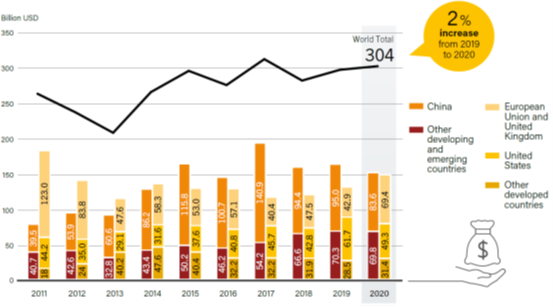
REN21 is recognized as a global energy community with the goal of collect, consolidate, synthesize and disseminate up-to-date information on Renewable Energy from around the world. According to the REN21 Report (2019), in 2018, 10 years after a severe economic crisis, the world experienced a period of relative stability in the sustainable technologies market. However, after the most acute phase of the Covid-19 pandemic (REN21, 2021) and the conflict between Russia and Ukraine (Castilho, 2022), the so-called "energy security" will gain even more prominence. Figure 1 shows the global investments made in renewable energy from 2011 to 2020 according to data from the REN21 (2021).
Figure 1 – Global investment in renewable energy capacity in developed, emerging and developing countries, 2011-2020
Source: REN21 (2021, p. 184). Translated by the authors.
Study carried out by Pricewaterhouse Coopers (PwC) called "The World in 2050" indicates that a group of seven emerging countries will take the lead in generating global wealth. The unbridled growth of these emerging countries will correspond to an average increase of 1.6% per year in world energy consumption. In other words, it will take twice as much energy in the year 2050, or 21 billion tons of oil equivalent to meet demand. Greenhouse gas emissions may double by the middle of the century and make the global warming scenario even more critical, depending on which energy sources are determined for supply (Bizawu & Aguiar, 2016).
According to Appavou (2019), the result of policies aimed at energy development in a sustainable way generates not only environmental impacts, but also on the economy. The economic effects caused by renewable energies in the world are not only based on investments. The opening of many new job opportunities is one of the great positive factors of this market. This is especially because these opportunities often arise in remote regions with few companies, such as in rural areas and even on islands, thus creating a possibility of development for emerging economies.
According to Guevara et al. (2020), the use of renewable energies brings energy autonomy to the country, since its use does not depend on the import of fossil fuels from other countries, in addition to granting the generation of new jobs, investments, especially in less favored areas. Providing, then, the economic growth of several cities further away from urban centers, consequently generating business, urbanization, schools and new housing. Another advantage, which is worth mentioning, is related to the increase in research into new technologies that allow improving energy efficiency. Enabling the country to make new scientific discoveries, being able to share them with other countries, contributing to the growth of technology, as well as to the advancement of humanity.
In addition, perhaps the main advantage for the use of renewable energies is linked to the fact that their environmental impact is lower than that caused by energy sources originating from fossil fuels, since they do not produce Greenhouse Gases (GHGs). The use of sustainable energy contributes to a better quality of life. Thus, these energies help mitigate global warming, a climate phenomenon caused by the retention of above-normal heat on the earth's surface and in the oceans, something that can catastrophically result in the extinction of flora and fauna (Guevara et al., 2020).
However, Guevara et al. (2020) highlights the following disadvantages of renewables:
1) Energies from wind, sunlight and water are usually subject to the unpredictability of nature. In other words, when there is little incidence of sun, wind, or even low reserves in hydroelectric plants, when they go through drought, there is no generation of electricity. Therefore, sustainable energies are totally at the mercy of changes in nature, which can compromise the population supply.
2) There is a very high cost of investments and appropriate infrastructure. For example, the use of solar energy requires several solar panels, to capture enough energy to sustain a city. The cost of a solar panel is still high. For the execution of this energy source, a high capital investment is required, which often does not end up being advantageous or motivating the investor.
3) In the case of a hydro plant, ecological problems usually occur, such as the destruction of fauna, flora and displacement of riverside populations.
But despite some disadvantages, these are outweighed by the positive aspects involved in the generation and use of renewable energies, leading society to build a new model of relationship with nature. This certainly changes the current mode of production and consumption (Campos et al., 2022).
In dealing with this new context, Lara and Oliveira (2017) state that the effects caused by these patterns of production and consumption have led societies, companies and public institutions to think more intensively about issues related to sustainability from different perspectives, such as economic, social and environmental in search of a new form of development, guided by sustainable development.
In this new context, the 2030 Agenda, especially through SDGs 8, 9 and 12, recognizes that private business activity, investment and innovation are motivating components of development and productivity. Companies are essential for sustainable development not only for their financing, but also for ensuring the capillarity of their actions (Silva, 2021). Therefore, it can be said that, currently, not relating sustainability to the organizational context and business performance has become inexplicable (Silva, De Benedicto, Sugahara, Bittencourt, & Conti, 2022). Even if some companies deviate from this scenario, it should be noted that the non-applicability of sustainability in their operations can cause a succession of problems – including as a threat to the continuity of the company's activities and its performance in the market (Dias & Marques, 2017).
To achieve the objective proposed in this study, an approach to Critical Success Factors (CSF) is carried out below.
3 Critical Success Factors (CSFs)
In the 1970s, John Fralick Rockart wrote a fundamental book on Critical Success Factors (CSFs). The author points to CSFs as an effective instrument in identifying the information necessary for the success of activities. In other words, CSF allows the identification of favorable results that contribute to ensuring competitive performance, whether at the individual or organizational level (Rockart, 1978). In the organizational field, Silveira, De Benedicto, Silva, and Bittencourt (2022) state that the CSFs serve as a set of indicators applicable to different types of organizations.
CSFs refer to those few areas that have the power to influence an organization's positive performance (González, Zambalde, Grützmann, & Furtado, 2018). In most organizations, there are about three to six factors that determine their success (Banales & Adam, 2007; Mathiyazhagan, Gnanavelbabu, Naveen Kumar, & Agarwal, 2022). A few areas, if they achieve positive results, ensure performance that will increase competitiveness and contribute to the success of the organization (Brodeur, Pellerin, & Deschamps, 2022). The biggest challenge is to identify the areas, elements or factors that most contribute to ensuring performance and increasing competitiveness. However, the technique used in CSF makes it possible to achieve this goal (Schaefer, Siluk, & Carvalho, 2022).
Identifying CSFs areas or activities that deserve the concentration of resources, helps in planning and, consequently, successful organizational management (Zaman, Wang, Rasool, Zaman, & Raza, 2022). Corroborating this, Freund (1988) states that they can be an effective way to focus strategic direction and investment, and, when used top-down, allow management to focus on more critical areas, and this whole process becomes an effective tool to communicate and unify the organization's strategic approach. According to Bullen and Rockart (1981), CSFs allow them to answer the following question: where should we turn our attention?
Caralli, Stevens, Willke and Wilson (2004), in defending CSF, present a set of positive aspects that justify their use: i) it is a simple and easy method to be used; ii) it is well accepted by management; iii) it offers support for organizational planning; iv) enables a structured analysis of each of the parts of the organization. According to Caralli et al. (2004), the main sources that can be investigated with the purpose of identifying CSF in organizations are: i) the sector in which the organization is inserted; ii) competitors (competitive position); iii) the surroundings (environment); iv) conjunctural or temporary events, and; v) management.
In recent years, CSFs have emerged as a powerful framework that points to problem solving in the organizational context (Librelato & Lacerda, 2021; Rodriguez Serna, Bowyer, & Gregory, 2022) and can significantly assist in project management (Jordão, Pelegrini, Jordão, & Jeunon, 2015; Shokri, Antony, & Garza-Reyes, 2022). However, despite the fact that the "organizational sustainability" approach has already had considerable scientific production in recent years, approaches are still needed that demonstrate how CSFs can be used as instruments to leverage organizational performance, with sustainability as a priority (Silveira et al., 2022).
4 Methods and research procedures
Based on the instructions of Chizzotti (2018) and Gil (2019), this research is considered applied, with a qualitative approach and exploratory objective. The research approach is qualitative, according to Lakatos and Marconi (2008) this approach brings together elements for the analysis of complex issues, such as habits, attitudes and trends.
Considering that the investigation was anchored in studies carried out and published in articles, dissertations, theses, government and sustainability reports and institutional documents on the use of energy from renewable sources in companies from other countries. Regarding data collection, this research was characterized as bibliographic and documentary. According to Gil (2019), bibliographic research uses sources consisting of material that has already been completed (for example, articles, dissertations, and theses, among others). Documental, on the other hand, uses primary sources, that is, data and information that have not yet been proven in a scientific or analytical way (for example, reports from government agencies, research reports, among others).
Initially, a search was carried out in the Capes Journal Portal and in the databases: Scielo, Scopus and Web of Science. In the search, keywords in Portuguese and English were used, with emphasis on recent and high-impact publications, as shown in Table 1.
Table 1: Keywords consulted in Portuguese and English
|
Keywords in Portuguese |
“energias renováveis” e “Brasil” |
Place of identification: Title and abstract of manuscripts |
|
“energias renováveis” e “países” |
||
|
“política” e “energias renováveis” |
||
|
“energias renováveis” e “empresas estrangeiras” |
||
|
“energias sustentáveis” e “empresas estrangeiras” |
||
|
“energias limpas” e “empresas estrangeiras” |
||
|
Keywords in English |
“renewable energy” and “Brazil” |
Place of identification: Title and abstract of manuscripts |
|
“renewable energy” and “countries” |
||
|
“policy” and “renewable energy” |
||
|
“renewable energy” and “foreign companies” |
||
|
“sustainable energy” and “foreign companies” |
||
|
“clean energy” and “foreign companies” |
Source: Elaborated by the authors (2022).
In view of the large number of materials resulting from the consultation, it was considered necessary to carry out a qualitative selection of the documents. In a second stage, the collected materials were filtered. At this stage, some criteria were adopted in the selection of contents, as shown in Table 2.
Table 2: Selection criteria, types of documents consulted and authors selected
|
Selection criteria |
Types of documents |
Selected authors |
|
Adherence to the research theme. Data quality. Focus on renewable energy policies. Focus on the adoption of renewable energy by companies. Within six years (i.e. between 2016 and 2022). |
Scientific: articles, dissertations and theses.
|
(Bizawu & Aguiar, 2016). It analyzes the challenges and prospects of renewable energy in emerging countries. |
|
(Bondarik, Pilatti, & Horst, 2018). It analyzes the potential for renewable energy generation in Brazil. |
||
|
(Eckhouse, 2017). It analyzes the goals set by the largest U.S. companies for renewable energy. |
||
|
(Juncal, 2019). It analyzes the trajectory of renewable energy policy in China and the future prospects. |
||
|
(Losekann & Hallack, 2018). It analyzes the challenges and opportunities of renewable energy in Brazil. |
||
|
(Ogunlana & Goryunova, 2017). It analyzes the tax rates and incentives for the adoption of renewable energies by European companies. |
||
|
(Rangel, Borges, & Santos, 2016). It performs comparative analysis of renewable energy costs and tariffs in Brazil. |
||
|
(Santos, 2020). It analyzes the use of renewable energies and energy efficiency actions in the Brazilian market. |
||
|
Institutional: content from specialized websites.
|
(Appavou, 2019). It analyzes the global panorama of renewable energy. |
|
|
(As You Sow, 2022). It presents research on the clean energy of the future. It indicates the top-ranked companies in the use, development, investment, and operation of renewable energy sources. |
||
|
(European Parliament, 2020). It sets the renewable energy policies and targets in the European Union. |
||
|
(PWC, 2021). It analyzes the adoption of tax incentives for renewable energy in South American countries. |
||
|
(REN21, 2021). Synthesizes up-to-date renewable energy information from around the world. |
Source: Elaborated by the authors (2022).
With the selected documents, the next step would be the search and identification of the Critical Success Factors, based on the policies adopted in the countries and the adoption of renewable energies by the companies.
In the present research, the discussion and contributions of the Critical Success Factors in the current Brazilian scenario was conducted based on the analysis of the data collected in the selected documents, these being scientific articles, dissertations and theses and contents of specialized websites, according to the selection criteria pointed out in Table 2.
Regarding the technical procedures, documentary research was used. Gil (2019) highlights that this type of research is used when the research materials have not received analytical treatment according to the research objectives. It is noteworthy that the documents pointed out in Chart 2 made it possible to identify a set of companies that use renewable energies in different countries, which contributed to the identification of the Critical Success Factors.
Following the guidelines of Caralli et al. (2004) and Silveira et al. (2022), the information collected was analyzed and organized into affinity groups, so that critical factors could be identified more efficiently in order to represent the main activities carried out in the organization and/or in the country, regarding the use of renewable energies. To this end, the following sequence was followed: 1. Definition of the scope; 2. Data collection; 3. Data analysis; 4. Identification of critical factors; 5. Analysis of Critical Success Factors.
5 Results
5.1 Presentation of results
Tables 3 and 4 present the Critical Success Factors identified in the research. Naturally, there is a link between government incentives and governance strategies adopted at the national level, in several countries, and the initiatives of the business sector in these same countries, since the legislation and government direction of a nation interfere – in this case in a positive way – in the way companies and industries act on agendas related to sustainability. However, the separate enumeration in two tables was done to facilitate the reading and understanding of the CSFs described.
Table 3: Key Critical Success Factors collected in countries, including government incentives and governance strategies, and their respective descriptions
|
Country/Region |
Description of Critical Success Factors |
|
North America, Asia (excluding China), and Europe |
In The United States, and European and Asian countries, the incentive to invest in renewable energy sources and green technologies has been a reality for a considerable time, mainly in the form of reduced taxes on the purchase of materials, land, installation and production of clean energy generators.
Examples can be given in countries with regard to investments in technologies: Belgium (14.5% reduction in the rate); Spain (12% credit rate), which has also regulated incentives associated with reducing losses in distribution networks (Iberdrola, 2022); Ireland (12.5% deduction rate); South Korea (10% reduction credit rate); United States (credit reduction in 30% reduction credit rate for solar energy) (Ogunlana & Goryunova, 2017).
In some European countries, the incentive rate for renewable technologies has the following proportions: Italy (34% for biomass, wind and photovoltaic technologies); Spain (between 8 and 12% for all); Belgium (13.5%) and Poland (30 to 70%) (Ogunlana & Goryunova, 2017). |
|
Latin America |
As of 2017, Argentina began to require that 8% of all electricity consumed nationally be generated from renewable energy sources. By 2025, the goal is to reach 20% (PWC, 2021).
In addition, Argentina has created tax incentives involving benefits to companies that address investments and constructions/projects for renewable energy generation in the country, such as: accelerated depreciation (income tax benefits); recovery of anticipated value-added tax with the purchase of assets or infrastructure; tax credit; exemption from taxes related to the import of assets involved in projects of this kind (PWC, 2021).
In Colombia, tax incentives for companies were regulated in 2014, such as: deduction of half of corporate income tax; accelerated tax depreciation, related to R&D and investments in the maintenance, management and operation of such energy sources; exemption from value-added tax, applied to assets inside and outside the country related to investments and R&D for projects of this kind (PWC, 2021).
Renewable energies are also among the economic sectors prioritized by the Ecuadorian state. They are subject to several benefits that stimulate their development. Currently, there are public processes opened by the State to grant the concession for the construction and operation of this type of enterprise (PWC, 2021).
Peru defines as a national priority the promotion of renewable energies (from solar, wind, geothermal, biomass and hydroelectric sources). It also sets targets for the percentage of renewable energy sources in relation to total domestic consumption and ensures stable long-term tariffs (PWC, 2021).
And Uruguay is seen as an example in the generation and management of renewable energy. About 97% of its electricity is produced from renewable sources, mainly wind and solar. The country has tax incentives regulated and strictly supervised by the "Administración Nacional de Usinas y Trasmisiones Eléctricas" (or UTE). Incentives include: tax exemptions (partial or total exemption from IRC, Net Worth Tax, VAT refund or exemption) if detailed projects are approved and recognized by the Executive Branch. (PWC, 2021). |
|
China |
China has policies aimed at developing and expanding the use of energy from different renewable sources. It includes awareness work and large-scale supply of renewable energy to the population and industries, seeking to manage the impacts that generate global climate change. Chinese legislation imposes a greater share of renewable energy among the sources available in the continental country, containing goals every 15 years to achieve it (Juncal, 2019).
Similarly, China presented a 15% reduction rate only for solar, geothermal, wind and biomaterial energy. (Ogunlana & Goryunova, 2017). |
Source: Survey data.
Table 4: Key Critical Success Factors Collected from International Companies
|
Critical Success Factors |
Description of Critical Success Factors |
|
Business strategy |
After 2010, Unilever reduced its electricity consumption by 28% and halved its carbon emissions per ton compared to previous years. It adopts a power purchase agreement in 38% of its electricity supply network, offering support in the development of the local renewable energy market of its facilities. It managed to achieve 100% renewable electricity grid in the units on five continents (Unilever, 2019). |
|
Iberdrola invested €337.5 million in 2021 in renewable energy innovations. It develops research in conjunction with universities and the creation of startups in renewable energy sources (Iberdrola, 2022). |
|
|
The Iberdrola company qualifies its advertisements and marketing communications by adopting voluntary mechanisms and codes that ensure such communications are transparent and truthful (Iberdrola, 2022). |
|
|
The Tesla company has adapted its facilities to be powered by renewable electricity, leading to a decrease in the carbon footprint, and uses this as a strategy to win customers and gain visibility in the market (Tesla, 2021). |
|
|
In the US, companies use the “Green-e logo” aimed at sustainable energy use to appeal to consumers’ environmental awareness and enhance their brand image. Consumers tend to pay more attention to these brands, which allows them to diversify their products from the competition. (Brannan, Heeter, & Bird 2021). |
|
|
The technology company, Apple, has projects – either by building its own sources (equivalent to 10% of its projects), investments in some clean energy markets (3%) or by long-term renewable energy contracts (87%) – to bring electricity from renewable sources generating a higher cost-benefit of energy and with less volatility in its prices in the market, in addition to consuming energy efficiently in its facilities (Apple, 2021). |
|
|
The company Suez Recycling and Recovery UK generates electricity with its own facilities and uses the reuse of waste in gasification, anaerobic digestion and landfill gas in most of its facilities. It has a thermoelectric plant for internal use or distribution to local factories in one of its units, adding the equivalent of electricity to the supply of almost 440 thousand homes (Suez Recycling and Recovery UK, 2021). |
|
|
Innovation and Use of Technologies |
In Germany, Siemens Energy holds a 67 percent majority stake. It focuses on the design, development, supply, and installation of technologically advanced products and services for the renewable energy sector using wind turbines for various wind conditions (Siemens Energy, 2022). |
|
In the United States, Tesla started to manufacture and sell high-tech solar panels and roofs, contributing to the decrease in the costs of these products over time (Tesla, 2021). |
|
|
Panasonic manufactures high-tech equipment for the installation and use of solar and hydrogen energy systems. It serves the market and also uses them internally in its production units (Panasonic, 2021). |
|
|
Economic and social benefits |
In Spain, residents of the Solar Community (secondary school and residents’ association) can enjoy 500W of free renewable energy, and will be able to monitor their savings with the App. The company Iberdrola has created a management platform offering subsidies to ‘Smart Solar’ customers that will make it easier for them to access subsidies from the New Generation of European Funds (Iberdrola, 2022). |
Source: Survey data.
5.2 Analysis of the results
Based on the critical success factors identified in Table 3, the countries of North America, Europe, Asia and South America reveal the initiatives and/or policies developed in terms of generation or use of renewable energy. This is because their results indicate a favorable position for investment and undertaking of renewable energy in the companies of the mentioned countries, such as the fact that almost all (97%) of Uruguay's electricity matrix is geared towards generation from renewable sources or the implication of a strong research and development (R&D) front of Iberdrola, in Spain, reaping the rewards in opportunities and market gains as a result of millions of euros invested.
To reach the point of success among these foreign companies, the political-economic and external infrastructure aspects; internal development of the organization; opening of investments in the financial market; government supervision and regulation; positioning in the market and business strategy are of utmost importance to reach the favorable and growing positions in which the companies have found themselves in recent years.
In view of this, some comparative and analytical suggestions between foreign and Brazilian companies are presented. Companies such as Iberdrola (Spain), Panasonic (Japan), Siemens (Germany), Tesla and Apple (United States), Unilever (on 5 continents) and Suez (United Kingdom), despite being in different markets and consumption/experience objectives at the end of their chain, all have a strong internal investment to make the energy consumed and sold in their processes come from renewable sources. With well-defined strategies and similar goals, its positive results demonstrated in the annual reports expose increasingly upward curves of improvement in performance, consumption and development both internally and externally (response of companies and end consumers in the chain).
On Brazil's side, although the numbers are modest in relation to the number of national companies that adopt this strategic stance from within the organization, as is the case of Natura, Klabin and Raízen, to name a few (Bondarik et al., 2018; Losekann & Hallack, 2018; Santos, 2020), the growing numbers of sales of their products, gains in efficiency in processes and reduction of pollution by GHG are notable, as well as the market's response to the brand's image in its relationship in favor of sustainability and adopting the 2030 Agenda as a guide, suggest encouraging profits and activities. Mainly, because there is a growing and developing electricity market in the country, it shows itself to be a viable path to be followed by national companies.
In Brazil, there are directions to disseminate biogas technology, but this process is moving at a slow pace. There are federal policies that support the Brazilian Biogas Innovation System (BBIS); however, biogas is still not competitive compared to other types of renewable energy. It is evident that the markets in this sector depend on state and federal support and investments, with the effective participation of public service companies, since they can guide the Brazilian Innovation System with actions such as public bidding and energy auctions (Borges et al., 2023). Added to this is the National Energy Transition Policy (PNTE), supported by the National Energy Transition Plan (Plante), and aimed at restructuring the country's energy matrix, making it more sustainable and aligned with the objectives of reducing greenhouse gas emissions. Its universal character seeks to promote not only the mitigation of negative impacts on communities and workers in the energy sector, but also to combat energy poverty, ensuring universal access to quality energy services, also in line with what is recommended by SDG 7 of the 2030 Agenda. The PNTE also emphasizes the importance of international cooperation and technological innovation as pillars for the energy transition (Ministry of Mines and Energy, 2024).
Still based on internal investment, it is worth highlighting the adaptation of products and services to the new demand for intermediate products in the development, construction and implementation of new plants with clean energy sources to be installed throughout the territory of countries on the five continents, a success factor taken advantage of by Tesla, Panasonic, Siemens and Iberdrola in offering installation services and/or facilitating products in the installation of renewable plants, resulting in a market gain and boosting of internal installation activities for renewable energy generation, since this niche has few supply options and an increasingly greater demand – given the political and governmental positions of Europe, the United States and Asia with a high commitment to expanding the achievement of the goals of the 2030 Agenda –, highlighting an opportunity that is well-used, strategically.
In this regard, Brazil may present difficulties for this type of position of Brazilian companies, since R&D in the national territory is basic and without a culture of creating patents in the Brazilian energy sector, making it necessary to import these products for the implementation of photovoltaic, hydraulic and wind power plants, for example, and, consequently, increasing costs due to tariffs and unit costs, despite presenting – in general – a short-term payback for the implementation of these plants (Bondarik et al. 2018; Nascimento & Alves, 2016; Rangel et al, 2016).
To improve the Brazilian situation, a proportional stimulus would be the nationalization and development of technologies, in addition to financing lines for new installations for renewable energy sources, an alternative argued in agreement by Santos (2020). Something that also proves advantageous is the strong partnership between companies, startups, universities and research centers to develop new technologies and more advanced methods that are favorable to services and products made for this renewable market, as is the case of Iberdrola, which plays an exemplary role in balancing the essential parties to establish a new product or a new means for the effectiveness of a process.
This can help to avoid disconnection between the aforementioned organizational areas towards a more economically and socially beneficial path, while efforts and investments would have a driving purpose on the part of research and competitive advantages regarding the interests of national companies in participating in this heated technological environment.
In terms of business, the data collected shows that foreign companies are contributing to the sustainable category on the stock exchange, which helps to boost competitiveness, encourage and circulate capital so that organizations adopt and use renewable energy and other sustainable attributes for mutual benefit (of the company and the economic and social group). In terms of brand image, it is also a favorable factor for participating in a diversified activity in the face of competition.
In this case, the activities of Brazilian national organizations may find an opportunity to do the same, something already done by large companies, but with the joint vision of seriousness for these investments and commitment to the environment, since, in isolation, it is not synonymous with guaranteeing sustainability in the company, but rather as another means of corporate strategy to encourage global goals in favor of an entire production chain.
When analyzing the political-economic aspect of some of the foreign regions collected, the presence of government actions in countries such as Argentina, Belgium, China, Spain, the United States, Ireland and Uruguay, it is possible to perceive a facilitation of market viability and global positioning of companies for participation and competition in the area of renewable energy. In the case of Brazil, Brazilian energy policy has stood out compared to other developed economies, as pointed out by the work carried out by Santos et al. (2024), which investigates the participation of private and state investment by type of energy source in the twenty largest economies, taking into account opportunities arising from technological and price transformations, in addition to the perspective and potential of renewable and non-renewable energy in the country.
This is a critical success factor that reveals the strength of the Brazilian energy transition. Santos et al. (2024) point out that over a period of twenty years, Brazil's role in the energy market will move from an energy-scarce country to a primary energy exporting country.
The justification for this critical success factor is due to the regulation and institution of policies and laws to establish targets for the participation of renewable energy in the regions (such as Argentina, China and Uruguay); the fiscal incentive and joint fees to boost the development and application of technologies in the area (mainly European countries, China and the United States); and strict supervision of undertakings and regulation of projects (Uruguay), enabling cooperation between the State and institutions to achieve goals, objectives and economic performance, in addition to the profitability and growth of companies becoming more tangible to their realities in the international market.
In this last factor, the comparative analysis between Brazilian companies integrates aspects discussed in the next section, such as: political, energy efficiency, use of territory and energy management, proving to be something more complex and implicative for more than one parameter.
In this context, an analysis of the Brazilian reality allows us to establish some points of impact for national companies. According to Santos (2020), the national energy and electricity matrix has a great potential for use within national limits, justified by Mauad, Ferreira and Trindade (2017) when presenting, regionally, in which renewable energy branches Brazil could be better used. These figures predict that: the North region has a better capacity for water resources; the Southeast region (expressively, the state of São Paulo), for biomass; wind power has a potential for exploration in the Northeast and Brazilian coastal regions; and, finally, solar in all regions, with the potential being one of the best in the world due to the high rate of solar irradiation (Santos, 2020).
Based on the statistical figures presented by EPE (2022), in 2021, hydro energy had a share of 55.3% (including HPP, SHP and CGH), in addition to wind with a share of 11% of the national electricity matrix, followed by biomass (7.9%) and solar (2.6%), symbolizing a growing use given the market opportunities.
This demonstrates an increase in the interest of Brazilian institutions in the implementation of renewable energy generation, but these numbers still do not represent a totality of what is said to meet the country's demand with the desired capacity (Bondarik et al., 2018).
In addition, in Brazil, there are laws regarding the incentive of equipment (Law No. 5,655, of 1971) for wind production; discounts from 50% on transmission and distribution fees for SHPs (Law No. 9,427, of 1996); sending resources to offset additive costs of electricity generation in isolated systems (Law No. 9,648, of 1998); institution of Proinfa and CDE to increase competitiveness in the renewable market (Law No. 10,438, of 2002) and tax benefits (ICMS, PIS and Cofins rates, IRPJ) for regions and allocation of investments in renewable energy plants (Mauad et al., 2017; PWC, 2021). It is also worth mentioning the National Energy Plan 2030 – PNE, which aims at the long-term planning of the country's energy sector, guiding trends and guiding the alternatives for the expansion of this segment in the coming decades (Ministry of Mines and Energy, 2007).
In addition, Santos et al. (2024) consider that Brazil has expanded its operational capacity with an installed capacity of wind and solar energy. This condition contributes to increasing the competitiveness of the sector. It is important to highlight that investments in the development of the local industry supply network are a major differentiator in the Brazilian energy market.
However, these do not foster and stimulate the national market and state to encourage the use of renewable energy due to the need to update regulations and legislation; establish supported sustainable goals and objectives; increase rigor in infrastructure and monitoring of projects in this sector. In order for the results presented by foreign companies to be similar to those of national companies, government investment in infrastructure, financial incentives and the adoption of strategies for better energy management are important factors to leverage Brazil's scenario in the global scenario.
By adopting these parameters, there is a tendency to: increase the variability of energy resources in order to reduce the risks of harmful impacts on energy security and the impacts of water crises; a downward trend in the costs of installing plants with renewable sources, enabling an initial investment cost favorable to clean energies compared to their antagonistic ones; energy efficiency present resulting in an approximate saving of 20% of the energy spent (Bondarik et al., 2018; Mauad et al., 2017; Santos, 2020).
Although the State has a fundamental role in improving the economic situation to expand the Brazilian participation in the development of new technologies, the use of renewable energy and the use and efficiency of the production chain, the willingness of corporations to change points to relatively quick results of financial return and brand visibility with its competitors, increasing the chances of success and growth of the company, resulting in a welcome alternative for appreciation.
In order to facilitate the visualization of all the Critical Success Factors found in the research and analyzed in this topic, Table 5 presents their synthesis in five CSFs:
Table 5: Summary Table of the Critical Success Factors found in the research
|
Category |
Critical Success Factors |
|
Public sector |
1. Political option, also translated into legislation, for the transition to sustainability, with the replacement of the previously polluting national energy matrix with clean energy, taking advantage of all the possibilities offered by the country, especially those geographically, and generating positive externalities for society and the environment; 2. Incentives and tax benefits (on the one hand) for investments in renewable energy sources and green technologies, and monitoring (on the other hand) of polluting activities or those that fail to comply with current legislation; |
|
Private enterprise |
3. Use of renewable energies in local plants, reducing the carbon footprint and, consequently, the fixed costs of maintaining activities; 4. Establishment of partnerships with Universities, Research Centers and startups for the production and strengthening of clean energy matrices; 5. Communication, transparency and awareness on the subject, understanding that the use of renewable energies is also a Corporate Social Responsibility (CSR) action and, therefore, a competitive advantage. |
Source: Survey data.
6 Final considerations
Currently, global activities progressively demand electrical energy to keep up with the growth of countries around the world, implying intensified exploration in the search for efficient energy resources and, more precisely, those that are beneficial to the environment (the stage for the greatest exploration of natural resources to meet this demand, whether through renewable or non-renewable means).
Therefore, due to the great negative impact resulting from human actions, the 2030 Agenda is seen as a global strategy to curb global warming and ensure the maintenance of the ecosystem. The 17 SDGs highlight the ambition for clean and renewable energy. This, in turn, is the main guideline for evaluating the Critical Success Factors of foreign companies, in a comparative manner, in order to analyze an intersection and attributes that can be correlated to Brazilian companies.
Among the various CSFs analyzed in the foreign companies studied, a strong presence of a well-structured, planned and integrated infrastructure was observed to promote the energy needs of companies such as Tesla, Iberdrola, Siemens, Apple and Unilever, to manage and obtain the positive performance achieved by them in the use of clean energy. The presence of an adaptation of production and supply of products to meet the growing demand for intermediate products and services that were capable of assisting in the construction and implementation of renewable plants favored the companies Panasonic, Tesla, Siemens and Iberdrola to participate in a deficit part of the market and, at the same time, to provide opportunities for growth and prominence.
At the basis of these CSFs is the important partnership and participation of the State in order to allow a greater balance of foreign companies and enable technological and infrastructure advancement that resulted in international highlights in the offering of services and products, as well as in fiscal assistance and faster achievement of government goals and objectives and the 2030 Agenda.
In general, Brazilian companies have a great advantage when analyzing the availability of renewable sources, climate and geographic factors. However, internal planning and investment are necessary to achieve advantageous results, economically and productively, from the adoption and promotion of R&D, through strong energy management, to partnerships between institutions (companies, research centers, universities and startups) to begin developing in the energy market and produce organizational actions that enable a quick and versatile return on this investment.
In contrast, the government's role extends across all boundaries of the energy market as a whole, with the need for state presence in updating and formulating laws and regulations that allow Brazil to expand its participation in the global market, taking advantage of the prominent proportion of clean energy in the national electricity matrix. It is worth asking whether the energy policy strategy adopted by Brazil is supported by sustainable development that considers energy justice in the face of the current threats posed by climate change.
This expansion would enable job creation, increase tax incentives and the proportion of infrastructure for Brazilian companies to use and stand out in the sector's competitiveness, in addition to achieving global sustainability goals and making it more economically viable to install a renewable plant instead of a non-renewable one due to the high prices of the former. In this regarding, there are paths to developing new national energy technologies and, consequently, to achieving SDG 7.
7 References
Agenda 2030. (2016). Transformando nosso mundo: a Agenda 2030 para o desenvolvimento sustentável. Retrieved from http://www.mds.gov.br/webarquivos/publicacao/Brasil_Amigo_Pesso_Idosa/Agenda2030.pdf
Appavou, F. (2019). Renewables 2019 Global Status Report. Retrieved from https://www.ren21.net/wp-content/uploads/2019/05/gsr_2019_full_report_en.pdf
Apple. (2021). Environmental Progress Report 2020. Retrieved from https://www.apple.com/environment/pdf/Apple_Environmental_Progress_Report_2021
As You Sow. (2022). Carbon Clean 200: Investing in a clean energy future. Retrieved from https://www.asyousow.org/report-page/2022-clean200
Banales, D. L. G., & Adam, M. R. (2007). Factores críticos de éxito de la industria del software y su relación con la orientación estratégica de negocio: un estudio empírico-exploratorio. Journal of Information Systems and Technology Management, 4(1), 47-70.
Barbosa, V. (2015). A nova era da energia renovável já começou no Brasil. Retrieved from https://exame.com/economia/a-nova-era-da-energia-renovavel-ja-comecou-no-brasil/
Bizawu, K., & Aguiar, P. L. M. (2016). Energias renováveis e desenvolvimento sustentável: desafios e perspectivas para os países emergentes. Conpedi Law Review, 2(4), 394-411. http://dx.doi.org/10.26668/2448-3931_conpedilawreview/2016.v2i4.3671
Bondarik, R., Pilatti, L. A., & Horst, D. J. (2018). Uma visão geral sobre o potencial de geração de energias renováveis no Brasil. Interciência, 43(10), 680–688. Retrieved from https://www.interciencia.net/wp-content/uploads/2018/10/680-HORST-43_10.pdf
Borges, C. P., Silberg, T. R., Uriona-Maldonado, M., & Vaz, C. R. (2023). Scaling actor´s perspectives about innovation system functions: diffusion of biogas in Brazil. Technological Forecasting and Social Change, 190, 122359. Retrieved from https://www.sciencedirect.com/science/article/abs/pii/S0040162523000446#preview-section-introduction
Brannan, D. B., Heeter, & Bird, L. (2021). Made with renewable energy: how and why companies are labeling consumer products. Golden, CO: NREL.
Brodeur, J.; Pellerin, R.; Deschamps, I. (2022). Operationalization of critical success factors to manage the industry 4.0 transformation of manufacturing SMEs. Sustainability, 14(14), 8954. https://doi.org/10.3390/su14148954
Bullen, C., & Rockart, F. J. (1981). A primer on critical success factors. Retrieved from http://hdl.handle.net/1721.1/1988
Campos, P. B. N., De Benedicto, S. C., Silva, L. H. V., & Sugahara, C. R. (2022, novembro). Identificação dos fatores críticos de sucesso no uso de energias renováveis nas empresas estrangeiras e aplicação na realidade brasileira à luz dos objetivos da agenda 2030. In Anais do 4º Sustentare da PUC-Campinas, 7º WIPIS da USP São Carlos, Campinas, SP, São Carlos, SP, Piracicaba, SP.
Caralli, R., Stevens, J., Willke, B., & Wilson, W. (2004). The critical success fator method: establishing a foundation for enterprise security management. Retrieved from http://resources.sei.cmu.edu/library/asset-view.cfm?AssetID=7129
Castilho, F. P. (2022). Energia, guerra e transição: a guerra da Ucrânia e os novos paradigmas do consumo energético. Conjuntura Global, 11(3), 62-78. http://dx.doi.org/10.5380/cg.v11i3.86616
Chizzotti, A. (2018). Pesquisa em ciências humanas e sociais. (9. ed.). São Paulo: Cortez.
Dias, L. S., & Marques, M. D. (2017). Organizações e sustentabilidade: aproximações, cooperação e distanciamentos. Revista Eletrônica de Gestão Organizacional, 15(1), 73-85. https://doi.org/10.21714/1679-18272017v15n1.p73-85
Eckhouse, B. (2017). Maiores empresas dos EUA fixam mais metas para energia renovável. Retrieved from https://exame.com/negocios/maiores-empresas-dos-eua-fixam-mais-metas-para-energia-renovavel/
EPE – Empresa de Pesquisa Energética. (2022). Anuário estatístico de energia elétrica 2022. Retrieved from https://www.epe.gov.br/pt/publicacoes-dados-abertos/publicacoes/anuario-estatistico-de-energia-eletrica
EPE – Empresa de Pesquisa Energética. (2020). Fontes de energia. Retrieved from https://www.epe.gov.br/pt/abcdenergia/fontes-de-energia
EPE – Empresa de Pesquisa Energética. (2017). Projeção da demanda de energia elétrica para os próximos 10 anos (2017-2026). Rio de Janeiro, RJ: MME/EPE.
Feil, A. A., & Schreiber, D. (2017). Sustentabilidade e desenvolvimento sustentável: desvendando as sobreposições e alcances de seus significados. Cadernos EBAPE.BR, 14(3), 667-681. http://dx.doi.org/10.1590/1679-395157473
Freund, Y. P. (1988). Critical success factors. Planning Review, 16(4), 20-23. https://doi.org/10.1108/eb054225
Gil, A. C. (2019). Métodos e técnicas de pesquisa social. (7. ed.). São Paulo: Atlas.
Goldemberg, J., & Lucon, O. (2007). Energia e meio ambiente no Brasil. Estudos Avançados, 21(59), 7-20. Retrieved from https://www.revistas.usp.br/eav/article/view/10203
González, J. V., Zambalde, A. L., Grützmann, A., & Furtado, T. B. (2018). Critical success factors (CSF) to commercializing technologies in universities: The radar framework. Lecture Notes in Computer Science, 11032, 123-132. http://dx.doi.org/10.1007/978-3-319-98349-3_10
Guevara, A. J. H., Silva, F. S. C., Hayashi, G. K., & Sangiuliano, G. U. (2020). Sustentabilidade: desafio 1 – Energia. Retrieved from https://www.pucsp.br/sites/default/files/download/eventos/bisus/d1-energia.pdf
Iberdrola. (2021). Statement of Non-Financial Information - Sustainability Report: Financial Year 2021. Retrieved from https://www.iberdrola.com/documents/20125/1606413/gsm22_IA_SustainabilityReport2021.pdf
Ipea – Instituto de Pesquisas Econômicas Aplicadas. (2018). ODS – Metas Nacionais dos Objetivos de Desenvolvimento Sustentável. Brasília, DF: IPEA. Retrieved from https://www.ipea.gov.br/portal/images/stories/PDFs/livros/livros/180801_ods_metas_nac_dos_obj_de_desenv_susten_propos_de_adequa.pdf
Jordão, R. V. D., Pelegrini, F. G., Jordão, A. C. T., & Jeunon, E. E. (2015). Fatores críticos na gestão de projetos: um estudo de caso numa grande empresa latino-americana de classe mundial. Gestão & Produção, 22(2), 280-294. https://doi.org/10.1590/0104-530X1091-13
Juncal, L. F. (2019). Virada Verde na China? Um estudo de caso sobre a trajetória da política de energia renovável (2000-2017). (Dissertação de Mestrado). Universidade Federal de Minas Gerais, Belo Horizonte, Brasil.
Lara, L. G. A., & Oliveira, S. A. (2017). The ideology of economic growth and the business discourse of sustainable development. Caderno EBAPE.BR, 15(2), 326-348. https://doi.org/10.1590/1679-395159387
Lakatos, E. M., & Marconi, M. de A. (2008). Metodologia Científica. 5. ed. São Paulo: Atlas.
Librelato, T. P., & Lacerda, D. P. (2021). Fatores críticos de sucesso do ecossistema de inovação: uma meta-síntese sobre a participação de universidades. Revista Produção Online, 21(1), 105-130. https://doi.org/10.14488/1676-1901.v21i1.4174
Losekann, L.; Hallack, M. (2018). Novas energias renováveis no Brasil: desafios e oportunidades. Retrieved from https://repositorio.ipea.gov.br/bitstream/11058/8446/1/Novas%20energias%20renov%c3%a1veis%20no%20Brasil_desafios%20e%20oportunidades.pdf
Mathiyazhagan, K., Gnanavelbabu, A., Naveen Kumar, N., & Agarwal, V. (2022). A framework for implementing sustainable lean manufacturing in the electrical and electronics component manufacturing industry: An emerging economies country perspective. Journal of Cleaner Production, 334, 130169. https://doi.org/10.1016/j.jclepro.2021.130169
Mauad, F. F., Ferreira, L. C., & Trindade, T. C. G. (2017). Energia renovável no Brasil: análise das principais fontes energéticas renováveis brasileiras. São Carlos, SP: EESC/USP.
Ministério de Minas e Energia. (2007). Plano Nacional de Energia 2030 / Ministério de Minas e Energia; colaboração Empresa de Pesquisa Energética. Brasília: MME: EPE. 324 p. Retrieved from https://www.gov.br/mme/pt-br/assuntos/secretarias/sntep/publicacoes/plano-nacional-de-energia/plano-nacional-de-energia-2030/relatorio-final/plano-nacional-de-energia-2030-pdf.pdf/view.
Ministério de Minas e Energia (2024). Política Nacional de Transição Energética. Retrieved from https://www.gov.br/mme/pt-br/assuntos/secretarias/sntep/dte/cgate/pnte.
Nascimento, R. S., & Alves, G. M. (2016) Fontes alternativas e renováveis de energia no Brasil: métodos e benefícios ambientais. Revista Univap, 22(40), 274. https://doi.org/10.18066/revistaunivap.v22i40.713
Ogunlana, A. O., & Goryunova, N. N. (2017). Tax incentives for renewable energy: the european experience. Lifelong Wellbeing in the World, 19, 507-513. Retrieved from https://www.europeanproceedings.com/files/data/article/50/1579/article_50_1579_pdf_100.pdf
ONUBR. (2017). Conferências de meio ambiente e desenvolvimento sustentável: um miniguia da ONU. Retrieved from https://brasil.un.org/pt-br/76532-conferencias-de-meio-ambiente-e-desenvolvimento-sustentavel-um-miniguia-da-onu
Panasonic. (2021). Annual Report 2021. Retrieved from https://holdings.panasonic/global/corporate/investors/pdf/annual/2021/pana_ar2021e_a3.pdf
Parlamento Europeu. (2020). Energias renováveis. Retrieved from https://www.europarl.europa.eu/ftu/pdf/pt/FTU_2.4.9.pdf
Parlamento Europeu. (2016). Resolução do Parlamento Europeu, de 23 de junho de 2016, sobre o relatório relativo aos progressos no domínio das energias renováveis. Retrieved from https://www.europarl.europa.eu/factsheets/pt/sheet/70/renewable-energy
PWC. (2021). Incentivos fiscais para energias renováveis na América do Sul. Retrieved from https://www.pwc.com.br/pt/publicacoes/servicos/assets/assessoria-tributaria-societaria/2021/incentivos_fiscais_21.pdf
Rangel, M. S., Borges, P. B., & Santos, I. F. S. (2016). Análise comparativa de custos e tarifas de energias renováveis no Brasil. Revista Brasileira de Energias Renováveis, 5(3), 267–277. http://dx.doi.org/10.5380/rber.v5i3.48124
REN21. (2019). Renewables 2019 Global Status Report. Retrieved from https://www.ren21.net/wp-content/uploads/2019/05/gsr_2019_full_report_en.pdf
REN21. (2021). Renewables 2021 Global Status Report. Retrieved from https://www.ren21.net/wp-content/uploads/2019/05/GSR2021_Full_Report.pdf
Rockart, J. F. (1978). A new approach to defining the chief executive’s information needs. Cambridge, MA: Massachusetts Institute of Technology (MIT).
Rodriguez Serna, L., Bowyer, D., & Gregory, S. (2022). Management control systems. A non-family stakeholder perspective on the critical success factors influencing continuous stakeholder support during businesses succession. Journal of Small Business and Enterprise Development, 29(6), ahead-of-print. https://doi.org/10.1108/JSBED-09-2021-0364
Roma, J. C. (2019). Os Objetivos de Desenvolvimento do Milênio e sua transição para os Objetivos de Desenvolvimento Sustentável. Ciência e Cultura, 71(1), 33-39. http://dx.doi.org/10.21800/2317-66602019000100011
Santos, E. P. (2020). Mercado no Brasil para o uso de energias renováveis e ações de eficiência energética. Dissertação de Mestrado). Universidade de São Paulo, São Paulo, Brasil.
Santos, M. E. M., Singh, J. N., Castro, R., Santos, H., Costa, H. K. de M., & Santos, E. M. (2024). SWOT analysis of Brazilian energy policy: a comparative panel data analysis of the twenty largest economies. Energy Policy, 191, 114172. https://doi.org/10.1016/j.enpol.2024.114172
Sartori, S., Latrônico, F., & Campos, L. M. F. (2014). Sustentabilidade e desenvolvimento sustentável: uma taxonomia no campo da literatura. Ambiente & Sociedade, 17(1), 01-22. Retrieved from http://www.scielo.br/scielo.php?script=sci_arttext&pid=S1414-753X2014000100002&lng=en&nrm=iso
Schaefer, J. L., Siluk, J. C. M., & Carvalho, P. S. (2022). Critical Success Factors for the implementation and management of energy cloud environments. International Journal of Energy Research, 46(10), 13752-3768. https://doi.org/10.1002/er.8094
Shokri, A., Antony, J., & Garza-Reyes, J. (2022). A new way of environmentally sustainable manufacturing with assessing transformation through the green deployment of Lean Six Sigma projects. Journal of Cleaner Production, 351, 131510. https://doi.org/10.1016/j.jclepro.2022.131510
Siemens Energy. (2022). Sustainability Report 2021. Retrieved from https://assets.siemens-energy.com/siemens/assets/api/uuid:f9cc58e5-e334-4b64-8fe6-ffa989192b6a/siemens-energy-sustainability-report-2021.pdf?ste_sid=d74769aa15768077dbb7e45a964b4fdd
Silva, L. H. V. (2021). Aplicação e impactos dos Objetivos de Desenvolvimento Sustentável em grandes empresas privadas do setor industrial no Brasil (Dissertação de Mestrado). Pontifícia Universidade Católica de Campinas, Campinas, Brasil.
Silva, L. H. V., De Benedicto, S. C., Sugahara, C. R., Bittencourt, J. J., & Conti, D. M. (2022). Application and impacts of sustainable development goals in large Brazilian industries. Revista de administração da UFSM, 15, 817-840. https://doi.org/10.5902/1983465969429
Silveira, L. L., De Benedicto, S. C., Silva, L. H. V., & Bittencourt, J. J. (2022). Strategic business sustainability: study of critical success factors. Revista de administração da UFSM, 15, 760-780. https://doi.org/10.5902/1983465969205
Singh, U., & Singh, S. (2023). Future research directions to facilitate climate action and energy transitions. Energy and Climate Change, 4, 100092. https://doi.org/10.1016/j.egycc.2022.100092
Suez Recycling and Recovery UK. (2021). Sustainability Report 2020. Retrieved from https://www.suez.co.uk/en-gb/news/list-of-publications
Tesla. (2021). Impact Report 2020. Retrieved from https://www.tesla.com/ns_videos/2020-tesla-impact-report.pdf
Unilever. (2019). Unilever achieves 100% renewable electricity across five continents. Retrieved from https://www.unilever.com/news/press-and-media/press-releases/2019/unilever-achieves-100-per-cent-renewable-electricity-across-five-continents
Wang, L., & Shao, J. (2023). Digital economy, entrepreneurship and energy efficiency. Energy (Oxford), 269, 126801. https://doi.org/10.1016/j.energy.2023.126801
Zaman, S., Wang, Z., Rasool, S. F., Zaman, Q., & Raza, H. (2022). Impact of critical success factors and supportive leadership on sustainable success of renewable energy projects. Energy Policy, 162, 112793. https://doi.org/10.1016/j.enpol.2022.112793
Zhang, Q., Wu, Y., Yan, J, & Peng, T. (2023). How to promote rural household energy transition in energy poverty area? Energy Reports, 9, 539-551. https://doi.org/10.1016/j.egyr.2022.12.001