Sensemaking, decision-making and private educational management in a city in Sergipe
Sensemaking, tomada de decisão e gestão educacional privada de cidade sergipana
Eloina Santos Nascimento1*, ORCID: https://orcid.org/0000-0001-6090-3592; Ludmilla Meyer Montenegro2, ORCID: https://orcid.org/0000-0003-2346-7589.
1. Universidade Federal de Sergipe, Programa de Pós-Graduação em Administração, São Cristóvão, Sergipe, Brasil. E-mail: eloinasnascimento4@gmail.com
2. Universidade Federal de Sergipe, Programa de Pós-Graduação em Administração, São Cristóvão, Sergipe, Brasil. E-mail: ludmilla2907@gmail.com
Abstract
Basic education is a benchmark for building citizens and is made up of the interaction of different actors, among which the manager has the mission of mediating this series of relationships and making decisions. Faced with the complexity of managing an educational institution, this study aimed to understand the sensemaking process in decision-making in the educational management of private institutions in a city in the Brazilian State of Sergipe. The research methodology was qualitative, exploratory and descriptive, with the application of semi-structured interviews and a psychological personality test, in a study of multiple case studies. It can be concluded that personal experiences, personality and emotional aspects exert a strong influence on the way managers create meaning and make their decisions. Moreover, findings show that decisions are always taken in a structured way. The study contributes to the understanding of decision-making in educational management under a subjective emphasis and oriented towards the relationships and meanings of management.
Keywords: decision-making, sensemaking, school management.
Resumo
A educação básica é um referencial da construção de cidadãos é composta pela interação de diversos atores, dentre esses, o gestor tem a missão de mediar essa série de relações e tomar decisões. Diante da complexidade de gerir uma instituição de educação, este estudo objetivou compreender o processo de sensemaking nas tomadas de decisões na gestão educacional de instituições privadas de uma cidade sergipana. A metodologia de pesquisa foi qualitativa exploratória e descritiva, com a aplicação de entrevista semiestruturada e teste psicológico de personalidade, em um estudo de casos múltiplos. Pode-se concluir que experiências pessoais, aspectos da personalidade e emocionais exercem forte influência no modo como as gestoras criam sentido e tomam suas decisões e; que as decisões nem sempre ocorrem de maneira estruturada. O estudo contribui para a compreensão da tomada de decisões na gestão educacional sob uma ênfase subjetiva e orientada para as relações e sentidos da gestão.
Palavras-chave: tomada de decisão, sensemaking, gestão escolar.
Citação: Nascimento, E. S., Montenegro, L. M. (2023). Sensemaking, tomada de decisão e gestão educacional privada de cidade sergipana. Gestão & Regionalidade, v. 41, e20259233. https//doi.org/10.13037/gr.vol41.e20259233
1 Introduction
Schools are conveyed as spaces for fostering relationships among different social groups, with the manager being the mediator of all these interrelationships. In other words, he/she seeks to align communication between his/her team, the students, their families, the community, social demands, in conjunction with the objectives proposed by the institution itself (Lima, 2021). In the midst of daily activities and the articulation of the various actors that make up this environment, decisions are constantly made, ranging from the simplest to highly complex decisions.
The literature portrays aspects of school management, as well as the practices and activities of managers (Faustino & Silva, 2020; Silva-Filho & Damaceno, 2021). Takahashi, Graeff and Teixeira (2006) also discuss management strategies and the growth of private schools in Brazil due to the weakening quality of teaching in public schools in the country.
A study by Xiao & Li (2020), carried out in China, on the impacts of the pandemic on education highlights that there have been shortcomings in access to technology due to the lack of knowledge of teachers and students, as well as the shortage of software and devices, which prevented online teaching. This resulted in the closure of some offline education companies, besides repercussions of late student graduation and unemployment.
Some international studies have focused on sensemaking of autonomy and control, comparing school managers in independent public schools in a Swedish case study (Nordholm, Arnqvist & Nihlfors, 2022). Moreover, other studies have been carried out on intuition and sensemaking with managers of Information Technology companies and car manufacturers in Sweden and France, indicating the crucial role of sensemaking in analyzing information to achieve high-quality ideas (Sukhov et al., 2021).
With the changes that have taken place in the context of the Covid-19 pandemic, the new scenario for education has caused a series of negative and positive impacts for schools and their management, as well as for teachers and students (Peres, 2020). Among the challenges, the following stand out: maintaining the (good) functioning of schools, sectors and employees; the possibility of continuing the studies of children and adolescents remotely; internet access for all, as a means of maintaining activities, among other issues (Faria & Moura, 2021). Besides, the following positive impacts on the education sector can be pointed out: dealing with new teaching tools and getting to know technological resources (Rondini, Mayra Pedro & Duarte, 2020; Fávaro et al., 2021).
In the Brazilian state of Sergipe, following the state government's decree to contain and reduce the spread of Covid-19, social isolation was inevitable. Thus, on the sixteenth day of March 2020, 2,126 public and private schools were closed, which affected a contingent of 331,297 students, according to data from the last census carried out by the National Institute of Educational Studies and Research Anísio Teixeira (INEP) in 2018 (Santos, Lima & Linhares, 2021).
In the literature on sensemaking and the role of management in the most diverse organizations, there are studies on sensemaking (Gioia & Chittipeddi, 1991; Weick, Sutcliffe & Obstfeld, 2005); sensegiving (Gioia & Chittipeddi, 1991) and sensebraking (Maitlis & Christianson, 2014).
Sensemaking refers to the process in which people seek to attribute meaning to events in a given environment, applying their acquired knowledge, experiences, values and beliefs to new situations in order to understand them (Weick, Sutcliffe & Obstfeld, 2005). In turn, Sensegiving is defined by Gioia & Chittipeddi (1991) as an attempt to influence the creation of meaning and the construction of meaning by others for a chosen redefinition of a given organizational reality. Sensebraking, on the other hand, is associated with breaking down a given meaning in order to reframe and direct a new meaning (Maitlis & Christianson, 2014).
Given the dynamic nature of the organizational context and the changes that impact day-to-day management, sensemaking stands out as an appropriate analytical basis for understanding different phenomena, not least because of its broad view of issues, interactions and the construction of everyday meanings. In addition, sensemaking provides a wide analysis both at the individual and cognitive level of the subject, considering experiences, values and beliefs, and at the relational level, creating social and group meaning. Moreover, it has a relationship with the decision-making process, as pointed out by various authors, among them: Tillmann & Goddard (2008); Leitão & Nassif (2009) and Giuliani (2016).
Against this backdrop, this study sought to investigate the following problem: How does the sensemaking process occur in the decision-making process used by the management of private schools in a city in the Brazilian State of Sergipe?
This study is justified in view of the period of uncertainty generated by the Covid-19 pandemic, in which numerous institutions faced difficulties and sought strategies to remain active amidst the critical health and economic scenario (Faustino & Silva, 2020). In addition, it is also based on the possibility of providing an alternative reading of management and decision-making processes, based on sensemaking.
2 Literature review
2.1 Decision-making
In theoretical reflections, Rocha & Angnes (2017) point out that decision-making is based on Greek and Chinese philosophy, with foundations in rational logic. In turn, it is also based on the principle of utility, that is, in the choice of an action, occurring from a set of choices and possible alternatives.
Rocha & Angnes (2017) state that a decision usually needs to be made whenever one is faced with a situation that needs to be resolved or a problem that needs to be solved. In this regard, it is also linked to cognition, i.e. cognition will provide the person with direction when making their decision, along with their past experiences and their cultural background.
According to Brito & Amaral (2020), decisions can most often be based on a set of factors to achieve financial objectives, especially within an organization. This is considered a fundamental and complex process, given that it also has to deal with good choices in order to prevent high risks.
Löbler et al. (2019) point out that decision-making is considered by some theorists to be a learned habit that will inevitably have differences. These differences are linked with the amount of information and the number of alternatives up to the moment of the decision. Thus, Daft & Weick (2005) believe that decision-making is linked to the information process and, in turn, to the way in which this information is interpreted within the organization. Therefore, decisions are also interconnected with the interpretations made by the individual.
In order to analyze the statements made by the managers interviewed within the scope of this work, this study considered the concept of decision-making proposed by Rocha & Angnes (2017). This concept takes into account the analysis of options and recognizes that it is an action produced by the brain, which will lead to the choice of an alternative to solve a given problem. Besides, it recognizes that decision-making often takes place in relation to changing and contradictory objectives or even in unstructured circumstances.
2.1.2 Managers and the decision-making process: necessary relationships
According to Simon (1976), humans are rationally limited. Thus, when individuals try to be rational, their rational behavior is limited by their cognition and also by the organizational restrictions inherent in all environments. In this regard, decision-makers tend to adopt strategies that simplify the complexity of problems and the amount of information they have to make a decision.
According to Bragé & Costa (2020), decision-making is an extremely important function within management. The authors also state that decision-making means the function of choosing between two or more alternatives, always seeking to choose the best alternative for the organization.
Bragé & Costa (2020) point out that people who make decisions based on an analytical style are more likely to be rational, i.e. not acting impulsively, thus using plenty of cognition. However, those who make decisions based on an intuitive model often let their affective processes interfere significantly. The authors consider that combining the two styles is beneficial, as managers can use reason and information analysis, without losing their affection for what they are doing and for all parties involved.
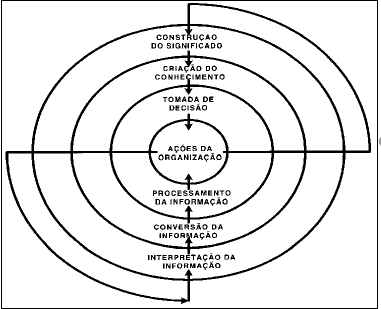
In this process, the search for information, the socialization of this information and the creation of their own meanings, taking into account their experience and the reality of the organization, are essential to make a decision that is more coherent with their reality and which, in turn, can achieve good results. Choo (2003) created a scheme that highlights the path of information meaning-making in the decision-making process by managers. Figure 1 represents the information processing paths for building knowledge and making decisions in organizations.
Figure 1
The Organization of Knowledge
Source: Adapted from Choo (2003, p. 31).
For Choo (2003), an organization that manages to effectively integrate the processes of creating meaning, building knowledge and making decisions can be considered a knowledge organization. The decision-making models proposed by Choo (2003) - rational, political, procedural and anarchic models - were used to analyze the cases studied in this research.
The rational model is the most systematic and structured, with pre-defined rules and procedures to be followed in order to obtain a satisfactory result. It is also considered a closed model, whose organization is highly bureaucratic, with formal rules. In the political model, whose mechanism is decision-making, the actors occupy different positions in terms of their degree of influence.
The procedural model, on the other hand, elucidates the phases and cycles that support decision-making activities, which are more complex and also dynamic. It is a model that focuses on phases, as well as activities, and the dynamics of decision-making processes.
The anarchic model has ambiguous objectives and procedures, i.e. there is no clear vision regarding problems and decision-making. Also known as the "garbage can" model, there is no presentation of the organization's experiences in this model, since problems and solutions are solved by the decision-makers, regardless of the decisions made.
2.2 Sensemaking
Gioia & Chittipeddi's (1991) conception of sensemaking refers to the process in which the actors involved construct and reconstruct the meaning of a given event while seeking to understand it. They also define sensemaking as a cognitive process, oriented towards analysis and interpretation, in the construction of frames of reference, frameworks, schemas and/or mental models (Cunliffe & Coupland, 2012; Maitlis & Christianson, 2014). It is considered as a movement that collaborates in creating, sustaining and legitimizing organizational practices (Cunliffe & Coupland, 2012).
Taking into account the impossibility of understanding reality in its entirety, sensemaking is the production and apprehension of meanings. As such, reality is made up of discontinuities that promote ambiguity, which will require rational and emotional processes to decode the phenomena that permeate existence (Weick, 1995).
Sensemaking thus represents the process in which individuals perceive and interpret unexpected and confusing events, and structure an explanation for their meaning (Weick, 1995). From a unique perspective, sensemaking allows us to understand how the actors in organizations understand the environment in which they permeate through verbal or internal behaviors, which construct and limit their own behaviors, while also changing the environment and requiring a new understanding of such.
With a new point of view on understanding organizations (Weick, 1995), sensemaking establishes relationships between the organizational context and the way in which the actors who make up these spaces create meanings based on their experience, as well as through the culture and discursive context of which they are part at the time.
According to Weick (1995), organizations should be understood as dynamic processes that are constantly influenced by the actions of the people who are part of them. In this vein, sensemaking is understood as a cognitive and social process that takes place to the extent that it seeks to resolve highly complex situations, seeking to mitigate the ambiguity of problematic events in organizations (Weick, 1995).
2.2.1 Sensemaking and managers: creating meaning in organizations
The theory of sensemaking can be used to understand how organizational actors produce meaning from their activities in the business environment. This idea comes from sociology, psychology, strategy and organizational theory and was brought to management by Karl Edward Weick (Mello, Fonseca & Vieira, 2012).
Cunha (2021) highlights one of Weick's most effective contributions to understanding this complex process, explaining seven properties inherent to sensemaking. These are: 1- it is a process based on the construction of identity; 2- it is retrospective; 3- it propagates sensitive environments; 4- it is a social process; 5- it is continuous; 6- it focuses on clues and suggestions and; 7- it is more guided by plausibility than precision (Cunha, 2021).
Garcia, Montenegro & Araújo (2021) relate ideas that contribute to understanding the intrinsic aspects of the sensemaking process and decision-making in organizations. The aforementioned authors point out that considering that rationality is limited (Simon, 1947). However, the authors still recognize that experience helps organizational actors, since they produce and reproduce rules and resources in every new situation.
Given the breadth of particularities that exist in the sensemaking process, an analysis was made of the sensemaking of the school managers interviewed in the decision-making processes in school management. To this end, the seven properties of sensemaking (Weick, 1995) were taken into account as a basis for understanding what is involved in the senses that culminate in the decisions made.
2.3 School management
2.3.1 School management: pedagogical, administrative and decision-making perspectives
Libâneo (1997), when discussing management in schools, already pointed out that the term management has a broader scope than administration and organization. Thus, the author proposes its application within a systemic vision, understanding the education system as a whole, with the educational policies and guidelines of schools, management of education systems, autonomy and participatory processes.
Another aspect worth noting is that a manager needs to manage every situation that arises at their school, from enrollment to student access, the budget, school meals - everything that guides the school and is part of its context (Santos, Andrade & Linhares, 2021). Therefore, school management implies being attentive from the perspective of mobilization for the innovation of collective and liberating educational practices that will seek to guarantee equity in order to ensure transformation (Santos, Andrade & Linhares, 2021).
The educational institution is characterized as an environment for discussion and debate in which the actors involved - students, teachers, families and the management team - interact in the decision-making process, following the wishes and objectives of the school community (Araújo, 2020). Nonetheless, school managers are often not trained in management, with most of them coming from continuing education courses in the area, but generally being long-standing teachers (Silva & Bonfim, 2020).
Santos, Andrade & Linhares (2021) emphasize that democratic practices need to be part of the school management context. The school management process needs to coordinate the education system as a whole, while also paying attention to the laws that guide education (Oliveira & Menezes, 2018).
According to Faustino & Silva (2020), the coordinator/manager needs to be active and be able to understand their emotions so that they can control them. They also need to have mastery of their role and improve themselves with new technologies and transformation, in other words, they need to have the capacity for innovation.
With regard to the qualities that managers need to have, Faustino & Silva (2020) mention the ability to receive criticism and to consider the opinions and suggestions of other educators, as well as the need to be aware of new resources that contribute to promoting learning, so that the school can be successful in its operation and the development of its work.
2.3.2 School management and educational practices in times of pandemic
The complexity of the practice of educational policy was further accentuated during the pandemic, especially in the development of school activities in line with the restrictions triggered by this period (Silva, Silva & Gomes, 2021; Leal et al., 2021). These authors point out that the school, a place of constant training and social interaction, became an isolated and motionless environment during the social isolation at the height of the pandemic. As a result, the manager's role suddenly became even more intense, presenting new demands and challenges to keep the institution running (Honorato & Marcelino, 2020).
According to Leal et al. (2021), no one was prepared to deal with remote education, with education being monitored from home, neither managers, students, teachers, nor the community itself. Thus, it was of utmost importance to seek to understand this new way of educating and, in turn, adapt. Schools and the community needed to join efforts to achieve common goals. At this point, it was also necessary to create strategies, always seeking to build new paths.
Varela et al. (2020) point out that school managers, who are most often administrators, coordinators, teachers and psychologists, needed to be willing to reinvent themselves. Thus, to promote innovations, to have new visions, especially about their school beliefs, in order to succeed in the pandemic. Within education, it is essential that managers seek to minimize problems and thus seek help from their group. Planning and thinking together help them to change challenging situations, besides understanding the new demands that arise so that they can adapt (Giordano, 2021).
3 Methodology
This study is qualitative, exploratory and descriptive in nature. The research strategy was a multiple case study, which according to Menezes & Teixeira (2017), has been a widely used strategy as it enables comparisons to be made and more robust results to be achieved.
Managers of private primary schools in a city in the Brazilian state of Sergipe were interviewed. There are 7 private schools open in the city, but only 4 took part in the study. By contacting each one and explaining the research proposal, 3 managers showed no interest in taking part.
The criteria for choosing the schools were: a) private schools that are active in the market; b) schools that have a formalized management team; c) schools that allow non-participant observation in addition to interviews with managers or coordinators. The choice of schools to take part in the study was based, in addition to the criteria mentioned above, on the availability and acceptance of the managers to take part in the study, by signing the consent form and answering the interview questions and personality test.
Data was collected by means of semi-structured interviews with the managers of the selected schools, which were carried out in person with prior scheduling of on average one and/or two weeks prior to the interview date, only one of which was via social media. The interview script was built in blocks, containing data on the interviewee, such as school, gender, age, city, academic background, time working at the institution and weekly time dedicated to working at the institution; the second block with data on the interview: date, place, and duration; a third block on data on the school-organization: time of operation, number of employees, role performed by each position and; the fourth block with 19 open questions about sensemaking and the decision-making process in educational management (Rocha & Angnes, 2017; Weick, 1995; Silva-Filho & Damasceno, 2021).
A psychological profile test was also administered to the managers interviewed in order to better understand the implication of their psychological personality traits in the way they make decisions. The test used was QUATI - version II. The Typological Assessment Questionnaire (QUATI) was the first typological assessment test in Brazil, in Portuguese and was produced by José Jorge de Morais Zacharias, a psychologist. The structure of the test is based on Carl Gustav Jung's theory of psychological types (Melo Neto et al., 2021).
A Free and Informed Consent Form (FICF) was used, which was presented and read to the managers before the interview began. After they agreed and signed, the interview began and was recorded for later transcription and coding into analysis categories, as shown in Table 1. The participants were informed that their participation would not be compulsory and that they were free to withdraw at any time, so no procedures would be adopted that would cause them discomfort or risks.
Table 1
Categories and elements of analysis
|
Specific objective: to understand the process of construction of meanings by key informants in the context of the schools studied. |
|
|
Categories |
Elements of analysis |
|
Social elements |
Degree of interaction between actors, for example, feeling of belonging to the group, feeling of comfort/discomfort, environment open or closed to suggestions and criticism; internal communication, external communication, symbols, meanings, language. |
|
Administrative and management practices |
Work routines, planning, control systems, formal and informal meetings, training, events, lectures, etc. |
|
Behavioral practices |
Interaction between managers, coordinators and teachers, environment/organizational climate. |
|
Sensemaking |
Meanings attributed to decision-making in school management. |
|
Specific objective: to describe the decisions made by school management |
|
|
Categories |
Elements of analysis |
|
Administrative and management practices |
Work routines, planning, control systems, formal and informal meetings, training, events, lectures, etc. |
|
Decision-making procedures |
Steps, how it happens, exchange and handling of information. |
|
Specific objective: to understand and discuss the effectiveness, impacts and possible benefits of decision-making from the point of view of sensemaking. |
|
|
Categories |
Elements of analysis |
|
Social elements |
Degree of interaction between the actors, for example, feeling of belonging to the group, feeling of comfort/discomfort, environment open or closed to suggestions and criticism; internal communication, external communication, symbols, meanings, language. |
|
Sensemaking |
Meanings attributed to the results obtained from the decisions made |
Source: Prepared by the authors (2023).
Narrative analysis was carried out on the data obtained from the interviews, based on the analytical categories shown in Table 1. The personality test was analyzed based on Jung's theory of Psychological Types.
4 Results
This section presents the data collected through semi-structured interviews and the application of the QUATI Personality Test. It should be noted that the same criteria were used to collect the information in the institutions investigated. Four managers were interviewed, each from a different school. The analysis was divided as follows. First, an explanation of each case with a table showing the main concepts arising from the interviewees' statements, followed by an analysis of the personality profile of each of them, based on the test applied and, finally, points of relationship between the cases interviewed are highlighted in the analysis.
Description of the cases selected for the research
Table 2 shows the general details of the institutions studied, as well as the representatives interviewed at each of them. The interviews were conducted during the second semester of 2022, between the months of September and November. All interviews took place at the schools.
Table 2
General Data on the Managers and Institutions Interviewed
|
General Data on Managers and Institutions |
||||
|
FEATURES |
SCHOOL A |
SCHOOL B |
SCHOOL C |
SCHOOL D |
|
Gender |
Female |
Female |
Female |
Female |
|
Age |
27 years old |
51 years old |
41 years |
67 years old |
|
Academic training |
Postgraduate studies |
Postgraduate studies |
Postgraduate studies |
Postgraduate studies |
|
Time working at the institution |
1 year |
12 years |
18 years |
34 years |
|
Time the school has been open |
1 year |
12 years |
46 years |
34 years |
|
Number of employees |
10 |
14 |
43 |
50 |
Source: Prepared by the authors (2023).
Case A
At the time of the interview, school A had only been in business for one year. The interviewee pointed that she and her husband had always been interested in education and in setting up a school. Using a space that was already rented out to a school that closed its doors during the pandemic, she and her husband rented the space and, together with a teacher to help with the pedagogical procedures for opening a school, founded the first Montessori school in the city where she lives. Table 3 shows the main concepts of the interviewee's statements based on the analytical categories previously pointed out.
Table 3
Main Concepts Pointed Out by Manager A
|
Categories of Analysis |
Main Concepts Pointed Out - Manager A |
|
Sensemaking |
Montessori method; Child development; Practical learning; Freedom with security; Affection and care; Criticism of the traditional approach; Development of motor coordination; Personal experience; Individuality and respect for the rhythm of learning; Child autonomy; Practical and playful classes. |
|
Behavioral Practices |
Frequent meetings at the school; Occurrence of events or situations that require attention and resolution; Need to solve problems immediately to avoid future complications. |
|
Social Elements |
Including parents in the school’s decisions; Solving problems through WhatsApp conversations; Valuing students individually; Maintaining a bond and openness to dialogue with parents; Humanity at work; Positive changes in pedagogical approach; Acceptance of open-minded teachers with no previous experience; Openness to changes and suggestions. |
|
Decision-making procedures |
Notes and meetings; Decision-making: how she makes decisions considering her own observations and opinions, and also seeking the opinion of other people such as her partner and husband; Teacher involvement; Changes and adjustments; External influence; Security. |
|
Administrative and Management Practices |
Parental participation in students' school life; Meetings with parents and between professionals; Teamwork between school professionals; Teacher planning and training; Communication via e-mail and WhatsApp; Records and storage of information; Evaluation and monitoring of the changes implemented; Problem-solving and the search for effective solutions. |
Source: Prepared by the authors (2023).
Case B
School B was opened in 2010, when, due to the family history of siblings with degrees and working in education, they decided to open a business in which they could practice their professions. The headmistress had been with the institution since it was founded and reported working every day of the week during office hours. Table 4 shows the main concepts expressed by the manager based on the analytical categories.
Table 4
Main Concepts Pointed Out by Manager B
|
Categories of Analysis |
Main concepts pointed out - Manager B |
|
Sensemaking |
Opening a school in honor of a teacher's sister; Moving to a different city to run the school; The importance of the parents' role in their children's education; The importance of being demanding with students and encouraging their potential; Difficulties faced during the pandemic and the lack of partnership from staff; Administrative challenges and dealing with staff; The role of the teacher as an educator and responsible for discipline; The importance of education coming from home; Problems with students' excessive use of mobile phones. |
|
Behavioral Practices |
Negative impact of the pandemic on the current situation; Challenges faced with employees leaving; Hiring new employees and the need to train them; Importance of conveying the institution's expectations and values to employees; Need to meet an annual schedule and lack of recognition on commemorative dates; Pressure to perform tasks with quality and personal satisfaction; Difficulty in dealing with financial issues related to paying employees; Prioritizing equal payment for all employees; Communication about unavailability of payment and deadlines. |
|
Social Elements |
Relationship between parents and teachers; Role of teachers; Search for specialists; Diagnosis of autism; Difficulties in attending private schools; Need for court order and medical reports; Importance of adequate care for children's needs; Financial difficulties; Multidisciplinary team at school; Concern for the well-being of parents and students. |
|
Decision-making procedures |
Management with the heart; Human side; Staff; Different opinions; Technology; Teacher autonomy; Dynamic classroom; Study and effort; Alternative strategies and plans; Collaborative suggestions and decisions. |
|
Administrative and Management Practices |
Decision-making; Relations with parents and students; Recording and monitoring actions; Difference between public and private schools; Emotional involvement of the manager with her responsibilities. |
Source: Prepared by the authors (2023).
Case C
The private school in case C had been in business for 46 years. The interviewee had worked at the institution for 18 years. Table 5 summarizes the main points of the interview with manager C, highlighting them based on the analytical categories used in the study.
Table 5
Main Concepts Pointed Out by Manager C
|
Categories of Analysis |
Main concepts pointed out - Manager C |
|
Sensemaking |
Desire to work at school since childhood; Training in pedagogy and invitation to work at the school; Emotional bond and sense of belonging to the school; Working in different professional areas (education, law, hypnotherapy); Importance of dealing with people, understanding behavior and contexts; Challenges of school management; Relationship with parents and understanding human behavior; Practice versus theory in education; Learning and maturing through practical experience; Conflict mediation and understanding human behavior; Importance of self-care and self-reflection in dealing with others; Human management as the main form of leadership. |
|
Behavioral Practices |
Fortnight meetings to evaluate activities and necessary changes; Assessment of events and defining agendas; Consensus in the work environment; Flexibility in changing direction over time; Evaluation of the whole and necessary adjustments; Use of WhatsApp groups for communication; Emphasis on organizing the classroom environment; Valuing targeted and safe activities for children in the playground; Concern for the safety and well-being of children. |
|
Social Elements |
Communication and participation of parents in the school’s decisions; Participation of the administrative side (management, finance, coordination) in specific decisions; Search for a common denominator and consensus between the ideas of the people involved; Holding individual meetings with parents to hear their opinions and suggestions; Welcoming parents and listening to their opinions and ideas as partners of the school; Holding separate meetings with each class or segment; Different styles of administration and management; Emphasis on the importance of dialogue and proximity to resolve conflicts. |
|
Decision-making procedures |
Critical thinking, considering different areas (pedagogical, legal, etc.) before making decisions; Legal knowledge; Pedagogical aspects; Influence of previous experiences; Influence of the media and social networks; Challenges of the pandemic; Quality of teaching; Participation of those involved; Online classes; Modernity and competition with social networks; Valuing participation and teamwork. |
|
Administrative and Management Practices |
Frequency of meetings; Monitoring the implementation of actions; Constant training; Recording and monitoring decisions. |
Source: Prepared by the authors (2023).
Case D
The school represented by case D had been running for 34 years. The manager of school D is one of the owners and has been since it was founded. The school is a family-run business, based on the identification of deficiencies in public education networks and on recognizing that there was a portion of the population that could not afford to enroll their children in the private network due to their financial circumstances. Table 6 lists the main points addressed in the interviewee's statements in accordance with the questions and analytical categories of this study.
Table 6
Main Concepts Pointed Out by Manager D
|
Categories of Analysis |
Main Concepts Pointed Out - Manager D |
|
Sensemaking |
Observing deficiencies in schools in order to build their own; Differences between public and private schools; Experiencing difficulties with school registration; Building the school: The founders demolished an old building and built the current school in just 60 days; Family management; Impact and adaptation during the pandemic; Learning from mistakes. |
|
Behavioral Practices |
Taking advantage of the pandemic to adapt to remote teaching; Positive elements such as online communication; The school's slogan and identity; Scheduling meetings and events; Improving relationships with parents and the use of technology. |
|
Social Elements |
Decisions always communicated; Parental participation; Teacher consent; Relativity of decisions; Progressive adherence to some decisions; Importance of trust. |
|
Decision-making procedures |
Team decision-making; Important school experience. Discrepancy between theory and practice in education; Learning through external situations; Need to adapt and absorb what is relevant; Personal growth through experiences; Staying with and improving what is working well; Resilience and overcoming challenges, such as the pandemic; Openness to innovations while maintaining a solid foundation. |
|
Administrative and Management Practices |
Meetings with parents; Meetings with staff; Decision-making; Remote classes. |
Source: Prepared by the authors (2023).
Typological Assessment Questionnaire (QUATI)
The QUATI test is based on Carl Gustav Jung's theory of personality (1967) and covers attitudes (focus of attention), perceptual functions (related to receiving information) and evaluative functions (aimed at making decisions) to structure 16 psychological types. According to Zacharias (2003), the aim of this test is to assess personality through the situational choices made by the individual during the test. It also shows the styles in which each person interprets the environment, pointing out cognitive and behavioral aspects.
Attitude, in Jungian theory, means the direction that psychic energy or libido takes through representations of the external world of facts, people and things (De Maria, 2014). The test works with the idea of two psychic attitudes (I - Introversion and E - Extroversion) and four psychic functions, two of which are rational (those that cross the field of consciousness and are therefore identified as rational): St - feeling and Ps - thinking; and the other two irrational (which are apprehended directly at the Unconscious level): In - intuition and Ss - sensation. In this regard, personality dynamics distinguishes between these functions in terms of intensity and order, thus maintaining psychic homeostasis (Melo Neto et al., 2021).
According to Jung, "type is a general disposition that is observed in individuals, characterizing them in terms of interests, references and abilities. By disposition one must understand the state of the psyche prepared to act or react in a given situation" (1967, p. 551). It should be noted that the use of the Jungian typology system is not intended to define human behavior in its entirety, but rather to enable a closer understanding of psychic phenomena (Zacharias, 2003).
Of the 4 managers interviewed, 2 were classified as focusing on an extroverted attitude (managers A and C) and the other 2 (managers B and D) as focusing on introversion. According to Jung (1967), no individual is purely extroverted or introverted. Both attitudes are present, but one of the attitudes was more developed as a result of adaptation. These functions together with the attitudes (In and E) represent the Psychological Types.
One aspect that stands out is the fact that both managers have feeling as their main psychic function. The feeling and thinking functions are part of the evaluative functions, oriented towards decision-making. For Jung, the feeling function is linked to the evaluative dimension, as well as to a personal value and should not be confused with emotion.
Table 7
Psychological types of the managers interviewed
|
Managers |
ATTITUDE |
MAIN FUNCTION |
AUXILIARY FUNCTION |
|
A |
E |
St |
In |
|
B |
I |
St |
Ss |
|
C |
E |
St |
Ss |
|
D |
I |
St |
Ss |
Source: Prepared by the authors (2023).
Thus, individuals with feeling as their main function generally make decisions based on their own personal values, or even on the values of other people, even if these decisions lack logic or objectivity (Zacharias, 2003). Table 7 shows the data resulting from the application of the QUATI test, grouping the psychological types of each manager analyzed.
5 Discussion
5.1 Sensemaking and social and behavioral practices
There were some points in common between the four managers interviewed, including the fact that none of them had specific training in management before taking up the post. Only the manager of school B did a postgraduate degree in management a few years after becoming head of the school. This corroborates other studies, such as Silva & Bonfim (2020). Another point in common was the prevalence of female managers.
In the typological analysis of the personality profile of the managers, the four interviewees found feeling as the main or dominant behavior - a behavior that attributes to individuals their particular characteristics in the way they see the world and act on situations. Psychological types with this dominant behavior tend to value personal feelings and values in their assessments and decision-making and to judge the intrinsic value of things, as well as seeking to maintain harmony in the environment (Zacharias, 2003).
One aspect highlighted in the narratives of three of the managements was the focus on relational value for students and parents over financial value. All four schools use social networks to facilitate the exchange of information with their staff and parents. This is also in line with what Ferraz, Abreu & Motta (2021) point out, that in the midst of the Covid-19 pandemic, pedagogical work had found online communication tools as a support point for communication between the team and the entire educational community.
When seeking to understand how the managers' sensemaking process takes place, three of them cited the Covid-19 pandemic as an example of a difficult and uncertain situation they faced. The three managers who cited the pandemic are part of institutions that had already been active when the pandemic broke out. The other institution (A) opened after the restrictive period of the pandemic, even using a space where it had once been a school, which closed its doors during the pandemic period.
It was clear that the managers interviewed make use of knowledge acquired in other training and/or jobs in their current management position. For instance, the manager of school A recognizes that the spirit of leadership she has always had and her previous work as a doula have had repercussions on the humanized management she seeks to develop. In addition, manager B recalls that her previous work as a cashier, having been a team leader in other positions, have also influenced her organization and the way she seeks to relate to the school staff. In turn, the manager of school C uses her knowledge of behavior and the legal sphere to deal with relationships at work. At school D, the manager recognizes that her teaching experience has been one of the main pillars of her management approach.
5.2 Administrative and decision-making practices
At the outset, the prevalence of schools founded and run by people from the same family is noteworthy. Only in school C was the manager not part of the family running the school, though she felt like she was, given that her feeling of belonging and identification with the institution was very strong. She even recounts that since childhood she had dreamed of working at the school, referring to the institution as "my school".
Regarding the decision-making models proposed by Choo (2003), based on the report of manager B, similarities were observed with the anarchic decision-making model. The practices of manager C were closer to the rational model and the management of school D was closer to the political model. The relationship between the decision-making models proposed by Choo (2003) and Jung's personality types, more specifically the introvert and the extrovert types, can be established by considering the characteristics and influences of each type in relation to the decision-making process.
The "human" character and the association with feelings such as "love" stand out at various points in the narratives of the four managers. This aspect of the interviewees' management is related to what Coelho & Linhares (2008, p. 4) believe, that "in effective schools, managers act as pedagogical leaders [...] and as leaders in human relations".
This may also be related with the meanings attributed to the role of each of these managers, also based on their personal and subjective experiences. It can be said that the managers who had no experience in management positions created meaning for their practice in their daily work and on how they identified more effective ways of conducting the process and engaging the school community in the decisions made.
Regarding the results of the decisions taken, the head of school A understands that, so far, in the midst of the difficulties of management and the start-up of the institution, she has managed to cope with the prospect of growth. For the manager of school B, despite the financial difficulties and dealing with other staff members and parents, she is still in charge and believes that the partnership between parents and the school has been strengthened, and that she will succeed in the administration.
In turn, manager C usually monitors decisions and stays close to employees, making changes when she realizes that a decision is not effective, and does not postpone the decision. Finally, the manager of institution D believes she has been successful with her decisions, exemplifying the context in which the Covid-19 pandemic arose and using technology to hold classes remotely and improve relations with the school community through social networks.
6 Conclusion
The results obtained from the interviews show that the sensemaking process of the school managers is primarily based on their personal experiences. Nonetheless, the managers also observe the emotional aspects present in this process, including the meanings attributed to their own management activity. However, the decision-making process of each of these managers varied, with some of the models proposed by Choo (2003) being found: the bureaucratic, anarchic and rational models.
In turn, the results of the application of the personality test to the interviewees and their narratives on decision-making portray that feelings and emotions have a direct influence on the management of the four schools and their decision-making. Three of the managers see the decisions they have made so far as effective and positive. One of them showed dissatisfaction, particularly at the decline in the organization's/school's income, reporting a lack of fulfillment in her 12-year tenure at school B.
Thus, taking into account the findings of the sample investigated, it can be concluded that far beyond the decision-making models presented in the literature, managers tend to consider their life experiences and the meaning they attribute to them when making decisions and exercising school management. In addition, managers also make use of intuition in the decision-making process.
It should be noted that this study was only carried out in the context of a city in the interior of the Brazilian state of Sergipe, which had seven private schools, four of which could be analyzed. Recognizing as a limitation of this study the impossibility of researching all the schools identified based on the selection criteria, it is important to consider the possibility of further research encompassing other cases that may provide insights into other aspects of the concepts studied. Moreover, it is also important to consider the creation of new decision-making models based on subjective aspects and the personality of individuals, which may also be relevant to the literature and to advancing the understanding of subjective aspects of management.
References
Araújo, G. A. S. (2020). Public school management and occupational stress in the context of the covid-19 pandemic in Ceilândia-DF. Revista Nova Paideia-Revista Interdisciplinar em Educação e Pesquisa, 2(2), 39-55.
Bragé, D. K. & Costa, L. F. (2020) Intuition and decision-making in management: a bibliometric review from 2009 to 2019. Journal of Entrepreneurship and Micro and Small Business Management, 5 (1), 137-156.
Brito, A. D. & Amaral, M. S. (2020). Prospect theory: real estate investor decision-making in the light of behavioral finance. Navus: Journal of Management and Technology, 10(1), 1-16.
Choo, C. W. (2003) The knowledge organization: how organizations use information to create meaning, build knowledge and make decisions. São Paulo: SENAC.
Coelho, S. B. R. & Linhares C. (2008, Mar.). Participatory management in the school environment. Revista Eletrônica Latu Sensu, 3(3).
Cunha, F. L. (2021). The challenge of strategic change in management imposed by the pandemic. 2021. 93f. Dissertation (master's) - Brazilian School of Public and Business Administration, Rio de Janeiro.
Cunliffe, A. & Coupland, C. (2012). From hero to villain to hero: Making experience sensible through embodied narrative sensemaking. Human relations, 65(1), 63-88.
Daft, R. L. & Weick, K. E. (2005). Toward a model of organization conceived as an interpretive system. RAE-Revista de Administração de Empresas, 45(4), 73-86.
De Maria, C. C. (2014, Nov.). Inventory of the Typological Profile, using the Quati test, of employees working in information units. XVIII National Seminar on University Libraries SNBU 2014, Belo Horizonte - MG.
Faria, T. C. & Moura, J. P. S. (2021). Reflections on school management during the pandemic and its relationship with the smartphone and the use of whatsapp. In: Anais do Congresso Nacional Universidade, EAD e Software Livre.
Faustino, L. S. S. & Silva, T. F. R. S. (2020). Educators facing the pandemic: dilemmas and alternative interventions for coordinators and teachers. Boletim de Conjuntura (BOCA), Boa Vista, 3(7), 53-64.
Fávaro, L. C., Fonseca, L. R., Souza Luciano, T. D., Minasi, L. F., Silva, M. R. & Lahmann, D. F. P. (2021). The impact of the COVID-19 pandemic on the pedagogical practices of basic education math teachers. Paranaense Journal of Mathematics Education, 10(22), 446-469.
Ferraz, J. P. V., Abreu, D. C. & Motta, M. A. (2021). Regulation of pedagogical and school work in times of pandemic. Notandum, (56), 111-121.
Garcia, A., Montenegro, L. M. & Araújo, G. F. (2021). Reflexivity and learning in the sensemaking process: a multiple case study in junior companies in Sergipe. Farol-Revista de Estudos Organizacionais e Sociedade, 8(21), 122-171.
Gioia, D. A. & Chittipeddi, K. (1991). Sensemaking and sensegiving in strategic change initiation. Strategic management journal, 12(6), 433-448.
Giordano, D. X. F. (2021). A look at the work of school managers in the context of the pandemic. Educação Básica Online, 1(1), 125-133.
Giuliani, M. (2016). Sensemaking, sensegiving and sensebreaking: The case of intellectual capital measurements. Journal of Intellectual Capital, 17(2), 218-237.
Honorato, H. G. & Marcelino, A. C. K. B. (2020, Jan.-Jun.). The art of teaching and the COVID-19 pandemic: the teachers' view. REDE-Revista Diálogos em Educação, 1(1), 208-220.
Jung, C. G. (1967). Psychological Types. SP, Zahar.
Leal, I. O. J., Vasconcelos, C. R. D., Rios, L. P. & Araújo, J. A. Q. C. (2021). The impact of Covid-19 on daily school life: a study on the work of school managers in Jacobina/BA. Revista de Gestão e Avaliação Educacional, 10(19), p. 63188-1-13.
Leitão, P. C. C. & Nassif, M. E. (2009). Strategic decisions and information: organizational sensemaking as an alternative approach. Revista Eletrônica de Estratégia & Negócios, 2(1), 136-157.
Libâneo, J. C. (1997). Educação, pedagogia e didática: O campo investigativo da pedagogia e da didática do Brasil. Historical outline and search for epistemological and professional identity. In: PIMENTA, S.G. (Org.) Didática e formação de professores: percurso e perspectivas no Brasil e em Portugal. São Paulo: Cortez.
Lima, G. D. (2021). Educational management in times of Covid-19: the experiences of the municipal education department in Santa Rita-PB. 2021. Course Conclusion Work (Degree in Pedagogy), João Pessoa. Full degree course in Pedagogy.
Löbler, M. L., Reis, E., Nishi, J. M. & Tagliapietra, R. D. (2019, Jan.-Apr.). Inventory of decision-making styles: Validation of an instrument in the Brazilian context. Revista de Administração Unimep, 17(1).
Maitlis, S. & Christianson, M. (2014). Sensemaking in organizations: Taking stock and moving forward. Academy of Management Annals, 8(1), 57-125.
Mello, S. C. B., Fonseca, F. R. B. & Vieira, R. S. G. (2012). Sensemaking and the development of business relationship networks in the context of technology-based companies. Organizations & Society, 19(61), 253-275.
Melo Neto, P. L., Silveira, H. J., Fontes, D. C., Reis Neto, J. F. & Wagner, E. (2021). TYPOLOGICAL EVALUATION QUESTIONNAIRE: A Bibliographic Review. 5th International Meeting on Management, Development and Innovation (EIGEDIN), 5(1).
Menezes, C. R. C. & Teixeira, R. M. (2017). Innovations in small businesses in the service sector: a multi-case study in private schools in Sergipe. Revista de Administração da Universidade Federal de Santa Maria, 10(6), 1009-1026.
Nordholm, D., Arnqvist, A. & Nihlfors, E. (2022). Sense-making of autonomy and control: Comparing school leaders in public and independent schools in a Swedish case. Journal of Educational Change, 23(4), 497-519.
Oliveira, I. C. & Menezes, I. V. (2018). Literature review: the concept of school management. Cadernos de pesquisa, 48(169), 876-900.
Peres, M. R. (2020-jan.-jun). New challenges for school and classroom management in times of pandemic. Revista Administração Educacional, Recife, 11(1), p. 20-31.
Rocha, C. M. & Angnes, J. S. (2017). The decision maker's cognitive influence on information processing from the perspective of bounded rationality, Revista Espacios, 38(22), 25.
Rondini, C. A., Mayra Pedro, K. & Duarte, C. S. (2020). COVID-19 pandemic and emergency remote teaching: changes in teaching praxis. Educação, 10(1), 41-57.
Santos, M. G. G., Andrade, L. R. S. & Linhares, R. N. (2021). Non-face-to-face school activities during the covid-19 quarantine: the view of public school managers in the state of Sergipe. International Symposium on Education and Communication-SIMEDUC, 10.
Santos, R. C. C., Lima, R. D. & Linhares, R. N. (2021, Mar.). Sergipe State Technology Park and the multimedia literacy practices of basic education teachers during the Covid-19 pandemic. 10th International Symposium on Education and Communication (SIMEDUC).
Silva Filho, J. N. & Damaceno, C. (2021). School management and scientometrics: a study on the volume of scientific publications in the Scielo Brasil database. Educação em Revista, Marília, 22(2), 121-136.
Silva, G., Silva, A. V. & Gomes, E. P. S. (2021, Jan) School management in times of pandemic in the capital of Alagoas. Journal of Educational Policies, 15(1).
Simon, H. A. [1947] (1965). Comportamento administrativo: estudo dos processos decisórios nas organizações administrativas. Translation by Aluízio Loureiro Pinto. In: SIMON, Herbert Alexander. Administrative Behavior: A Study of Decision-making Process in Administrative Organization. The New York: The Macmillan Company. Rio de Janeiro: Getúlio Vargas Foundation.
Simon, H. A. (1976). Administrative Behavior: a Study of Decision-Making Processes in Administrative Organization. 3rd Edition. New York: Free Press.
Sukhov, A., Sihvonen, A., Netz, J., Magnusson, P. & Olsson, L. E. (2021). How experts screen ideas: The complex interplay of intuition, analysis and sensemaking. Journal of Product Innovation Management, 38(2), 248-270.
Takahashi, A. R. W., Graeff, J. F. & Teixeira, R. M. (2006, Oct.-Dec.). Strategic planning and female management in small companies: the case of private schools in Curitiba-Paraná. Organizations & Society, 13(39), 29-44.
Tillmann, K. & Goddard, A. (2008). Strategic management accounting and sense-making in a multinational company. Management Accounting Research, 19(1), 80-102.
Varela; J. H. S., Castro; A. B. C., Silva; C. A. F., Nodari; C. H. & Silva; A. W. P. da. (2020-out.-Dec.). Consequences of the Covid-19 pandemic: a management perspective in private early childhood education - reflect, act, retreat or anticipate? Colloquium Socialis, Presidente Prudente, 4(4), 143-147.
Weick, K. E. (1995). Sensemaking in organizations. Thousand Oaks, CA: Sage Publications.
Weick, K. E., Sutcliffe, K. M. & Obstfeld, D. (2005). Organizing and the process of sensemaking. Organization science, 16(4), 409-421.
Xiao, C. & LI, Y. (2020, april). Analysis on the Influence of the Epidemic on the Education in China. 2020 International Conference on Big Data and Informatization Education (ICBDIE), IEEE - Institute of Electrical and Electronics Engineers, 143-147.
Zacharias, J. J. M. (2003). QUATI: Typological Assessment Questionnaire (version II): manual. 5th ed., São Paulo: Vetor.