Received: 26/10/2023
Accepted: 07/08/2024
Relationship of Quality Control Circles and
Organizational Learning Process in Santa Catarina Companies: How does this analysis provide
clues about potential
contributions to the ESG process?
Relação dos
Círculos de Controle de Qualidade e Processo de Aprendizagem Organizacional nas Empresas Catarinenses: Como esta análise
fornece pistas sobre potenciais contribuições para o
processo ESG?
Varderlei Werlich1i, Orcid: https://orcid.org/0000-0002-9502-4253; Priscila Ferraz
Franczak2ii, Orcid: https://orcid.org/0000-0002-9549-7018; Marcelo Leandro de Borba3iii, Orcid: https://orcid.org/0000-0002-1940-5994; Denise Abatti Kasper Silva1iv*,
Orcid: https://orcid.org/0000-0002-2762-6818
1.
Universidade da Região de Joinville, Programa
de Mestrado em Engenharia de Processos, Joinville, SC, Brasil
2.
Universidade da Região de Joinville, Departamento das Engenharias e Exatas, Joinville, SC, Brasil
3. Universidade da Região
de Joinville, Programa
de Mestrado em Sistemas Produtivos, Joinville, SC, Brasil
*Autor correspondente: denise.abatti@univille.br; Rua Paulo
Malschitzki, 10, Joinville, Brasil, 89.219-710
Abstract
This study demonstrates how Quality Control Circles (QCC) facilitate organizational learning (OL) in companies associated with the Núcleo de Círculos de
Controle de Qualidade in Santa
Catarina, Brazil. The research was based on the
"4I's" model and the eight dimensions of OL, as outlined in the questionnaire and subsequent
quantitative analysis. Four hundred nineteen forms were distributed to 5,855
members of 28 companies, covering the three levels of participants. Of these,
272 were returned, and 242 were validated. The results demonstrated that the
QCC supports three dimensions of OL, with members and coordinators perceiving
these contributions differently from leaders. The study revealed
how QCCs promote
OL, boost employee development, and assist decision-makers. In the light of recent literature, it has been possible to show how this community
of practice can cooperate with ESG (Environment, Social and Governance) through
some dimensions of OL mediated
by knowledge management. Keywords: improvement
programs; learning process; knowledge management.
Resumo
Este trabalho aponta como os Círculos de Controle de Qualidade (QCC)
contribuem para o processo de aprendizagem organizacional (AO) em empresas associadas ao Núcleo de Círculos
de Controle de Qualidade em Santa Catarina,
Brasil. A pesquisa
baseou-se no modelo
“4I’s” e em oito dimensões de AO por meio de questionário e análise quantitativa. Dos 5.855 membros de 28 empresas distribui-se 419
formulários englobando os três níveis de participantes; 272 retornaram e 242 foram validados. Os resultados demonstraram que o QCC subsidia três dimensões da AO; os membros e coordenadores percebem
essas contribuições de forma
distinta dos líderes. Revelou como os QCC promovem a AO, impulsionam o desenvolvimento dos empregados e auxiliam os tomadores
de decisão. À luz da literatura de vanguarda, foi possível revelar como essa comunidade
de prática pode cooperar com ESG (Meio ambiente, social e governança) via
algumas dimensões de AO mediadas pela gestão do conhecimento. Palavras-chave: programa de melhoria; processos de aprendizagem; gestão
do conhecimento.
Citation: Werlich, V., Franczak, P., Borba, M. L., &
Silva, D. A. K. (2025). Organizational
Learning Process in Santa Catarina Companies: How does this
analysis provide clues about potential contributions to the ESG process?. Gestão
& Regionalidade, v.41, e20259318.
https//doi.org/10.13037/gr.vol41.e20259318
Gestão & Regionalidade | v. 41 | e20259318 | jan.-dez. | 2025. https//doi.org/10.13037/gr.vol41.e20259318
Copyright: © 2025, os autores. Licenciado sob os termos
e condições da licença Creative
Commons Atribuição -
1 Introduction
One of the Total Quality Management (TQM) practices is
the Quality Control Circle (QCC). The QCC methodology, introduced by Deming, Juran,
Crosby, and others
over 70 years ago, aims to improve the quality of processes and
products, provide a motivational force for workers, create a pleasant
environment that contributes to the development of professionals, increase
companies' growth potential and competitiveness (Aljaffan, 2017; Reza, 2020;
Hamaguchi & Ramos, 2023).
In Brazil, the TQM system, mainly
the QCC practices, continues to play an important role in industries because
it is ingrained in organizational culture (Hamaguchi & Ramos, 2023). Especially for workers at the shop
floor level, QCC participation helps in the perception of belonging to the
company, allows the workers’ involvement, encourages them to think about
solutions, and shares ideas and initiatives that keep them motivated (Lagares,
2011). Additionally, the QCC adaptation that Brazil did, configuring the
organization, promotes the engagement of workers and managers (Ferro &
Grande, 1997).
Otherwise, one can consider QCCs
accustomed to being challenged to think about solutions cooperatively, look for alternatives for the company’s
internal processes, and remain engaged in analyzing new
challenges presented in this century, such as the ESG agenda (Xia, 2022).
Maiti (2021) underscores the profound impact of financial
economics studies, which delve into the realm of sustainable investing, surpassing the conventional notion of maximizing shareholder wealth. These
studies, crucially intertwined with organizational performance, are based on
three key pillars: environmental footprints, responsibility, and
corporate governance. The acronym ESG (Environmental, Social and
Governance) is often employed to encapsulate the performance of organizations
in these parameters in financial analysis.
Thus, Xia (2022) provides the first comprehensive
assessment of the relationship between organizational learning and ESG,
highlighting that organizational learning related to ESG is essential to ESG
performance. Strengthening organizational learning makes engaging in ESG
practices in companies effectively possible, and it is only possible with the
support of senior management. This transcends to the conduct
of other employees
and consequently to the
results.
In a scenario where the decay of
the expectation of lifetime employment and increase in temporary and non-permanent workers, volunteerism to participate in QCC has reduced, and employees’ resistance to being
required to participate in unpaid QCC has increased (Hamaguchi & Ramos, 2023). Ensuring that recording events
within the QCC can be crucial to reduce the gap between the create/readapt and
innovation process and keep an OL strong.
The OL process begins
when someone acquires
and shares knowledge
with other people or groups in the organization,
followed by a recording of these ideas
that can be discussed and
tested (Vera & Crossan, 2003; Manfredini, Vinotti, Rosa & Santos,
2017). Hence, OL is understood as a social construction in which the knowledge
developed at the individual level will be directed towards organizational aims and, at
times of “deconstruction”, developing the need to unlearn to learn.
Organizations only learn thanks to individuals’ experiences and actions.
Further, personal knowledge does not transfer immediately or independently to
an organization, meaning people are the key (Steil, 2006; Antunes &
Pinheiro, 2020).
Furthermore, it is possible to see the convergence between
QCC methodology and OL.
Through QCC activities, employees acquire knowledge about working together to
improve their organization activities, resulting in the possibility of the
development of the individual’s abilities within the groups that share
their knowledge, allowing to generate an improvement of
the processes, contributing to the learning
processes and cost reduction (Blaga & Jozsef,
2014). These groups can be considered an environment for individual and
group learning and development, and knowledge can flow from the individual to
the organization and vice-versa. It is consistent with the OL model Crossan,
Lane and White (1999). Moreover, OL is a complex
construct based on a set of dimensions. Considering this, it was recognized as a measure
for the OL construct
developed by Templeton, Lewis and Snyder (2002) because this model had already
been validated in the Brazilian context.
Previously, a survey carried
out by Fodra (2019) identified few studies that analyzed the relationship between QCC and OL in
Brazil (Melo & Vasconcelos, 2007; Chiva, Alegre & Lapiedra, 2007;
Campos, 2004; Souza, Bresciani, Oliveir, Johann & Silva, 2020).
Although these groups
have been organized to contribute to quality in the manufacturing workplace (Mittal,
Gupta, Kumar & Ki Chan,
2023), healthcare services
(McDermott, Antony, Sony, Rosa, Hickey & Grant, 2023),
and other areas, this work sought to highlight the potential
that these groups of engaged people, promoters of improvements and with a more
systemic view of the business, can contribute to OL in general and to support
ESG guidelines.
Hence, this work aimed to assess whether there is a relationship between the QCC and the OL
process within the QCCN/SC scope and shed light on how these groups can
cooperate to overcome some challenges, specifically ESG.
2 Theoretical Background and
Hypotheses
Companies need to serve customers satisfactorily and
change and transform the vision of quality for the customer, associating with
the organizations' aims and the continuous improvement (CI) philosophy
disseminates and promotes this quality (Carpinetti, Miguel & Gerólamo,
2007). CI is a systematic process in the company that involves, from the
physical resources, the learning of the employees with a focus on their best
performance, providing autonomous analytical and managerial tools to reassess
and achieve their goals (Vivone & Júnior, 2017; Manfredini et al., 2017).
The QCC is one of these instruments.
The advantages of applying
the QCC methodology, beyond the financial gains, assist in health,
safety, quality, and internal satisfaction when improving employees' activities
or external when improving product quality (Hommerding, 2011).
QCC
teams are small groups containing 5 to 12 members who may be from the same area (Sato,
2019). The groups are formed by:
•
Leader: Its main activity is to guarantee conditions for
meetings, provide explanatory material about the QCC, conduct meetings, and
encourage the participation of all.
•
Members: employees who voluntarily carry out project
studies identifying the possible
causes of the problems, suggesting opportunities for improvement;
•
Secretary: a member responsible for recording, reporting
and filing all meeting matters.
•
Coordinator:
Responsible for organizing events and training in QCC, monitoring the projects,
and consolidating the data and results of the program.
For the teams' progress, QCCs are
engaged and encouraged to increase their training, and QCC activities embolden
individual members to develop work-related creativity and group-based innovation (Chen & Kuo,
2011). The development of each activity requires a level of knowledge that is enriched
in the applicability of quality
tools, instigating personal
growth and enabling the
evolution of skills, whether to analyze, plan, make changes in the work
environment, participate or act in the process
and in supporting the formation
of work teams
that have an above-average productive potential concerning homogeneous teams, as they have different experiences and
perspectives, facilitating the emergence of new ideas and initiatives (Adler
& Gundersen, 2008; Moinhos & Mattioda, 2011).
Therefore, companies seek to form
more agile teams to help achieve the goals and streamline their processes. In a
recent study that analyzed the challenges of three teams from two multinational
companies and addressed questions about leadership, national culture, and
learning, it was possible to identify that the diversity experienced between
them was essential in stimulating the project results (Moraes, Bueno &
Domingues, 2020). They observed a) the plurality of age of group,
religion, sex, and academic
experience, and b) that the differences in opinions generate debates and more dynamism, contributing to
selecting the best ideas and results.
In the OL literature, we sought to
verify possible relationships between this theme and the QCC and identify
some models and scales. OL is multidisciplinary, creating a need for more consensus to act in several
fields: product innovation, change, strategy, organizational culture, and information processing
(Crossan et al., 1999).
There are two views on OL, one as a process and the other
as a result (Tsang, 1997). This article considers the OL as a process in which
the individual becomes a learning agent, accumulating information and knowledge
that makes it possible to explain how groups and associations learn (Antonello
& Godoy, 2011).
The OL in this context of the QCC brings several
perceptions about these contributions,
as it uses analysis tools, making it possible to identify a root cause and using a problem-solving method, guaranteeing its
effectiveness (Campos, 2004), and contributing to the institutionalization of
processes and record in the organization's memory (Fischer & Silva, 2004). This learning provided
by environments was identified as movements that contribute to the continuous improvement of the processes in organizations
maintaining experiences in the following factors: persistence, leadership,
learning, flexibility, commitment to company guidelines, autonomy, and
recognition (Lizarelli & Alliprandini, 2006; Melo & Vasconcelos, 2007). In this context, the QCC is a favorable
environment for OL treating information helps manage individual experiences, as
this process in organizations contributes systemically to knowledge, together
with companies' needs,
and focuses on competitive advantages (Matthews, Maccarthy & Braziotis, 2017; Mittal et al., 2023).
The success of TQM execution, or any other organizational practice as QCC
groups, is contingent upon many individual factors and eventualities (Ashraf,
Iqbal, Bazmi, Munir & Azeem, 2023).
Companies with high levels of learning have a high potential for overcoming, especially companies in developing
economies that have the potential to join already proven favorable solutions in
advanced economies, reducing the cost of development for new knowledge
(Santos-Vijande, Lopez-Sánchez & Trespalacios, 2012; Zhao, Li, Lee &
Chen, 2011).
Besides, the literature indicates that quality control
systems, including the QCC, have already been shown to contribute to
organizational performance, at least in the service sector, mediated by
organizational learning (Saud, 2019; McDermott et al., 2023).
In this sense, the learning of new
individual competencies has the
potential to leverage the learning of the organization when:
a) these individuals can transform the abstract knowledge learned cognitively into
actions or behaviors aimed at organizational purposes, b) the knowledge is
shared or distributed among the members of the organization, c) the learning
results (the skills developed) are incorporated into the processes, structure
or organizational culture (Steil, 2006).
Assessing the OL
occurs with the development of each individual's routine tasks and, in the majority, with a realistic
character occurring formally
and informally, depending
on
individuals' needs and activities (Souza et al., 2020).
Formal learning befalls
with structure and an intention directed to the company's
interests or the employee, and informal learning occurs in everyday life and is
associated with immediate demands related to work performance.
Campos (2004) reinforced that the
QCC is an opportunity for personal and team training. Melo and Vasconcelos (2007) identified the QCC as a dynamic
environment favorable to OL,
evaluating how OL occurs at a motorcycle dealership. It was possible to confirm
that employees learned through
the relationships between
them, either in the informality of activities or
when they bring quick solutions provided with the availability
of company information and
in-service training,
technical magazines, and manuals, showing that individual learning
occurs from tacit to tacit, through
the interaction that occurs between
them (Souza et al.,
2020). Additionally, Udin (2023) offers theoretical and practical implications for strengthening
organizational learning culture in the workplace to improve employees'
sustainable performance.
Considering OL and the QCC as central themes, Fodra
(2019), through a survey from 1997 to 2017, emphasizes the works carried out in
Brazil. This synthesis showed that studies relating the QCC to the OL in Brazil are evident (e.g.,
Melo & Vasconcelos, 2007; Chiva et al.,
2007), although the QCC has recognized its contribution to the manufacturing environment. In
general, all the works indicate
CI in the processes, and for all companies, the audience involved was exclusively the Members of
the QCC's groups.
In their study, Correia-Lima, Loiola & Leopoldino
(2017) observed that OL scales are composed of items that measure
individual or social behavior and organizational characteristics with different scales to
measure the same concepts differently, using theoretical operational dimensions that vary. They identified 24 scales and 11 classified in the category that
measures OL processes and results, enabling
them to bring methods and measures that evaluate, measure gradually, and verify the phenomenon that occurred. It is strategic
because using scales
reduces the theoretical and empirical problems, making it possible to
generate instruments with accuracy and precision, comparability, and
accumulating empirical research results. From the practitioners' perspective,
research results with greater precision contribute to increasing the
effectiveness of decisions and practices related to learning in organizations.
When developing a scale
for empirical evaluation of the organizational learning process,
Templeton et al., (2002) established and tested a unifactorial scale in the
North American context, developing a study on 119 high technology companies. This scale evaluates OL's multidimensional
character. Table 1 summarizes the variables that comprise each dimension and
explains their meaning.
Table 1
The variables
that based on eight dimensions and their description
|
VARIABLES
|
DIMENSIONS
|
DESCRIPTION OF THE
ITEMS
|
|
Understanding knowledge
sources;
organizational self appraisal; focused searching; integrating
disparate knowledge; understanding information needs
|
Consciousness
|
It concerns the extent to which members of the
organization are aware of the sources of key organizational information and its applicability to the problems in
each area.
|
|
Electronic documenting; media choice; language framing
|
Communication
|
It concerns the extent of existing communication (including the use and accessibility of communication
technologies) between members of the organization).
|
|
Monitoring
performance; storing;
managing data; cognitive making influence
|
Performance evaluation
|
The
comparison of performance related to processes and results with
organizational goals.
|
|
Human memory; imitating alliance organizational practices; technology-based
disseminating; noticing
|
Intellectual
cultivation
|
It is related to the development of experience,
expertise, and skills among employee
|
|
Educating and training; electronic storing; structural unlearning; retrieving
|
Environmental adaptability
|
Consider the relation between the organizational responses to
environmental changes.
|
|
Sharing; behavioral unlearning; unintentional or
unsystematic learning
|
Social learning
|
Refers to how members learn
about organizational
interests through social channels..
|
|
Adopting organizational forms; strategic human
resources turnover; adopting new members
|
Intellectual capital management
|
Reflects how the organization manages knowledge,
skills or other intellectual capital for long-term strategic gain.
|
|
Practicing corporate intelligence; adopting intelligence
|
Organizational effort
|
Reflects the extent to which the
organization capitalizes on other organizations' knowledge, practices
and internal capabilities.
|
Source: Adapted
from Templeton et al., (2002)
Souza & Trez (2006) adapted and validated this scale
for the Brazilian environment, making it possible
to assess the perception of those involved
and how much they perceive
each of the dimensions taking place.
When assessing the involvement of
the individual, group, and organization levels, describe how personal knowledge is distributed across
an organization, outlining and enabling
OL. This model's four interrelated processes build the OL: intuition, interpretation, integration,
and institutionalization. "Intuition" is related to the pre-awareness
of the patterns and possibilities of individual experiences. The "Interpretation"
explains actions, insights, or ideas
for the participant or other people, acting in the process at an individual and
group level. "Integrating" is the action of understanding and
development sharing among the participants, so
the dialogue is crucial. "Institutionalizing" is the process
of ensuring that routine actions
take place. Incorporating learning occurs through individuals and groups
with systems, structures, procedures, and strategies. It is known as the
"4Is" (Crossan et al., 1999) and adapted to the Brazilian context by
Branquehais and Garcia (2016). This adaptation allowed the
authors to make statements that identify the processes
between levels, resulting in:
"individual" There is a
satisfactory level of insights, new ideas, and intuitions in the QCC groups);
"group" The experiences of individuals and groups help in the development of knowledge shared
in the QCC and "organizational" The ideas and insights of the
QCC individuals become shared, integrated and institutionalized
knowledge in the organization; the knowledge generated from the experiences of
individuals and groups at the QCC is used in the development of the
organization's strategy, processes, routines and systems.
According to Vera and Crossan (2003), OL
begins when individuals share their knowledge with others; some happens in QCC
teams.
It is similarly crucial to examine the relationship
between OL and ESG performance. Both processes involve integrating strategies
and operational procedures. This
integration can be viewed as a process
through which experience is converted into tacit and explicit knowledge. In the context of ESG, this
knowledge can inform future ESG performance (Argote, Lee & Park, 2021). It
is recommended that the organization prioritize enhancing its learning aspects
(Adi, Haryadi, Wiadi,
Mayasari, Mudrika, &
Mila, 2023). It illustrates that ESG orientation can be conceptualized as a type of OL process. The
implementation of ESG, which encompasses the
enhancement of long-term
performance, the cultivation of an excellent
corporate image and reputation, the reduction of investment risk, compliance with regulations, the
consideration of stakeholder interests, the attraction of new talent, the
strengthening of altruistic value, the fulfillment of investor demands, and the
encouragement of the company's ability to diversify its business (Boffo &
Patalano, 2020), engages with the premises of OL.
Little attention has been given to
analyzing how ESG can be embraced throughout the organization. It was observed
in a review which covers 57 peer-reviewed academic journal articles published from 2001 to 2021. Xia (2022) structured a comprehensive assessment of the relationship
between OL and ESG, highlighting that organizational learning related to ESG is
crucial to ESG performance. To better facilitate ESG strategy through people
and process, he based on single-loop learning about the process (i.e., control
system, decision-making, ethics, gender balance, human
resource management, knowledge management, risk management, and training) and double-loop learning
about the roles of people (i.e., practitioners, professionals, managers, and the top management team).
Furthermore, environmental governance and strategy
represent significant challenges that require attention
and resolution from companies that adopt
a proactive environmental approach (Ren & Chin,
2024). These challenges are pervasive within the QCC and manifest through OL.
For the relationship between continuous improvement and OL, Souza (2018)
identifies the maintenance sector’s individual, group, and
organizational processes, evidencing this learning and evaluating this contribution. Fodra
(2019) assessed from the QCC participants that this program contributes to OL’s
dimensions in a company in the Textile segment in SC. The SC State presents a diversified economy, enhancing its development (Freitas, 2019). A QCCN was founded in
Santa Catarina (SC) State in 1999. It is a non-profit institution and believes
in valuing work between teams for sustainable development (QCCSC, 2019).
Given the above,
this study assumed
the following hypotheses:
H1: QCC groups operate
on the “4Is” model.
H2: The contribution of the QCC groups to the OL is perceived by the coordinators differently from these groups' members.
The hypothesis was based on the assumption that coordinators possess a deeper
knowledge of the company's management than other members of the QCC. This is
due to their proximity to senior management and more comprehensive business
view, an aspect analyzed previously by Fodra, Alano & Silva (2021).
H3:
The contribution of the QCC groups to OL occurs in some but only in some eight
dimensions established by Templeton et al. (2002).
Beyond that, in light of the theoretical findings that OL
can support the fundamental factors and mechanisms to drive ESG performance
(Xia, 2022), it became possible to exploit the main results of this work to see
how QCC groups could help the companies to integrate ESG factors.
3 Methodology
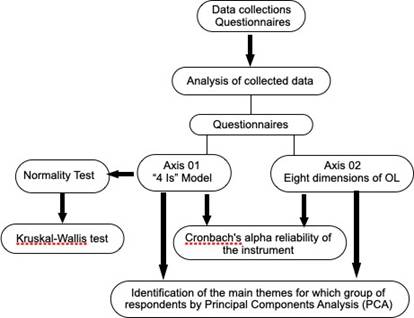
The research was conceived and developed by a flowchart
in Figure 1 to address the relationship between OL and the QCC and assess how
the QCC participants that make up the QCCN realize their contributions to the
OL process. A quantitative approach dealt with 4I’s model (axis 01) and the eight dimensions (axis
02) within the scope of the three types
of QCC participants nominated by QCC coordinators, leaders, and members
through a survey. Subsections 3.1 and 3.2 provide details of the data
collection and statistical analysis used.
Figure 1
Research Flowchart
3.1 Research Procedures and sample delimitation
Using the terms OL, QCC, Improvement Programs, Learning Processes, ESG, and some combinations in English and
Portuguese supported the bibliographic review.
The invitations were made through a telephone call to the regional offices’
coordinators and by email. To detail and clarify how the research
instrument should be applied and how it should
return, a schedule
with the nucleus
president on the state meeting
took place in February
2019. After this, the coordinators distributed the questionnaires to the members
and the leaders of their companies. The research population sample consisted of 5,855 QCC participants from 28 enterprises belonging to QCCN. Considering that “N” is known in this case,
this allowed for determining a sample size of 227
people (Gonçalves et al., 2014).
Beyond the 31 items of the learning
scale proposed by Templeton et al. (2002), the questionnaire consisted of a set
of phrases (items), also included nine questions for obtaining demographic data and four questions related
to the “4Is” model (Attachment 1). Using a 5-level
Likert scale expressing the degree of agreement from “totally disagree” to
“totally agree”. To apply the survey, the Committee on Ethics in Research with
Human Beings authorized this work (nº 3.088.397).
3.2
Data Analysis
Out of 419 distributed
questionnaires, 272 were returned and used as the exclusion criteria: forms that were not filled out or without the signatures of the
Informed Consent Form authorizing the use of the data allowed
validates only 234 forms. Each OL’s dimension and the “4Is” model
answers were submitted to the reliability test using Cronbach’s alpha
coefficient (α). These analyses run in Minitab® 2018 and are divided into two
axes.
Axis 01: Regarding the levels and processes in the “4Is” model. In this axis, besides the α
coefficient, the Normality test supports the choice of the statistical test to be used considering the significance level of α =
0.05. Subsequently, the Kruskal-Wallis test was used to compare the
coordinators’ responses, leaders, and members of the QCC to assess these
respondents’ profiles and the perception of the contribution of the QCC to OL,
including the correlation analysis between the categories of the participants.
Axis 02: Concerning eight dimensions of OL. OL’s degrees
of reliability results were distributed on the
graph using the red center to indicate the minimum to present
reliability, α =
0.6 (Hair, Anderson, Tatham
& Black,, 2009).
After verifying the reliability of
the questionnaire and discussing these results, to help identify the main
themes for which group of respondents has applied Principal Components Analysis
(PCA) using software RStudio 4.0.3 (R Core Team, 2020) and a set of sentences
expressing each PC was organized in a table.
4 Results and Discussion
4.1 Survey results and analysis
In this phase, 23 companies participated. From the 272
that gave back, ruling out 38 representing a return of 86% of the survey and
corresponds to 56% of the total questionnaires applied. Also, the number of
valid instruments for the analysis (234) was 3% above the 227 initially
calculated.
Looking into the valid answers, Axis 01
and 02 helped understand the relationship between QCC and OL.
Axis 01 - Perceptions of the
4I’s Model
Table
2 summarizes the results, considering the set of the answers
and classified by size
companies. Regarding the reliability regarding the specific issues
of the “4Is” model α ≥ 0.7, it
suggests that QCC operates according to the “4Is” model, regardless of the
companies’ size.
Table 2
Reliability indices
(α) by all respondents and classified by company size.
|
CRONBACH'S ALPHA
|
|
All sample
|
Scale of companies
|
|
Big
|
Medium
|
Small
|
|
0.76
|
0.71
|
0.82
|
0.75
|
For this same issue, Fodra, Alano and Silva (2021)
presented similar results when applied to QCC groups
in the textile industry context in Santa Catarina. In fact, during the pre-test and in the main study, the
reliability indexes achieved were 0.72 and 0.77, respectively, indicating that
both reached a safe level of reliability.
In agreement with the purpose of the QCC methodology,
group participation allows employees in a purposeful environment to experience leadership (Melo & Vasconcelos, 2007). After each cycle's
end, the members
are evaluated by peers about
their performance and appoint
someone to assume leadership. This dynamic generates leadership competencies, which means
that QCC contributes to OL, validating the "H1" hypothesis suggested in this work, as Campos
(2004) noted, who reinforced that the QCC is an opportunity for personal and
team training. Melo and Vasconcelos (2007) identified the QCC as a dynamic
environment favorable to OL, evaluating how OL occurs at a motorcycle
dealership.
The Normality Test reached the p-value = 0.02868 for the set of respondents, indicating that the samples do not follow a normal distribution
but a non-parametric one. The Kruskal-Wallis test comparing the means of the
coordinators' and members' p-values were less than 0.05, 6.118e-05 and 0.0079, respectively, and the leaders' p-values
were 0.0639. The members
and coordinators presented p-values lower than 0.05, suggesting that they
perceived the OL process was occurring between the three levels and through the
4I processes. The leaders’ results drew attention since these individuals link
the coordinators and the members. Usually, they have a more profound knowledge of the company’s
management and seem not to identify
the OL process. Besides, an understanding and alignment between managers and
employees positively contribute to workers’ performance (Tafvelin, Schwarz
& Hasson, 2017). These results reject the “H2” hypothesis.
Axis 2 - The eight
dimensions of OL
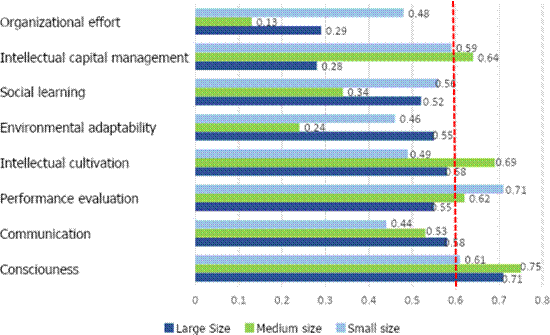
Concerning the OL dimension, Figure 2 shows
the variations in the degree
of reliability by dimension
and the companies’ size that make up the QCCN. These results highlighted three dimensions: “Consciousness”,
“Performance evaluation”, and “Intellectual cultivation”.
Figure 2
Distribution of Cronbach's alpha for each OL dimension
classified by company
size.
Independent
of the companies’ size, “Consciousness” presented an α ≥ 0.61. These results
suggest that QCC participants are aware of their knowledge to serve the
company. When necessary, they seek information from the organization and orient the problems to the teams to bring solutions. Souza and
Trez (2006) highlighted "Consciousness" in large companies. The
employees have a structure for managing information and controlling processes,
enabling QCC participants to access information provided by the company, and
they know where to find it. QCC groups of medium and small companies learned that in large
ones, a positive contribution of this Nucleus to SC companies.
“Performance evaluation” emerged both in QCC of the medium
size (α = 0.62) and in small size companies (α = 0.61). This dimension shows
how much the quality of the detailed process
information shared with members of QCC helps develop the program and the members, encouraged by managers, and the
project results in the company. “Intellectual cultivation” emerged in the QCC
of the medium-sized companies (α = 0.69), confirming that the members perceive the interaction taking
place with the company's customers or suppliers, as well as with
the QCC teams of other companies, in addition to their contribution to the
development of technicians/specialists in the organization.
The last two dimensions show the
importance of tacit knowledge to improve the companies' performance and
corroborate another study with small and medium companies (Venkatachalam,
Marshall, Ojiako & Chanshi, 2020).
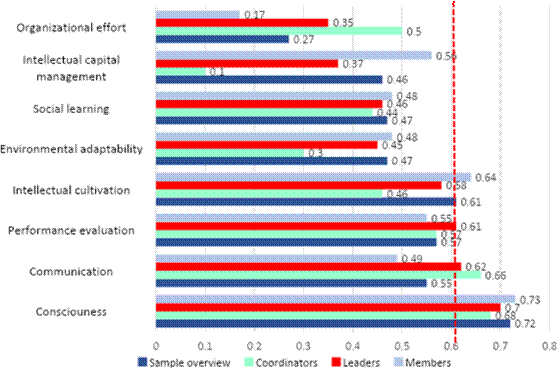
Considering the degree of reliability by the OL
dimension, Figure 3, the “Consciousness” dimension was identified by the three
categories, evidencing that they perceive knowledge serving the company and confirming that they have access to information and know where to
look for to seek solutions to different organizations’ problems. Markedly,
consciousness is an essential item in building
paths for implementing ESG practices.
Research indicates that as ESG awareness increases, companies with higher ESG
performance tend to overinvest less in some sectors (Irawan & Okimoto,
2021).
“Communication” was highlighted by
coordinators (α = 0.66) and leaders (α
= 0.62), suggesting that they have more access to means of communication as well as being encouraged to communicate, in addition to
having more support than members, possibly due to the representation that these
members have within the teams.
Just QCC members validate
the “Intellectual cultivation” (α=0.64). It steps up that they
realize that the QCC contributes to the development of technicians and internal
specialists in the company, conducting training in other areas in which they
operate and showing the relationship between customers, suppliers, and other
QCC members of other companies.
On
the other hand, leaders validate
the “Performance evaluation” (α=0.61); they realize that the QCC keeps detailed
information about the program’s development. As the person responsible for the
program, they have access to company data and are encouraged to use structured
tools for more structured decision-making.
These results indicate that QCC contributes to OL by some and not all verified
dimensions and confirmed the “H3”.
Figure 3
The
set of a degree of reliability for each OL dimension compiled
to all samples and by category
of QCC participants.
The validated dimensions support
one or more of the four dimensions of knowledge management (KM): acquisition,
creation, sharing and application (Zhang et al., 2021). “Consciousness” is
related to the acquisition, once the essential information disposable helps to solve problems; “Communication” includes the different means for this process are based on
acquisition and sharing; while “Performance evaluation”
drives the process performance to results can be linked to the application and
for last, “Intellectual cultivation” that assumes an environment that allows to
develop specialized abilities by experiences contribute hardly to acquisition
and sharing, in a broad look, contributes to four KM dimensions.
4.2 Highlights from PCA - What can be used to drive QCC groups to cooperate with ESG?
In agreement with the respondents’ category, it was
possible to produce sentences (Table 3)
based on PCA and produce highlights that elucidate how acting on specific
points in the QCC group
dynamic can improve their collaboration with OL in SC industries.
Table 3
Summary of the sentences structured based on PCA analysis.
|
|
Sentences structures based on PCA
analysis
|
|
Coordinators (C)
|
RC1C -Communication between members is
encouraged by management, and the necessary information is available.
|
|
RC2C - There is no stimulus for internal training of QCC members,
prioritizing the incorporation of new participants
who are already trained, and there is some retention of some information for
these managers.
|
|
RC4C - QCC
members know their
importance to the
company and have
the appropriate communication tools.
|
|
RC3C - There
are opportunities for
personal development of QCC participants in areas other
than those currently
working.
|
|
RC8C - There
is a sharing of information about results, customers and suppliers.
|
|
RC5C - QCC has a team with
important skills for the company.
|
|
RC7C- There is information sharing
because there are people designated to manage this
flow.
|
|
RC6C - Changing some practices still
generates resistance among
members.
|
|
RC9C - There needs to be formal
communication about the
progress achieved by the company.
|
|
RC10C - There is no incentive for QCC participants' contributions to the company's growth.
|
Looking at the PCA members’ results face to 4I’s
processes and OL constructs, it is verifiable
that the main themes
were focused on “Consciousness” (RC5M, RC4M, RC9M and RC
10M); “Communication” considering the RC3M, RC6M and RC7M sentences and,
evidencing the “Integration” and “Institutionalization” processes through RC1M
and RC2M. RC1M, in a way, individuals perceive the value of knowledge generated
in the group.
Leaders also perceive “Communication”
(RC1L, RC2L and RC9L), even as “Consciousness” RC9L, RC10L and RC5L.
The coordinators assume that the
management supports the communication between members (RC1C) and offers tools
for that (RC4C). However, part of communications from management to members occurs informally (RC9C). They recognize that members
know their value for companies
(RC5C), but this needs to be clarified for them (RC10C). Facing OL constructs,
a plan about “Intellectual cultivation” could be an essential strategy
and RC2C and RC3C support it.
Comparing the results by kind of QCC participant drew attention to RC2C x RC3L and RC6C x RC9L par sentences. These
opposite perceptions demonstrate the performance of leaders to identify some
dissatisfaction among members and mediate this while recognizing some
resistance to change. Furthermore, confronting RC8C with RC4L evidence that
leaders identify some hindrances in the socialization process in the QCC groups
that coordinators did not perceive or externalize.
Beyond that, RC1 for both leaders
and coordinators drives the same way and denotes that in the QCC leadership
context, there is the same understanding, i.e., it is their role to encourage
direct and transparent communication between the groups’ members in order to
facilitate the solution of problems and generate new opportunities.
This convergence can be
a) attributed to the condition of leaders in the QCC hierarchy, since
they act as moderators between members and coordinators and b)
even if from different companies and micro-regions of the SC/Brazil, all respondents belong to the QCCN sharing
many experiences in their
meetings. According to Kalogiannidis (2020), the effect of business
communication on employee performance is not a determining factor.
When it comes to communication,
RC5M and RC6C demonstrate recognition by the responding members that the group leaders
are the bridge
between them and the company’s
top management. They also recognize that it is from the encouragement of
managers that new results can be reached, as pointed out by RC9M. The critical
point in RC2M is “information” and indicates the collaborative nature of the
analyzing, selecting and storing process.
As evidenced by members (RC5M) and
coordinators (RC4C), the theme “tools for interaction and communications”
provided by companies deserves attention. Internal communication tools are traditional
in enterprises. The highlight here is that it
is not the use of electronics but digital forms of
communication that have gained more expression after the COVID-19 pandemic.
In a Chinese financial services
firm, Song, Wang, Chen, Benitez,
& Hu, (2019) registered that digital media used for social media,
when oriented towards
socialization, are complementary resources that generate synergies to
improve team and individual performance.
The effect of sharing information and knowledge has
been described, and it was found to have an impact
not only on the performance of people and groups but on beyond-convention work-related, e.g., team
climate and employees’ life satisfaction (Ahmad & Karim, 2019). A recent
study with information processing groups identified that leaders do not always serve as information integrators but may instead
compete with their team members
by focusing on their
position rather than promoting consideration of others’ knowledge (Sauer, Rodgers & Thomas-Hunt,
2021).
In short, PCA’s primary results
disclosed information, knowledge and access to them, the importance of
interaction and communication tools as a strategy for results, as well as the
relevant alignment between
tactic and strategic
management and the perception of the value
of the group. According
to the constructs proposed by Xia (2022) to
compose the framework
that can evaluate the relationship between OL and ESG, it appears that among the QCC groups of Santa Catarina
companies, this contribution can be made through constructs Training, KM,
Intellectual capital, Human resources management in Process dimension, mainly
by internal management. Likewise, these results involve managements of
different levels, professionals and practitioners (in agreement with Xia’s
vocabulary), suggesting that the QCC group and other community of practices teams can
contribute through OL dimensions to ESG ones based on KM dimensions. As Ren & Lin (2024) observe, corporations that develop forward-looking environmental strategies
prioritize stakeholder integration, organizational learning, and green
innovation. This approach can significantly enhance a company's cost advantage,
social reputation, and social performance.
5 Conclusion
The results showed
that the QCC groups operate
in the "4Is" model,
independent of the size of companies, soon confirming the "H1"
hypothesis and the hypothesis "H3" that the contribution of the QCC
groups to the OL occurs in some and not in all dimensions. On the other hand,
this study unauthenticated the "H2" hypothesis. This hypothesis was
evaluated based on the hierarchic structure
established in the QCC methodology. The gap found
needs to be clarified as to
why it took place and needs to be explored.
It is possible
to conclude that there is a relationship between QCC and OL, and the limits of this study are established by
the "Consciousness", "Communication", "Performance
evaluation," and "Intellectual cultivation", dimensions evaluated further, the processes of "4Is"
between the three levels described
in that model. Additionally, the PCA analysis
helped to
identify specific points to be explored
to improve QCC groups'
contributions to OL companies
and suggested that these groups have the potential to contribute, through OL
dimensions, to ESG factors based on KM dimensions.
In essence, the evidence presented in this study offers
theoretical and practical implications for strengthening organizational
learning in the workplace. This should lead to improved sustainable QCC member
relationships and performance. At the same time, the findings of this study can
help the QCC nucleus drive their QQC groups to contribute to the ESG
performance of the SC organizations.
Two areas for improvement of the present study are:
Firstly, this study focused on the relationship between QCC and contributions
to the organizational learning process (OL) in companies associated with the
Nucleus of Quality Control Circles in Santa Catarina (SC), Brazil. However,
there are many other influencing factors that this paper has not exhausted.
Future research could explore additional factors, such as corporate culture
and the pressure on the performance of the groups. Secondly, the analysis
in this paper is based on QCC data from
companies in SC, Brazil. Future research could be extended to investigate
variations in the relationship between QCC and OL, their impact on ESG performance,
and the reasons for it in
other states in Brazil, Latin America, and worldwide.
References
Adi, H. K., Haryadi, A., Wiadi, I., Mayasari, I., Mudrika, S., &
Mila, S. (2023, October). Organizational Learning Perspective Analysis in
Accelerating Environmental, Social & Governance (ESG) Orientation: Studies
in the Banking Industry. In e-Proceedings (p.
35).
Adler, N. J.; Gundersen, A. (2008). International dimensions of organizational behavior. 5a ed.
New York: South Western.
Ahmad, F.; Karim,
M. (2019). Impacts of knowledge sharing: a review
and directions for future research. Journal of
Workplace Learning, 31(3), 207-230.
Aljaffan, A. H. (2017). A review of the tripartite model
linking associations between TQM, organization
learning and Performance. International Business
Research, 10(8), 11- 30.
Antonello, C. S.; Godoy,
A. S. (2011). Aprendizagem organizacional no Brasil. Porto Alegre: Bookman.
Antunes, H. D. J. G.; Pinheiro, P. G. (2020).
Linking knowledge management, organizational learning, and memory. Journal of Innovation
& Knowledge, 5, 140-149.
Argote, L.; Lee, S.; Park, J. (2021).
Organizational Learning Processes and Outcomes: Major Findings and Future Research
Directions. Manag. Sci., 67, 5399–5429.
Ashraf, Iqbal, Bazmi, Munir & Azeem (2023).
Unlocking Business Performance Potential: Quality Management, Innovation
Performance and Organizational Learning Culture in Focus. Journal of Asian
Development Studies, 12(3), 123-139.
Blaga, P.; Jozsef,
B. (2014). Human
Resources, Quality Circles,
and Innovation. Procedia
Economics and Finance, 15(14), 1458–1462.
Branquehais, A., & Garcia, S. (2016). Analysis of the degree of
institutionalization of communities of practice
in a Brazilian federal public
company. In: Proceedings of the Brazilian
Congress on Knowledge Management - KM Brasil.
Boffo, R., and R. Patalano. ESG Investing: Practices, Progress and Challenges. 2020. OECD Paris, www.oecd.org/finance/ESG-
Investing-Practices-Progress-and-Challenges.pdf
Campos, F. A. L. (2004). Uma investigação
sobre a solução de problemas a partir da experiência do QCC: análise
da teoria e prática. (Dissertação de Mestrado), Universidade Federal de Minas Gerais. Belo
Horizonte.
Carpinetti, L. C. R.;
Miguel, P. A. C.;
Gerólamo, M. C. (2007). ISO 9001: 2000 quality management: principles and
requirements. São Paulo: Atlas.
QCCsc.(2019, 28 maio). Valores do Núcleo Catarinense de QCC. Recovered from: https://www.QCCsc.com.br.
Chen, I. C.; Kuo, M.
H. C. (2011). Quality improvement: perspectives on organizational
learning from hospital-based quality control circles in Taiwan. Human
Resource Development International, 14, 91-101.
Chiva, R.; Alegre J.; Lapiedra, R. (2007). Measuring organizational learning capability among the workforce. International
Journal of Manpower, 28(3), 224-242.
Correia-Lima, B. C.; Loiola, E.; Leopoldino, C.B. (2017). Bibliographic review of organizational learning
scales focusing on their processes and results, on their enablers
or on learning and performance. Organizações & Sociedade,
24(82), 509-536.
Crossan, M. M.; Lane, H. W.; White,
R. E. (1999). An organizational learning framework:
from intuition to institution. Academy of Management Review, 24(3),
522-537.
Ferro, J. R.; Grande, M. M. (1997). Círculos de controle da qualidade (QCCs)
no Brasil: Sobrevivendo ao
modismo. Revista de Administração
de Empresas, 37(4), 78–88.
Fischer, A. L.; Silva,
N. B. (2004, setembro). Os programas de melhoria contínua
como processos de aprendizagem organizacional: o caso de uma indústria
de produtos alimentícios. In: Anais do XXVIII Encontro da ANPAD,
Curitiba, PR.
Fodra, R. C. (2019).
Contribuições do programa
de Círculo de controle de qualidade (QCC) para o processo de aprendizagem
organizacional: o caso de uma indústria têxtil. (Dissertação de Mestrado),
Universidade da Região de Joinville. Joinville.
Fodra, R. C.; Alano, F. da S.; Silva, D. A.
K. (2021). Contribuição do círculo de controle de qualidade (QCC) à aprendizagem
organizacional: evidências em uma indústria têxtil catarinense. Revista
Produção Online, 21(1), 1–27.
Freitas, E. (2019, 26, maio). Economy of Santa Catarina. Recovered from: https://brasilescola.uol.com.br/brasil/economia-santa-catarina.htm
Gonçalves, L.M.;
Baldin, N.; Zanotelli, T. C.; Carelli,
N. M.; Franco, C. S. (2004).
Fazendo Pesquisa: Do projeto à Comunicação Científica. Joinville:
Editora Univille.
Hair, J. F.; Anderson, R. E.; Tatham, R. L.; Black, W. C. (2009).
Análise Multivariada de Dados. Porto Alegre: Bookman.
Hamaguchi, N.; Ramos, D. (Eds). (2023).
Brazil–Japan Cooperation: From Complementarity to Shared Value.
Singapur: Springer.
Hommerding, J.D. Application and Comparison of Group Project
Methodologies for Problem Solving. UFRS-Brazil, 2011.
Irawan, Denny; Okimoto Tatsuyoshi, 2021. "How Do ESG
Performance and Awareness Affect Firm Value and Corporate
Overinvestment?," Discussion papers
21033, Research Institute of
Economy, Trade and Industry (RIETI).
Kalogiannidis, S. (2020). Impact of Effective Business Communication on Employee
Performance. European Journal of
Business and Management Research, 5(6).
Lagares, F.C. A (2011). Sustentação do Círculo de Controle de Qualidade em uma
empresa de grande porte do setor de mineração: fatores impulsionadores e
restritivos. Itabira, Brasil.
Lizarelli, F. L.;
Alliprandini, D. H. (2006, novembro). Investigação das relações entre
Aprendizagem Organizacional e Ferramentas da Melhoria. In:
Proceedings of the XIII
Symposium of Production Engineering - XIII SIMPEP.
Bauru, Brasil, 2006.
Maiti, M. (2021). Is ESG the
succeeding risk factor? J. Sustain. Financ. Investig. 11,
199–213.
Manfredini, F.; Vinotti, C.A.; Rosa, K.C.M.;
Santos, I. L. (2017, novembro). Proposta de avaliação da eficácia do programa de Círculo de Controle de Qualidade (QCC).
In: Anais SEMEAD Seminários em Administração PPGA/FEA/USP, 20,
pp. 1-15. São Paulo, SP.
Matthews, R.; Maccarthy, B.; Braziotis, C. (2017). Organizational
learning in SMEs: a process improvement perspective. International Journal
of Operations and Production
Management, 37(7), 907-1006.
McDermott, O., Antony, J., Sony, M., Rosa, A., Hickey, M. and
Grant, T.A. (2023).
A study on Ishikawa’s original
basic tools of quality control in healthcare. The TQM Journal, 35(7),
1686-1705.
Melo, R. C.; Vasconcelos, M.C.R.L (2007). Aprendizagem e
compartilhamento de conhecimento nos Círculos
de Controle da Qualidade – QCC de uma empresa
siderúrgica. Revista Gestão & Tecnologia, 7(1), 119-141.
Mittal, A.; Gupta, P.; Kumar, V.; Ki Chan, C. (2023). The application
of quality control circle to improve
the PQCDSM quality
parameters: a case study.
International Journal of Productivity and Quality Management,
40(1), 102-119.
Moinhos, C.; Mattioda, R. A. (2011,
outubro). Círculo de Controle de Qualidade (QCC) na
indústria de autopeças. 31º Encontro Nacional de Engenharia de Produção.
Belo Horizonte, MG.
Moraes, F.V.; Bueno, J. M.; Domingues,
C. R. (2020). Os desafios de equipes multiculturais de trabalho: da liderança
e influência da cultura nacional ao processo de aprendizagem organizacional. Revista
De Gestão E Secretariado, 11(2), 164–189.
R Core Team (2020). R: A language
and environment for statistical computing. R Foundation for Statistical Computing, Vienna, Austria. URL https://www.R-project.org/
Ren, C.; Lin, X. (2024) The impact of performance feedback
on corporate ESG performance:
Mediating role of environmental strategy. PLoS ONE 19(3): e0298471
Reza, M. H. (2020). Relationship between human
resource management and total quality management. International Journal
of Research in Human Resource
Management, 2(1), 41-46.
Santos-Vijande, M.L.; Lopez-Sánchez, J.A.; Trespalacios, J.A. (2012). How organizational
learning affects a firm’s flexibility, competitive strategy, and performance. Journal
of Business Research, 65(8), 1079-1089.
Sato (2019,
17 august). Quality control
circles - QCC.
Recovered from: http://www.sato.adm.br/rh/circulos_de_controle_de_qualidad.htm
Saud, T.R. (2019).
Total Quality Management System and Organization Performance: Mediating Effect of Organizational Learning in
Nepali Service Sector. Journal of Business and Social Sciences Research,
4(1), 39-60.
Sauer, S.; Rodgers, M.; Thomas-Hunt,
M.C. (2021). The expert paradox:
How team member expertise impacts leaders’
information integration. Academy of Management Proceedings. 1.
Song, Q.; Wang, Y.; Chen, Y.;
Benitez, J.; Hu, J. (2019). Impact
of the usage of social media in the workplace on team and
employee performance. Information & Management, 56(8), 103160.
Souza, M. M. C.(2018).
Melhoria Contínua e Aprendizagem organizacional. (Monografia Graduação em Ciências Econômicas), Universidade
Federal de Ouro Preto, Mariana.
Souza, R. V.; Trez, G. (2006,
setembro). Mensuração em Aprendizagem Organizacional: Adaptação
de uma Escala para o Contexto Brasileiro. In: Anais 30º Encontro
ANPAD, Salvador, BA.
Souza, G. R.; Bresciani, T. A. S.; Oliveira, L. A.; Johann,
D. A.; Silva, L.G.P. (2020).
Aprendizagem organizacional: fatores de geração
de conhecimento em uma concessionária de motocicletas. Revista
Observatorio de la Economía Latinoamericana. Abril, 2020.
Steil, A. V. (2006). Competencies and
organizational learning: How to plan training programs so that individual competencies help the organization to learn. Florianópolis: Instituto Stela.
Tafvelin, S.; Schwarz,
U.V.; Hasson, H. (2017).
In agreement? Leader-team perceptual distance in organizational learning affects work
performance. Journal of Business Research, 75, 1-7.
Templeton, G. F.; Lewis, B. R.; Snyder, C. A.
(2002). Development of a measure for the Organizational Learning construct. Journal of Management Information Systems, 19, 175-218.
Tsang, E. W. K. (1997).
Organizational learning and the learning
organization: A dichotomy between descriptive and
prescriptive research. Human Relations, 50, 73-89.
Udin, U. (2023).
Linking transformational leadership to organizational learning
culture and employee
performance: the mediation-moderation model. Intern. Journal of Profess.
Bus. Review, 8(3), 1-17, e01229
Vera, D.; Crossan,
M. (2003). Organizational learning
and knowledge management: towards an integrative structure. In M. Easterby-Smith &
M. Lyles (Eds.), The Handbook of Organizational Learning and Knowledge
Management (pp. 122 - 141). London: Wiley-Blackwell.
Venkatachalam, S.; Marshall, A.; Ojiako, U.; Chanshi,
C. S. (2020). Organizational learning
in small and medium sized South African energy project organizations. Management
Research Review, 43(5), 595-623.
Vivone, M. V.; Junior, A. S. T. (2017). Internal
improvement agents continue. Management and Society,
11(28), 1611-163.
Xia, J. (2022).
A Systematic Review: How Does Organizational Learning
Enable ESG Performance (from
2001 to 2021)? Sustainability, 14, 16962.
Zhang, B.; Comite, U.; Yucel, A.G.; Liu, X.; Khan, M.A.; Husain, S.;
Sial, M.S.; Popp, J.; Oláh, J. (2021). Unleashing the Importance of TQM and
Knowledge Management for Organizational Sustainability in the Age of Circular
Economy. Sustainability, 13, 11514.
Zhao, Y.; Li,
Y.; Lee, S.; Chen, L (2011).
Entrepreneurial orientation, organizational learning, and performance: evidence from China.
Entrepreneurship Theory and Practice, 35, 293-317.
Attachment 1
Dimension of Organizational Learning
Consciousness
· QCC members are aware of where their knowledge can serve the company (question 17).
·
When QCC members need specific information, they know where to get it (question
19).
·
Management addresses problems so that QCC teams can seek alternative solutions (question 21)
· Management monitors important
QC Program performance variable (question 22)
·
Management provides the QCC
with access to information from different areas of the organization (question
25).
Communication
·
QCC members have access and / or support for the use of electronic means to communicate (question 11).
·
QCC members have a wide
variety of communication tools (telephone, email, internet and others) available to continue with their projects
(question 12).
·
QCC members are encouraged to communicate clearly
(question 20).
Organizational effort
·
When the internal capacities in the QCC groups are deficient, the aim is to supply with the incorporation
of new team members (question 10).
·
The administration, when knowing
about QCC strategies developed
by competitors, ignores
them (question 27).
Performance evaluation
·
The QCC stores detailed
information on processes that are important
for program development (question 2).
·
There is a person in the company identified as responsible for the management of the information
relevant to the QCC (question 3).
·
The QCC has access to data and information on different results of projects in the company
(question 8).
·
Management encourages QCC members to make use of
structures and models to support decision making
(question 29)
Intellectual Cultivation
·
QCC contributes to the
development of technicians /
specialists internally within the
organization (question 1).
·
The administration gives QCC members the opportunity to
conduct training in areas other than those in which they
operate (question 24).
·
The management facilitates the relationship of QCC members
with company partners (customers,
suppliers) or even with QCC groups from other companies (question 26).
·
Management learns
new things about
the company through
direct observation of QCC members
and / or program indicators
(question 28).
Environmental adaptability
The QCC is slow to react to technological change (question 4).
·
QCC makes extensive use of electronic storage (such as databases, data warehousing, electronic documents) (question 7).
· QCC members seek to retrieve
archived information for decision-making (question 15).
·
QCC members make extensive use of the Information System
as a support tool in conducting projects (question 16).
Social learning
· QCC members are reluctant to move to new ways of doing things (question 13). · QCC members learn about the company's recent developments through
informal means (such as news, hall conversations and gossip) (question 14).
· QCC members keep information (such as numbers,
spreadsheets, and ideas)
away from other
employees (question 18).
Intellectual capital
management
·
In the QCC are part of the employees with key skills
for the company (question 5) · The QCC has among its participants, highly specialized
or highly educated people (question 6).
·
The company seeks to
implement the QCC in other units, including acquisitions of new companies,
envisioning short-term financial gains (question 9).
“4Is” Model
Individual
-There is a satisfactory level of insights, new ideas, and intuitions in the QCC groups (question32).
Group
- The experiences of individuals and groups help in the development of
knowledge shared in the QCC (question33).
Organizational
-
The ideas and insights of the QCC individuals become shared, integrated and institutionalized
knowledge in the organization (question 34).
-The knowledge
generated from the experiences of individuals and groups at the QCC is used in
the development of the organization's
strategy, processes, routines and systems (question 35).
i Mestre em Engenharia de Processos
ii Doutorado em Ciência
e Engenharia de Materiais pela Universidade do Estado de Santa Catarina, Brasil(2018).
Professora da Universidade da Região de Joinville , Brasil
iii Doutorado em Engenharia e Gestão do Conhecimento pela Universidade Federal de Santa Catarina, Brasil(2017)
iv Doutorado em Engenharia e Gestão do Conhecimento pela Universidade Federal
de Santa Catarina,
Brasil(2017). PhD - Química, Universidade Estadual Paulista Júlio de
Mesquita Filho - Campus de Araraquara (UNESP).