UberHub – Ecosystem of innovation entrepreneurship and startups of Uberlândia – MG – configuration, results and future challenges
UberHub – Ecossistema de inovação, empreendedorismo e startups de Uberlândia-MG – configuração, resultados e desafios futuros
Guilherme Augusto Paula Silva1i, Orcid: https://orcid.org/0009-0004-7007-7123; Janaina Maria Bueno2ii, Orcid https://orcid.org/0000-0002-0858-7657
1. Universidade Federal de Uberlândia, Minas Gerais, Brasil. E-mail: guilhermeaugustoequi@gmail.com.
2. Universidade Federal de Uberlândia, Minas Gerais, Brasil. E-mail: janaina.bueno@ufu.br.
Abstract
In Uberlândia – MG, a movement from entities and technology-based companies culminated in the development of the innovation and entrepreneurship ecosystem – UberHub. The objective of this study was to identify the configuration, characteristics, performance of the agents involved, results, and future challenges of UberHub’s ecosystem. The research is exploratorydescriptive, qualitative, counting with a case study method and data collection through documentary research and 12 semi-structured interviews with representatives of ecosystem agents. In its current configuration, UberHub can be understood by the concept of the quadruple helix, although with significant results, it is still susceptible to the actions of specific individuals and suffers from mismatches between its institutional agents, in a state of imbalance. It became clear that the dynamics of interaction and leading roles change throughout the life cycle of an ecosystem in a non-linear and non-gradual way, affected by internal and external factors, making it possible to understand the ecosystem only by observing the effective participation and importance of its agents. Some suggestions were made for creating and improving actions and connections between agents.
Keywords: innovation ecosystem; entrepreneurship; quadruple helix.
Resumo
Em Uberlândia-MG, um movimento de entidades e de empresas de base tecnológica culminou no desenvolvimento do ecossistema de inovação e empreendedorismo - UberHub. O objetivo com este estudo foi identificar a configuração, características, atuação dos agentes envolvidos, resultados e desafios futuros do ecossistema UberHub. A pesquisa é exploratória-descritiva, qualitativa, com método de estudo de caso e coleta de dados por pesquisa documental e 12 entrevistas semiestruturadas com representantes dos agentes do ecossistema. Na sua configuração atual, o UberHub pode ser compreendido pelo conceito da quádrupla hélice, ainda que com resultados expressivos é suscetível à atuação de indivíduos específicos e sofre com descompassos entre seus agentes institucionais, em um estado de desequilíbrio. Evidenciou-se como a dinâmica de interação e protagonismo muda ao longo do tempo de vida de um ecossistema, de forma não linear e nem gradual, afetada por fatores internos e externos, só sendo possível compreender o ecossistema observando a efetiva participação e importância dos seus agentes. Algumas sugestões foram dadas para criação e aprimoramento de ações e conexões entre os agentes.
Palavras-chave: ecossistema de inovação; empreendedorismo; quádrupla hélice.
Citation: Silva, G. A. P., & Bueno, J. M. (2024). UberHub – Ecossistema de inovação, empreendedorismo e startups de Uberlândia-MG – configuração, resultados e desafios futuros. Gestão & Regionalidade, v. 40, n. Especial: Regionalidade e desenvolvimento: o papel da gestão, e20249325. https//doi.org/10.13037/gr.vol40.e20249325
1 Introduction
Innovation is a recurring theme in the literature and practices of business management, being understood as a source of creation and maintenance of competitive advantage, both individually and through cooperation between different companies (Lara et al., 2021). Entrepreneurship, especially when linked to technology, has been one of the drivers behind innovation, local, regional, and national economic development, creation and dissemination of knowledge, as well as generation of employment and income (Chung, Jung & Lee, 2022; Ziakis, Vlachopoulou & Petridis, 2022).
Given the business results of entrepreneurship and innovation, some countries governments have been moving towards the creation of policies encouraging innovation and entrepreneurship (Buschmann et al., 2016; Chung, Jung & Lee, 2022). Some results of the union of these two forces can be identified in the development or activation of a local and institutional context necessary to foster entrepreneurial and innovative potential (Martins, Olave & Rocha, 2022), originating, among other forms, the ecosystems of entrepreneurship and innovation.
This type of ecosystem can be understood as a geographical space with high rates of entrepreneurship growth linked to innovative businesses, resulting from the combination of environmental, economic, social, and cultural factors directly related to startups (Ziakis, Vlachopoulou & Petridis, 2022). For Kon (2016), an entrepreneurship and innovation ecosystem is born from the economic integration and interaction among agents, entities, and tangible and intangible activities with the socioeconomic environment of a given locality.
The theme is relatively recent, with different studies focusing in two main directions: the configuration of an ecosystem and the relationship between its various actors (Felizola & Aragão, 2021). One of the understandings about the entrepreneurship and innovation ecosystem is that the organizations inserted in it manage to create value in a way these organizations would hardly achieve on their own (Adner & Kapoor, 2010), which can be aimed at both economic and social advances (Lara et al., 2021; Martins, Olave & Rocha, 2022).
In this context, a movement was observed in the city of Uberlândia – MG , starting with various entities (Municipal Secretariat of Economic Development, Innovation and Tourism, SEBRAE, higher education institutions, and various technology-based companies already established, in addition to startups) developing an innovation ecosystem focused on entrepreneurship for the information technology sector, called UberHub.
Thus, this research aims to identify, in the UberHub ecosystem, its configuration, characteristics, the role of agents involved, presenting results and future challenges. The research was exploratory-descriptive, with a qualitative approach, using a case study method and data collection carried out through document research and 12 semi-structured interviews with representatives of the organizations that are agents of this ecosystem. According to the World Economic Forum – WEF (2009), it is important to know the characteristics of an innovation ecosystem with a focus on entrepreneurship, its agents, their interactions, and the main challenges to better conceive policies and conditions that allow its growth and consolidation, as evidenced in works such as those written by Hernández and González (2017) and Nabarreto, Cirani, and Costa (2022).
As a theoretical contribution, the aim is to enrich the debate with an integrated view of the configuration of an ecosystem alongside the role and interaction of its different agents; to show the results obtained and the challenges expected in its trajectory over time in the Brazilian context. As a practical contribution, the goal is to assist agents involved with UberHub by recording the actions and participations in the construction of this ecosystem and by reflecting on this and other similar ecosystems regarding strategic directions and paths for its consolidation and permanence. It is understood that the agents of an ecosystem need to understand what their strengths and limitations are, as well as their execution capacity, integration, and collective learning ability to then contribute on a regional and global scale (Lara et al., 2021; Felizola & Aragão, 2021).
2 Theoretical Framework
2.1 Entrepreneurship and Innovation Ecosystem – Definitions and Characteristics
Innovation is directly linked to business advantages, as it represents a radical or incremental advance in a product, process, or service (Adner & Kapoor, 2010), but it can also be related to economic and social advances in a specific region (Lara et al., 2021; Chung, Jung & Lee, 2022). More specifically, technological innovation can be created and must be encouraged in its environment, whether in established companies, emerging technology companies (startups), public authorities, research and educational institutions, and public or private support and funding institutions (Felizola & Aragão, 2021; Moreira et al., 2022; Ziakis, Vlachopoulou & Petridis, 2022).
It is increasingly understood that the development of technologies can generate advantages and ways to ensure competitiveness as a result of the efforts of different companies, as advocated by the concept of open innovation (Lara et al., 2021), an outcome of joint work between different organizations. According to Kon (2016), innovation has been treated in an associated manner, where companies work with other partners who do not necessarily belong to the same sector or activity segment, but within the same environment, in search of mutual benefits.
Over the last three decades, in the Brazilian innovation scenario, different nomenclatures and definitions have emerged for spaces conducive to entrepreneurship aimed at innovation, which vary according to their geographical dimension, degree of intentionality for their creation or activation, insertion and participation of certain agents, degree of articulation and coordination among them, and so on (Felizola & Aragão, 2021). The innovation ecosystem is a particularly current and recurring theme in recent literature (Felizola & Aragão, 2021; Moreira et al., 2022). The term “ecosystem” emerged in the 1990s with the work of Moore (1993), who made an analogy between biological ecosystems, in which the character of interdependence and coevolution of the actors is explored, with business ecosystems. Later, Ron Adner contributed to advancing the understanding of ecosystems in the business environment, highlighting other agents besides companies (Adner & Kapoor, 2010; Felizola & Aragão, 2021).
The theme of innovation ecosystem appears in the literature regularly associated with entrepreneurship, or more specifically, with the environment that fosters startup companies, understood as nascent technology-based companies that operate in environments with a high degree of uncertainty (Felizola & Aragão, 2021; Ziakis, Vlachopoulou & Petridis, 2022), but also linked to a specific sector of activity, a platform, or some particular type of innovation (Nascimento, Lima & Gondim, 2022). According to Jackson (2011), innovation ecosystems are interconnected organizational networks whose primary goal is to interact with the local environment through the development of technology and innovation, receiving and providing subsidies to drive such a process. Therefore, their origin is based on this primary connection between organizations and between these and the local environment, stimulating the creation of new ventures (Ziakis, Vlachopoulou & Petridis, 2022).
While the business ecosystem is more focused on value acquisition, the concept of the innovation ecosystem is more connected to the co-creation of value (Gomes et al., 2018). In this sense, Russell and Smorodinskaya (2018) consider that ecosystems are constituted by business networks, which have evolved into cooperation among agents. Alternatively, they are spaces where there is a combination of individual contributions in a coherent manner to a customer-oriented solution (Adner & Kapoor, 2010).
Innovation ecosystems are generated and maintained by their participating members, where flexibility in structure and cooperation of those involved are key for an entrepreneurial and innovative environment (Gonçalves, Machado & Dalfovo, 2017; Nascimento, Lima & Gondim, 2022). They also provide stimuli for entrepreneurial and innovation development from the birth of the idea to the realization of the organization focused on technology and innovation (Stam, 2015; Silva, Sá & Spinosa, 2019; Nabarreto, Cirani & Costa, 2022) depending on the articulation between its agents, the action of leaderships (Dedehayir, Mäkinen & Ortt, 2018; Ziakis, Vlachopoulou & Petridis, 2022), the development of continuous innovation, synergy between its actors, collective learning, and the exchange of ideas and practices (Silva, Sá & Spinosa, 2019).
2.2 The Agents of the Ecosystem in the Approaches of the Triple, Quadruple, and Quintuple Helix
The agents that create the foundation of the ecosystem and have the greatest centrality and interactions are companies of various sizes and ages involved with objectives of creation and value chain, but the ecosystem is not limited to them (Felizola & Aragão, 2021). Public funding agencies also participate as mobilizers of other agents, highlighting the need for public policies aimed at fostering and stimulating local innovations, in order to mobilize small and medium-sized business entrepreneurs to invest in research and development (Ikenami, Garnica & Ringer, 2016; Felizola & Aragão, 2021). A continuous (re)alignment of the relationships among the ecosystem members is necessary, which contributes to its vitality, understanding that co-creation is essential for maintaining the capacity for internal changes and external forces (Ziakis, Vlachopoulou & Petridis, 2022).
According to Kon (2016), the interactions within an innovation ecosystem take two distinct economic forms. One is the economy of knowledge, through research and teaching; and the other is the economic and commercial form, responsible for investments in the first one. The joint work between universities and local actors is considered a key point of ecosystem growth (Brem & Radziwon, 2017; Moreira et al., 2022) and one of its pillars, as universities go beyond teaching, research, and extension to be promoters and spaces for incubators, accelerators, technological parks, along with other innovation habitats (Felizola & Aragão, 2021).
In addition, the concept of the innovation ecosystem was related to the triple helix approach, which consists of understanding the interactions and joint actions between government/public power, academia (educational institutions), and industry (companies) for innovation (Etzkowitz, 2008). In a comparative study between Brazilian (Florianópolis) and German (Münster) cities, Buschmann, Meyer and Schewe (2016) noted that, despite the political and socioeconomic differences of the two countries, through public policies and interaction among the actors it was possible to develop innovative environments in a synergistic manner. The authors also identified common elements such as the presence of strong higher education institutions; public policies directed towards development made by the state government; focus of government policies on developing local companies and not on attracting external companies; cooperation between universities, government, and companies; as well as an impulse in innovative environments with investments in infrastructure and sustainability.
With the growing importance of the triple helix approach, other studies have contributed with criticism, discussion, and inclusion of new elements and models such as the quadruple and quintuple helix (Mineiro & Castro, 2020; Lara et al., 2021; Nascimento, Lima & Gondim, 2022). One of the criticisms of the triple helix approach is that it does not takes into account the asymmetry of power among the ecosystem agents, who have different objectives and are driven by diverse interests, in addition to not considering the variations of context in which each ecosystem can exist (Mineiro & Castro, 2020).
In the view of the quadruple helix, in addition to the agents of the triple helix, Carayannis and Campbell (2009) propose the addition of society based on media and culture, understanding that creative industry, culture in general, values, art, and lifestyles contribute to the construction of “public reality” and its communication, which influences the innovation process of a society. Thus, for Lara et al. (2021), in addition to society, the quadruple helix integrates the perspectives of media and culture as representatives and interlocutors of the demands of civil society and the other ecosystem agents in a collaborative perspective between users, consumers, and citizens.
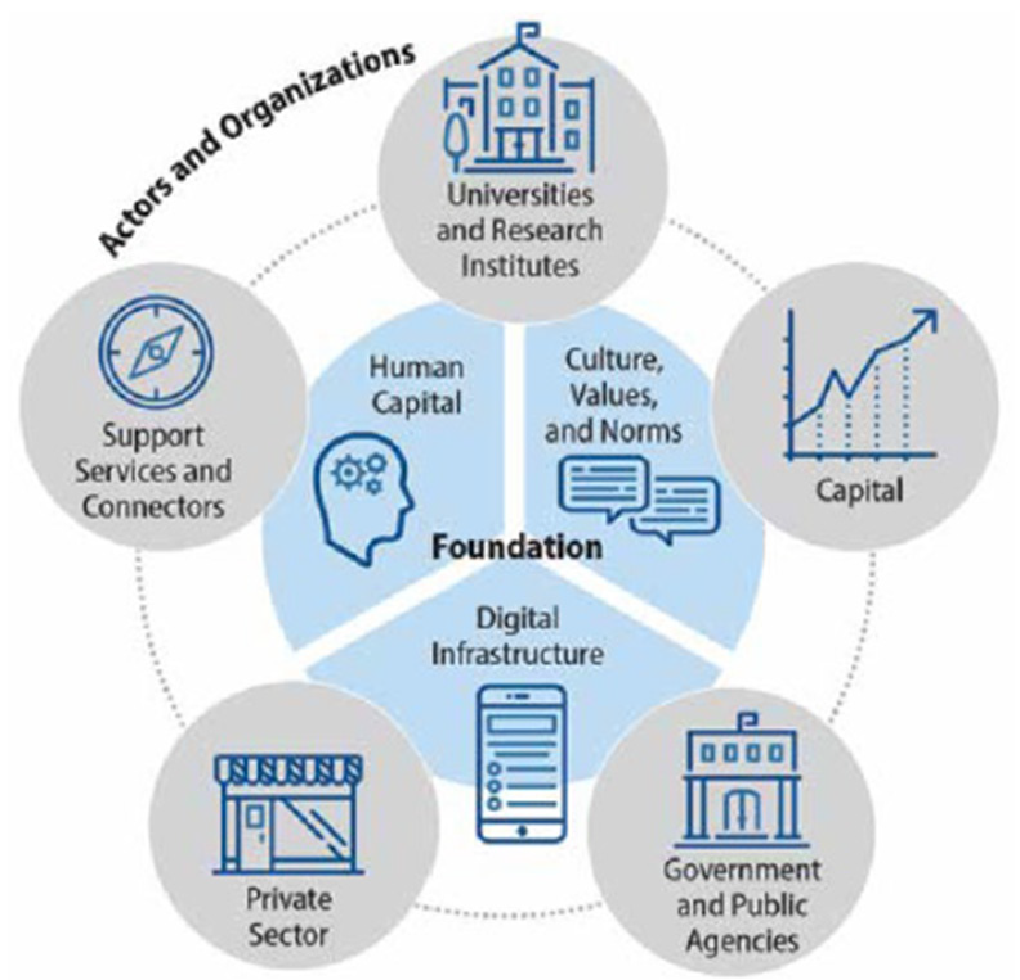
Finally, in the quintuple helix, in addition to the agents of the quadruple helix, the environmental context is included (Lara et al., 2021; Nascimento, Lima & Gondim, 2022). In it, the role of society’s natural environments is emphasized, considering environmental issues, strategies, and plans for the planet’s sustainability. These elements go beyond the vision of Etzkowitz (2008), adding new roles and agents that will influence the promotion, creation, development, financing, and dissemination of innovation in an ecosystem of this nature (Mineiro & Castro, 2020; Moreira et al., 2022). Along with these different agents, Felizola and Aragão (2021) comment that other elements also make up the ecosystem, such as local infrastructure (city, region, state, or country), intellectual capital, institutions that support entrepreneurship, knowledge and technology transfer hubs, among others. Figure 1 represents the main elements that constitute an innovation ecosystem.
Figure 1
Elements and Agents of an Innovation Ecosystem
Source: Lawrence, Hogan e Brown (2019, p. 1).
Dedehayir, Mäkinen, and Ortt (2018) identified up to 11 possible roles for agents within an innovation ecosystem and grouped them into 4 key roles, aligning them in a temporal dimension throughout the ecosystem’s lifecycle. These are: leadership roles (leader and dominator); direct value creation roles (provider, assembler, supplier of complementarities, user); value creation support roles (specialist and champion); and ecosystem entrepreneurship roles (entrepreneur, sponsor, regulator). This segmentation shows that each agent has its distinct influence within the ecosystem and reiterates the synergy that must exist among them.
Parallel to business ecosystems, Zahra and Nambisan (2012) state that there are 4 distinct models of innovation ecosystems: orchestra, creative bazaar, jam central, and mod station. The first pertains to a model where there is a dominant company with strong leadership guiding the other actors; the second is described as a dominant company that, due to its purchasing power, buys new ideas and products and makes them available in the market; in the third model, there is no dominant company, as well as no defined governance structure; in the fourth model, companies view the ecosystem as a community of foes, thus encouraging customers, experts, among others, to suggest modifications and improvements.
In the Brazilian context, recent works on entrepreneurship and innovation ecosystems deal with elements that compose an innovative ecosystem and promote startups (Nabarreto, Cirani & Costa, 2022; Martins, Olave & Rocha, 2022); shared values (Bittencourt & Figueiró, 2019), collaboration, and knowledge transfer (Nascimento, Lima & Gondim, 2022) among actors; relating cases of innovation ecosystems, in different locations and contexts, to better understand the phenomenon (Buschmann, Meyer & Schewe, 2016; Felizola & Aragão, 2021; Martins, Olave & Rocha, 2022); elements for development and relationship between governance in innovation ecosystems (Silva, Sá & Spinosa, 2019); service innovation, stemming from ecosystems (Kon, 2016); interactions and dynamics within an innovation ecosystem (Ikenami, Garnica & Ringer, 2016); the role of intermediary agents such as technology parks (Mineiro & Castro, 2021; Moreira et al., 2022) and incubators from the perspective of the quintuple helix (Lara et al., 2021), among other studies.
3 Method
The research was exploratory-descriptive in nature, as it enabled the analysis of the varied roles, spaces, interactions, and outcomes upon identifying the configuration, characteristics, as well as constituent and complementary agents of the innovation ecosystem in Uberlândia – MG, UberHub. A qualitative approach was used, favoring an in-depth study of the phenomenon, along with the case study method, which is recommended when asking the “how” and “why” of complex contemporary phenomena that occur in a specific context (Yin, 2015). The case was chosen based on Stake’s (1995) concept of an instrumental case study, where the selected case can help to understand a broader reality, providing clues about a theme or phenomenon.
The UberHub, already established and with a trajectory that could be analyzed since 2014, allows for the discussion on the creation and review of public policies, as suggested by the WEF (2009), and reflections on the direction of other Brazilian innovation and entrepreneurship ecosystems and their agents to better contribute to their region, as pointed out by Lara et al. (2021) and Felizola & Aragão (2021).
Data collection occurred primarily in two ways: i) documentary research on the official website of UberHub, the Municipal Secretary of Economic Development, Innovation, and Tourism of the city of Uberlândia, SEBRAE, educational institutions, and the various technology-based companies involved in the activities of the UberHub; and ii) semi-structured interviews with representatives of the constituent institutions and agents of the ecosystem. A total of 12 interviews were conducted, as detailed in Table 1, using the “snowball” method, where, starting from an initial contact with one of the interviewees, they recommended others, and so on, until the point of saturation was reached when the repetition of already reported information was observed and no new data emerged.
Table 1
Information About the Interviewees
|
Interviewee |
Institution |
Position |
Interview Duration |
|
Interviewee 1 |
Private |
Regional Manager of Entrepreneurship |
32min 54s |
|
Interviewee 2 |
Public/Academic |
Marketing / Project Manager |
41min 2s |
|
Interviewee 3 |
Public/Academic |
Director of Innovation / Technology Transfer |
43min 23s |
|
Interviewee 4 |
Private |
Regional Manager of Innovation |
52min 31s |
|
Interviewee 5 |
Private/Public |
Communication / Director of Innovation |
1h 09min 25s |
|
Interviewee 6 |
Private |
Event Organization |
39min 10s |
|
Interviewee 7 |
Private |
CEO |
53min |
|
Interviewee 8 |
Private |
Initiative Leader |
1h 08min 0s |
|
Interviewee 9 |
Private |
Director of Innovation |
46min 43s |
|
Interviewee 10 |
Private |
Administrative Director |
51min 54s |
|
Interviewee 11 |
Private |
Founder |
52min |
|
Interviewee 12 |
Private / Public |
Founder – Director of Innovation |
31min 05s |
A question guide was used, crafted from the theoretical framework, related to: i) knowledge about initiatives for the development of innovation and the promotion of technology-based entrepreneurship (Buschmann et al., 2016; Chung, Jung & Lee, 2022; Martins, Olave & Rocha, 2022) that have taken place in the city and their history; ii) what constitutes an innovation environment, its characteristics (Adner & Kapoor, 2010; Felizola & Aragão, 2021; Moreira et al., 2022), and, in particular, UberHub and its configuration; iii) identification of the agents (Kon, 2016; Ikenami, Garnica & Ringer, 2016; Brem & Radziwon, 2017) of UberHub and their role in this environment over time (Dedehayir, Mäkinen & Ortt, 2018); iv) the articulation, leadership process, and decisions that direct the ecosystem (Etzkowitz, 2008; Zahra & Nambisan, 2012); v) the results observed (Adner & Kapoor, 2010; Bittencourt & Figueiró, 2019); and vi) perspectives for the future and improvements.
The employed analytical technique was content analysis, following the principles of Bardin (1977), consisting of three phases: 1) pre-analysis; 2) exploration of material; and 3) treatment of results, inference, and interpretation. The pre-analysis phase deals with systematizing initial ideas about the content to be verified through floating reading, selection of documents, hypothesis formulation, and item referencing. The material exploration phase was conducted by defining thematic categories; initially, 13 distinct thematic categories were found during the process of identifying patterns and content cores. The third phase involved grouping the thematic categories into more comprehensive themes that explain the analyzed data, assisting in the process of inference and interpretation of results, leading to the 4 main thematic categories that will be presented and discussed in the next section: i) History and Characteristics of UberHub; ii) Constituent Agents from the Quadruple Helix Perspective; iii) Achieved Results; and iv) Future Challenges.
4 Results
In the category History and Characteristics of UberHub, it was found that the foundations for the emergence of the innovation ecosystem began to form with the association of software development companies in the 1990s, called Trisoft, to defend their interests. From 2004, there was involvement from SEBRAE, through SEBRAETECH, and other agents began to appear with the goal of fostering and developing innovation, as Trisoft transformed into i9. The Minas Startup movement began in the years 2010 and 2011, involving SEBRAE, i9, and other companies focused on the promotion of startups. There were several events and initiatives for developing solutions, and the city of Uberlândia began to appear more consistently in the media.
Colmeia emerged in 2017 as a community of startups. Until then, actions had been separate and fragmented, but almost entirely initiated by companies and SEBRAE, shaping it more as a business network formation movement, as per the concept presented by Jackson (2011) and Gomes et al. (2018), a situation that only changed with SEBRAE’s action to aggregate initiatives from different agents. As a result, there were interactions and joint actions with other institutions like Endeavour and people who had common goals and wanted to work together. Within this initial movement, local higher education institutions, the public sector, and companies of different sizes and ages also participated, aiming to start developing the local innovation ecosystem and establish what each one could do within it.
These facts converge with what Russell and Smorodinskaya (2018) argued about the ecosystem being an evolution of business networks linked to cooperation among its different agents, with defined responsibilities and roles as mentioned by Adner & Kapoor (2010) and Ikenami, Garnica, and Ringer (2016), highlighting the importance of the whole and moving away from what was once a business network. As a result, at an international event on technology, innovation, entrepreneurship, and sustainability hosted in Uberlândia during 2017, the UberHub brand was unveiled. Subsequently, joint actions were consolidated among the agents of the local ecosystem, such as training, events, communication of interest information, and the emergence of new ventures.
Regarding the characteristics of UberHub, it was possible to verify that some of them are easily identified and frequently mentioned by the interviewees, such as the search for continuous innovation involving different ecosystem agents; the relationships and interactions are markedly individual before being institutional, with a constant effort to feedback these relationships among the people involved; and a focus on the search for knowledge and resources. The synergy between participating individuals, more than between organizational agents, the structure of communication and interaction aimed at collective learning, and the exchange of ideas and practices, which were also mentioned in studies such as Silva, Sá, and Spinosa (2019), involved different agents and perspectives of the community, encompassing the pillars of the quadruple helix (Mineiro & Castro, 2021).
The cooperation among the ecosystem’s agents is essential for its consolidation and the possibility of results, not just among companies but among all constituted agents, as already pointed out by Stam (2015), Gonçalves, Machado, and Dalfovo (2017), as well as Nascimento, Lima, and Gondim (2022). However, it is noted that cooperation has occurred more among companies, not always involving other agents. Indeed, cooperation among companies has been one of the most striking characteristics of UberHub and one of its main strengths, with examples including partnerships for communication and events, technical cooperation, strategic alliances, sharing of knowledge, problem-solving, among others. However, it is understood that it is necessary to advance in forms of cooperation with other agents of the ecosystem, as the creation and development of innovation environments depend on various forms of joint work and cooperation in different directions, such as the creation of new technologies by academia and their transfer to different companies, with promotion and support from the public sector and participation from the interested community.
Table 2 presents some excerpts from the interviews that illustrate and synthesize the information described in this analysis category:
Table 2
History and Characteristics of UberHub
|
Interviewee |
Excerpts from the Interviews |
|
Interviewee 10 |
SEBRAE took a leading role at the beginning, with support from startups, to bring together various actions that were already happening separately. And from there, the movement called Minas Startups was born, which was the embryo of the UberHub ecosystem today. |
|
Interviewee 5 |
There are a lot of initiatives happening. Why not bring these people together? By uniting, we help each other. It facilitates communications and starts to spin to do more. This gave birth to the Uberhub initiative, and Minas Startups ceased to exist. |
|
Interviewee 4 |
So we started to call everyone to one table: some universities, the city hall, and many companies. We began to work on developing a future plan for the city. We needed a brand, a reference. We chose the name UberHub. |
|
Interviewee 5 |
An ecosystem, I see, is made up of several actors, various relevant people, who come together and create synergy among themselves. They connect. One helps the other; one contributes to the other. Instead of each one fighting for their own interest, everyone fights for a greater interest. The small strategies, roles, and actions of these actors contribute to a greater good. |
|
Interviewee 7 |
How much we can learn from each other, not in a competitive way, but more collaboratively. We have several groups here that, when someone has a problem, there’s always someone to refer to or to solve the problem. |
|
Interviewee 2 |
This part of the collaboration still needs to improve. But there are already alliances between some companies. I see the cooperation of some companies that are in different spaces as very strong. |
|
Interviewee 9 |
I see that today communication is much more open. Companies, in general, and especially the more mature ones, and already collaborate much more than before. |
Regarding the category Constituent Agents from the Quadruple Helix Perspective at UberHub: to have a defined structure of agents and their roles in full operation is ideal for the functioning and synergy of the ecosystem, as already mentioned by Brem and Radziwon (2017) as well as Lawrence, Hogan, and Brown (2019). This understanding is also shared by the interviewees, as can be verified in some excerpts from the interviews that show the existence of four different types of agents forming, even if partially, a quadruple helix, as cited by Mineiro and Castro (2020) and Lara et al. (2021).
The perception of the quadruple helix (government, academia, companies, and society’s representations) varies and depends on the temporal horizon in which it is analyzed and the degree of each interviewee’s insertion into the ecosystem. This means that, when analyzing chronologically, at the beginning, the action was taken by established companies, followed by the institution of promotion and support (SEBRAE), which represents various demands and stakeholders, along with startup entrepreneurs. It was only later that public power was involved and active, in the figure of the Municipal Secretary of Economic Development, Innovation, and Tourism, and specific activities of teachers and researchers linked to local higher education institutions. Subsequently, the public power’s (mainly municipal) and academia’s actions were more forceful, more present in the guidelines and actions. Currently, the respondents’ statements point to a new period in which companies (both established and startups) play a leading role, together with support institutions and representatives of the community involved with technology in the city.
Regarding the participation of the municipal public power, Interviewee no. 4 commented that “today, the issue of innovation for the people at the city hall is not a priority. The city hall once had a great team linked to innovation.” And Interviewee no. 11 said that “public decision time is slow and engagement is low. The mindset is still wrong and precarious. That’s why we learned not to depend on the public power”. These and other excerpts help to better understand the relation and perception of this ecosystem agent. Regarding the educational institutions, interviewees commented more on the public university, which is the largest higher education institution in the region and which has also had greater participation, even if in an individualized form of teachers and researchers, than currently.
There was some frustration observed with the current participation of these two agents (government and academia); however, their importance is repeatedly recognized. Some interviewees have a more positive perception of the current action, highlighting individuals or sectors in these two agents that have contributed more and been more active in the ecosystem. This varies according to their insertion in the organizations that are the agents in the ecosystem and their action within UberHub itself. One of the initiatives in the ecosystem was the creation of the UberHub Code Club (a program funded by companies to qualify low-income youth in programming languages), where the participating teachers were from the public higher education institution.
All of the interviewees affirm that the participation of both the public power, mainly in the form of the municipal administration, and academia (especially higher education institutions) could be more comprehensive, with more effectiveness, intensity, and commitment. From this, it is inferred that the ecosystem is not at its maximum point of action and articulation among its agents; interactions and actions can still be more developed and articulated. Unlike what was observed in this research, other studies show that in innovation ecosystems, the agents with the most interactions and participation over time are those involved in public funding (Ikenami, Garnica & Ringer, 2016) and by the knowledge economy, driven by research and teaching, as pointed out by Kon (2016).
In Table 3, there are some excerpts from the interviews that express and exemplify the interviewees' opinions on public power and academia’s role in the ecosystem.
Table 3
Participation of Public Power and Academia
|
Interviewee |
Excerpts from the Interviews |
|
Interviewee 5 |
Today, I see that the public power could participate more. And perhaps it does not participate due to political issues, and this is all over Brazil. There were people from the ecosystem in the city hall, making a greater connection with entrepreneurs, with the ecosystem as a whole. |
|
Interviewee 12 |
The public sector can help in the coordination of everyone for a common good. But, unfortunately, to this day, the city hall does not understand that by stimulating the ecosystem, it can generate many resources beyond what it has already generated. |
|
Interviewee 1 |
I think the partnership with the university is not in an ideal phase or format. It does not absorb 100% of what they could offer, perhaps due to the speed or the availability of professionals. |
|
Interviewee 4 |
Today, the participation of the university is timid, it could be much better. I don’t know anyone, there’s no openness, and the Federal University itself is very large. Really, for people who are outside, it’s very difficult to access. |
|
Interviewee 5 |
I see people at the university with so many projects, and sometimes I hear some entrepreneurs say, “Oh, but the university is very closed”. But we are too, what have we done to improve this? And I think when the public sector starts to understand where it can help and where it can solve its problems, it will be very interesting too. |
Another important issue observed is individual protagonism, meaning some people have participated more intensely and durably, being more memorable than the institutions to which they have been and are linked. This is the case for Interviewee no. 4 and Interviewee no. 5, who are mentioned by all others and seen as fundamental pillars for the development and maintenance of UberHub: “today, in UberHub, there’s a person, Interviewee no. 5, who helps in all spheres. He managed to create sub-segments” (Interviewee no. 6), and “there are people who, regardless of criticism or not, are there working for the common good. An example is Interviewee no. 5, who, for many years, has been at the forefront of the ecosystem’s actions” (Interviewee no. 12), and “there’s the participation of Interviewee no. 5, which is very strong, he is the personification of UberHub” (Interviewee no. 4).
The problem with protagonism personified in the figure of one or two individuals may lie in the dependence that the ecosystem and its participants may generate from these individuals, besides diminishing the initiative for new ideas and actions from other agents. If, on one hand, respondents recognize the role and importance of some people in the development of UberHub, some express concern about the continuity of the innovation environment if some of these individuals no longer wish to participate, for any reason. This situation refers to the stages described by Moore (1993) of an ecosystem which are: birth, expansion, leadership, and renewal, or death. Leadership and articulation capacity that some people have more than others are necessary, but for the ecosystem to survive and thrive over time, it needs more than that and requires more institutional engagement and participation, renewal, as also pointed out by Dedehayir, Mäkinen, and Ortt (2018). It was also found that there is an imbalance in the environment, as there is different participation and protagonism among the agents, which may compromise the existence and development of the innovation environment in the form of an ecosystem.
Regarding the category of Obtained Results, UberHub has already experienced moments of significant outcomes, such as: receiving significant capital contributions for established companies and startups; acquisition of business units and companies of the ecosystem by companies with national and international presence; growth of the operation of different companies, expanding their actions to the national and international scope; and recognition received by the ecosystem itself in events and by entities like ABStartups. According to Kon (2016), innovation ecosystems generate opportunities for the companies within them to optimize their distribution, production, and creation of new products and services. Therefore, when results are achieved, even if they are specific to one company, they reflect on everyone in the ecosystem and serve as an example, influencing the entry or creation of new businesses and the attraction of local funding.
Some of the obtained results pointed out by the interviewees are related to the sales successes and capital contributions of companies within the ecosystem, with emphasis on payment solutions companies, fintechs, and agrotechs. The gains obtained by the companies (sales of products/services, capital contributions) are seen as positive results for UberHub for bringing recognition to the ecosystem and, consequently, to the efforts made for its development, as well as its promotion to people who are not linked to the startup movements, which causes the ecosystem to expand, gain more visibility, and arouse the interest of new potential entrants.
The results obtained so far can serve, in the opinion of the interviewees, as a way to attract investments more consistently and permanently, integrated with the other agents and with the ecosystem as a whole. If this happens, the UberHub ecosystem would have the four helices more well-represented, according to the most recent views on the composition of an innovation ecosystem, evolving to a new degree of maturity and less dependence on external factors. In Table 4, some of the results pointed out by the interviewees are summarized.
Table 4
Main Results
|
Interviewee |
Excerpts from the Interviews |
|
Interviewee 1 |
In the UberHub portfolio, there are companies that 3, 4 or 5 years ago did not exist or were in the embryonic stage, and today they transact millions, have high market value, and hundreds of employees. |
|
Interviewee 4 |
In the ecosystem, a company developed that became a unicorn, receiving an investment in the ballpark of one billion dollars. There have also been cases of companies being sold for billion–dollar amounts. In 2019, the largest startup event in Brazil took place in São Paulo, and it recognized the 3 most representative ecosystems, with UberHub being in the top 3. |
|
Interviewee 5 |
In 2020, we had 12 nominees in Brazil's top 10, making it the third city with the most nominations. |
|
Interviewee 11 |
The city has become the focus of investments and investors. We have several recent cases of acquisitions, mergers, and investments in companies from our ecosystem. Between 2017 and 2018, we were featured in Estadão (newspaper). |
|
Interviewee 4 |
We managed to move the ecosystem. It strengthened in a way that more people talk about it, more people know it exists. We have already reached people who had no relation at all with the movement that happened back then to promote entrepreneurship and innovation. |
Regarding the Future Challenges of UberHub, that is, what are the prospects of challenges and future steps, several suggestions and ideas were provided for the strengthening and maturation of UberHub, such as: i) improving routines and processes along with defining and clarifying responsibilities; ii) fostering the oxygenation of ideas and the entry of new companies into the ecosystem; iii) increasing the participation and action of all agents, enhancing the ecosystem’s density; iv) expanding and qualifying the support given to entrepreneurs in the initial phases of business creation and development so that they have a better chance at thriving; v) working on more actions for communication and visibility of the ecosystem both inside and outside the city; and vi) improving the relationship and interaction between the different types of agents, promoting events for closer ties and proposing a shared agenda.
Some common points were observed in the opinions given, focusing on improving and refining the ecosystem’s structure from the perspective of the quadruple helix. Even though the relationship between companies already occurs organically, there is still room for improvement, as there are different degrees of participation and infrastructure. Considerations were also made about the need for more participation from the public sector and academia, which could help attract capital agent institutions.
4.1 Discussion
Innovation ecosystems are environments where innovation flourishes in an organicac, shared, and joint manner, state Gomes et al. (2018) and Felizola and Aragão (2021), fostering the creation of startups (Nabarreto, Cirani & Costa, 2022) and that can provide flow and support for the development policies of countries (Chung, Jung & Lee, 2022). In this vein, it was found that UberHub began with business initiatives, later receiving support and direction from a support institution, SEBRAE, representing some interests and demands of the community, evolving to include more effective participation and coordination from the public sector (Municipal City Hall) and academia (mainly the Federal University). At a certain point, due to different political forces and diverse interests, the public sector and educational institutions began playing a secondary role, and once again, actions and interactions originated more from companies, with dialogue with civil society through specific communities focused on communication and information exchange about what happens in UberHub, which continues in the current scenario. Despite various and significant results from the ecosystem and its participating startups and companies, this has not yet led to more cooperation and actions involving the public sector and academia, as suggested in studies like those by Ziakis, Vlachopoulou, and Petridis (2022) about the continuous need for realignment of relationships among ecosystem participants.
When analyzing from a temporal perspective the different key roles played by the agents of UberHub, as presented by Dedehayir, Mäkinen, and Ortt (2018), leadership roles (1. companies; 2. support institutions; 3. public sector and 4. companies/communities), value creation support roles (companies and higher education institutions), and ecosystem entrepreneurship roles (companies in the role of entrepreneurship and public sector as a regulator) were identified. And according to the innovation ecosystem models presented by Zahra and Nambisan (2012), UberHub is seen as a jam central due to the absence of a dominant company and a defined governance structure, despite some companies and individuals standing out.
UberHub has become a reference in the region and the country, as shown by the numbers presented by entities like ABStartups, but it finds itself in what can be called an unbalanced ecosystem, meaning one or more of its components are not functioning as they should — in this case, the public sector and educational institutions. Even though actions involving these two agents with companies and support institutions continue to happen, such as participation in events or creation of spaces for technological development, they play more of a supporting role and are of lesser interest and relevance for the development and consolidation of the ecosystem, which goes against what is postulated in the concepts of triple, quadruple, and quintuple helix and observed in other examples and contexts (Mineiro & Castro, 2020; Lara et al., 2021; Moreira et al., 2022).
An unbalanced ecosystem leads to attempts to compensate for this dysfunction in order to minimize the problems that may have been caused. In this case, it is the participating companies that have taken the lead in actions to prevent the ecosystem from entering a latent state, resembling the protagonism of the initial period when it was a business network. Perhaps for this reason, they depend on some key individuals who stand out and personify UberHub in relation to other participants, representatives of the two agents that are more active. This dependence shows UberHub’s fragility in being anchored, at least partly, in people and not in structured institutional relationships, in defined processes and roles, constituting an articulated whole, as argued by Ikenami, Garnica, and Ringer (2016). On the other hand, it shows how the participation of civil society representatives in the form of communication and information communities about the ecosystem has emerged and strengthened, constituting a positive point in the process of adaptive integration and coevolution within the system, as argued by Carayannis and Campbell (2009).
The capacity for continuous development of innovation will depend on the synergy between its agents and collective learning (Silva, Sá & Spinosa, 2019) within a specific context that has its own demands and configuration. This will direct which mode of knowledge and innovation in the ecosystem and what the involvement of its agents will be, with society's participation being very important through the creation and circulation of knowledge in different formats and communication mediums, in addition to the influence of local culture in the composition of the added value knowledge chain (Caravannis & Campbell, 2009).
5 Conclusion
This research aimed to identify the characteristics of the innovation ecosystem in Uberlândia – MG in order to analyze its configuration, the presence and action of agents involved, and to present results as well as future challenges. It can be concluded that different efforts over the years have resulted in the creation of UberHub, starting from an initial business network, which received a strong boost after 2010 and then in 2014, being characterized as an environment of continuous search for innovation, of relations and interactions markedly individual before being institutional, with a communication structure aimed at collective learning and exchange of ideas and practices.
The studied innovation ecosystem can be understood through the quadruple helix approach with its active agents. Although it already shows significant results, it is still susceptible to the participation and commitment of specific individuals and is subject to ups and downs in the actions and interactions among its institutional agents. Important results have been achieved, such as national recognition for creating innovative businesses, the installation of research and innovation units by companies with national activity, and the acquisition of companies and businesses from the UberHub ecosystem by large national and international companies. Seeking cooperation in an articulated manner among the other agents, with the government and academia, can help consolidate the ecosystem and make a consistent and continuous effort to inovate, transfer technology, foster and support the creation of companies and new businesses, thus bringing more results.
This research contributes to the vision of an ecosystem that is undergoing changes, in a state of imbalance (for the time being, at least), seeking organic integration of all parts within the local environment. As a theoretical contribution, this situation shows how the dynamics of interaction and protagonism change over the life span of an ecosystem in a non–linear and non–gradual way, affected by internal and external factors. Therefore, it is not possible to understand an ecosystem using only the temporal perspective or the presence/absence of agents, but rather their effective participation and importance for the achieved results.
As a practical contribution to the UberHub and other similar ecosystems, the following actions and connections between agents should be created and improved: i) to seek support and participation of state and federal entities and not only municipal in the matter of expanding government participation in the ecosystem; ii) to invest in ecosystem governance actions, bringing more transparency and participation of agents and society; and lastly iii) to develop actions to involve other educational entities, such as schools, in addition to universities, with activities like creation workshops, technical visits, innovation knowledge trails, among others.
This study has some limitations as it deals with a particular and complex context, in which the aim was to listen to all representatives of the interest groups and participants of the ecosystem; however, information was not obtained directly from the main decision-makers on the part of the municipal government and educational institutions, which could have added more relevant information for a discussion on the strategic direction of the ecosystem.
In order to delve deeper into the subject, it is considered necessary to better understand the relationship between public power and academia with the innovation ecosystem and why such ties diminish or tighten over time, mapping ways to bring such agents closer, linking theory to practice. Furthermore, it is suggested that studies be carried out on how community representatives can contribute to the articulation and revitalization of the objectives and interests present in an entrepreneurship and innovation ecosystem.
References
Adner, R., & Kapoor, R. (2010). Value creation in innovation ecosystems: how the structure of technological interdependence affects firm performance in new technology generations. Strategic Management Journal, 33(3), 306–333.
Bardin, L. (1977). Análise de conteúdo. Lisboa: Edições 70.
Bittencourt, B. A., & Figueiró, P. S. (2019). A criação de valor compartilhado com base em um ecossistema de inovação. Cad. EBAPE.BR, 17(4), out/dez.
Brem, A., & Radziwon, A. (2017). Efficient triple helix collaboration fostering local niche innovation projects – a case from Denmark. Technological Forecasting & Social Change, 123, 130–141.
Buschmann, A, Meyer, B., & Schewe, G. (2016). Factor state in innovative ecosystems: a comparison between Brazil and Germany. International Journal of Innovation, 4(2), 198-207.
Carayannis, E. G., & Campbell, D. F. J. (2009). “Mode 3” and “Quadruple Helix”: toward a 21st century fractal innovation ecosystem. International Journal of Technology Management, 46(3/4), 201. doi:10.1504/ijtm.2009.023374
Chung, D., Jung, H., & Lee, Y. (2022). Investigating the relationship of high-tech entrepreneurship and innovation efficacy: the moderating role of absorptive capacity. Technovation, 111 (1).
Dedehayir, O., Makinen, S. J., & Ortt, J. R. (2018). Roles during innovation ecosystem genesis: A literature review. Technological Forecasting & Social Change, 136, 18–29.
Etzkowitz, H. (2008). Triple helix innovation: industry, university, and government in action. Routledge.
Felizola, M. P. M., & Aragão, I. M. (2021). A regionalização do ecossistema de inovação do Rio Grande do Sul. Revista Pensamento Contemporâneo em Administração, 15(3), 50-66.
Gomes, L. A. V., Facin, A. L. F., Salermo, M. S., & Ikenami, R. K. (2018). Unpacking the innovation ecosystem construct: Evolution, gaps and trends. Technological Forecasting and Social Charge, 136, 30-48.
Gonçalves, A., Machado, M. M., & Dalfovo, M. S. (2017). Um estudo do ambiente de inovação em uma IES sob reforço da aprendizagem organizacional. Revista Gestão e Planejamento, 18, 425-443, jan./dez.
Hernández, C., & González, D. (2017). Study of the start-up ecosystem in Lima, Peru: Analysis of interorganizational networks. Journal of technology management & innovation, 12(1), 71-83.
Ikenami, R. K., Garnica, L. A., & Ringer, N. J. (2016). Ecossistema de inovação: abordagem analítica de perspectiva empresarial para formulação de estratégias de interação. RACEF – Revista de Administração, Contabilidade e Economia da Fundace. 7(1), 162-174.
Jackson, D. J. (2010). What is an innovation ecosystem? Arlington: National Science Foundation.
Kon, A. (2016). Ecossistemas de inovação: a natureza da inovação em serviços. Revista de Administração, Contabilidade e Economia da FUNDACE, 7, 14-24.
Lara, J. E., Esteves, C. M. A., Cremonez, V. G., & Ribeiro, R. M. (2021). The quintuple helix modeling technological innovation: characterization and the status of business accelerators in a metropolitan region. International Journal of Professional Business Review, 6(1), 1-16.
Lawrence, S., Hogan, M., & Brown, E. (2019). Planning for an innovation district: questions for practitioners to consider. Research Triangle Park, NC: RTI Press.
Martins, I. M., Olave, M. E. L., & Rocha, R. (2022). Critical elements to the development of an entrepreneurship ecosystem: The case of Sergipe. Teoria e Prática em Administração, 12(2), 1-23.
Moore, J. F. (1993). Predators and prey: a new ecology of competition. Harvard Business Review, 71(3), 75-83.
Moreira, V. F., Maciel, V. M., Gomes Júnior, A. A., & Alves, V. Q. (2022). O papel de intermediação do Parque Tecnológico da Paraíba em seu ecossistema de inovação: um estudo de caso. Revista Gestão & Planejamento, 23(1), 56-72.
Nabarreto, R. L., Cirani, C. B. S., & Costa, P. R. (2022). O ecossistema inovador das startups em economias emergentes. Revista Gestão & Tecnologia, 22(3), 268-284.
Nascimento, S. F., Lima, M. C., & Gondim, I. J. C. (2022). Level of collaboration and knowledge transfer among actors of the innovation ecosystem: the proposition of an analytical model. International Journal of Innovation, 10(3), 434-460.
Russell, M. G., & Smorodinskaya, N. V. (2018). Leveraging complexity for ecosystemic innovation. Technological Forecasting & Social Change, 136, 114- 131.
Silva M. V. G., Sá D., & Spinosa, L. M. (2019). Ecossistemas de inovação: Proposta de um modelo de governança para o exército brasileiro. Revista Brasileira de Gestão e Inovação, 6(3).
Stake, R. (1995). The art of case study research. Thousand Oaks, CA: Sage Publications.
Stam, E. (2015). Entrepreneurial ecosystems and regional policy: a sympathetic critique. European Planning Studies, 23(9), 1759-1769.
Yin, R. K. (2015). Estudo de caso: planejamento e métodos. 5ª ed. Porto Alegre: Bookman.
Zahra, S. A., & Nambisan, S. (2012). Entrepreneurship and strategic thinking in business ecosystems. Business Horizons, 55, 219-229.
Ziakis, C., Vlachopoulou, M., & Petridis, K. (2022). Start-Up ecosystem (StUpEco): a conceptual framework and empirical research. Journal of Open Innovation: Technology, Marketing & Complexity, 8(35).
------
i Graduado em Engenharia Química (Universidade Federal de Uberlândia) e Graduando em Administração (Universidade Federal de Uberlândia). Mestrando em Gestão Organizacional (Universidade Federal de Uberlândia).
ii Doutora em Administração pela EAESP-FGV/SP. Docente Permanente do PGGO – Mestrado Profissional em Gestão Organizacional - Universidade Federal de Uberlândia.