
Sustainable strategies in Designations of Origin:
Connection between GIs and SDGs
Estratégias sustentáveis nas Denominações de Origem: Conexão entre IGs e ODS
Sidney Lincoln Vitorino1i, Orcid: https://orcid.org/0000-0003-2542-8284; Ilan Avrichir2ii, Orcid: https://orcid.org/0000-0001-8234-3872
1. Escola Superior de Propaganda e Marketing, São Paulo, Brasil. E-mail: sidney.vitorino@acad.espm.br
2. Escola Superior de Propaganda e Marketing, São Paulo, Brasil. E-mail: avrichir@espm.br
.
Abstract
Geographical Indications (GIs) are collective strategic tools for valuing products, governed by rules and definitions expressed in Technical Specifications Booklets (CETs) Designations of Origin (DOs) are GIs that appoint products or services whose characteristics are essentially due to the geographical environment. OBJECTIVES: To check if CETs of Brazilian DOs contain phrases that can be considered as references to the 2030 Agenda of Sustainable Development Goals (SDGs). METHOD: Content analysis of DOs Technical Booklets. RESULTS: When references to DO exist in CETs, they are vague or just commit to complying with legislation. DISCUSSION: The article argues if the National Institute of Industrial Property (INPI), the body responsible for approving CETs, should have an active role regarding DOs’ commitment to SDGs. SUGGESTION: Further research to continue the discussion that apparently has not been done yet.
Keywords: Geographical Indication (GI); Designation of Origin (DO); UN Sustainable Development Goals (SDGs); Management of Geographical Indications; Organizational Strategies.
Resumo
Indicações Geográficas (IGs) são ferramentas estratégicas coletivas de valorização dos produtos. São regidas por regras e definições expressas em Cadernos de Especificações Técnicas (CETs). Denominações de Origem (DO) são IG que designam produtos ou serviço cujas características se devem essencialmente ao meio geográfico. OBJETIVOS: Verificar se os CETs das DOs brasileiras trazem frases que podem ser lidas como referências a Objetivos de Desenvolvimento Sustentável (ODS) da agenda 2030. MÉTODO: Análise de conteúdo dos Cadernos Técnicos das Denominações de Origem. RESULTADOS: As referências que os CETs das DO fazem, quando existem, são em boa parte vagas ou se comprometem apenas com o cumprimento de legislação. DISCUSSÃO: O artigo questiona se o Instituto Nacional da Propriedade Industrial (INPI), órgão responsável pela aprovação dos CETs, deveria ter um papel ativo com relação ao compromisso das DOs com as ODS. SUGESTÃO: Dar continuidade, através da pesquisa, a essa discussão, que parece não ter sido realizada.
Palavras-chave: Indicação Geográfica (IG); Denominação de Origem (DO); Objetivos de Desenvolvimento Sustentável (ODS) ONU; Gestão das Indicações Geográficas; Estratégias Organizacionais.
Citation: Vitorino, S. L., & Avrichir, I. (2024). Sustainable strategies in Denominations of Origin: Connection between GIs and the SDG. Gestão & Regionalidade, v. 40, n. Especial: Regionalidade e desenvolvimento: o papel da gestão, e20249362. https//doi.org/10.13037/gr.vol40.e20249362
1 Introduction
Geographical Indications (GIs) are distinctive signs and collective strategic tools for valuing products. They work by associating quality and reputation to an area and its products. Examples of GIs known around the world are: Tequila liqueur (Mexico); Bordeaux wines (France); Manchego cheese (Spain); Habanos tobacco (Cuba); Long-Ging tea (China); Parma ham (Italy); Argan oil (Morocco) (oriGIn, 2022).
Geographical Indications seek to create a differentiating factor between their products and others available on the market, whether food, minerals, or services, due to their own identity (Falasco, Caputo, & Garrone, 2024). These products are associated with symbolic values and local socio-cultural dynamics, and seek to enter a market of globalized and standardized products (Lages, Lagares, & Braga, 2006).
In Brazil, the GI movement began in the 2000s, with the creation of the Vale dos Vinhedos DO, and has grown until reaching 111 by February 2024 (Sebrae, 2024). Although many GIs are small or embryonic, others are very large. There are currently 14 coffee GIs in the country, and several cover dozens of municipalities and regions, with thousands of farms.
There are two types of GIs: Indications of Source (ISs) or Designations of Origin (DOs). ISs are regions whose geographical names have become known as the center of extraction, production, or manufacturing of a product. DOs are geographical names of a country, city, region, or location that designate products or services whose qualities or characteristics are essentially due to the geographical environment, including natural and human factors. In Brazil, examples of DOs are the wines from Vale dos Vinhedos, in Rio Grande do Sul, and the coffee from Cerrado Mineiro, in Minas Gerais (INPI, 2022).
In Brazil, GIs as a whole, and DOs in particular, are ruled by Technical Specifications Booklets (CETs). These are documents that define the attributes and production methods of DOs. They assign to the products their unique qualities and reputation associated with a specific geographical region. These booklets are essential for the registration and regulation of GIs, acting as a manual for their production. The National Institute of Industrial Property (INPI) plays a crucial role in the management of CETs related to GIs. Its work involves several essential stages for their protection and recognition (INPI, 2024).
Given the importance of SDG-related issues in the discussions on the sustainability of production activities, due to the growth in the number and size of GIs in Brazil, and the relevance of CETs for DOs, this article analyzes if and how CETs of Brazilian DOs contain phrases that may be read as references to the 2030 Agenda of Sustainable Development Goals.
Scientific production on GIs and Sustainable Development is still scarce (Pereira et al., 2024). At the time of this research, no studies were found that assessed the capacity of GI production systems to contribute to achieving SDGs, specifically regarding the environmental dimension. The article suggests extending the discussion on this capacity based on studies by Milano and Cazella (2021), Kimura and Rigolot (2021), and Guareschi, Mancini, and Arfini (2023).
The theoretical contribution is to expand the literature on Geographical Indications, especially those on the Designation of Origin type, by analyzing the Technical Specifications Booklets and comparing them with the Sustainable Development Goals of the UN Global Pact, on the environmental dimension.
As for practical implications, we contribute by pointing out issues of environmental sustainability that should be present in CETs, and suggesting examples that could be put into practice in some of the Geographical Indications of Designations of Origin, based on their dependence on the environment.
This paper is divided as follows: the introduction sets out the research problem; next, the theoretical framework presents the concepts of Geographical Indications and DO. The third chapter addresses the methodological procedures used. The following chapters present the results, their analysis and discussion, and the conclusions.
2. Theoretical Background
In this chapter, we present the main concepts of Geographical Indications and SDGs of the United Nations Global Pact.
2.1 The strategic relevance of Geographical Indications for SDGs.
GIs designate products that have characteristics, qualities, or reputations stemming from their geographical origin, which differentiate them from others. This distinction must result from the history or distinctive attributes of composition, production, or processing, linked to natural and human factors, such as soil, climate, symbiosis, local know-how and traditions of the region where GI is located (Vandecandelaere et al., 2020).
GIs have been addressed in different disciplines, especially regarding their strategic role in driving and accelerating the development of regions. GIs have the characteristics of a collective production dimension, serving as an organizational, value-added, and marketing mechanism for local products (Chabrol, Mariani, & Sautier, 2017).
Regarding their origin, GIs are closely associated at the European Union with agri-food products like cheeses, wines, and other beverages dating back to the 18th century. Examples are Chianti wine in Italy, Port wine in Portugal, in the 14th century, and French Champagne. In Latin America, the first known GIs occurred in the 20th century, with Chilean Pisco and Mexican tequila. In Brazil, GIs arrived in the 1990s, with agri-food products such as coffee and wine (Duran & Radomski, 2020).
To characterize the IS (indication of source), it is sufficient to link the product or service to a specific geographical area, regardless of its intrinsic characteristics or qualities. It is the mere origin of the product that makes it unique (Lages et al., 2006). In other words, when a geographical area is known for its reputation as a center of extraction or manufacturing of a certain product, or provision of a certain service, it is characterized as an IS. ISs in São Paulo are the Franca Footwear GI and the Porto Ferreira Porcelain IS.
On the other hand, DO is more demanding. Besides a link with the territory, the product or service must have its own characteristics and qualities related to the territory, including natural factors (climate, soil, vegetation) and cultural factors (knowledge, practices, ways of making and creating, traditional product manufacturing processes and techniques). Therefore, DO characterizes a product whose method of manufacturing has special features that differentiate it from others of the same nature. In other words, a DO is identified when qualities or attributes of the product result exclusively or essentially from the natural and human geographical environment (Cole, Bruch, & Vogel, 2012).
Several studies have mentioned the strategic relevance of GIs in Brazil and noticed their growth. However, the number of Brazilian products and services seeking this regulation is still small, indicating little dissemination of the concept (Barbosa, Fernandes, & Lage, 2013). Given this scenario, there have been major efforts by government and non-governmental institutions and trade associations, among others, to promote and increase the number of Brazilian GIs (Sebrae, 2021).
The diversity and potential of Brazilian GI products is large, mainly agri-food products, offering good options to the international market. Cerdan (2013) observes that presenting a product as a GI of a particular region has a strong influence on the decision to set up new agricultural businesses there, as it increases the potential remuneration of these new ventures.
European Community studies show that the sales value of a product whose name is protected by a GI is, on average, twice the price of similar non-certified products (EU, 2020). This happens for several reasons: protection allows adding value to products at different levels: socially, through the collective process; economically, through the creation of higher value products; culturally, through the creation of cultural ties; and ecologically, through the promotion of sustainable practices (Bowen, 2010).
Therefore, GIs provide a lens for analyzing market building critically. According to the Food and Agriculture Organization (FAO, 1989), GIs can support the sustainable development in agri-food systems if they fulfill their potential to foster economic development and food safety. They are also a promising territorial approach to achieve SDGs (Vandecandelaere et al., 2020).
Nations’ interest in protecting and stimulating the participation of their products in the international market has led several bodies to organize themselves in order to establish conditions for registering their assets (Cerdan, 2013). To ensure the authenticity and origin of their products, producers began to register and use distinctive seals, to protect themselves from unfair competition and as a way of increasing market value.
In order to register a GI in Brazil, one should fill and submit the Technical Specifications Booklet, one of the mandatory documents asked by INPI. According to Table 1, it must contain some descriptions that comply with IN No. 95/2018.
Table 1
Minimum requirements for the Technical Specifications Booklet
|
Source: Adapted from INPI (2024)
A well-structured Technical Specifications Booklet, which shows the best practices in the production chain, helps preserve the traditions of the community and strengthen the Geographical Indication itself (INPI, 2022). In this study, we looked for evidence that these booklets mention items related to environmental sustainability. Our assumption was that environmental sustainability is particularly relevant for Designations of Origin (DO).
Sustainability refers to a type of development where production and consumption patterns are aligned with respect for natural resources, social welfare, and economic development. It implies conserving land, water, plants, animals, and genetic resources, being environmentally non-degrading, technically appropriate, economically viable, and socially acceptable (FAO, 1989).
The assumption of FAO's concept of sustainability is that positive social, economic, and environmental externalities spread to society, when tangible and intangible goods are produced privately. In other words, the notion is that sustainable production practices not only respect the limits of natural resources, but also contribute to positive social and economic development, thus covering a holistic and integrated approach for achieving a long-term balance.
The increasing use of resources extracted from the environment to support the global production of goods and services has left unprecedented degradation, even before serving current and future generations. Finding ways to reverse this situation and create a fairer world and a healthy environment is the raison d'être of the sustainable development movement (Barbieri, 2020).
The term ‘sustainable development’ first appeared in 1980, in a document called World Conservation Strategy (WCS), produced by the International Union for Nature Conservation (IUNC) and the World Wildlife Fund (WWF). It spread more intensively in 1987, with the publication of the Report of the World Commission on Environment and Development (WCED) called "Our Common Future", also known as the Brundtland Commission. These documents are essential sources of concepts and proposals on sustainable development, with worldwide repercussion (Barbieri, 2020).
For sustainable development to take place, certain needs must be met. These include solidarity with future generations, participation of the population concerned, preservation of natural resources and the environment, in addition to the development of a social system that ensures employment, social security and respect for other cultures, and education programs (Sachs, 2006).
At the same time, responsible development requires clear criteria for social and environmental sustainability and economic feasibility. Only solutions that result in economic growth, with positive social and environmental impacts, deserve this designation (Sachs, 2006). In 2015, at the United Nations Sustainable Development Summit, in New York, the document "Transforming our world: the 2030 Agenda" was approved.
Several academic studies have shown the potential impact of GIs on environmental sustainability. Guareschi et al. (2023) developed a methodology based on the European Union's ‘Strength2food’ project, to measure the extent to which production systems based on GIs contribute to achieving SDGs. The project assesses the impacts, exchanges knowledge, and provides information for policy-making on sustainable food chains. The authors argue that the methodology is effective to reach those goals.
The analysis of the Parmigiano Reggiano Cheese GI, using the methodology, showed that the development of the GI's governance system avoided power concentration and strengthened the relationship between the actors in the GI value chain. A second element that explains GI success was the consortium's ability to evolve traditional production processes and achieve local community's socio-economic and environmental priorities. The authors mention the impacts of the GI on SDGs, concluding that GI had an important impact on SDG 12, Responsible Consumption and Production; on SDG 4, Quality Education; and on SDG 8, Decent Work and Economic Growth.
Milano and Cazella (2021), based on a literature review, identified 16 GI positive and five negative impacts on environmental sustainability. Besides identifying the impacts, whether positive or negative, they also classified the factors that influence them in six categories: GI governance in the territory; public policies and social and environmental incentives for the adoption of appropriate practices; GI's ability to connect with the territory's cultural characteristics; the inclusion of GI objectives in GI specifications and standards; availability of technical assistance; and activity’s profitability.
In a chart presenting the factors that affect the impacts of GIs on the environment, the authors included the insertion of environmental goals in GI specifications as one of the six items, and mentioned them again in the discussion of results. They state that this inclusion is important not only because it contributes to building each GI processes, but because this requirement from national and international bodies for GI registration would make it impossible their recognition as only a marketing guideline. Inclusion, with this purpose, could lead to the distortion of the GI institution. According to the literature, negative effects are more common in countries with weak institutional contexts, like those in Latin America.
Kimura nd Rigolot (2021) analyzed the case of Mishima Potato and concluded that GIs have the potential to contribute to several SDGs, including Zero Hunger, Decent Work, Reducing Inequalities, Responsible Consumption and Production, and Life on Earth. The study shows how a close connection between GIs and their local environments can lead to positive contributions to different SDGs.
As we can see from the analysis of these three articles, they establish a mostly positive relationship between GIs and environmental sustainability. However, this relationship does not necessarily involve specifying the benefited SDG; only one of the articles shows this link. They also do not make explicit a connection between the environmental goals and their achievement, in a document equivalent to the Brazilian CET in the countries they analyze; only Milano and Cazella (2021) do that. The conclusion drawn from the literature review is that the analysis of references to SDGs in the founding documents of GIs is incipient. Even the possibility of establishing relationships between GI objectives and SDGs, based on what is mentioned by GIs on environmental sustainability goals, is limited.
The 2030 Agenda for Sustainable Development is an action plan for the period 2016-2030 that is based on five essential and interrelated elements, presented in Table 2 according to UN definition.
Table 2
UN 2030 Agenda goals
|
I. People: eradicate poverty and hunger in all their forms and dimensions, and ensure that everyone can realize his/her potential with dignity and equality in a healthy environment; II. Planet: protect the planet from degradation, mainly through sustainable modes of production, consumption, and management of natural resources, with urgent measures for the present and future generations; III. Prosperity: ensure that everyone enjoys a prosperous and fulfilling life, and that economic, social and technological progress takes place in harmony with nature; IV. Peace: promote peaceful, fair, and inclusive societies, free from fear and violence. There is no sustainable development without peace, and no peace without sustainable development; and V. Partnership: mobilize the resources needed to implement the 2030 Agenda through a renewed global partnership for sustainable development, based on a stronger spirit of global solidarity, focusing on the needs of the poorest and most vulnerable, with the participation of people and stakeholders from all countries. |
Source: Adapted from ONU (2021).
In September 2015, the 193 member-countries of the United Nations adopted a new global policy, expressed in the 2030 Agenda for Sustainable Development (ONU, 2021), with the aim of increasing world's development and enhancing the quality of life of all people. This policy is based on the five essential elements mentioned in Table 2, and guides nations towards sustainable development, eradicating extreme poverty and strengthening global peace.
The 2030 Agenda established 17 Sustainable Development Goals (SDGs) with 169 global targets, which define the priorities and aspirations for sustainable development. These goals should be achieved through joint action, seeking to mobilize global and effective efforts (ONU, 2021). The specific goals for the environmental dimension are listed in Table 3. They cover different levels of government, organizations, companies, and society as a whole, at international, national, and local levels.
Table 3
Sustainable Development Goals for the environmental dimension
|
Source: Adapted from ONU (2021).
4. Method
The article describes a qualitative research using documentary content analysis, with data collected from 100% of the universe of Technical Booklets of Geographical Indications of the Brazilian Designations of Origin type, publicly available on the INPI database. Data were triangulated with information available on websites, regulatory and development bodies such as the Ministry of Agriculture and Livestock (MAPA), the Support Service for Micro and Small Businesses (Sebrae), and the National Institute of Industrial Property, in addition to literature on Geographical Indications. Finally, data were analyzed in the light of the literature on Geographical Indications and the United Nations' Sustainable Development Goals (SDGs).
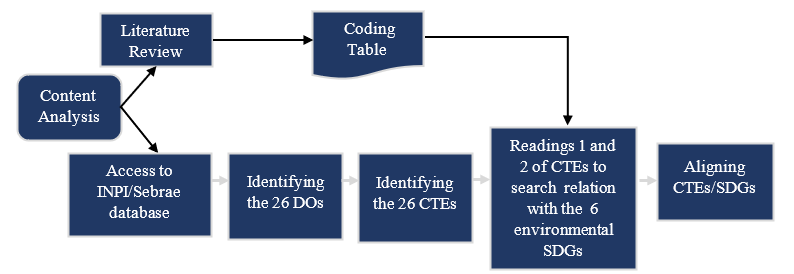
First, we carried out a floating reading of the research corpus (Bardin, 1977), where we read the Technical Specifications Booklets (CET) in full, in order to get information and generate a list of codes, and then compare and validate the codes between the authors. The CETs of the 26 DOs were identified in the public database DataSebrae for Geographical Indications, created in partnership with the National Institute of Industrial Property (INPI); from there we defined the codes for detailed analysis. The step-by-step process for accessing the database is shown in Figure 1.
Figure 1
Step-by-step for accessing DOs database
- Step 1: Access Sebrae’s public platform for studies and research data – DataSebrae – on the tab of geographical indications, at https://datasebrae.com.br/indicacoesgeograficas/;
- Step 2: Roll the page upward and go down until viewing the list of Geographical Indications, both Designations of Origin and Indications of Source;
- Step 3: Click on each Designation of Origin individually to access its general information, and, at the end of the list, click; and
- Step 4: Download the Technical Booklet
The approach follows the steps of Bardin's (1977) and Creswell's (2014) proposition of content analysis, as shown in Figure 2. We analyzed if the 26 CTEs of Brazilian Designations of Origin include, in their councils, entities related to the preservation of the environment or to other environmental issues. We also checked if the booklets explicitly mention issues linked to SDGs on environmental dimensions. This was carried out in two rounds, the first in February 2022, and updated in February 2024. In the second round, we checked if CTEs had been updated in any essential aspects.
Figure 2
Research Flow Chart
5. Results
Analyzing the relationship between sustainability and GIs represents an innovative and effective approach for promoting responsible production practices, environmental preservation, and local economic development. Sustainability, understood as the search for balance between the environmental, social, and economic pillars, gains new impulse when associated with geographical indication.
Content analysis of the documents reveals the specific requirements contained in the Technical Specifications Booklets (CETs). Table 4 classifies the DOs, showing the official list, in February 2024, of the 26 DOs and the Brazilian state of location. Table 2 also shows which Designations of Origin most fulfill the requirements proposed by CETs, in order to serve the highest number of SDGs.
Table 4
Brazilian Designations of Origin in Chronological Order of Registration
|
N. |
UF |
BRAZILIAN DESIGNATIONS OF ORIGIN |
PRODUCT |
REGISTRATION |
|
1 |
RS |
Vale dos Vinhedos (IS changed to DO in 09/2012) |
Wine |
11/19/2002 |
|
2 |
RJ |
Paraty (IS changed to DO on 30/01/24) |
Sugarcane liquor (‘cachaça’) |
07/10/2007 |
|
3 |
RS |
Litoral Norte Gaúcho |
Rice |
08/24/2010 |
|
4 |
MG |
Mantiqueira de Minas |
Coffee |
05/31/2011 |
|
5 |
CE |
Costa Negra BR |
Shrimp |
08/16/2011 |
|
6 |
RJ |
Região Pedra Carijó Rio de Janeiro |
Stone |
05/22/2012 |
|
7 |
RJ |
Região Pedra Madeira Rio de Janeiro |
Stone |
05/22/2012 |
|
8 |
RJ |
Região Pedra Cinza Rio de Janeiro |
Stone |
05/22/2012 |
|
9 |
AL |
Manguezais de Alagoas |
Propolis |
07/17/2012 |
|
10 |
MG |
Região do Cerrado Mineiro |
Coffee |
12/31/2013 |
|
11 |
MT |
Ortigueira |
Honey |
09/01/2015 |
|
12 |
MG |
Região do Própolis Verde de Minas Gerais |
Propolis |
09/06/2016 |
|
13 |
SC |
Região da Banana da Região de Corupá |
Banana |
08/28/2018 |
|
14 |
SC and RS |
Campos de Cima da Serra |
Cheese |
03/03/2020 |
|
15 |
PA |
Terra Indígena Andirá- Marau |
Guaraná |
10/20/2020 |
|
16 |
MG |
Caparaó |
Coffee |
02/02/2021 |
|
17 |
ES |
Montanhas do Espírito Santo |
Coffee |
05/04/2021 |
|
18 |
RO |
Matas de Rondônia |
Coffee |
06/01/2021 |
|
19 |
AM |
Mamirauá |
Pirarucu (fish) |
07/13/2021 |
|
20 |
SC/PR/RS |
Mel de Melato da Bracatinga Planalto Sul Brasileiro |
Honey |
07/20/2021 |
|
21 |
SC |
Região de São Joaquim |
Apple |
08/03/2021 |
|
22 |
MG |
Norte de Minas |
Honey |
02/01/2022 |
|
23 |
SC |
Planalto Norte Catarinense |
Yerba-Mate |
05/24/2022 |
|
24 |
RJ |
Região de Tanguá |
Orange |
07/26/2022 |
|
25 |
RS |
Altos de Pinto Bandeira |
Sparkling wine |
11/29/2022 |
|
26 |
MG |
Canastra Café |
Coffee |
09/19/2023 |
Source: Adapted from Portal Sebrae (2024).
Observing Table 4, it is important to consider that the Designations of Origin products have a strong relationship with the use and extraction of environmental and natural resources (soil, water, climate), especially in agri-food chains such as coffee, honey, fruit, cheese, shrimp, and stone extraction. And that the number of GIs has grown fast since 2020. In just four years, 50% of the DOs, or thirteen out of twenty-six, have been recognized, after almost 30 years of the GI law in Brazil.
6. Technical specifications booklets (CETs) of DOs and relationships with environmental SDGs
The Technical Specifications Booklets are documents that regulate the operation of Brazilian GIs in general, and DOs in particular. Based on this document, INPI grants the GI registration, in the mode of DO or Indication of Source to the Procedural Substitute, the name given in Brazil to the association or other entity with an established legal existence, which requests granting this status to a region and product. Therefore, CET is the document of choice for identifying what commitments were made by the DO regarding sustainability practices and UN SDGs, when approved by the national body in charge. These goals are number 6, 7, 12, 13, 14 and 15, and are listed in Table 3. Table 5 shows, for each OD, the phrases that, in our view, express OD's commitments to SDGs.
Table 5
Phrases related to environmental sustainability mentioned in CETs
|
Brazilian Designations of Origin |
SDG |
Reference in DOs’ Technical Specifications Booklets |
|
01. Vale dos Vinhedos - RS - Wine |
|
|
|
02. Paraty - RJ - Cachaça |
12- Sustainable production and consumption |
Adopt practices to mitigate environmental impacts, especially the reuse of by-products |
|
03. Litoral Norte Gaúcho - RS - Rice |
15 – Sustainable management |
Have and keep up to date the environmental license, according to State legislation |
|
04. Mantiqueira de Minas -MG - Coffee |
15 - Sustainable management |
Have and keep up to date the environmental license |
|
Respect the current environmental legislation; |
||
|
05. Costa Negra BR - CE - Shrimp |
15 - Sustainable management |
Have good practices that maximize the use of resources and eliminate the possibilities of environmental damage |
|
Comply with the Brazilian environmental legislation |
||
|
12 - Sustainable production and consumption |
Promote sustainable shrimp farming, based on the code of conduct |
|
|
06. Região Pedra Carijó Rio de Janeiro - RJ - Stone |
15 - Sustainable management |
Regularize and keep up to date the requirements for complying with the Environmental License |
|
Adopt practices that mitigate environmental impacts, especially the reuse of waste |
||
|
12- Sustainable production and consumption |
Discard only waste that cannot be reused |
|
|
Reuse waste that can become by-products |
||
|
07. Região Pedra Madeira Rio de Janeiro - RJ - Stone |
15 - Sustainable management |
Regularize and keep up to date the requirements for complying with the Environmental License |
|
Adopt practices that mitigate environmental impacts, especially the reuse of waste |
||
|
12- Sustainable production and consumption |
Discard only waste that cannot be reused |
|
|
Reuse waste that can become by-products |
||
|
08. Região Pedra Cinza Rio de Janeiro - RJ - Stone |
15 - Sustainable management |
Regularize and keep up to date the requirements for complying with the Environmental License |
|
Adopt practices that mitigate environmental impacts, especially the reuse of waste |
||
|
12- Sustainable production and consumption |
Discard only waste that cannot be reused |
|
|
Reuse waste that can become by-products |
||
|
09. Manguezais de Alagoas - AL - Propolis |
|
|
|
10. Região do Cerrado Mineiro - MG - Coffee |
12- Sustainable production and consumption |
During cultivation and production, comply with hygiene, work, safety, and environmental rules of conduct |
|
11. Ortigueira - MT - Honey |
|
|
|
12. Região da Própolis Verde de Minas Gerais - MG - Propolis |
12- Sustainable production and consumption |
Meet the mandatory sustainability requirements in the manufacturing process |
|
13. Região da Banana da Região de Corupá - SC - Banana |
12- Sustainable production and consumption |
Commit to the reduced use of agrochemicals |
|
15 - Sustainable management |
Keep environmental compliance for rural activities in the region |
|
|
14. Campos de Cima da Serra - SC/RS - Cheese |
|
|
|
15. Terra Indígena Andirá-Marau - PA - Guaraná |
12- Sustainable production and consumption |
Harmonize production with the integrated ethnodevelopment and ecodevelopment project |
|
Promote the recovery of bee nests in trees cut down for guaraná production |
||
|
15 - Sustainable management |
No use of pesticides or highly soluble (chemical) fertilizers |
|
|
16. Caparaó - MG - Coffee |
15 - Sustainable management |
Promote the organization, preservation, and sustainability of the environment |
|
Stimulate the sustainability of the geographical area through environmental preservation and conservation |
||
|
Carry out practices to mitigate environmental impacts |
||
|
Comply with the current environmental legislation |
||
|
Employ techniques for the use and preservation of soil and water. |
||
|
12- Sustainable production and consumption |
Register and control pesticides and respect the grace period for each product |
|
|
17. Montanhas do Espírito Santo -ES - Coffee |
15 - Sustainable management |
Promote the organization, preservation, and sustainability of the environment |
|
Stimulate the sustainability of the geographical area |
||
|
18. Matas de Rondônia - RO - Coffee |
06 – Reducing water pollution |
Practice rational water management when irrigation is necessary |
|
15 - Sustainable management 15 – Managing impacts on soil and water |
Conservation and nutritional soil management |
|
|
Do not burn garbage or waste |
||
|
Do not use chemical fertilizers with higher levels of heavy metals than allowed |
||
|
Preserve natural resources, soil and water with reduced production impacts |
||
|
19. Mamirauá - AM - Pirarucu |
15 - Sustainable management |
Promote the organization, preservation, and sustainability of the Mamirauá environment |
|
Carry out sustainable management |
||
|
20. Planalto Sul Brasileiro - SC/PR/RS - Honey |
15 - Sustainable management |
Use sustainable practices in all stages of the production chain |
|
21. Região de São Joaquim - SC - Apple |
15 - Sustainable management |
Adopt agricultural practices that use and conserve the soil and have a low environmental impact. |
|
12- Sustainable production and consumption |
Practice responsible disposal of products, packaging, inputs, and waste. |
|
|
22. Norte de Minas - MG - Honey |
|
|
|
23. Planalto Norte Catarinense - SC - Yerba-Mate |
|
|
|
24. Região de Tanguá - RJ - Orange |
15 - Sustainable management |
Develop environment conservation |
|
25. Altos de Pinto Bandeira - RS – Sparkling wine |
|
|
|
26. Canastra Café - MG - Coffee |
15 - Sustainable management |
Keep the cultivation and establishment in compliance with safety and environmental regulations |
|
|
Conserve water, soil, and native vegetation, respecting the current environmental legislation |
Note: Blank cells indicate that no references to any SDG were identified
5.1 Discussion of Results
A first result that stands out is that, for seven DOs - 1, 9, 11, 14, 22, 23 and 25 - we did not identify a single reference associated with SDGs or sustainability issues. This may be due to the fact that some of these DOs are among the oldest in Brazil. Number 1, from Vale dos Vinhedos, was the first registered Brazilian DO; number 9, Manguezais from Alagoas, and number 11, Ortigueira, honey from Paraná, were registered in the first half of the 2010s. At that time, concern about environmental issues was not as strong as today, and SDGs were adopted by UN only in 2015. However, this explanation does not hold up, since DOs 14, 22, 23, and 25, for which there are no associations with SDGs either, were all registered in the last five years. Hence, the fact that almost 1/3 of DOs make no reference to a potential association with SDGs shows that many of the writers of these booklets did not bother to emphasize this link.
We could also consider that the lack of mention to issues that could be associated with SDGs is because these DOs had no impact, even potential, on the sustainability of the ecosystems where they are located. But this is not the case either. First, because almost all SDGs on the agenda are agricultural, and, for them, the issue of preserving soil and water is essential. And second, because, of these seven, two DOs are wineries, one is located in a mangrove area, three depend on healthy conditions for bee reproduction, and the last one depends on milk production by cows that feed mainly on native pastures. Clearly, all these DOs depend on and affect important environmental issues.
For two SDGs - number 7, which addresses reliable and sustainable access to energy, and number 13, climate change - we did not identify any phrase, or segment of a phrase, in any DO, that referred to them. With regard to SDG 6, sustainable water management, only one coffee DO, Matas de Rondônia, does so. No DO mentions the issue of energy, and this can perhaps be explained by the fact that, except for the three that exploit the extraction and processing of stones, they are agricultural rather than industrial, and are not major consumers of this resource. Similarly, the fact that climate change seems a distant issue, not directly affected by DO’s operations, may help us understand why no DO refers to anything related to SDG 13. But the fact that only one DO refers to water management is more difficult to understand, given that all of them are highly dependent on the availability of rivers, springs, and groundwater for the irrigation of crops, on which the survival of their businesses depends.
Regarding SDG 12 - ensuring sustainable production and consumption patterns - and SDG 15 - protecting land ecosystems -, for which most citations were found, they express goals that are so wide and elementary in the context of current climate threats, that it is not absurd to expect that all DOs should make some kind of reference to them. However, this is not what we found. Only six refer to SDG 12, and seven to SDG 15. We can consider that only 13 of the 26 DOs refer to the basic SDGs in the context of agricultural GIs, and with a strong dependence and impact on ecosystems.
In the set of 26 DOs analyzed, we identified 40 phrases, or segments of phrases, associated with SDGs. However, 10 of them just state that the DO is committed to complying with the environmental legislation. These are DOs 3, 4, 5, 6, 7, 8, 10, 13, 16 and 26. Typical sentences are: "Have and keep up to date the environmental license according to state legislation" or "Regularize and keep up to date the requirements for compliance with the Environmental License", or still "Meet the mandatory sustainability requirements in the manufacturing process".
We also found generic, non-specific phrases, saying little more than what the DO intends to do for conserving the environment: "Adopt practices that mitigate environmental impacts"; "Stimulate the sustainability of the geographical area"; "Promote the organization, preservation, and sustainability of the environment" are some of them.
There are also sentences that showed some attention to specific aspects of the DO activity by those responsible for the CET, and suggest that there was some discussion on how it could foster sustainable development. However, they were 12, less than 30% of the total. Phrases that referred to DO activity or polluting aspects were considered of this type. "Do not use chemical fertilizers with levels of heavy metals above those allowed"; “register and control pesticides and respect the grace period for each product"; “promote the recovery of bee nests in trees cut down for Guaraná production" are some examples.
This analysis of DOs Technical Specification Booklets led us to consider that references to the UN SDGs are few and generic. Therefore, it is worth discussing if these references should exist and be more frequent and detailed, and if it is appropriate to consider that they should have been made by the representatives of the Geographical Indications who drafted and submitted the booklets. Similarly, it is worth discussing whether INPI should require a more complete reference to these goals in CETs.
Until the last available update, the CETs of Geographical Indications (GIs) were not required explicitly to specify GI's commitments to UN SDGs in Brazil. The Brazilian legislation on GIs, regulated by the National Institute of Industrial Property (INPI), focuses on aspects such as characterization of the product or service, geographical delimitation, production methods, and the qualities or reputations attributed to their geographical origin. Hence, the fact that CETs are not more specific or detailed regarding SDGs in no way represents a breach or non-compliance with their legal obligations.
The article discusses to what extent and how INPI should act to compel GIs that submit their CETs for approval to commit to environment preservation. Or to encourage entities that submit their CETs for approval to commit to such actions. It is also worth discussing if INPI's responsibility should include some of these actions; in the documents and standards this is not common.
Only one article - Milano and Cazella (2021) - identifies these goals. The others we analyzed (Guareschi et al., 2023; Kimura & Rigolot, 2021) show a relationship between practice, the consequences of GI's action, and SDGs, but not between the documents and SDGs. Milano and Cazella (2021), although not highlighting this point in their conclusions, draw attention in the article’s body to the enormous potential that GIs would have if they included environmental sustainability goals in their founding documents, in terms of the building processes of each GI individually, and of GIs institution as a whole.
We recognize that measures that create responsibilities for INPI, such as making environmental commitments explicit for getting CETs approved, would increase the time needed for the approvals, and would hamper the drafting of CETs from potential GIs, among other implications. But given the current relevance of environmental issues and the increase in the number and size of DOs, we think that this discussion is timely. The literature we examined on sustainability and GIs describes successful and unsuccessful experiences of environmental preservation, rather than discussing the need to make GIs’ assumption of commitments mandatory.
6. Summary and conclusions
This article analyzed the Technical Specifications Booklets (CETs) for geographical indications of the Designations of Origin type, paying particular attention to whether or not these booklets mention commitments that could be associated with the UN Sustainable Development Goals. We conclude that these mentions do not exist, or are not very specific. While acknowledging that INPI, the body in the Brazilian government structure responsible for approving CETs, has no formal responsibility for including these commitments, we wonder if it shouldn't do that, and if the legislation shouldn't be changed to give INPI the power and obligations on this matter. The importance of mentioning the impacts of GIs in their founding documents was identified in at least one article of impact in the literature. Other articles cite the impacts of GIs on environmental sustainability goals and SDGs. In our reading of CETs, we found a significant number of them where environmental sustainability goals that could be associated with SDGs were not mentioned at all, or vaguely and non-specifically.
The paper is limited to highlighting that even indirect references to SDGs were not identified in many CETs, and that is a problem. We did not address, and therefore left open, several questions that should be answered in future studies: Do GIs whose CETs explicitly mention SDGs achieve more environmental preservation goals? What are the impacts on the GI formation process of the mandatory inclusion of these goals? Does INPI have a legal mandate to require this inclusion? What are the implications of including this requirement in the process of analysis and approval of GI registers at INPI? Is this demand explicit in other countries? How? What are the results?
This article is original, since we did not identify any others, in the consulted literature, that have addressed the issue we discuss here. Deepening the discussion certainly requires the investigation of several matters. We expect that the community of researchers and those interested in developing the institution of GIs in Brazil consider the issue we raised relevant and discuss it further.
References
Barbieri, J. Carlos. (2020). Desenvolvimento sustentável: das origens à Agenda 2030. Petrópolis: Vozes.
Barbosa, P. M. D. S., Fernandes, L. R. de M. V., & Lage, C. L. S. (2013). Quais são as indicações geográficas brasileiras? Revista Brasileira de Pós-Graduação, 10(20), 317–347. https://doi.org/10.21713/2358-2332.2013.v10.394
Bardin, L. (1977). Análise de conteúdo . Trad. de L. A. R. e A. P. 70. ed. Universitaires de France, Soc. Ind. Gráfica Telles da Silva.
Bowen, S. (2010). Embedding Local Places in Global Spaces: Geographical Indications as a Territorial Development Strategy. Rural Sociology, 75:209-243(June), 2010. https://doi.org/https://doi.org/10.1111/j.1549-0831.2009.00007.x
CE, C. E. (2020). Comunicação da Comissão ao Parlamento Europeu, ao Conselho, ao Comité Económico e Social Europeu e ao Comité das Regiões: Agenda de Competências para a Europa em prol da competitividade sustentável, da justiça social e da resiliência.
Cerdan, C. (2013). Indicações geográficas e estratégias de desenvolvimento territorial. Indicações Geográficas: qualidade e origem nos mercados alimentares. Porto Alegre: UFRGS, 125–150.
Chabrol, D., Mariani, M., & Sautier, D. (2017). Establishing Geographical Indications without State Involvement? Learning from Case Studies in Central and West Africa. World Development, 98, 68–81. https://doi.org/10.1016/j.worlddev.2015.11.023
Cole, M. S., Bruch, H., & Vogel, B. (2012). Energy at work: A measurement validation and linkage to unit effectiveness. Journal of Organizational Behavior, 33(4), 445–467.
Creswell, J. W. (2014). Investigação Qualitativa e Projeto de Pesquisa-: Escolhendo entre Cinco Abordagens. Porto Alegre: Penso Editora.
Falasco, S., Caputo, P., & Garrone, P. (2024). Can Geographical Indications promote environmental sustainability in food supply chains? Insights from a systematic literature review. Journal of Cleaner Production, 141100. https://doi.org/10.1016/J.JCLEPRO.2024.141100
Fao, A. O. of the U. Nations. (1989). Sustainable development and natural resources management. FAO, Agriculture Organization of the United Nations.
Guareschi, M., Mancini, M. C., & Arfini, F. (2023). Geographical Indications, public goods and sustainable development goals: A methodological proposal. Journal of Rural Studies, 103, 103122. https://doi.org/10.1016/J.JRURSTUD.2023.103122
Inpi. (2022). Indicações geográficas: denominações de origem reconhecidas.
Inpi, I. N. de P. I. (2024). Manual de Indicações Geográficas. Em Indicações Geográficas. Instituto Nacional de Propriedade Industrial. http://manualdemarcas.inpi.gov.br/projects/manual-de-indicacoes-geograficas/wiki/02_Indica%C3%A7%C3%A3o_Geogr%C3%A1fica_e_esp%C3%A9cies_de_registro
Kimura, J., & Rigolot, C. (2021). The potential of geographical indications (GI) to enhance sustainable development goals (SDGs) in Japan: overview and insights from Japan GI Mishima potato. Sustainability, 13(2), 961.
Lages, V., Lagares, L., & Braga, C. L. B. (2006). Valorização de produtos com diferencial de qualidade e identidades: Indicações Geográficas e certificações para competitividade nos negócios. Em C. e E. L. SDV (Org.), Gastronomía ecuatoriana y turismo local. 2. ed. Vol. 1, Número 69. Serviço Brasileiro de Apoio às Micro e Pequenas Empresas.
Milano, M. Z., & Cazella, A. A. (2021). Environmental effects of geographical indications and their influential factors: A review of the empirical evidence. Current Research in Environmental Sustainability, 3. https://doi.org/10.1016/j.crsust.2021.100096
Origin, O. for an I. G. I. N. (2022). ORIGIN Presentation. ORIGIN. https://www.origin-gi.com/web_articles/origin-presentation/
Onu. (2021). Objetivos de Desenvolvimento Sustentável no Brasil. ONU Brasil, 1. https://brasil.un.org/pt-br/sdgs
Pereira, M. G. A., Silva, M. S., Lima, Â. M. F., & Ribeiro, N. M. (2024). Indicações Geográficas e desenvolvimento sustentável: uma análise bibliométrica. Cadernos de Prospecção, Salvador, 17(1), 337–353. https://doi.org/https://doi.org/10.9771/cp.v17i1.56568
Sachs, I. (2006). Desenvolvimento: includente, sustentável, sustentado.
Sebrae. (2021). Cenário das Indicações Geográficas Brasileiras.
Sebrae. (2024). Panorama das IGs brasileiras registradas. Em SEBRAE - Serviço Brasileiro de Apoio às Micro e Pequenas Empresas. https://app.powerbi.com/view?r=eyJrIjoiZDA2MDk0M2YtYjBmYS00ZTFjLThiOWQtOGI1ZDQ0MTA3YWExIiwidCI6Ijk3Mjk4MjcxLTFiZDctNGFjNS05MzViLTg4YWRkZWY2MzZjYyIsImMiOjR9
Vandecandelaere, E., Teyssier, C., Barjolle, D., Jeanneaux, P., Fournier, S., & Beucherie, O. (2020). Strengthening sustainable food systems throughgeographical indications: an analysis of economicimpacts. 1. ed. European Bank.
-------
i Professor Universitário. Doutorando em Administração de Empresas (ESPM, 2024) com pesquisa em Criação de Valor para os Shareholders com foco em Indicações Geográficas, Mestre Profissional em Administração com Extensão Internacional em Projetos Complexos pela Bentley University - Boston, EUA, Especialista em Gestão de Empresas, Especialista em Docência no Ensino Superior e Bacharel em Administração Geral de Empresas.
ii :Doutor em Administração de Empresas pela Fundação Getúlio Vargas – SP (2002). Mestre em Administração pela mesma instituição. Engenheiro de Produção pela Escola Politécnica pela Universidade de São Paulo. É professor da graduação e pós-graduação da Escola Superior de Propaganda e Marketing (ESPM) na área de Estratégia Internacional e Estudos Organizacionais