Drivers and barriers to the implementation of the 2030 Agenda at a state university in Paraná (Brazil): regional and sustainable development in perspective
Drivers e barreiras à implementação da Agenda 2030 em uma universidade estadual paranaense (Brasil): desenvolvimento regional e sustentável em perspectiva
Gabriela Daiana Christ1*, ORCID: https://orcid.org/0000-0002-5457-5884 ; Moacir Piffer1, ORCID: https://orcid.org/0000-0003-3937-0941 ; Lucir Reinaldo Alves1, ORCID: https://orcid.org/0000-0001-5703-623X ; Janidr Pauli2, ORCID: https://orcid.org/0000-0003-4618-6958 .
1. Programa de Pós-graduação em Desenvolvimento Regional e Agronegócio, Universidade Estadual do Oeste do Paraná, campus Toledo, Paraná, Brasil. E-mail: gabrielachrist@gmail.com
2. Programa de Pós-graduação em Administração, Atitus Educação, campus Passo Fundo, Rio Grande do Sul, Brasil. E-mail: mopiffer@yahoo.com.br
3. Universidade Estadual do Oeste do Paraná, campus Toledo, Paraná, Brasil. E-mail: lucir.alves@unioeste.br
4. Programa de Pós-Graduação Stricto Sensu em Administração, Atitus Educação, Passo Fundo, Rio Grande do Sul, Brasil. E-mail: jandir.pauli@atitus.edu.br
*Autor correspondente: gabrielachrist@gmail.com ; R. Guaíra, 3141 – Jardim Santa Maria, Toledo – PR, 85903-220, Brasil.
Abstract
The 2030 Agenda for Sustainable Development draws attention to learning opportunities throughout its implementation process. In this scenario, there are higher education institutions (HEIs); how they act towards its implementation is an open question. This study aimed to "understand the perception of UNIOESTE’s management regarding the drivers and barriers to implementing the 2030 Agenda at the institution." Using a qualitative approach, this single-case study used content analysis based on semi-structured interviews with fourteen managers in leadership roles at the HEI. As a result, ten drivers and fourteen barriers were identified. In practice, this research could support decision-making regarding sustainability management at the university. It is concluded that the studies are not exhausted since there is still a need for further research on the subject.
Keywords: regional development, higher education institution, United Nations 2030 Agenda
Resumo
A Agenda 2030 para o Desenvolvimento Sustentável chama a atenção para oportunidades de aprendizagem ao longo de seu processo de implementação. Nesse cenário, estão as instituições de ensino superior (IES); como elas estão agindo para sua implementação é uma questão em aberto. Foi objetivo deste estudo “compreender a percepção da gestão da UNIOESTE quanto aos drivers e barreiras na implementação da Agenda 2030 na instituição”. Este estudo de caso único de abordagem qualitativa, utilizou-se de análise de conteúdo a partir de entrevistas semiestruturadas com quatorze gestores que estão em função de liderança na IES. Como resultado, identificou-se dez drivers e quatorze barreiras. Na prática, esta pesquisa poderá apoiar a tomada de decisão no que toca a gestão da sustentabilidade na Universidade. Conclui-se que os estudos não se esgotam, uma vez que ainda existe a necessidade de expansão de pesquisas acerca da temática.
Palavras-chave: desenvolvimento regional; agenda 2030; instituição de ensino superior.
Citation: Christ, G. D., Piffer, M., Alves, L. R. & Pauli, J. (2024). Drivers and barriers to the implementation of Agenda 2030 a state university from Paraná (Brazil): regional and sustainable development in perspective. Gestão & Regionalidade, v.40, e20249366. https//doi.org/10.13037/gr.vol40.e20249366
Data availability: data is available in an external repository.
Author contributions: Gabriela Daiana Christ (Conceptualization; Methodology; Software; Validation; Formal analysis; Research; Data curation; Writing - Review and Editing); Moacir Piffer (Supervision); Lucir Reinaldo Alves (Writing - Review and Editing); Jandir Pauli (Supervision).
Funding: This work was conducted with the support of the Coordination for the Improvement of Higher Education Personnel - Brazil (CAPES) - Funding Code 001.
Ethics committee approval and informed consent obtained: Certificate of Submission for Ethical Appraisal (CAAE/Plataforma Brasil) N. 44790921.0.0000.0107.
1 Introduction
The discussion around the creation of mechanisms and the formulation of a sustainable development policy for institutions is pertinent given the challenges that persist in the 21st century (Ferrera de Lima & Alves, 2012; Frandoloso & Rebelatto, 2019; Pike et al., 2006). Poverty, hunger, health, education, gender equality, accessible water and energy, economic and social inequality, responsible consumption, global climate change, peace, and justice are some of the issues on the agenda of different countries and institutions (Schulz et al., 2021).
However, this topic is recent: it is a concept that has been widely disseminated and used in various areas of science (Ferrera de Lima, 2020b). Its theoretical and practical breadth is present in the transversality of knowledge with diverse approaches in universities and research institutions, among other areas (Sabará et al., 2021). The development of a region, for example, is not attributed solely to economic growth, but also to its capacity for political articulation and social organization, which are related to the supply of various capitals available in the region, especially intangible capital (Boisier, 2000), such as institutional, human, civic, social, and synergetic (Duarte & Schneider, 2019; Piacenti, 2016).
Indeed, considering such social progress, the concept of sustainability is worth mentioning as the right of future generations to enjoy the same (or better) present conditions (UN, 1987). Furthermore, with a focus on developing a more sustainable world and facing the complexities of global problems, the United Nations (UN) approved the Sustainable Development Goals (SDGs) at its 70th General Assembly in September 2015, defined as an action plan for people, institutions, the planet, and prosperity (UN, 2015). The 2030 Agenda includes 17 Sustainable Development Goals and 169 targets to be achieved by 2030 (Prieto-Jiménez et al., 2021).
This is the context in which Higher Education Institutions (HEIs) operate. They have an action strategy to create and consolidate a favorable environment for generating and disseminating intangible capital, innovations, competitiveness, sustainability, and the development of regions (Ferrera de Lima & Alves, 2012). Specifically, the production of scientific, technological, and cultural knowledge at the Western Paraná State University (UNIOESTE), maintained by the State Government of Paraná, is recognized as having a positive impact on the development of the region where it is located (Borges & Sbardelotto, 2018; Corrêa, 2021; Raiher, 2017). It is a university that was created as a development strategy for the west and southwest of Paraná in the 1990s. Understanding the magnitude of this influence has relevant repercussions for public and private institutions and the actors that are part of them (Christ & Piffer, 2022). Staying attentive to the demands of society and global agendas is significant and needs to be part of UNIOESTE's agenda.
Therefore, the problem permeating this research lies in identifying the perception of UNIOESTE's leaders regarding implementing Agenda 2030 at the institution. In other words, this study aims to understand the perception of UNIOESTE's management regarding the drivers and barriers to implementing the 2030 Agenda at the institution. Its secondary objective is to identify actions that contribute to implementing the 2030 Agenda at UNIOESTE.
In addition to this section, which introduces the reader to the topic (1), this work is organized into four other parts: the theoretical framework (2), which contextualizes, but does not exhaust, the understanding of regional development and the role of HEIs in regional development; the methodological procedures (3), where the modus operandi of the study is presented; the analysis and discussion of the results are presented next (4); and the last section presents the final considerations (5).
2 Theoretical framework
This section presents perspectives on regional development (2.1) and the role of higher education institutions in regional development (2.2) in order to build a theoretical framework that will be used to analyze the results.
2.1 Regional development
Development is not only linked to incentive policies or an increase in production and income but also, above all, to the ultimate goal of the well-being of specific populations. For example, the coordination of projects with a view to a virtuous cycle to promote education, health, employment, social protection, and respect for diversity (Ferrera de Lima & Alves, 2012), among other aspects, many of which are included in the 2030 Agenda (UN, 2015). The multiple dimensions of development include the following: economic, social, human, endogenous, underdevelopment, sustainable, organizational, urban, rural, ecodevelopment, regional, and territorial (G. B. Oliveira, 2002).
The concept of regional development and the creation of regional science are closely linked. Regional Science emerged in the 1950s to rethink new theorizing and new approaches to regional phenomena and interventions, including the development process. Walter Isard (1960) coined the term regional science to create a school that could include regional development researchers in a single line of analysis (Theis et al., 2021).
In terms of understanding the concept of regional development, the desire to understand its issues goes back to the theories that emerged from the 1960s onwards as a counterpoint to the theories of location that, until the mid-20th century, were dominated by the classics Johan-Heinriche Von Thünen (The Isolated State, 1826), August Losch (The Spatial Order of the Economy, 1940), Walter Christaller (Central Places, 1933) and Alfred Weber (Theory of the Location of Industries, 1909) (Ferrera de Lima, 2020a). In other words, these authors addressed issues such as the location of productive activities, the centrality and hierarchy of places, and the importance of productive locational dynamics to overcome intra-regional inequalities, and this is where theories of regional development emerged and spread (Silva, 2021).
However, the discussion around the development concept began to pay less attention to the role of exogenous elements (from outside the regions, such as industrialization based on investments from outside the region). It increasingly began to consider endogenous ones (internal to the region, taking advantage of its characteristics and intangible capital and cooperation). Thus, for Ferrera de Lima (2020b, p. 132) "The regional development theory seeks to understand the role of space, public policy, and territories in improving the quality of life and economic progress of regions." The author believes that promoting regional development is linked to building citizenship in the regions, with human development being the main focus of regional development public policy.
As an example of a Brazilian theorist, Celso Furtado, in his book "A Nova Dependência" (The New Dependency), published in 1982, draws attention to popular participation in the development process. Furtado (1982) believes that re-democratization is the way to development and that the legitimization of public policies, and the effective participation of citizens are essential in this process. Furtado emphasizes that development is a social and cultural process and, secondly, an economic one.
For a long time, there has been a tendency everywhere to imagine that development is quantifiable, whose substrate is accumulation, investment, and the formation of productive capacity. However, experience has amply demonstrated that true development is primarily a process of activating and channeling social forces, advancing associative capacity, and exercising initiative and inventiveness. It is, therefore, a social and cultural process and only ancillary to an economic one. It produces development when society manifests energy capable of channeling, in a convergent way, latent or dispersed forces (Furtado, 1982, p. 149, our translation).
In other words, despite the efforts, technologies, innovations, and methods used to describe, measure, and evaluate a region in its development process, its true meaning comes when people can cooperate. For this to happen, knowing the region and how exogenous and endogenous factors act is essential for formulating policies and programs focused on regional development (Christ, Alves, et al., 2021).
Using the assumptions of regional development or regional analysis, which studies the location of productive and regional activities in which HEIs are inserted in the space of regions, makes sense to promote the aforementioned development of regions. Considering regional development as a regional science, which is related not only to economics and geography but also to other knowledge such as sociology, political science, anthropology, history, law, and architecture, Theis et al. (2021) state that space is not neutral, but reflects human actions, as well as having a connection with regional policy and planning.
It is worth mentioning that the development of a society results in decisions formulated and implemented by governments in conjunction with other forces in society that make up the public sphere. Overall, these decisions and actions by governments and other social actors constitute public policies, which are considered instruments of planning, rationalization, and participation (Monteiro et al., 2020). Hence, the following question arises: What role do HEIs play in regional development?
2.2 The role of higher education institutions in regional development
Since their inception, universities have been subjected to processes of transformation and movements that put their raison d'être into question. The missions of universities are known as the triad: to safeguard and protect the values of civilization (1); to produce knowledge (2); and to provide extension, transfer, and innovation services (3) (Kempton et al., 2021b; Santos & Almeida Filho, 2012). Nevertheless, efforts to justify their relevance have required a capacity for reconfiguration, preserving original responsibilities, and suggesting new challenges.
In terms of regional development, HEIs play a fundamental and increasingly necessary role in developing the communities in which they operate. Kempton et al. (2021a) attribute the main value of higher education in a region to increasing human capital. According to the authors, the work of universities can bring more productivity, entrepreneurship, and innovation to the region.
In practical terms, while HEIs have access to new forms of funding, considering participation in different spheres, regional partners will be able to access the human and social capital of that institution, as well as the knowledge, innovation, and technology produced there (Kempton et al., 2021a).
Within a knowledge-based economy, universities are no longer considered just creators and producers of knowledge, trainers of a skilled workforce that will become future citizens or cultural disseminators. They are recognized as useful assets and strategic players in the successful economic growth and development of their home regions. (Kempton et al., 2021c, p. 18).
The role of HEIs has changed over time. If in the past – since their conception in the Middle Ages – they were perceived as simple propellers of knowledge (teaching), over the years, during the 19th century, another mission was added to universities: in addition to teaching, research was added. Later, at the end of the 20th century and the beginning of the 21st century, extension (engagement with the community) was added as the third mission of HEIs, i.e., to understand demands and act in society. In addition to teaching, research, and extension, the concepts of University 4.0 and University 5.0 (technological approaches and a human-centered approach) have been discussed (Kempton et al., 2021c).
Kempton et al. (2021b) point out that this influence is not automatic despite the diversity of possible missions for a HEI. The fact that a HEI exists is not synonymous with development for the region. As each region has its specificities, the context in which the HEI is inserted will determine which missions it will be able to generate and develop and what its engagement with its surroundings will be. For example, suppose the region does not have a development strategy. In that case, the country does not have a higher education policy in which the HEI plays a leading role, or if the HEI's mission does not include regional articulation, the HEI is unlikely to influence regional development.
What is certain is that regardless of the era, in general, HEIs have been and continue to be fundamental axes for building a developed society or one that wants to develop, not only because of their knowledge capital but also because of their human capital, their ability to act in intra-organizational networks, participate in local governance and other contributions (Christ, Frohlich, et al., 2021). In addition to being suitable places for dialoguing, planning, and executing society's demands, it is in HEIs that people are found who can participate in and lead such movements as those suggested by the 2030 Agenda.
It should also be noted that the development of a global higher education system that generates social impact, or even community engagement, is the recognition that a paradigm shift is taking place, in which HEIs are not just a strategic resource for local, regional or national development, but a resource connected to the world order with all its asymmetries. In this sense, it is worth quoting Morejon, Ferrera de Lima, and Bianco (2017), who, when analyzing data on the level of human development in the regions, reveal the need to consider territorial development policies with social inclusion.
An example related to the global discussion of higher education is the Education Sector of the Southern Common Market (MES/Mercosur), in which Aliandra Barlete explains the role of HEIs in regional construction. For the author, about education, the MES/Mercosur project brought a new cultural dimension to Mercosur; rather than a network of structures and hierarchies conducive to its political and economic objectives, it was planned as a platform for the creation of shared values and meanings (Barlete, 2019).
Concerning higher education for sustainable development, HEIs play a central role. Hallinger and Chatpinyakoop (2019) attribute the importance of HEIs not only to being responsible for preparing teachers for primary and secondary education with the knowledge but also with the skills and attitudes needed to incorporate concepts about sustainability; after all, the role that universities play in creating knowledge has far-reaching implications for global efforts to find sustainability solutions.
Integrating the subject of sustainability into the curriculum (syllabus) of both undergraduate and postgraduate courses is necessary in terms of education for sustainable development, with a focus on developing and stimulating actions to this end (promoting sustainable development) (Goodall & Moore, 2019). To this end, it is essential to transfer competencies for teaching sustainability to teachers, developing competencies in education for sustainability, and linking the teaching of sustainability to student learning (Fuertes-Camacho et al., 2019).
In addition to teaching sustainability, knowledge and know-how about sustainability are necessary, but they are not enough. It is necessary to undertake actions that respond to real needs that engage and transform by impacting society and promoting real change (Frandoloso & Rebelatto, 2019; Nilsson et al., 2018; Sen, 2000).
Sustainable development is a complex concept that emerged due to economic degradation, negative externalities caused by productive activities, economic fragility, the destruction of nature, among others presented by Vizeu et al. (2012). In Brazil, sustainable development and the educational context, especially for the implementation of the 2030 Agenda, especially SDG 4 (quality education), can be cited in the National Education Plan (PNE) and the National Common Curriculum Base (BNCC). For Pimentel, "the PNE is a reference document for education policies at the national, state, and municipal levels" (Pimentel, 2019, p. 27, our translation). On the other hand, the BNCC is a "normative document that defines the progressive set of essential learning that all students should develop throughout basic education" (Brasil, 2020, p. 2, our translation). How HEIs are dealing with the implementation of Agenda 2030 is an open question.
Given the relevance of the topic (implementation of the Agenda in HEIs), Murillo-Vargas, Gonzalez-Campo, and Brath (2020) asked: "Is the integration of the SDGs and Universities a field of study?" After mapping the relationship between the sustainable development goals in universities, the authors concluded that there is indeed a new field of study to be explored in the coming years, evident from the scientific production level.
However, these demands - especially concerning the SDGs - did not arise endogenously, at the heart of the HEIs and especially at UNIOESTE. Instead, they arose exogenously from top-down pressures, especially from the state government, considering, among other factors, deadlines to be met and results to be achieved (Fundação Araucária, 2020). These external demands have given rise to the need for dialog and action on the subject at UNIOESTE and other HEIs in Paraná.
That said, although formulating an idea of regional development is utopian (Theis et al., 2021), the understanding of regional development – which will guide the theoretical and analytical construction of this study, based on the authors mentioned above – will be the combination of the evaluation of the actors and institutions inserted in the region and the metrics for regional and institutional analysis with a focus on the region's development process, considering aspects related to sustainability.
3 Methodology
This study has a qualitative approach and is descriptive since the aim is to understand the perception of UNIOESTE's management regarding the drivers and barriers to the implementation of Agenda 2030 at the institution. This means context and processes are essential in shaping the university's strategies and decisions. Given the importance of contextual understanding, the qualitative approach will analyze the events, elements, and meaning of such phenomena, unfolding the social processes related to them (Bardin, 2011; Creswell, 2007; Van Maanen, 1979).
In terms of objectives, this research is characterized as exploratory – since it seeks to identify the factors that determine or contribute to the occurrence of phenomena – and descriptive – since it seeks to describe the characteristics of a given population and establish relationships between the variables studied (Creswell, 2007; Rea & Parker, 2000). The focus is on the research process, and the data collected from the participants and analyzed inductively (Creswell, 2007). In the approach adopted, the researcher is the primary instrument for collecting and analyzing data and is, therefore, responsible for its interpretation.
Regarding the nature of the research, this study can be considered descriptive to a greater extent, as it seeks to describe an inevitable reality in depth, obtaining detailed information about the already defined problem (Triviños, 2009). A fundamental characteristic of this type of study is the use of standardized data collection techniques. Examples of research of this nature are document analysis and case studies.
About the environment, the study is a field study in which UNIOESTE is a contextual unit, with a cross-sectional time dimension, considering that the research is based on a specific period (Rea & Parker, 2000). Table 1 shows a summary of the interviews conducted during the research.
According to the institution's governance structure, the survey focused on people in leadership positions. UNIOESTE's current administration was elected in October 2019. The administration began in January 2020 and continues until December 2023, i.e., for four years. Except for the six pro-rectors and the director of the University Hospital of Western Paraná (HUOP), whom the rector appoints, the other positions are elected following the institution's statutes (UNIOESTE, 1999).
Table 1
Interviews conducted during the research
|
Interviewee |
Group |
Interviewee code |
Date of realization (dd/mm/yyyy) |
Means |
Length of interview |
No. of pages transcribed |
|
1 |
Rectory |
G_1 |
08/10/2021 |
Online |
00:30:09 |
10 |
|
2 |
Rectory |
G_2 |
11/10/2021 |
Online |
00:51:30 |
16 |
|
3 |
Rectory |
G_3 |
19/10/2021 |
Online |
00:53:34 |
14 |
|
4 |
Rectory |
G_4 |
22/10/2021 |
Online |
00:28:36 |
10 |
|
5 |
Rectory |
G_5 |
25/10/2021 |
Online |
00:48:12 |
12 |
|
6 |
Rectory |
G_6 |
25/10/2021 |
Online |
00:39:23 |
14 |
|
7 |
Rectory |
G_7 |
25/10/2021 |
Online |
01:09:49 |
18 |
|
8 |
Board |
G_8 |
26/10/2021 |
Online |
00:28:31 |
9 |
|
9 |
Rectory |
G_9 |
27/10/2021 |
Online |
00:26:05 |
7 |
|
10 |
Board |
G_10 |
27/10/2021 |
Online |
01:13:14 |
14 |
|
11 |
Board |
G_11 |
05/11/2021 |
Online |
01:16:56 |
17 |
|
12 |
Board |
G_12 |
09/11/2021 |
Online |
00:36:55 |
12 |
|
13 |
Board |
G_13 |
09/11/2021 |
Online |
00:18:01 |
4 |
|
14 |
Board |
G_14 |
12/11/2021 |
Online |
00:26:57 |
8 |
|
Total |
10:07:52 |
165 |
||||
Source: adapted from Christ (2022).
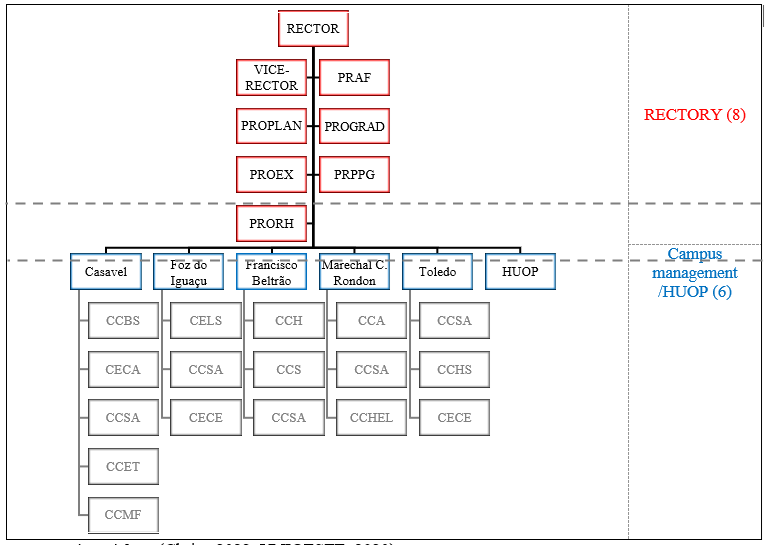
Figure 1
Research sample: adapted organization chart
Source: adapted from (Christ, 2022; UNIOESTE, 2020).
Fourteen people were interviewed between October and November 2021, totaling approximately 10 hours of recording/interviewing and 165 pages transcribed from the recordings (Table 1). The interviews were conducted online via videoconference, using Microsoft Teams and Google Meet as connection platforms, and transcribed into Word.
The two groups of interviewees comprised the rectory – 8 people from this group were interviewed (in red in Figure 1), and the campus management – 6 people from this group were interviewed (in blue in Figure 1). In its organizational chart (UNIOESTE, 2020), above the rectory is the University Council (the secretariat of the higher councils and the teaching, research, and extension council are part of it). The Rector's Office has pro-rectorates, advisory services, a secretariat, and supplementary support bodies. Below the rector's office are the campus directorates, center directorates, and course coordinators.
The data analysis methodology used in this research was content analysis. According to Bardin (2011), content analysis should follow three stages: pre-analysis, exploration of the material, and treatment and interpretation of the results. The field notes (14 documents generated during the interviews), authorized recordings of the interviews, and materials located mainly on the UNIOESTE website (mainly the Institutional Development Plan – IDP, information published on the news center, data) were also elements for data analysis. The content analysis used aimed to infer knowledge through quantitative indicators (Bardin, 2011) to adequately consider the evidence obtained, reaching convincing analytical conclusions in the process (Yin, 2002).
To answer the research question, two categories of analysis (Drives and Barriers) generated a total of 24 codes, coded 363 times from the documents used (interviews and field notes). Given that coding is a crucial activity (Bardin, 2011), the qualitative data analysis software ATLAS.ti (version 9.1.7) was chosen to support this process. Among other things, using this software makes the research analysis more robust, makes it possible to find patterns that are not evident, and gives qualitative research more excellent reliability (Saldaña, 2016).
4 Results and discussion
This section presents the results of the bibliographic surveys and the consequent discussions. The first part provides a contextualization of the higher education institution that is the object of this study's analysis. The second part presents the drivers and barriers to implementation identified by the authors based on the interviews with the subjects.
4.1 UNIOESTE: brief notes
The system of state universities in Paraná is made up of the following institutions: State University of Maringá (UEM, created in 1969), State University of Ponta Grossa (UEPG, created in 1969), State University of Londrina (UEL, created in 1970), Western Paraná State University (UNIOESTE, created in 1988), State University of the Midwest (Unicentro, created in 1990), State University of Paraná (Unespar, created in 2001) and the State University of Northern Paraná (UENP, created in 2006) (SETI, 2021). Paraná's seven state universities operate and are consolidated as institutions that are indispensable to the socio-economic development of Paraná (Corrêa, 2021; Raiher, 2017; SETI, 2018).
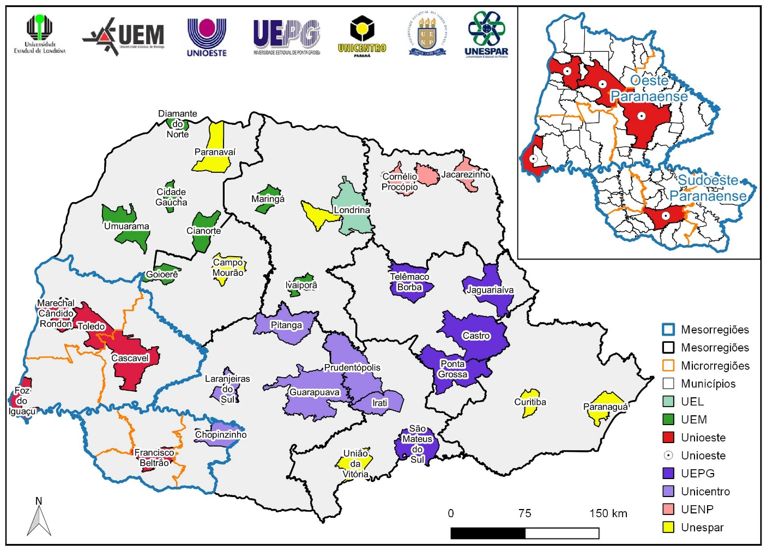
Figure 2 shows where the state universities of Paraná are located, with UNIOESTE standing out, located in the homogeneous mesoregion Oeste Paranaense (which covers a total of 50 municipalities, with campuses in Cascavel, Toledo, Foz do Iguaçu and Marechal Cândido Rondon), and in the homogeneous mesoregion Sudoeste Paranaense (composed of 37 municipalities, with a campus in Francisco Beltrão) (IBGE, 2020).
Figure 2
State Universities of Paraná, especially UNIOESTE
Source: Christ (2022).
Figure 2 shows the presence of state HEIs in the ten mesoregions of Paraná. The State Higher Education System of Paraná maintains face-to-face activities in 32 municipalities and distance education (distance learning) in more than 60 cities, offering free undergraduate and postgraduate courses in various areas of knowledge.
In December 2023, UNIOESTE registered 13,432 students enrolled in undergraduate (65 courses) and postgraduate (30 lato sensu and 55 stricto sensu master's and doctoral courses) courses, 2,892 teaching staff and university agents (UNIOESTE, 2024). As for its position in the Times Higher Education Impact Ranking, Table 2 shows UNIOESTE's progress in relation to the SDGs, the leading universities in the years evaluated, and their overall position.
Table 2
UNIOESTE's ranking in THE Impact Rankings (2019/2022)
|
SDG |
2019 |
2020 |
2021 |
2022 |
|
SDG 1: No Poverty |
*Not evaluated |
301+ |
401+ |
401-600 |
|
SDG 2: Zero Hunger |
*Not evaluated |
201+ |
201-300 |
101-200 |
|
SDG 3: Good Health and Well-being |
201-300 |
401-600 |
401-600 |
801-1000 |
|
SDG 4: Quality Education |
201-300 |
401-600 |
401-600 |
1001+ |
|
SDG 5: Gender Equality |
201-300 |
401+ |
401-600 |
601-800 |
|
SDG 6: Clean Water and Sanitation |
*Not evaluated |
201-300 |
201-300 |
101-200 |
|
SDG 7: Affordable and Clean Energy |
*Not evaluated |
301+ |
301-400 |
301-400 |
|
SDG 8: Decent Work and Economic Growth |
201+ |
401+ |
401-600 |
401-600 |
|
SDG 9: Industry, Innovation, and Infrastructure |
no information submitted* |
401+ |
601+ |
601-800 |
|
SDG 10: Reduced Inequalities |
201+ |
301-400 |
601+ |
801 + |
|
SDG 11: Sustainable Cities and Communities |
201+ |
401+ |
401-600 |
601-800 |
|
SDG 12: Responsible Consumption and Production |
no information submitted* |
301+ |
401+ |
601+ |
|
SDG 13: Climate Action |
101-200 |
301+ |
301-400 |
401-600 |
|
SDG 14: Life below Water |
*Not evaluated |
201+ |
101-200 |
101-200 |
|
SDG 15: Life on Land |
*Not evaluated |
201+ |
201-300 |
201-300 |
|
SDG 16: Peace, Justice, and Strong Institutions |
101-200 |
201-300 |
301-400 |
401-600 |
|
SDG 17: Partnerships for the Goals |
301+ |
601+ |
401-600 |
301-400 |
|
Leading university in the overall ranking (score) |
University of Auckland (97.2) |
University of Auckland (98.5) |
University of Manchester (98.8) |
Western Sydney University (99.4) |
|
UNIOESTE's position in the overall ranking (score) |
301+ (23.8–53.6) |
601+ (9.5–46.6) |
601–800 (47.6–56.5) |
601-800 (59.7-66.7) |
|
Universities evaluated (countries) |
450 (76 countries) |
768 (85 countries) |
1.115 (94 countries) |
1.591 (112 countries) |
|
Brazilian universities |
15 |
30 |
38 |
47 |
|
Universities in Paraná |
4 |
6 |
6 |
6 |
Source: adapted from THE University Impact Rankings (2023).
The Times Higher Education (THE) Impact Ranking evaluates universities globally based on their social and environmental impact, measuring how HEIs contribute to achieving the Sustainable Development Goals (SDGs). This ranking considers a variety of indicators related to the SDGs, such as research, teaching, community engagement, and sustainable administrative practices as evaluation criteria, i.e., according to the missions the university carries out and its concern for sustainable development highlighted in the theoretical framework. Therefore, the main objective of the ranking is to encourage universities to play an active role in achieving the SDGs, highlighting those that are contributing to a positive impact on society and the environment.
However, HEIs' participation in the THE ranking is voluntary. They can choose whether to participate in the evaluation process and submit information to THE. However, joining the ranking can be seen as an opportunity for universities to demonstrate their commitment to sustainability and their contribution to the Sustainable Development Goals (SDGs). Most of Paraná's state HEIs participate in the ranking. In the case of UNIOESTE, in 2022, it was ranked in all the SDGs, highlighting its efforts to have concrete actions related to all dimensions.
4.2 The implementation of the 2030 Agenda at UNIOESTE: drivers and barriers
Considering the objective of this study – "to understand the perception of UNIOESTE's management regarding the drivers and barriers to the implementation of the 2030 Agenda in the institution" – Chart 3 shows the ten drivers mentioned by managers inductively during the interviews, as well as the 14 barriers.
Table 3
Codes assigned to the Drivers category and the Barriers category
|
DRIVERS |
|
BARRIERS |
||||
|
Code |
Magnitude¹ |
Percentage |
|
Code |
Magnitude¹ |
Percentage |
|
21 |
21.00% |
|
|
56 |
21.29% |
|
19 |
19.00% |
|
|
27 |
10.27% |
|
13 |
13.00% |
|
|
26 |
9.89% |
|
9 |
9.00% |
|
|
24 |
9.13% |
|
9 |
9.00% |
|
|
24 |
9.13% |
|
8 |
8.00% |
|
|
23 |
8.75% |
|
8 |
8.00% |
|
|
18 |
6.84% |
|
7 |
7.00% |
|
|
14 |
5.32% |
|
4 |
4.00% |
|
|
14 |
5.32% |
|
2 |
2.00% |
|
|
10 |
3.80% |
|
|
|
|
|
|
8 |
3.04% |
|
|
|
|
|
|
7 |
2.66% |
|
|
|
|
|
|
6 |
2.28% |
|
|
|
|
|
|
6 |
2.28% |
|
(=) Drivers (10) |
100 |
100.00% |
|
(=) Barriers (14) |
263 |
100.00% |
Source: adapted from Christ (2022).
Note: Magnitude¹ is how many times the code has been cited.
Notably, it is possible to see a more acute critical sense among the interviewees when it comes to identifying more of the institution's barriers (mentioned 263 times) to implementing Agenda 2030 at UNIOESTE. In contrast, drivers had one hundred findings, i.e., they were mentioned one hundred times.
In terms of drivers (in gray in Chart 3), the item most mentioned by the interviewees was cooperation (21 times) linked to some action by UNIOESTE, which includes both inside the university, such as in collegiate bodies, and outside, with the participation of the government and development agencies. It is also related to partnership (mentioned 13 times), teamwork (8 times) and governance (2 times). These responses are in line with UNIOESTE's own mission, which is "to produce, systematize and socialize knowledge, contributing to human, scientific, technological and regional development, committing itself to justice, democracy, citizenship, and social responsibility" (UNIOESTE, 2022).
...we've had a lot of integrated commissions between the PROEX, PRPPG and PROGRAD teams and we've seen that these conflicts aren't conflicts over a certain point, but over demands that are coming up, and they can be reconciled, they're productive. They take us out of one zone and into another and keep us moving forward. They update what we need to, but they make us move forward in a more united and integrated way (Manager 6, rectory, our translation).
...cooperation will always be one of the pillars for growth, for the development of an institution, so this exists in the institution, you have the local powers, the state power, the political forces, the economic agents, in one way or another they contribute to the institution, so in this sense I see that there is cooperation and an effort to develop the institution (Manager 7, rectory, our translation).
I understand that it's my responsibility, along with the other managers, to understand the importance of implementation and the benefits it will bring, especially in the long term, to the institution, to the university, to the university hospital. So there's no way not to recognize the responsibility of those who take on this role of manager, of director, from the perspective of implementing the SDGs (Manager 13, board, our translation).
his perception is congruent with what the literature says in the sense that if HEIs have the mission of being a catalyst for innovation for society, they must work hand in hand with partners, governments, development agencies, etc. (Kempton et al., 2021b), in order to address these challenges, as is the case with the SDGs. In addition to attracting public or private investment for research and innovation centers, HEIs can foster regional cooperation in a coordinated and development-focused manner (Owens, 2017). A quantitative study of 18 HEIs in Austria concluded that in addition to universities being able to contribute to paving the way for supporting the Austrian government in achieving the SDGs, collaboration between different scientific disciplines and stakeholders is critical in preparing policy options, even within a single SDG (Körfgen et al., 2018).
The fact that it is a public university (mentioned 19 times) and that it has a regional scope (mentioned 4 times) have a connection with the curricularization of extension with the provision of services, both mentioned 9 times each and with the e-protocol (mentioned 8 times), which in turn is also a legal requirement (mentioned 7 times).
We have outstanding projects, especially in the area where you're doing your qualifications, you're having the opportunity to do a master's degree, we can see that there's a great deal of integration with the region, as is also the case with other units we have at the university, but I think we can still go a long way, we have a lot of potential, perhaps we can strengthen these relationships, these partnerships that are currently established and perhaps work more closely together. I believe that UNIOESTE has immense potential and that it can be exploited more and act even more in this regional context (Manager 9, rectory, our translation).
In particular, the curricularization of extension was mentioned by 6 different managers, both pro-rectors and campus directors:
Today we see a great deal of integration between the three [teaching, research and extension], right? This triad. This tripod. Today, for example, we have the curricularization of extension, in other words, extension going into undergraduate studies, activities going into extension, and with the approval of the regulation on the provision of services, which was demanded by the state and the agencies, the foundations, the laws of the foundations, the innovation agencies, so today we have a very specific law on the provision of accounts, so the researcher, not the provision of accounts, the provision of services, the researcher, There's nothing more natural than for them to start providing services, your program [PGDRA] is a great example of activities aimed at providing services and the provision of services takes place through extension, so this extension happens from extension to undergraduate courses through the curricularization of extension, from extension to research and postgraduate courses through the provision of services and from postgraduate courses to undergraduate courses through scientific initiation activities, right? (Manager 6, rectory, our translation).
Even though the demands are imposed top-down, usually from the Paraná State Secretariat for Science, Technology, and Higher Education (SETI), UNIOESTE meets them satisfactorily. For example, the interviewees mentioned the implementation of the e-protocol system and the debate on the curricularization of extension. These examples show that the university's governance structure works and that UNIOESTE's human capital can respond to requests.
Regarding barriers to implementation, the one most frequently cited by managers is related to culture (56 times). Many of the quotes that were coded as "culture" are related to time management, lack of people (27 times), bureaucracy (24 times), and lack of commitment (24 times):
We live in a very difficult situation today. In general, people like it, they want to cooperate. That's not the problem. The problem is that there is such an overload of work that people shy away, for example, from a committee. And a committee to work on a topic in a course is cooperative work (Manager 11, board, our translation).
...as managers, we have a lot of passive day-to-day demands, and perhaps we don't have enough time to sit down and delve into the development of these activities, so it would be necessary, perhaps, for us to self-criticize as managers and think a little more about projects, think and sit down and develop this so that it has more consistency. And get away from being arsonists, putting out the fire, you know? So, I think that's it. A lot of what we were talking about before, the extreme bureaucratization of public administration, all these situations end up taking up a lot of our time and we end up lacking trained staff, in this sense, and effective time for us to dedicate to these projects (Manager 13, board, our translation).
...what's missing, then, is a team that doesn't necessarily even have to be internal, it could even be an external team, hired for this, with experience, but we need to invest in a team with time, workload and everything else, if you take a teacher, or an agent who is in a sector, they won't be able to produce this, so it needs to be people who can dedicate themselves continuously, that's what's missing not only in this discussion, but in others too, right? We see our problems sliced up, and someone who is going to carry that load can't do it alone, because there are few who are willing to do it, right? That's why I think it's not an impediment, in fact, there's something missing to help, you know? (Manager 12, board, our translation).
In his research on the regional experience in Italy, Putnam suggests that we need to create a culture of collaboration rather than ideological conflict, moderation rather than extremism, tolerance rather than dogmatism, practical management rather than abstract doctrine, efforts to aggregate interests rather than articulate them, and "good government" (Putnam, 2006, p. 51).
It is well known that culture cannot be changed overnight (Pizzutilo & Venezia, 2021). The fact that managers indicate this factor as a barrier to implementing the SDGs at UNIOESTE can currently be considered a weakness of the institution, which could be converted into a strength in the future (Budihardjo et al., 2021). Such a change will require strategies, collaboration, changes in habits, and leadership training. Implementing the Agenda at the university could be the driver of this change.
As for the lack of diagnosis, mentioned eight times by managers, this barrier is also linked to a lack of awareness (mentioned 26 times), a lack of control (14 times), a lack of an information system (14 times), and a lack of dissemination (10 times). However, Manager 6 reported that the university should carry out a diagnosis classifying projects to the SDGs:
So we have a survey of the most identified SDGs, by campus, for example, here in Cascavel it's SDG 3, which is focused on health and well-being, it was the most identified SDG, the SDG that we found the most, in research and scientific initiation activities, in Toledo, for example, is SDG 9, which is industry, innovation and infrastructure, so it was the most identified SDG, in Foz do Iguaçu, 2, zero hunger and sustainable agriculture, in Francisco Beltrão, also 3, in the health area. Sorry, in Rondon it's zero hunger, and in Foz de Iguaçu it's 4, quality education. So we have all the SDGs, right? But we have this distribution between the campuses, which shows how UNIOESTE is organized, so as to be able to attend to some segments as a priority, more incisively, for example, Cascavel, the health area, Beltrão, also the health area, Toledo, the innovation part, Marechal Cândido Rondon, the agriculture part, agricultural production, and Foz the quality education part, right? This comes a lot from how the campus, the city where the campus is located, is organized economically as well (Manager 6, rectory, our translation).
Manager 6's response corroborates the understanding of some managers regarding UNIOESTE's lack of communication. In other words, UNIOESTE acts in favor of the 2030 Agenda but does not communicate it efficiently; it is not published, and it is not known to society or even to the internal community. The diagnosis of what UNIOESTE has already done and is doing to achieve the goals could contribute to the implementation of the SDGs. Proof of this is the publication of new resolutions that include the registration of each SDG in the institution's forms (UNIOESTE, 2021b, 2021a).
Specifically, the lack of commitment was codified in the reports where the manager expressed not considering themselves part of the implementation of the SDGs at UNIOESTE, for example: "So, as [a manager] I don't see that I would have, not the strength, but the necessary resources, so much availability of personnel, finances, time, to convince a local community" (Manager 10, board, our translation). The understanding that another agent must be part of the change was a behavior also seen in other case studies (Togo & Gandidzanwa, 2021).
Concerning the lack of resources (mentioned 23 times by the managers interviewed), as HEIs face growing financial challenges, there are opportunities to capitalize on philanthropic donations and other sources of funding to support the prosperity of the community and increase the vitality of the university through a paradigm of shared responsibility centered on the SDGs (Wubah et al., 2021). This is a perceived reality in many HEIs around the globe (Owens, 2017; Togo & Gandidzanwa, 2021).
Even though UNIOESTE is a democratic institution regulated by a statute, with elections to choose directors, management conflicts are part of the process. The barrier "political issues" was mentioned 7 times by managers, as in the case of Manager 5:
Because then there's this political situation and the political situation, like we're civil servants and we have unions to defend us. As you said, both teachers and students, right? But they also have elections, they also live in a political situation. So, unlike the private environment, the public environment always has these issues of conflict that aren't just because I don't agree with what you say, it's because I shouldn't agree with it either, or because you're really quite the opposite of what I think, which perhaps today isn't so much the total opposite, the right and the left, I don't think it's put that way. But there is the opposition itself, which does the day-to-day work, which is a little different from the private institution (Manager 5, rectory, our translation).
School dropout (cited as a barrier 6 times by managers) is not a current problem, nor is it exclusive to UNIOESTE (Borges & Sbardelotto, 2018). However, it has undoubtedly been exacerbated by the pandemic. This, in turn, was mentioned (18 times) as a barrier or obstacle to implementing the SDGs at UNIOESTE. The COVID-19 health crisis is not a historical process; it appeared with unpredictability.
Leal Filho et al. (2021) establish three factors of the pandemic that have negatively influenced HEIs. Firstly, for the authors, there has been pressure on universities, especially by directing funds to combat the crisis, with fewer resources to support sustainability efforts. Secondly, institutions have prioritized these items because of the change in teaching and learning, being forced to teach remotely/online/synchronously. Finally, teaching staff are much busier with additional work, leaving them with less time to devote to sustainability-related activities.
For some managers, dialog is the way to build an alternative for implementing the SDGs in the institution:
I also don't really believe in pre-prepared projects that already say what each person should do and how to do it. But the first question is to publicly discuss this here, to see which actors want to dedicate themselves more to this and this affiliation is kind of automatic, why? Because there are people who are closer to these agendas and there are people who are more circumscribed to their area of teaching, research and extension and who don't have this sensitivity, who aren't prepared for this debate. So, those who are more prepared will need to make their influence overflow onto others, because relevance is not debatable (Manager 8, board, our translation).
I think that at our next meeting, two of these themes will be very strong, right? Theme 1, eradicating poverty and retaining our students, and health and well-being, and this, of course, [...], and your interview makes us think, I think that at the next meeting, we can deal with this issue informally there and promote something, a bigger discussion. I think the interview was very good in that sense, okay? (Manager 12, board, our translation).
It is essential to involve and promote the participation of current and future actors in the Agenda. The lack of a program to direct efforts and actions toward the challenges of implementing the 2030 Agenda was cited as a barrier 6 times. For policies to have the desired results, regardless of whether they are focused on innovative regional policies, as suggested by Putnam (2006), it is necessary to have a staff that is really capable of implementing such policies.
5 Final Considerations
This study aimed to understand the perception of UNIOESTE’s management regarding the drivers and barriers to the implementation of the 2030 Agenda at the institution. To meet the objective of this single-case study with a qualitative approach, semi-structured interviews with fourteen managers in leadership roles at UNIOESTE were used as a data collection technique. The data was analyzed using content analysis and Altas.ti software.
Ten drivers were identified for the implementation of the SDGs at UNIOESTE. Among the most cited by the interviewees are the ability of the university community to cooperate, the way UNIOESTE is organized as a public university, and the many partnerships that the HEI has shown it is capable of fostering. Fourteen barriers were identified as hindering the university's implementation of the 2030 Agenda. Among the barriers most cited by university managers are lack of organizational culture, lack of people, lack of awareness, bureaucracy, lack of commitment, and lack of resources.
It should be noted that agendas represent instruments of local, national, or, as in the case of the 2030 Agenda, international commitment and are aimed at a common goal. They are institutional frameworks for the joint efforts of governments and other actors seeking actions to make development and the environment compatible. Based on the theoretical foundation and literature review proposed in this study, it can be concluded that social capital can be a mechanism for achieving the objectives proposed by the agendas, given the specificities of UNIOESTE.
The subject of this study permeates several areas of knowledge, as it is considered multidisciplinary. First and foremost, this research has contributed to a better understanding of the practices adopted by UNIOESTE in relation to the SDGs and, more importantly, to social capital. As a theoretical contribution, the results of this study highlight the contributions to the literature, especially in the area of sustainable development and universities, the specificities of a public university in the interior of the state of Paraná, which, despite having been created as a regional development strategy and having a regional engagement, still has several factors that make it difficult for it to play a leading role. The research also broadened our knowledge of social capital and regional development at this HEI.
In practice, this study could support decision-making regarding sustainability management at the university and, above all, will help to raise awareness of the issues on the agenda at the institution, i.e., the first step towards action (understanding) in the face of the challenges that sustainability proposes. It is hoped that this research will draw the attention of UNIOESTE's academic community to the urgency of implementing the SDGs in the institution, as well as the government and funding institutions, to increase investments in promoting actions that reflect greater sustainability in universities.
The data presented here could also be used to support the development of a new study using action research methodology – considering events, forums, establishing policies, bringing together actors, and creating networks, as suggested in the fourth specific objective – in order to advance the implementation of Agenda 2030 at UNIOESTE in a strategic and planned way. It is concluded that the studies are not exhausted since there is still a need to expand research on the subject in higher education institutions, not only for the other 6 state universities in Paraná but for any other HEI interested in the subject, and that needs to know its specificities concerning its role in regional development and its concern with sustainable development, via the SDGs.
References
Bardin, L. (2011). Análise de conteúdo (Segunda). Edições 70.
Barlete, A. R. L. (2019). A cultural political economy account of higher education in Mercosur (Issue April) [Doctoral thesis (Wolfson College, Faculty of Education), University of Cambridge]. https://doi.org/https://doi.org/10.17863/CAM.45288
Boisier, S. (2000). El desarrollo territorial a partir de la construcción de capital sinergético. Revista Brasileira de Estudos Urbanos e Regionais, 2, 39. https://doi.org/10.22296/2317-1529.2000n2p39
Borges, L. F. P., & Sbardelotto, V. S. (2018). Política de ensino na Unioeste: democratização do acesso e política de permanência e conclusão discente. In E. C. P. Manchope, A. Araújo, D. L. Miranda, F. G. Costa, G. Massini-Cagliari, N. L. P. Fortes, P. S. Wolff, S. C. T. Luz, & V. Maquêa (Eds.), Interiorização do ensino superior: protagonismo das universidades estaduais e municipais no desenvolvimento regional (pp. 141–167). Edunioeste.
Brasil. (2020). Guia de implementação da Base Nacional Comum Curricular: orientações para o processo de implementação da BNCC. Guia de Implementação Da Base Nacional Comum Curricular: Orientações Para o Processo de Implementação Da BNCC. http://basenacionalcomum.mec.gov.br/
Budihardjo, M. A., Ramadan, B. S., Putri, S. A., Wahyuningrum, I. F. S., & Muhammad, F. I. (2021). Towards sustainability in higher-education institutions: analysis of contributing factors and appropriate strategies. Sustainability (Switzerland), 13(12), 1–14. https://doi.org/10.3390/su13126562
Christ, G. D. (2022). Capital social e desenvolvimento sustentável: uma análise da implementação da Agenda 2030 na Unioeste [Dissertação, Universidade Estadual do Oeste do Paraná]. https://tede.unioeste.br/handle/tede/6086
Christ, G. D., Alves, L. R., & Piffer, M. (2021). Análise regional do Oeste e Sudoeste do Paraná e ODS 8. X Seminário Internacional Sobre Desenvolvimento Regional, X, 15.
Christ, G. D., Frohlich, S., & Mattiello, R. (2021). Reflections on internationalization: quo vadis Unioeste? Revista Expectativa, 20(4), 108–132. https://doi.org/https://doi.org/10.48075/revex.v20i4.27857
Christ, G. D., & Piffer, M. (2022). Rumo à sustentabilidade: uma análise da implementação dos Objetivos do Desenvolvimento Sustentável em Instituições de Ensino Superior. XLVI Encontro Da ANPAD - EnANPAD, 1–17. http://anpad.com.br/uploads/articles/120/approved/7e6ff0205749bc6025b51155e26f6ced.pdf
Corrêa, C. P. (2021). O papel da Universidade Estadual do Oeste do Paraná no ecossistema de inovação da região Oeste do Paraná [Dissertação (Programa de Pós-graduação em Administração)]. Universidade Estadual do Oeste do Paraná.
Creswell, J. W. (2007). Projeto de pesquisa: método qualitativo, quantitativo e misto (2nd ed.). Artmed.
Duarte, V. N., & Schneider, M. B. (2019). Capitais intangíveis e desenvolvimento territorial: algumas considerações. XVIII ENANPUR, XVIII, 1–16.
Ferrera de Lima, J. (2020a). Desenvolvimento regional fronteiriço: elementos para reflexão. In J. Ferrera de Lima (Ed.), Desenvolvimento Regional Fronteiriço no Brasil (Issue May, pp. 07–14). Núcleo de Desenvolvimento Regional.
Ferrera de Lima, J. (2020b). O desenvolvimento regional como fenômeno regional. In C. M. Sousa, I. M. Theis, & J. L. A. Barbosa (Eds.), Celso Furtado: a esperança militante (Vol. 3, pp. 129–162). A união.
Ferrera de Lima, J., & Alves, L. R. (2012). Mecanismos e propostas para acelerar o desenvolvimento local e regional no Paraná. In A. P. Raiher, J. Ferrera de Lima, L. R. Alves, & R. Dathein (Eds.), Economia paranaense: crescimento e desigualdades regionaisense (pp. 205–232). Editora UEPG.
Frandoloso, M. A., & Rebelatto, B. G. (2019). The participatory process of planning social and environmental responsibility at a Brazilian university. International Journal of Sustainability in Higher Education, 20(5), 917–931. https://doi.org/10.1108/IJSHE-01-2019-0017
Fuertes-Camacho, M. T., Graell-Martín, M., Fuentes-Loss, M., & Balaguer-Fàbregas, M. C. (2019). Integrating sustainability into higher education curricula through the project method, a global learning strategy. Sustainability (Switzerland), 11(3). https://doi.org/10.3390/su11030767
Fundação Araucária. (2020). Araucária promove quatro dias de debates com relação aos Objetivos de Desenvolvimento Sustentáveis (ODS). Fundação Araucária. http://www.fappr.pr.gov.br/Noticia/Araucaria-promove-quatro-dias-de-debates-com-relacao-aos-Objetivos-de-Desenvolvimento
Furtado, C. (1982). A nova dependência: dívida externa e monetarismo (2nd ed.). Paz e Terra.
Galleli, B. (2019). Organizações e sustentabilidade: educação para a sustentabilidade. Organizações e Sustentabilidade, 7(1), 3–6. https://doi.org/http://dx.doi.org/10.5433/2318-9223.2019v7n1p3
Goodall, M., & Moore, E. (2019). Integrating the sustainable development goals into teaching, research, operations, and service: a case report of Yale University. Sustainability (United States), 12(2), 93–96. https://doi.org/10.1089/sus.2018.0038
Hallinger, P., & Chatpinyakoop, C. (2019). A bibliometric review of research on higher education for sustainable development, 1998-2018. Sustainability (Switzerland), 11(8), 1–20. https://doi.org/10.3390/su11082401
IBGE. (2020). Mesorregiões Homogêneas. Instituto Brasileiro de Geografia e Estatística (IBGE) - Mesorregiões Homogêneas. https://www.ibge.gov.br/geociencias/cartas-e-mapas/15778-divisoes-regionais-do-brasil.html?edicao=24860&t=sobre
Isard, W. (1960). Methods of Regional Analysis: an Introduction to Regional Science (Issue 1). MIT Press. https://doi.org/10.16309/j.cnki.issn.1007-1776.2003.03.004
Kempton, L., Rego, M. C., Alves, L. R., Vallance, P., Serra, M. A., & Tewdwr-Jones, M. (2021a). Executive summary. In Regional Studies Policy Impact Books (Vol. 3, Issue 1, pp. 5–6). Taylor & Francis Online. https://doi.org/10.1080/2578711x.2021.1891747
Kempton, L., Rego, M. C., Alves, L. R., Vallance, P., Serra, M. A., & Tewdwr-Jones, M. (2021b). Regional Studies Policy Impact Books. In Regional Studies Policy Impact Books (Vol. 3, Issue 1). Taylor & Francis Online. https://doi.org/10.1080/2578711x.2021.1891730
Kempton, L., Rego, M. C., Alves, L. R., Vallance, P., Serra, M. A., & Tewdwr-Jones, M. (2021c). Understanding the contributions of universities to regional development. In Regional Studies Policy Impact Books (3rd ed., Vol. 3, Issue 1, pp. 13–32). Taylor & Francis Online. https://doi.org/10.1080/2578711x.2021.1891765
Körfgen, A., Förster, K., Glatz, I., Maier, S., Becsi, B., Meyer, A., Kromp-Kolb, H., & Stötter, J. (2018). It’s a hit! Mapping Austrian research contributions to the sustainable development goals. Sustainability (Switzerland), 10(9), 1–13. https://doi.org/10.3390/su10093295
Leal Filho, W., Frankenberger, F., Salvia, A. L., Azeiteiro, U., Alves, F., Castro, P., Will, M., Platje, J., Lovren, V. O., Brandli, L., Price, E., Doni, F., Mifsud, M., & Ávila, L. V. (2021). A framework for the implementation of the Sustainable Development Goals in university programmes. Journal of Cleaner Production, 299, 1–15. https://doi.org/10.1016/j.jclepro.2021.126915
Monteiro, M. A., Bidarra, Z. S., & Piffer, M. (2020). A estratégia top-down da política pública de agricultura familiar na Guiné-Bissau. Revista Brasileira de Desenvolvimento Regional, 8(2), 55. https://doi.org/10.7867/2317-5443.2020v8n2p55-78
Morejon, C. F. M., Ferrera de Lima, J., & Bianco, T. S. Del. (2017). Índice de Desenvolvimento Territorial Sustentável. In B. S. Bidarra, F. A. P. Voll, & J. Ferrera de Lima (Eds.), Economia e desenvolvimento territorial (pp. 47–59). Parque Itaipu.
Murillo-Vargas, G., Gonzalez-Campo, C. H., & Brath, D. I. (2020). Mapping the integration of the sustainable development goals in universities: is it a field of study? Journal of Teacher Education for Sustainability, 22(2), 7–25. https://doi.org/10.2478/jtes-2020-0013
Nilsson, M., Chisholm, E., Griggs, D., Howden-Chapman, P., McCollum, D., Messerli, P., Neumann, B., Stevance, A. S., Visbeck, M., & Stafford-Smith, M. (2018). Mapping interactions between the sustainable development goals: lessons learned and ways forward. Sustainability Science, 13(6), 1489–1503. https://doi.org/10.1007/s11625-018-0604-z
Oliveira, G. B. (2002). Uma discussão sobre o conceito de desenvolvimento. Revista Fae, 5(2), 37–48.
Oliveira, M. M. (2007). Como fazer pesquisa qualitativa. Vozes.
ONU. (1987). World Commission on Environment and Development (Brundtland Commission). In The Palgrave Encyclopedia of Global Security Studies. https://doi.org/10.1007/978-3-319-74336-3_452-1
ONU. (2015). Transforming our world: the 2030 Agenda for Sustainable Development. In General Assembly: Vol. A/RES/70/1. https://doi.org/10.5040/9781782257790.part-008
Owens, T. L. (2017). Higher education in the sustainable development goals framework. European Journal of Education, 52(4), 414–420. https://doi.org/10.1111/ejed.12237
Piacenti, C. A. (2016). Indicadores do potencial de desenvolvimento endógeno dos municípios paranaenses no período 1999/2013 (1a). Editora Parque Itaipu.
Pike, A., Rodríguez-Pose, A., & Tomaney, J. (2006). Local and regional development. In Local and Regional Development. Routledge. https://doi.org/10.4324/9780203003060
Pimentel, G. S. R. (2019). O Brasil e os desafios da educação e dos educadores na Agenda 2030 da ONU. Revista Nova Paideia – Revista Interdisciplinar Em Educação e Pesquisa, 1(3), 22–33. https://doi.org/10.36732/riep.v1i3.36
Pizzutilo, F., & Venezia, E. (2021). On the maturity of social responsibility and sustainability integration in higher education institutions: Descriptive criteria and conceptual framework. International Journal of Management Education, 19(3), 100515. https://doi.org/10.1016/j.ijme.2021.100515
Prieto-Jiménez, E., López-Catalán, L., López-Catalán, B., & Domínguez-Fernández, G. (2021). Sustainable development goals and education: A bibliometric mapping analysis. Sustainability (Switzerland), 13(4), 1–20. https://doi.org/10.3390/su13042126
Putnam, R. D. (2006). Comunidade e democracia: a experiência da Itália moderna (5th ed.). Editora FGV.
Raiher, A. P. (2017). As universidades estaduais e o desenvolvimento regional do Paraná. In Editora UEPG. Editora UEPG.
Rea, L. M., & Parker, R. A. (2000). Metodologia de pesquisa: do planejamento a execução (1st ed.). Pioneira Thomson Learning.
Sabará, M. T. R., Silva, M. A. R., & Oliveira, N. M. (2021). Elites políticas e desenvolvimento regional: uma aproximação necessária. Revista Ciências Sociais Em Perspectiva2, 20(38), 20–33. https://doi.org/https://doi.org/10.48075/revistacsp.v20i38.25872
Santos, F. S., & Almeida Filho, N. (2012). A quarta missão da Universidade: internacionalização universitária na sociedade do conhecimento. In Revista Internacional de Educação Superior. Editora Universidade de Brasília; Coimbra: Imprensa da Universidade de Coimbra. https://doi.org/10.22348/riesup.v3i3.7794
Saldaña, J. (2016). The coding manual for qualitative researchers (3o ed). Sage Publications.
Schulz, K. P., Mnisri, K., Shrivastava, P., & Sroufe, R. (2021). Facilitating, envisioning and implementing sustainable development with creative approaches. Journal of Cleaner Production, 278, 1–10. https://doi.org/10.1016/j.jclepro.2020.123762
Sen, A. (2000). Desenvolvimento como liberdade (Issue 4). Companhia das Letras.
Seti. (2018). Superintendência Geral de Ciência, Tecnologia e Ensino Superior. Cursos Oferecidos e Alunos Matriculados Por Instituição de Ensino Superior Do Estado Do Paraná - Em Dez/2018. http://www.seti.pr.gov.br/sites/default/arquivos_restritos/files/documento/2019-09/censo_ensino_superior_2018.pdf
Seti. (2021). Superintendência Geral de Ciência, Tecnologia e Ensino Superior. Apresentação. http://www.seti.pr.gov.br/institucional/apresentacao
Silva, C. S. (2021). Dinâmicas locacionais dos municípios do estado do Tocantins entre 2001 e 2019 [Dissertação (Mestrado em Desenvolvimento Regional e Agronegócio)]. Universidade Estadual do Oeste do Paraná.
THE. (2023). Impact Rankings. Times Higher Education. https://www.timeshighereducation.com/impactrankings/
Theis, I. M., Ferrera de Lima, J., Oliveira, N. M., Barbosa, J. L. A., & Randolph, R. (2021). Regional development: construction of a knowledge field? Revista Brasileira de Desenvolvimento Regional, 18(1), 244–257. https://doi.org/10.54399/rbgdr.v18i1
Togo, M., & Gandidzanwa, C. P. (2021). The role of Education 5.0 in accelerating the implementation of SDGs and challenges encountered at the University of Zimbabwe. International Journal of Sustainability in Higher Education, 22(7), 1520–1535. https://doi.org/10.1108/IJSHE-05-2020-0158
Triviños, A. N. S. (2009). Introdução à pesquisa em ciências sociais: a pesquisa qualitativa em educação. Atlas.
Unioeste. (1999). Estatuto da Universidade Estadual do Oeste do Paraná: Resolução No 017/1999-COU, de 17 de setembro de 1999. https://www.unioeste.br/portal/arquivos/scs/docs/017_estatuto.pdf
Unioeste. (2020). Organograma. Pro-Reitoria de Planejamentp. https://www.unioeste.br/portal/sobre-a-unioeste/organograma
Unioeste. (2021a). Resolução No 055/2021-COU, de 29 de Julho de 2021 (Regulamento para criação, avaliação e alteração dos núcleos da Unioeste). Pró-Reitoria de Planejamento (PROPLAN). https://midas.unioeste.br/sgav/arqvirtual#/
Unioeste. (2021b). Resolução No 058/2021-COU, de 29 de Julho de 2021 (Regulamento da atividade de prestação de serviços e de produção de bens da Unioeste). Pró-Reitoria de Planejamento (PROPLAN). https://www.unioeste.br/portal/proextensao/documentos/resolucoes
Unioeste. (2024). Estatística – Unioeste em números. Pró-Reitoria de Planejamento (PROPLAN). https://www.unioeste.br/portal/acesso-aos-dados/estatistica
Van Maanen, J. (1979). Reclaiming qualitative methods for organizational research: a preface. Administrative Science Quarterly, 24, 520–524.
Vizeu, F., Meneghetti, F. K., & Seifert, R. E. (2012). Por uma crítica ao conceito de desenvolvimento sustentável. Cadernos EBAPE.BR, 10(3), 569–583. https://doi.org/10.1590/S1679-39512012000300007
Wubah, D., Steuer, C., Brown, G., & Rice, K. (2021). Funding community sustainable development using zero energy buildings. International Journal of Sustainability in Higher Education, 22(1), 29–43. https://doi.org/10.1108/IJSHE-10-2019-0312
Yin, R. K. (2002). Case study research, design and methods (3rd ed., Vol. 5). Sage Publications. https://doi.org/10.1017/dsd.2020.28
------
i Doutoranda e Mestra (2022) em Desenvolvimento Regional e Agronegócio na Universidade Estadual do Oeste do Paraná (Unioeste) Campus Toledo, Paraná, Brasil. Administradora pela Unioeste Campus Marechal Cândido Rondon (2016). Especialista em gestão de negócios em cooperativas pela Pontifícia Universidade Católica do Paraná (2018). Membro do grupo de pesquisa Contabilidade e Finanças (Unioeste) Campus Cascavel.
ii Doutor em Desenvolvimento Regional pela Universidade de Santa Cruz do Sul (UNISC) Campus Santa Cruz do Sul, Rio Grande do Sul, Brasil. Mestre em Desenvolvimento Econômico pela Universidade Federal do Paraná (UFPR). Bacharel em Ciências Econômicas pela Universidade Estadual de Maringá (UEM). Bolsista de produtividade em pesquisa da Fundação Araucária (PR). Professor do Programa de Pós-Graduação em Desenvolvimento Regional e Agronegócio — mestrado e doutorado — da Universidade Estadual do Oeste do Paraná (Unioeste)/Campus de Toledo. Pesquisador do CNPQ. Professor visitante da Escuela Venezolana de Planificación. Pesquisador do Núcleo de Desenvolvimento Regional (NDR) da Unioeste/Toledo.
iii Doutor em Geografia (2016), com especialização em Planejamento Urbano e Regional, no Instituto de Geografia e Ordenamento do Território (Igot) da Universidade de Lisboa. Tem graduação em Ciências Econômicas pela Universidade Estadual do Oeste do Paraná - Unioeste/Campus Toledo (2005). Mestrado em Desenvolvimento Regional pela Universidade de Santa Cruz do Sul — Unisc (2008). Professor Adjunto do colegiado de Ciências Econômicas na (Unioeste)/Campus de Toledo. Coordenador e professor do Programa de Pós-graduação em Desenvolvimento Regional e Agronegócio (Mestrado e Doutorado) da Universidade Estadual do Oeste do Paraná (Unioeste)/Campus de Toledo. Pesquisador do Núcleo de Desenvolvimento Regional (NDR) (www.ndrunioeste.com.br) e do Grupo de Pesquisa em Desenvolvimento Regional e Agronegócio (GEPEC) pela Unioeste/Toledo e do Grupo de Pesquisa Modelação, Ordenamento e Planeamento Territorial (Mopt) do Centro de Estudos Geográficos (CEG) da Universidade de Lisboa.
iv Pós-doutorado em Sociologia Econômica (Université Paris IV-Sorbonne), Doutorado em Sociologia (UFRGS) com estágio doutoral na Université Paris IV-Sorbonne, Mestrado em Sociologia (UFRGS) e Graduação em Filosofia (UPF). Professor da Escola de Negócios da ATITUS Educação, com atividades na graduação, lato sensu e no Programa de Pós-Graduação Stricto Sensu em Administração - PPGA. Como pesquisador, atua nos grupos de pesquisa CNPq: "Estudos Organizacionais Contemporâneos" (PPGA/ATITUS) e no "Grupo de Estudos em Redes Organizacionais, Sociais e Sustentabilidade" (PPGA/UEL). Em suas pesquisas desenvolve temas relacionados ao Comportamento organizacional, Relações de Trabalho e Comportamento social em mercados contestados